From First Login to Aha Moment: Jimo vs Userpilot
Dec 23, 2025
/
8 mins read


Choosing the right SaaS adoption platform is not about feature quantity, it’s about alignment with your product strategy, your team maturity, and your view on how quickly you want users to reach their aha moment. Based on the comparative insights from Jimo and Userpilot, several criteria clearly differentiate the two tools.
This article explores how Jimo and Userpilot help teams guide users from first login to that critical aha moment, using real examples, insights, data, and a strong strategy rooted in product discovery, onboarding, and in-app experience.
Book a free demo with Jimo and discover how to make your users reach their aha moment fast!

The Concept of the Aha Moment
The aha moment is not a vague idea. It is a measurable point in the user journey where clarity replaces confusion. At that moment, the product’s value becomes obvious, friction disappears, and the customer experience shifts from exploration to commitment.
This definition matters because it helps teams to design the right process, ask the right questions, and create a clear path to activation.
History and Origin
The term “aha moment” originates from psychological research on sudden insight. It describes the instant when a solution becomes obvious after a period of confusion. This idea was later adopted by the SaaS industry to describe the moment when new customers suddenly grasp how a product works and why it matters.
When it comes to product, the aha moment is the point where people move from “trying” to “believing.” It’s not about features alone, but about experience, context, and meaning.
Psychological Basis of Aha Moments
From a cognitive perspective, aha moments are linked to sudden clarity, dopamine release, and emotional reward. When users reach this moment, they feel a sense of success, confidence, and motivation.
This psychological response explains why retention rates improve when the aha moment happens early in the journey. The faster users reach it, the lower the risk of churned customers within the first days.
Why the Aha Moment Is Critical for SaaS Growth
For SaaS companies, the aha moment is directly connected to growth, activation, and long-term engagement. Without it, even a great product with powerful features will fail to deliver value.
The goal is simple: reduce time to value. But the way to achieve it is not.
The Cost of Missing the Aha Moment
When users don’t reach the aha moment: they feel friction in the process, they don’t see the benefit, they disengage from the app, they churn before adoption begins.
This happens even when the product experience is technically strong. The missing link is often guidance, context, and actions.
Aha Moment as a Strategic Metric
Modern product teams treat the aha moment as a strategic moment in the journey, not a side effect. They track it using data, analytics, feedback, and research.
Understanding when and how customers reach that moment allows teams to design better onboarding flows, remove friction, and guide users more effectively.
What Is Jimo, What It Promises, and Where It Excels
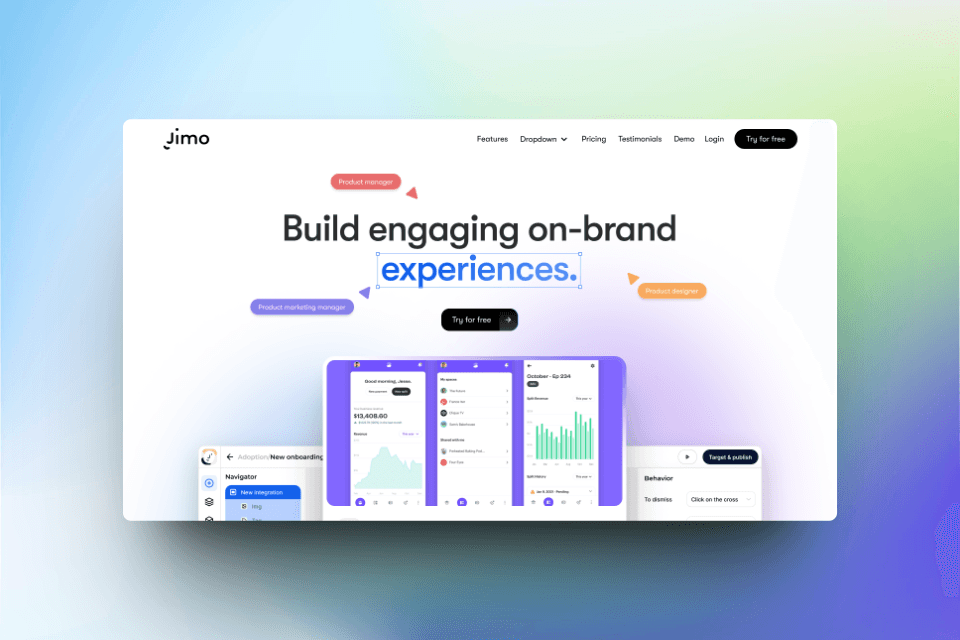
Jimo is a no-code SaaS adoption platform built to help product teams guide users to value faster and more clearly. Its core promise is simple: reduce friction and accelerate the aha moment through contextual in-app experiences.
Where Jimo excels is not in overwhelming users with complex onboarding flows, but in creating clear, lightweight, and timely interactions. Product teams use Jimo to surface the right message, feature, or insight at the right moment in the user journey.
Key strengths of Jimo include:
Built-in in-app announcements and changelogs to highlight new value
Fast setup with minimal engineering effort
Flexible customization of in-app journeys
Contextual feedback collection to detect blockers early
A strong focus on product experience rather than pure analytics
Jimo is especially effective for teams that want to move fast, iterate often, and guide customers toward their product’s aha moment without heavy technical dependency.
What Is Userpilot, and What Are Its Strengths and Benefits?
Userpilot is a product adoption platform centered on behavioral data, analytics, and segmentation. It helps product teams understand how users move through the product and which actions correlate with activation and retention.
Its main strengths lie in:
Advanced behavioral tracking
Event-based onboarding flows
Activation and retention measurement
Built-in analytics and reporting
Support for both web and mobile journeys
Userpilot provides strong insight into user behavior and is well suited for teams that prioritize measurement, experimentation, and optimization through data. However, this depth often comes with more configuration, setup time, and analytical complexity.
Key features comparison
Capability / Focus | Jimo | Userpilot |
Core Philosophy | Experience-first guidance | Analytics-driven adoption |
Main Strength | Speed to value | Deep behavior insights |
Onboarding Approach | Lightweight, contextual | Structured, behavior-triggered |
Feedback Collection | In-app surveys & contextual feedback | Built-in surveys + NPS tied to analytics |
Changelog Support | Native in-app changelog | Feature announcements without built-in changelog |
Customization | High visual and contextual flexibility | Logic-based structured flows |
Engineering Dependency | Low / no-code | Medium / event tracking required |
Target Use Case | Fast activation & clarity | Long term optimization & measurement |
Key Use Cases for Product Teams
1. Onboarding New Users
Jimo focuses on guiding new customers step by step through contextual prompts, announcements, and lightweight onboarding that reduce friction and speed up understanding.
Userpilot enables more structured onboarding flows driven by user behaviors and events, offering strong visibility into drop-off points.
Onboarding Feature | Jimo | Userpilot |
Behavioral Onboarding Triggers | Limited | Yes, event-based |
Guided Tours | Contextual banners & tips | Multi-step flows |
Progress Tracking | Simple | Detailed |
Personalized Flows | Yes | Yes |
Time to Launch | Fast | Moderate |
Engineering Setup | Minimal | Required for deep triggers |
2. Driving Feature Adoption
Jimo helps teams promote features through changelogs, in-app banners, and contextual nudges that appear exactly when users are ready.
Userpilot excels at tracking feature usage over time and triggering flows based on specific behavioral conditions.
Feature Adoption Capability | Jimo | Userpilot |
In-App Feature Highlights | Yes (banners / changelog) | Yes (tooltips / flows) |
Changelog Release Notices | Built-in | Not native |
Targeting by Behavior | Yes (basic) | Yes (advanced) |
Feature Usage Tracking | Basic | Strong |
Cross-Feature Funnels | Limited | Built-in |
Real-Time Nudges | Yes | Yes |
3. Collecting In-App Feedback
Jimo enables teams to collect feedback directly inside the product, at moments that matter most in the journey.
Userpilot combines surveys and NPS with analytics to quantify sentiment and link it to behavior.
Feedback Capture | Jimo | Userpilot |
In-App Surveys | Yes (contextual timing) | Yes (with NPS) |
NPS Support | Not native | Native |
Feedback Triggers | At key moments | Event-driven |
Qualitative Insight | Strong | Strong + tied to behavior |
Feedback Reporting | Simpler, direct | Analytics integrated |
User Segmentation | Basic | Advanced |
Choosing Your SaaS Adoption Platform: Jimo vs. Userpilot
Choosing the right SaaS adoption platform is not about feature quantity—it’s about alignment with your product strategy, your team maturity, and how quickly you want customers to reach their aha moment. Based on the comparative insights from Jimo and Userpilot, several criteria clearly differentiate the two tools.
Aspect | Jimo | Userpilot |
Speed to Activation | Excellent | Good |
Depth of Behavioral Insight | Moderate | Excellent |
Ideal for Fast Experimentation | Yes | Medium |
Ideal for Data-Driven Optimization | Medium | Yes |
1. Match the SaaS Adoption Tool to Your Use Case
Your primary use case should guide your decision.
Jimo is designed for teams that prioritize speed, clarity, and fast activation. Its strengths lie in guiding users through lightweight, contextual in-app experiences such as announcements, banners, and changelogs. This makes it particularly effective for SaaS companies that want users to quickly understand product value without complex onboarding flows.
Userpilot, on the other hand, is better suited for teams whose core need is deep behavioral insight and long-term optimization. Its event-based logic and behavioral tracking allow teams to analyze how customers move through the product over time and refine onboarding based on usage patterns rather than immediate guidance.
In short:
Choose Jimo if your main challenge is helping customers see value fast.
Choose Userpilot if your challenge is analyzing and optimizing complex user behaviors over time.
2. Understand Your Budget and Expected ROI
Budget considerations go beyond pricing tiers—they include time, internal resources, and operational cost.
Jimo typically delivers faster time-to-value. According to comparisons, teams can deploy meaningful in-app experiences quickly, with minimal setup and limited engineering involvement. This reduces indirect costs and allows teams to see ROI sooner, especially when the goal is activation and adoption rather than advanced analysis.
Userpilot’s ROI is often realized over a longer period. Its analytics-driven approach can deliver strong results, but only once events are properly tracked, flows are configured, and enough data is collected. This means ROI is more dependent on team maturity, data volume, and ongoing optimization efforts.
ROI Consideration | Jimo | Userpilot |
|---|---|---|
Time to Value | Fast | Slower |
Setup Cost vs Value | Low | Higher |
ROI from Adoption | Early | Long-term |
Engineering Resources | Low | Medium/High |
3. Evaluate the Depth of Features You Actually Need
A common mistake product teams make is over-investing in features they rarely use.
Userpilot offers advanced analytics, behavioral segmentation, funnels, and tracking capabilities. These features are valuable—but only if your team has the bandwidth and expertise to act on them consistently.
Jimo deliberately focuses on experience-driven features:
In-app announcements
Changelogs
Contextual nudges
Feedback collection
If your main objective is to improve the product journey and guide users toward the aha moment, Jimo’s feature set is often sufficien, and more efficient.
4. Assess Integration Requirements and Engineering Effort
Integration and maintenance effort are key differentiators between the two tools.
Jimo is positioned as a low-code / no-code solution with minimal engineering dependency. Teams can launch, iterate, and update in-app experiences without needing to define complex event schemas or maintain tracking logic.
Userpilot typically requires:
Event tracking setup
Ongoing maintenance of behavioral rules
More technical involvement to unlock its full value
For lean product teams or fast-moving SaaS companies, this difference can have a significant impact on velocity.
Setup Requirement | Jimo | Userpilot |
|---|---|---|
Event Tracking Needed | No | Yes |
Engineering Setup | Minimal | Required |
Ongoing Maintenance | Low | Medium/High |
Dependency on Product Team | Low | Medium |
5. Check Ease and Speed of Set-Up of Your SaaS Adoption Tool
When optimizing for the aha moment, speed matters.
Comparative reviews consistently highlight Jimo’s fast setup and ease of use. Teams can go from idea to live in-app experience quickly, making it easier to experiment, iterate, and adjust onboarding based on real clients feedback.
Userpilot’s setup is more structured and powerful, but also more time-consuming. Designing advanced flows and ensuring accurate tracking can slow initial deployment, especially for teams without dedicated product analytics resources.
Implementation Speed | Jimo | Userpilot |
|---|---|---|
Time to First Experience | Fast | Moderate |
Learning Curve | Low | Medium/High |
No-Code Friendly | Yes | Yes (but deeper logic) |
6. Inspect Depth of In-App Experiences, Customization, and Experience Quality
Both tools support in-app experiences but with different philosophies.
Jimo emphasizes:
Experience quality
Visual flexibility
Contextual relevance
Lightweight interactions that don’t disrupt the user journey
Userpilot emphasizes:
Structured onboarding flows
Consistent logic across user segments
Behavior-driven triggers
If your goal is to create subtle, high-quality journey that guide users naturally, Jimo stands out. If you prefer rigid, logic-heavy flows that enforce a specific journey, Userpilot may be a better match.
Feature Depth | Jimo | Userpilot |
|---|---|---|
Advanced Analytics | Moderate | Strong |
Onboarding Tools | Good | Strong |
Feedback Tools | Strong | Strong |
Feature Adoption Tools | Good | Strong |
7. Targeting, Analytics & Measurement Capabilities
This is where the contrast is most visible.
Userpilot offers deeper native analytics, including feature usage tracking, funnels, and behavioral insights. For teams that rely heavily on quantitative data to drive decisions, this is a clear advantage.
Jimo takes a different approach. Rather than competing on analytics depth, it focuses on actionable guidance and qualitative insig,using feedback, contextual signals, and experience design to influence behavior directly.
The trade-off is clear:
Userpilot helps you understand behavior in detail.
Jimo helps you shape behavior more immediately.
Analytics & Targeting | Jimo | Userpilot |
|---|---|---|
Behavioral Analytics | Basic | Deep |
Segmentation | Good | Advanced |
Funnels & Drop-off Analysis | Limited | Strong |
Feature Usage Metrics | Basic | Strong |
Insight-Driven Optimization | Moderate | Strong |
Final Fight: Jimo vs. Userpilot — Which to Choose to Reach the Aha Moment Faster and Boost Product Adoption?
Both tools help teams improve product adoption, but they serve different strategies.
Choose Jimo if your goal is to:
Reach the aha moment faster
Reduce friction early in the journey
Guide users with clarity and context
Move quickly without heavy engineering or analytics setup
Choose Userpilot if your goal is to:
Analyze behavior deeply
Optimize activation through data
Support complex, multi-platform products
In the end, the best tool is the one that helps your users understand your product’s value sooner — and turn that understanding into long-term engagement and growth.
Criteria | Jimo | Userpilot |
|---|---|---|
Speed to Aha Moment | High | Medium |
Clarity of Guidance | Clear & Contextual | Structured & Data-Driven |
Reducing Friction | Yes | Yes |
Quantifying Aha Moment | Moderate | Strong |
Best for Early Adoption | Yes | Yes (with analytics focus) |
FAQ
What is an aha moment in a SaaS product?
The aha moment is the point in the user journey where users clearly understand a product’s value and how it solves their problem. It’s a moment of sudden clarity that often leads to activation, engagement, and higher retention. In SaaS, reaching the aha moment early is critical to reduce churn and drive long-term success.
Why is the aha moment so important for product adoption?
The aha moment determines whether users continue using a product or abandon it. If users don’t quickly experience value, they disengage before adoption begins. Companies that design onboarding and in-app experiences around the aha moment typically see better activation rates, stronger engagement, and improved retention.
How does Jimo help users reach the aha moment faster?
Jimo focuses on speed, clarity, and contextual guidance. With in-app announcements, changelogs, lightweight onboarding, and real-time feedback collection, Jimo helps teams guide users to value without friction or heavy setup. Its strength lies in improving the product experience rather than relying on complex analytics.
How does Userpilot approach the aha moment differently?
Userpilot takes an analytics-first approach. It relies on behavioral tracking, event-based triggers, and detailed measurement to understand how users move through the product. This makes it well suited for teams that want deep insights into user behavior and long-term optimization, even if setup and iteration take more time.
Which tool should I choose to improve product adoption and retention?
Choose Jimo if your priority is fast activation, reduced friction, and helping users reach the aha moment quickly through clear in-app experiences. Choose Userpilot if your priority is deep behavioral analytics, detailed measurement, and optimizing complex user journeys over time. The best choice depends on your product maturity, team resources, and growth strategy.

Choosing the right SaaS adoption platform is not about feature quantity, it’s about alignment with your product strategy, your team maturity, and your view on how quickly you want users to reach their aha moment. Based on the comparative insights from Jimo and Userpilot, several criteria clearly differentiate the two tools.
This article explores how Jimo and Userpilot help teams guide users from first login to that critical aha moment, using real examples, insights, data, and a strong strategy rooted in product discovery, onboarding, and in-app experience.
Book a free demo with Jimo and discover how to make your users reach their aha moment fast!

The Concept of the Aha Moment
The aha moment is not a vague idea. It is a measurable point in the user journey where clarity replaces confusion. At that moment, the product’s value becomes obvious, friction disappears, and the customer experience shifts from exploration to commitment.
This definition matters because it helps teams to design the right process, ask the right questions, and create a clear path to activation.
History and Origin
The term “aha moment” originates from psychological research on sudden insight. It describes the instant when a solution becomes obvious after a period of confusion. This idea was later adopted by the SaaS industry to describe the moment when new customers suddenly grasp how a product works and why it matters.
When it comes to product, the aha moment is the point where people move from “trying” to “believing.” It’s not about features alone, but about experience, context, and meaning.
Psychological Basis of Aha Moments
From a cognitive perspective, aha moments are linked to sudden clarity, dopamine release, and emotional reward. When users reach this moment, they feel a sense of success, confidence, and motivation.
This psychological response explains why retention rates improve when the aha moment happens early in the journey. The faster users reach it, the lower the risk of churned customers within the first days.
Why the Aha Moment Is Critical for SaaS Growth
For SaaS companies, the aha moment is directly connected to growth, activation, and long-term engagement. Without it, even a great product with powerful features will fail to deliver value.
The goal is simple: reduce time to value. But the way to achieve it is not.
The Cost of Missing the Aha Moment
When users don’t reach the aha moment: they feel friction in the process, they don’t see the benefit, they disengage from the app, they churn before adoption begins.
This happens even when the product experience is technically strong. The missing link is often guidance, context, and actions.
Aha Moment as a Strategic Metric
Modern product teams treat the aha moment as a strategic moment in the journey, not a side effect. They track it using data, analytics, feedback, and research.
Understanding when and how customers reach that moment allows teams to design better onboarding flows, remove friction, and guide users more effectively.
What Is Jimo, What It Promises, and Where It Excels
Jimo is a no-code SaaS adoption platform built to help product teams guide users to value faster and more clearly. Its core promise is simple: reduce friction and accelerate the aha moment through contextual in-app experiences.
Where Jimo excels is not in overwhelming users with complex onboarding flows, but in creating clear, lightweight, and timely interactions. Product teams use Jimo to surface the right message, feature, or insight at the right moment in the user journey.
Key strengths of Jimo include:
Built-in in-app announcements and changelogs to highlight new value
Fast setup with minimal engineering effort
Flexible customization of in-app journeys
Contextual feedback collection to detect blockers early
A strong focus on product experience rather than pure analytics
Jimo is especially effective for teams that want to move fast, iterate often, and guide customers toward their product’s aha moment without heavy technical dependency.
What Is Userpilot, and What Are Its Strengths and Benefits?
Userpilot is a product adoption platform centered on behavioral data, analytics, and segmentation. It helps product teams understand how users move through the product and which actions correlate with activation and retention.
Its main strengths lie in:
Advanced behavioral tracking
Event-based onboarding flows
Activation and retention measurement
Built-in analytics and reporting
Support for both web and mobile journeys
Userpilot provides strong insight into user behavior and is well suited for teams that prioritize measurement, experimentation, and optimization through data. However, this depth often comes with more configuration, setup time, and analytical complexity.
Key features comparison
Capability / Focus | Jimo | Userpilot |
Core Philosophy | Experience-first guidance | Analytics-driven adoption |
Main Strength | Speed to value | Deep behavior insights |
Onboarding Approach | Lightweight, contextual | Structured, behavior-triggered |
Feedback Collection | In-app surveys & contextual feedback | Built-in surveys + NPS tied to analytics |
Changelog Support | Native in-app changelog | Feature announcements without built-in changelog |
Customization | High visual and contextual flexibility | Logic-based structured flows |
Engineering Dependency | Low / no-code | Medium / event tracking required |
Target Use Case | Fast activation & clarity | Long term optimization & measurement |
Key Use Cases for Product Teams
1. Onboarding New Users
Jimo focuses on guiding new customers step by step through contextual prompts, announcements, and lightweight onboarding that reduce friction and speed up understanding.
Userpilot enables more structured onboarding flows driven by user behaviors and events, offering strong visibility into drop-off points.
Onboarding Feature | Jimo | Userpilot |
Behavioral Onboarding Triggers | Limited | Yes, event-based |
Guided Tours | Contextual banners & tips | Multi-step flows |
Progress Tracking | Simple | Detailed |
Personalized Flows | Yes | Yes |
Time to Launch | Fast | Moderate |
Engineering Setup | Minimal | Required for deep triggers |
2. Driving Feature Adoption
Jimo helps teams promote features through changelogs, in-app banners, and contextual nudges that appear exactly when users are ready.
Userpilot excels at tracking feature usage over time and triggering flows based on specific behavioral conditions.
Feature Adoption Capability | Jimo | Userpilot |
In-App Feature Highlights | Yes (banners / changelog) | Yes (tooltips / flows) |
Changelog Release Notices | Built-in | Not native |
Targeting by Behavior | Yes (basic) | Yes (advanced) |
Feature Usage Tracking | Basic | Strong |
Cross-Feature Funnels | Limited | Built-in |
Real-Time Nudges | Yes | Yes |
3. Collecting In-App Feedback
Jimo enables teams to collect feedback directly inside the product, at moments that matter most in the journey.
Userpilot combines surveys and NPS with analytics to quantify sentiment and link it to behavior.
Feedback Capture | Jimo | Userpilot |
In-App Surveys | Yes (contextual timing) | Yes (with NPS) |
NPS Support | Not native | Native |
Feedback Triggers | At key moments | Event-driven |
Qualitative Insight | Strong | Strong + tied to behavior |
Feedback Reporting | Simpler, direct | Analytics integrated |
User Segmentation | Basic | Advanced |
Choosing Your SaaS Adoption Platform: Jimo vs. Userpilot
Choosing the right SaaS adoption platform is not about feature quantity—it’s about alignment with your product strategy, your team maturity, and how quickly you want customers to reach their aha moment. Based on the comparative insights from Jimo and Userpilot, several criteria clearly differentiate the two tools.
Aspect | Jimo | Userpilot |
Speed to Activation | Excellent | Good |
Depth of Behavioral Insight | Moderate | Excellent |
Ideal for Fast Experimentation | Yes | Medium |
Ideal for Data-Driven Optimization | Medium | Yes |
1. Match the SaaS Adoption Tool to Your Use Case
Your primary use case should guide your decision.
Jimo is designed for teams that prioritize speed, clarity, and fast activation. Its strengths lie in guiding users through lightweight, contextual in-app experiences such as announcements, banners, and changelogs. This makes it particularly effective for SaaS companies that want users to quickly understand product value without complex onboarding flows.
Userpilot, on the other hand, is better suited for teams whose core need is deep behavioral insight and long-term optimization. Its event-based logic and behavioral tracking allow teams to analyze how customers move through the product over time and refine onboarding based on usage patterns rather than immediate guidance.
In short:
Choose Jimo if your main challenge is helping customers see value fast.
Choose Userpilot if your challenge is analyzing and optimizing complex user behaviors over time.
2. Understand Your Budget and Expected ROI
Budget considerations go beyond pricing tiers—they include time, internal resources, and operational cost.
Jimo typically delivers faster time-to-value. According to comparisons, teams can deploy meaningful in-app experiences quickly, with minimal setup and limited engineering involvement. This reduces indirect costs and allows teams to see ROI sooner, especially when the goal is activation and adoption rather than advanced analysis.
Userpilot’s ROI is often realized over a longer period. Its analytics-driven approach can deliver strong results, but only once events are properly tracked, flows are configured, and enough data is collected. This means ROI is more dependent on team maturity, data volume, and ongoing optimization efforts.
ROI Consideration | Jimo | Userpilot |
|---|---|---|
Time to Value | Fast | Slower |
Setup Cost vs Value | Low | Higher |
ROI from Adoption | Early | Long-term |
Engineering Resources | Low | Medium/High |
3. Evaluate the Depth of Features You Actually Need
A common mistake product teams make is over-investing in features they rarely use.
Userpilot offers advanced analytics, behavioral segmentation, funnels, and tracking capabilities. These features are valuable—but only if your team has the bandwidth and expertise to act on them consistently.
Jimo deliberately focuses on experience-driven features:
In-app announcements
Changelogs
Contextual nudges
Feedback collection
If your main objective is to improve the product journey and guide users toward the aha moment, Jimo’s feature set is often sufficien, and more efficient.
4. Assess Integration Requirements and Engineering Effort
Integration and maintenance effort are key differentiators between the two tools.
Jimo is positioned as a low-code / no-code solution with minimal engineering dependency. Teams can launch, iterate, and update in-app experiences without needing to define complex event schemas or maintain tracking logic.
Userpilot typically requires:
Event tracking setup
Ongoing maintenance of behavioral rules
More technical involvement to unlock its full value
For lean product teams or fast-moving SaaS companies, this difference can have a significant impact on velocity.
Setup Requirement | Jimo | Userpilot |
|---|---|---|
Event Tracking Needed | No | Yes |
Engineering Setup | Minimal | Required |
Ongoing Maintenance | Low | Medium/High |
Dependency on Product Team | Low | Medium |
5. Check Ease and Speed of Set-Up of Your SaaS Adoption Tool
When optimizing for the aha moment, speed matters.
Comparative reviews consistently highlight Jimo’s fast setup and ease of use. Teams can go from idea to live in-app experience quickly, making it easier to experiment, iterate, and adjust onboarding based on real clients feedback.
Userpilot’s setup is more structured and powerful, but also more time-consuming. Designing advanced flows and ensuring accurate tracking can slow initial deployment, especially for teams without dedicated product analytics resources.
Implementation Speed | Jimo | Userpilot |
|---|---|---|
Time to First Experience | Fast | Moderate |
Learning Curve | Low | Medium/High |
No-Code Friendly | Yes | Yes (but deeper logic) |
6. Inspect Depth of In-App Experiences, Customization, and Experience Quality
Both tools support in-app experiences but with different philosophies.
Jimo emphasizes:
Experience quality
Visual flexibility
Contextual relevance
Lightweight interactions that don’t disrupt the user journey
Userpilot emphasizes:
Structured onboarding flows
Consistent logic across user segments
Behavior-driven triggers
If your goal is to create subtle, high-quality journey that guide users naturally, Jimo stands out. If you prefer rigid, logic-heavy flows that enforce a specific journey, Userpilot may be a better match.
Feature Depth | Jimo | Userpilot |
|---|---|---|
Advanced Analytics | Moderate | Strong |
Onboarding Tools | Good | Strong |
Feedback Tools | Strong | Strong |
Feature Adoption Tools | Good | Strong |
7. Targeting, Analytics & Measurement Capabilities
This is where the contrast is most visible.
Userpilot offers deeper native analytics, including feature usage tracking, funnels, and behavioral insights. For teams that rely heavily on quantitative data to drive decisions, this is a clear advantage.
Jimo takes a different approach. Rather than competing on analytics depth, it focuses on actionable guidance and qualitative insig,using feedback, contextual signals, and experience design to influence behavior directly.
The trade-off is clear:
Userpilot helps you understand behavior in detail.
Jimo helps you shape behavior more immediately.
Analytics & Targeting | Jimo | Userpilot |
|---|---|---|
Behavioral Analytics | Basic | Deep |
Segmentation | Good | Advanced |
Funnels & Drop-off Analysis | Limited | Strong |
Feature Usage Metrics | Basic | Strong |
Insight-Driven Optimization | Moderate | Strong |
Final Fight: Jimo vs. Userpilot — Which to Choose to Reach the Aha Moment Faster and Boost Product Adoption?
Both tools help teams improve product adoption, but they serve different strategies.
Choose Jimo if your goal is to:
Reach the aha moment faster
Reduce friction early in the journey
Guide users with clarity and context
Move quickly without heavy engineering or analytics setup
Choose Userpilot if your goal is to:
Analyze behavior deeply
Optimize activation through data
Support complex, multi-platform products
In the end, the best tool is the one that helps your users understand your product’s value sooner — and turn that understanding into long-term engagement and growth.
Criteria | Jimo | Userpilot |
|---|---|---|
Speed to Aha Moment | High | Medium |
Clarity of Guidance | Clear & Contextual | Structured & Data-Driven |
Reducing Friction | Yes | Yes |
Quantifying Aha Moment | Moderate | Strong |
Best for Early Adoption | Yes | Yes (with analytics focus) |
FAQ
What is an aha moment in a SaaS product?
The aha moment is the point in the user journey where users clearly understand a product’s value and how it solves their problem. It’s a moment of sudden clarity that often leads to activation, engagement, and higher retention. In SaaS, reaching the aha moment early is critical to reduce churn and drive long-term success.
Why is the aha moment so important for product adoption?
The aha moment determines whether users continue using a product or abandon it. If users don’t quickly experience value, they disengage before adoption begins. Companies that design onboarding and in-app experiences around the aha moment typically see better activation rates, stronger engagement, and improved retention.
How does Jimo help users reach the aha moment faster?
Jimo focuses on speed, clarity, and contextual guidance. With in-app announcements, changelogs, lightweight onboarding, and real-time feedback collection, Jimo helps teams guide users to value without friction or heavy setup. Its strength lies in improving the product experience rather than relying on complex analytics.
How does Userpilot approach the aha moment differently?
Userpilot takes an analytics-first approach. It relies on behavioral tracking, event-based triggers, and detailed measurement to understand how users move through the product. This makes it well suited for teams that want deep insights into user behavior and long-term optimization, even if setup and iteration take more time.
Which tool should I choose to improve product adoption and retention?
Choose Jimo if your priority is fast activation, reduced friction, and helping users reach the aha moment quickly through clear in-app experiences. Choose Userpilot if your priority is deep behavioral analytics, detailed measurement, and optimizing complex user journeys over time. The best choice depends on your product maturity, team resources, and growth strategy.

Choosing the right SaaS adoption platform is not about feature quantity, it’s about alignment with your product strategy, your team maturity, and your view on how quickly you want users to reach their aha moment. Based on the comparative insights from Jimo and Userpilot, several criteria clearly differentiate the two tools.
This article explores how Jimo and Userpilot help teams guide users from first login to that critical aha moment, using real examples, insights, data, and a strong strategy rooted in product discovery, onboarding, and in-app experience.
Book a free demo with Jimo and discover how to make your users reach their aha moment fast!

The Concept of the Aha Moment
The aha moment is not a vague idea. It is a measurable point in the user journey where clarity replaces confusion. At that moment, the product’s value becomes obvious, friction disappears, and the customer experience shifts from exploration to commitment.
This definition matters because it helps teams to design the right process, ask the right questions, and create a clear path to activation.
History and Origin
The term “aha moment” originates from psychological research on sudden insight. It describes the instant when a solution becomes obvious after a period of confusion. This idea was later adopted by the SaaS industry to describe the moment when new customers suddenly grasp how a product works and why it matters.
When it comes to product, the aha moment is the point where people move from “trying” to “believing.” It’s not about features alone, but about experience, context, and meaning.
Psychological Basis of Aha Moments
From a cognitive perspective, aha moments are linked to sudden clarity, dopamine release, and emotional reward. When users reach this moment, they feel a sense of success, confidence, and motivation.
This psychological response explains why retention rates improve when the aha moment happens early in the journey. The faster users reach it, the lower the risk of churned customers within the first days.
Why the Aha Moment Is Critical for SaaS Growth
For SaaS companies, the aha moment is directly connected to growth, activation, and long-term engagement. Without it, even a great product with powerful features will fail to deliver value.
The goal is simple: reduce time to value. But the way to achieve it is not.
The Cost of Missing the Aha Moment
When users don’t reach the aha moment: they feel friction in the process, they don’t see the benefit, they disengage from the app, they churn before adoption begins.
This happens even when the product experience is technically strong. The missing link is often guidance, context, and actions.
Aha Moment as a Strategic Metric
Modern product teams treat the aha moment as a strategic moment in the journey, not a side effect. They track it using data, analytics, feedback, and research.
Understanding when and how customers reach that moment allows teams to design better onboarding flows, remove friction, and guide users more effectively.
What Is Jimo, What It Promises, and Where It Excels
Jimo is a no-code SaaS adoption platform built to help product teams guide users to value faster and more clearly. Its core promise is simple: reduce friction and accelerate the aha moment through contextual in-app experiences.
Where Jimo excels is not in overwhelming users with complex onboarding flows, but in creating clear, lightweight, and timely interactions. Product teams use Jimo to surface the right message, feature, or insight at the right moment in the user journey.
Key strengths of Jimo include:
Built-in in-app announcements and changelogs to highlight new value
Fast setup with minimal engineering effort
Flexible customization of in-app journeys
Contextual feedback collection to detect blockers early
A strong focus on product experience rather than pure analytics
Jimo is especially effective for teams that want to move fast, iterate often, and guide customers toward their product’s aha moment without heavy technical dependency.
What Is Userpilot, and What Are Its Strengths and Benefits?
Userpilot is a product adoption platform centered on behavioral data, analytics, and segmentation. It helps product teams understand how users move through the product and which actions correlate with activation and retention.
Its main strengths lie in:
Advanced behavioral tracking
Event-based onboarding flows
Activation and retention measurement
Built-in analytics and reporting
Support for both web and mobile journeys
Userpilot provides strong insight into user behavior and is well suited for teams that prioritize measurement, experimentation, and optimization through data. However, this depth often comes with more configuration, setup time, and analytical complexity.
Key features comparison
Capability / Focus | Jimo | Userpilot |
Core Philosophy | Experience-first guidance | Analytics-driven adoption |
Main Strength | Speed to value | Deep behavior insights |
Onboarding Approach | Lightweight, contextual | Structured, behavior-triggered |
Feedback Collection | In-app surveys & contextual feedback | Built-in surveys + NPS tied to analytics |
Changelog Support | Native in-app changelog | Feature announcements without built-in changelog |
Customization | High visual and contextual flexibility | Logic-based structured flows |
Engineering Dependency | Low / no-code | Medium / event tracking required |
Target Use Case | Fast activation & clarity | Long term optimization & measurement |
Key Use Cases for Product Teams
1. Onboarding New Users
Jimo focuses on guiding new customers step by step through contextual prompts, announcements, and lightweight onboarding that reduce friction and speed up understanding.
Userpilot enables more structured onboarding flows driven by user behaviors and events, offering strong visibility into drop-off points.
Onboarding Feature | Jimo | Userpilot |
Behavioral Onboarding Triggers | Limited | Yes, event-based |
Guided Tours | Contextual banners & tips | Multi-step flows |
Progress Tracking | Simple | Detailed |
Personalized Flows | Yes | Yes |
Time to Launch | Fast | Moderate |
Engineering Setup | Minimal | Required for deep triggers |
2. Driving Feature Adoption
Jimo helps teams promote features through changelogs, in-app banners, and contextual nudges that appear exactly when users are ready.
Userpilot excels at tracking feature usage over time and triggering flows based on specific behavioral conditions.
Feature Adoption Capability | Jimo | Userpilot |
In-App Feature Highlights | Yes (banners / changelog) | Yes (tooltips / flows) |
Changelog Release Notices | Built-in | Not native |
Targeting by Behavior | Yes (basic) | Yes (advanced) |
Feature Usage Tracking | Basic | Strong |
Cross-Feature Funnels | Limited | Built-in |
Real-Time Nudges | Yes | Yes |
3. Collecting In-App Feedback
Jimo enables teams to collect feedback directly inside the product, at moments that matter most in the journey.
Userpilot combines surveys and NPS with analytics to quantify sentiment and link it to behavior.
Feedback Capture | Jimo | Userpilot |
In-App Surveys | Yes (contextual timing) | Yes (with NPS) |
NPS Support | Not native | Native |
Feedback Triggers | At key moments | Event-driven |
Qualitative Insight | Strong | Strong + tied to behavior |
Feedback Reporting | Simpler, direct | Analytics integrated |
User Segmentation | Basic | Advanced |
Choosing Your SaaS Adoption Platform: Jimo vs. Userpilot
Choosing the right SaaS adoption platform is not about feature quantity—it’s about alignment with your product strategy, your team maturity, and how quickly you want customers to reach their aha moment. Based on the comparative insights from Jimo and Userpilot, several criteria clearly differentiate the two tools.
Aspect | Jimo | Userpilot |
Speed to Activation | Excellent | Good |
Depth of Behavioral Insight | Moderate | Excellent |
Ideal for Fast Experimentation | Yes | Medium |
Ideal for Data-Driven Optimization | Medium | Yes |
1. Match the SaaS Adoption Tool to Your Use Case
Your primary use case should guide your decision.
Jimo is designed for teams that prioritize speed, clarity, and fast activation. Its strengths lie in guiding users through lightweight, contextual in-app experiences such as announcements, banners, and changelogs. This makes it particularly effective for SaaS companies that want users to quickly understand product value without complex onboarding flows.
Userpilot, on the other hand, is better suited for teams whose core need is deep behavioral insight and long-term optimization. Its event-based logic and behavioral tracking allow teams to analyze how customers move through the product over time and refine onboarding based on usage patterns rather than immediate guidance.
In short:
Choose Jimo if your main challenge is helping customers see value fast.
Choose Userpilot if your challenge is analyzing and optimizing complex user behaviors over time.
2. Understand Your Budget and Expected ROI
Budget considerations go beyond pricing tiers—they include time, internal resources, and operational cost.
Jimo typically delivers faster time-to-value. According to comparisons, teams can deploy meaningful in-app experiences quickly, with minimal setup and limited engineering involvement. This reduces indirect costs and allows teams to see ROI sooner, especially when the goal is activation and adoption rather than advanced analysis.
Userpilot’s ROI is often realized over a longer period. Its analytics-driven approach can deliver strong results, but only once events are properly tracked, flows are configured, and enough data is collected. This means ROI is more dependent on team maturity, data volume, and ongoing optimization efforts.
ROI Consideration | Jimo | Userpilot |
|---|---|---|
Time to Value | Fast | Slower |
Setup Cost vs Value | Low | Higher |
ROI from Adoption | Early | Long-term |
Engineering Resources | Low | Medium/High |
3. Evaluate the Depth of Features You Actually Need
A common mistake product teams make is over-investing in features they rarely use.
Userpilot offers advanced analytics, behavioral segmentation, funnels, and tracking capabilities. These features are valuable—but only if your team has the bandwidth and expertise to act on them consistently.
Jimo deliberately focuses on experience-driven features:
In-app announcements
Changelogs
Contextual nudges
Feedback collection
If your main objective is to improve the product journey and guide users toward the aha moment, Jimo’s feature set is often sufficien, and more efficient.
4. Assess Integration Requirements and Engineering Effort
Integration and maintenance effort are key differentiators between the two tools.
Jimo is positioned as a low-code / no-code solution with minimal engineering dependency. Teams can launch, iterate, and update in-app experiences without needing to define complex event schemas or maintain tracking logic.
Userpilot typically requires:
Event tracking setup
Ongoing maintenance of behavioral rules
More technical involvement to unlock its full value
For lean product teams or fast-moving SaaS companies, this difference can have a significant impact on velocity.
Setup Requirement | Jimo | Userpilot |
|---|---|---|
Event Tracking Needed | No | Yes |
Engineering Setup | Minimal | Required |
Ongoing Maintenance | Low | Medium/High |
Dependency on Product Team | Low | Medium |
5. Check Ease and Speed of Set-Up of Your SaaS Adoption Tool
When optimizing for the aha moment, speed matters.
Comparative reviews consistently highlight Jimo’s fast setup and ease of use. Teams can go from idea to live in-app experience quickly, making it easier to experiment, iterate, and adjust onboarding based on real clients feedback.
Userpilot’s setup is more structured and powerful, but also more time-consuming. Designing advanced flows and ensuring accurate tracking can slow initial deployment, especially for teams without dedicated product analytics resources.
Implementation Speed | Jimo | Userpilot |
|---|---|---|
Time to First Experience | Fast | Moderate |
Learning Curve | Low | Medium/High |
No-Code Friendly | Yes | Yes (but deeper logic) |
6. Inspect Depth of In-App Experiences, Customization, and Experience Quality
Both tools support in-app experiences but with different philosophies.
Jimo emphasizes:
Experience quality
Visual flexibility
Contextual relevance
Lightweight interactions that don’t disrupt the user journey
Userpilot emphasizes:
Structured onboarding flows
Consistent logic across user segments
Behavior-driven triggers
If your goal is to create subtle, high-quality journey that guide users naturally, Jimo stands out. If you prefer rigid, logic-heavy flows that enforce a specific journey, Userpilot may be a better match.
Feature Depth | Jimo | Userpilot |
|---|---|---|
Advanced Analytics | Moderate | Strong |
Onboarding Tools | Good | Strong |
Feedback Tools | Strong | Strong |
Feature Adoption Tools | Good | Strong |
7. Targeting, Analytics & Measurement Capabilities
This is where the contrast is most visible.
Userpilot offers deeper native analytics, including feature usage tracking, funnels, and behavioral insights. For teams that rely heavily on quantitative data to drive decisions, this is a clear advantage.
Jimo takes a different approach. Rather than competing on analytics depth, it focuses on actionable guidance and qualitative insig,using feedback, contextual signals, and experience design to influence behavior directly.
The trade-off is clear:
Userpilot helps you understand behavior in detail.
Jimo helps you shape behavior more immediately.
Analytics & Targeting | Jimo | Userpilot |
|---|---|---|
Behavioral Analytics | Basic | Deep |
Segmentation | Good | Advanced |
Funnels & Drop-off Analysis | Limited | Strong |
Feature Usage Metrics | Basic | Strong |
Insight-Driven Optimization | Moderate | Strong |
Final Fight: Jimo vs. Userpilot — Which to Choose to Reach the Aha Moment Faster and Boost Product Adoption?
Both tools help teams improve product adoption, but they serve different strategies.
Choose Jimo if your goal is to:
Reach the aha moment faster
Reduce friction early in the journey
Guide users with clarity and context
Move quickly without heavy engineering or analytics setup
Choose Userpilot if your goal is to:
Analyze behavior deeply
Optimize activation through data
Support complex, multi-platform products
In the end, the best tool is the one that helps your users understand your product’s value sooner — and turn that understanding into long-term engagement and growth.
Criteria | Jimo | Userpilot |
|---|---|---|
Speed to Aha Moment | High | Medium |
Clarity of Guidance | Clear & Contextual | Structured & Data-Driven |
Reducing Friction | Yes | Yes |
Quantifying Aha Moment | Moderate | Strong |
Best for Early Adoption | Yes | Yes (with analytics focus) |
FAQ
What is an aha moment in a SaaS product?
The aha moment is the point in the user journey where users clearly understand a product’s value and how it solves their problem. It’s a moment of sudden clarity that often leads to activation, engagement, and higher retention. In SaaS, reaching the aha moment early is critical to reduce churn and drive long-term success.
Why is the aha moment so important for product adoption?
The aha moment determines whether users continue using a product or abandon it. If users don’t quickly experience value, they disengage before adoption begins. Companies that design onboarding and in-app experiences around the aha moment typically see better activation rates, stronger engagement, and improved retention.
How does Jimo help users reach the aha moment faster?
Jimo focuses on speed, clarity, and contextual guidance. With in-app announcements, changelogs, lightweight onboarding, and real-time feedback collection, Jimo helps teams guide users to value without friction or heavy setup. Its strength lies in improving the product experience rather than relying on complex analytics.
How does Userpilot approach the aha moment differently?
Userpilot takes an analytics-first approach. It relies on behavioral tracking, event-based triggers, and detailed measurement to understand how users move through the product. This makes it well suited for teams that want deep insights into user behavior and long-term optimization, even if setup and iteration take more time.
Which tool should I choose to improve product adoption and retention?
Choose Jimo if your priority is fast activation, reduced friction, and helping users reach the aha moment quickly through clear in-app experiences. Choose Userpilot if your priority is deep behavioral analytics, detailed measurement, and optimizing complex user journeys over time. The best choice depends on your product maturity, team resources, and growth strategy.

Level-up your onboarding in 30 mins
Discover how you can transform your product with experts from Jimo in 30 mins
Level-up your onboarding in 30 mins
Discover how you can transform your product with experts from Jimo in 30 mins
Level-up your onboarding in 30 mins
Discover how you can transform your product with experts from Jimo in 30 mins
Level-up your onboarding in 30 mins
Discover how you can transform your product with experts from Jimo in 30 mins
Keep Reading


Aha Moment
May 30, 2025
What Is an Aha Moment? A Simple Guide for Product Teams

Fahmi Dani
Product Designer @Jimo


Aha Moment
Oct 2, 2023
Aha moments in SaaS: How to capture and leverage user epiphanies 😲

Louis Darques
Product @Jimo


Aha Moment
Jul 18, 2023
Sparking 'Aha moments' with UX Design: 7 tips to Follow + Examples

Louis Darques
Product @Jimo

Aha Moment
May 30, 2025
What Is an Aha Moment? A Simple Guide for Product Teams

Fahmi Dani
Product Designer @Jimo

Aha Moment
Oct 2, 2023
Aha moments in SaaS: How to capture and leverage user epiphanies 😲

Louis Darques
Product @Jimo

Aha Moment
Jul 18, 2023
Sparking 'Aha moments' with UX Design: 7 tips to Follow + Examples

Louis Darques
Product @Jimo