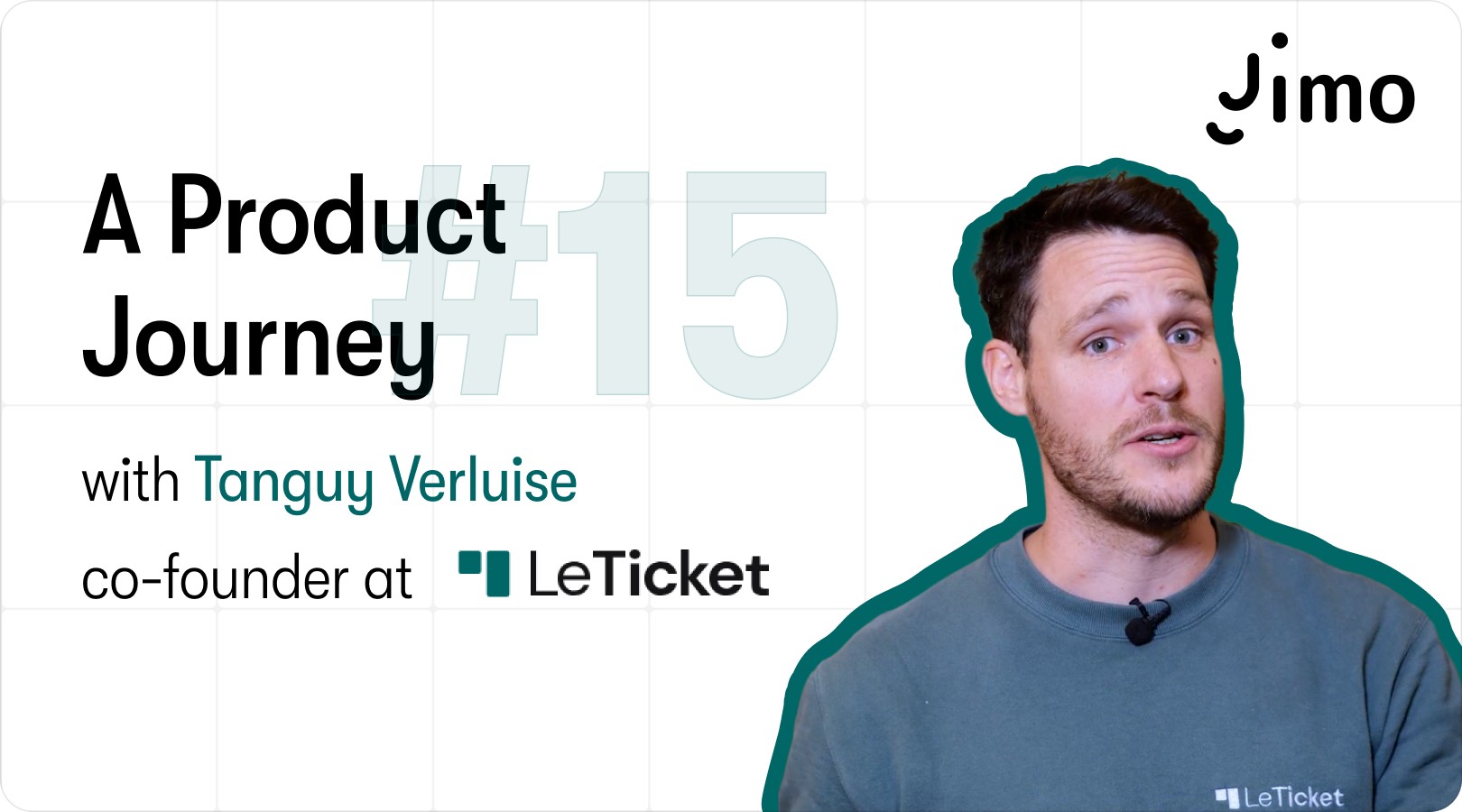
The future of product in an AI world: a conversation with Tanguy Verluise the co-founder of Le Ticket
Dec 11, 2025
/
7 mins read


We sat down with Tanguy Verluise, co-founder of Le Ticket, for a candid conversation on the evolution of the PM role, the rise of AI-powered teams, and what it really takes to build products people care about in 2025 and beyond.
When you were a kid, what did you dream of becoming? Were you already the imaginative type?
If I’m honest, I don’t really remember having a super clear dream job as a child.
What I do remember clearly is the moment I left high school, I was obsessed with the video game industry. My first internship applications were all for game studios, and I even managed to get a few interviews.
Pretty quickly, though, people realized I was more fascinated by the industry and the act of creating games than by the games themselves. I’ve never been a huge gamer, I mostly watched my friends play, basically Twitch before Twitch existed.
What really excited me was this idea: a game starts in the head of a few creatives, then an entire ecosystem of teams forms around it, builds it, ships it, and one day it lands in someone’s hands.
That journey, from idea to something real people use, was what I found magical.
As for being imaginative or creative, I wouldn’t naturally describe myself that way, especially after working with people who are truly creative. But funnily enough, those people often tell me that I am creative, just in a way that feels completely natural to me.
What really defines me is something slightly different. I love telling stories, bringing people together, and getting brilliant people to work in the same direction. Seeing very talented people, designers, engineers, data folks, build something together, and then watching users actually adopt it, that’s what excites me.
That’s also why, more than 15 years in, I’m still genuinely passionate about product, and about the stories of the people who build products.
What was your very first encounter with “product”?
My real entry point into product was that internship at La Fourchette in 2011.
I applied for an internship at La Fourchette (now TheFork) and started my journey as a Product Manager, which, in my mind, looked a lot like the “producer” roles I was targeting in gaming.
It was supposed to be a simple gap year plan,
“I’ll stay six months, get some experience, and then I’ll try my luck again in video games.”
A few months in, I realised,
“Actually, what I’m doing here is amazing, I don’t want to leave.”
The context was very different from today. This was before “la Startup Nation”, before product roles became mainstream in France. We were in a Haussmann-style apartment in the Sentier, with sales, dev, ops, everyone sitting side by side. It was chaotic, fast-paced, and incredibly energizing.
At the time, in France, almost nobody talked about product as a discipline. There were a few inspirations coming from the US, but you didn’t really hear “Product Manager” or “Product Owner” everywhere. I think Blablacar was one of the rare companies already speaking explicitly about product back then, partly because Frédéric Mazzella had spent time in Silicon Valley.
LaFourchette was one of the first big French consumer websites, long before today’s funding levels, cloud infrastructure, and playbooks.
I’m talking about a time when raising a Series C of €8–10 million was considered huge.
During the second part of my gap year, I became PM for the web platform for France and Spain. The product and tech team was maybe 25–30 people inside a company of around 100–200. And this was still the era where you managed your own infrastructure, there was no AWS to spin up in a few clicks.
For someone who was still a student, it was an incredible playground.
So my first encounter with product was very hands-on, owning a real piece of a real business, in a context where the job title “Product Manager” barely existed in France, but the impact was already very real.
Le Ticket is a media, a business, and above all a community. What are you most proud of?
If I had to pick one thing I’m proud of, it’s this:
We’ve proven that a niche media can build a sustainable business model based primarily on the trust of its readers.
The starting point was very personal.
I had, and still have, a lot of admiration for people like Pauline Marol (then CPO at Balinea) and Chloé Martineau (then CPO at ManoMano). These are people with huge responsibilities who still found the energy to create and nurture communities on the side.
Chloé, for instance, created a group called Product Assembly. Once a month, a small group of PMs, Heads of Product, CPOs would meet to discuss their real problems. Not theory, things like,
“I need to build a search engine, do I build it in-house, do I buy a solution, what have you tried, what worked, what failed?”
Those conversations were incredibly valuable. And at that time, as far as I knew, they simply didn’t exist outside that small circle.
The only places where product knowledge was really circulating were:
a few conferences like those organised by Thiga,
and Medium, which was, and still is, often more of a personal branding platform for Silicon Valley companies than a place where you can tell if the story is actually true or applicable to your context.
Around that time, I spoke with Kevin, who would become my co-founder. He’s a journalist by trade, and he told me,
“I believe strongly in niche B2B media, and I’m convinced there’s a real gap around product.”
He had spent three years at Blablacar working in PR, which gave him both a deep exposure to product and a good view of how US companies tell their stories. His conviction was simple,
“We can tell stories just as well in Europe, we just need the right format and the right focus.”
That’s how Le Ticket was born.
We launched in October 2020, in full side project mode, with one question in mind,
“Is there anyone out there who will care about this?”
By January 2021, we already had 1,000 subscribers.
That was our first signal that we weren’t completely crazy.
For a long time, until May 2024, Le Ticket remained a side project, Kevin was a journalist working for other media, I was a full-time CPO, and we were developing Le Ticket on evenings and weekends.
Our intention at the beginning was very pure,
put the spotlight on real stories,
help product people tell their story with an expert lens,
create a written record of what’s actually happening in European product teams.
We didn’t start by saying “Let’s build a business model.”
We started by saying “Let’s build an audience who genuinely cares.”
Our main success metric wasn’t vanity metrics. It was:
number of subscribers,
and above all our open rate.
Since launch, our average open rate is around 65%, with now roughly 8,500 subscribers, which means 5,000 to 6,000 people read us every week. For a niche B2B media, that’s huge.
The switch
In 2024, we realised that if we wanted to go to the next level, hire people, increase our ambition, produce more and deeper content, we needed a sustainable economic model.
That’s when we launched the paid version of Le Ticket,
more articles,
longer form deep dives,
exclusive content for paying subscribers.
We’re just closing our first financial year as a proper company. Today, we know:
we can pay several people,
we generate recurring revenue,
and more than 50% of that revenue already comes from subscriptions, not advertising.
If I had to pick one thing I’m proud of, it’s this,
We’ve proven that a niche media can build a sustainable business model based primarily on the trust of its readers, that there are enough people willing to pay €200 per year for high-quality, useful content about product and tech business, without everything being funded by ads.
In terms of ambition, we’re also evolving.
Right now, people see us as “the media for product people”, which we embrace.
But our next step is to become, more broadly, a media about tech businesses built through product.
We want to keep telling stories,
how companies like Alan or Blablacar build their organisations,
how they recruit,
how they structure their culture,
not just how they ship features.
That will probably mean interviewing more HR leaders, founders, and other profiles who shape how great tech companies are built.
And we don’t do this alone anymore. Today, beyond the two co-founders, we have a team of five regular contributors who each own a project and bring us ideas from what they see in their own companies.
Do we already have a “community”? I’m not sure we deserve the word yet, at least not in the sense of something we formally animate every day.
What I do know is that:
we love spending time with the people who read us and contribute,
and they seem to love spending time with us too.
We recently organised our five year anniversary, and seeing so many leaders from incredible companies show up, just because we started a newsletter five years ago, that felt pretty special.
Based on your experience and the many interviews you’ve conducted, how has AI impacted the role of PM?
To put things in context, we created Le Ticket in 2020, but I stayed a salaried CPO until April 2024, most recently at a company called OMIE. So I’ve lived this shift both from the inside as a product leader and from the outside through all the interviews we’ve done.
For most of my career, when we said “AI”, we were actually talking about machine learning or deep learning. I worked a lot on search and ranking problems, how do you personalise results based on user history, time of day, behaviour, and so on.
For the user, that kind of AI is invisible. It lives behind the scenes, and it’s mostly a topic for engineers and data teams.
GenAI changed the picture completely.
Suddenly, anyone, even with almost no technical background, could interact with AI directly and see immediate value.
As an employee, I used it like many others,
to draft tickets,
to clean up documentation,
to speed up everyday writing tasks, at work and at home.
Nothing revolutionary at first, but it definitely boosted productivity.
From the Le Ticket side, the last 18 to 24 months have been fascinating. We’ve seen two very clear waves.
#1. Internal productivity first
Most companies don’t start by putting AI in front of users. They start by giving it to their teams.
It’s less risky, if the model hallucinates or is “only” 80 to 90% correct, there’s still a human in the loop.
We’ve seen a lot of internal use cases,
drafting emails in the company’s tone of voice,
writing or refining product tickets,
challenging a Figma mock against UX best practices, brand guidelines, and wording,
building small internal “agents” to automate boring, repetitive tasks.
These are very concrete productivity wins for product teams, with a controlled risk surface.
#2. Then AI inside the product itself
More advanced companies, the ones that already had solid data teams (I think of Doctolib, Alan, Leboncoin and others), moved faster on embedding AI into the product.
The big difficulty is moving from POC to production. An AI feature that works “80% of the time” might be okay internally, but that’s often not acceptable in front of end users.
So you suddenly have to design for the fact that:
the system can be wrong,
it can hallucinate,
and you need to build escape hatches into the UX (“I think this is wrong, put me in touch with a human”, for example).
That means rethinking user journeys, error states, escalation paths. It’s not just “we added a chatbot on our FAQ”, it’s a proper product and risk design problem.
5. AI’s cultural impact
On top of that, AI has had a huge cultural impact on product roles themselves.
Between 2023 and 2024, PM teams went through a pretty rough phase.
We moved from the era where product people were the “rockstars” of the organisation”, roughly 2019 to 2022 when funding was abundant, to an era where product became a very visible cost centre.
A typical six person product team costs around €1M per year.
The new question became,
“Show me that you’re generating at least that much value.”
And just as this shift was happening, GenAI arrived and made everyone wonder,
“How much of this job could be automated?”
A fair portion of PM work is now clearly augmentable by AI,
writing and challenging business cases,
structuring and rewriting tickets,
generating test scenarios,
even prototyping interfaces or flows that look “good enough” to put in front of users.
On the design and engineering side, the same thing is happening,
designers can export code or suggest code level changes,
engineers can rely on AI for boilerplate, debugging, and sometimes full features.
The result is that the boundaries between PM, design, and engineering are getting much more porous.
You can easily imagine:
a designer pushing a small PR directly because the UI integration is slightly off,
a PM prototyping directly in tools like Cursor or Lovable, and testing with users before involving a designer or engineer.
In that world, the question isn’t “who owns which box on the org chart?” anymore.
The question is,
“Who is able to put something meaningful in users’ hands quickly and prove its impact?”
And that’s where AI is reshaping the role of PM,
It compresses cycles.
It raises expectations.
It pushes PMs to demonstrate value faster.
In parallel, more and more companies obsess over metrics like ARR per employee and celebrate lean teams generating huge revenue. The implicit message is,
“With the tools you have today, including AI, you should be able to do more with fewer people.”
That changes how PMs are evaluated, how teams are staffed, and ultimately, what “good” looks like in product.
Finally, how do you see the future of product? Is there any striking trend you believe will shape the product world in the coming years?
We’ve been trying for two years at Le Ticket to predict “the big trends of next year”, and I can confidently say I’m not very good at that game.
So I won’t pretend to have a crystal ball. But I can tell you what we’re seeing very clearly on the ground.
First, the tech job market has become much tougher, especially in product.
For junior profiles, it’s honestly a very difficult market right now.
Companies are over indexing on highly skilled individual contributors, people who are:
very strong in their craft,
able to own a slice of business end to end,
comfortable switching between discovery, delivery, and analysis.
When we talk to hiring managers today, what they want is,
“Someone who arrives with a prototype they’ve already shown to users,”
not someone who arrives with a beautiful but theoretical business case.
At the same time,
there are way more candidates per role than a few years ago,
and the level of case studies and tests has gone up dramatically compared to 3 to 4 years ago.
So we’re seeing a very strong professionalisation of the product role, with a big emphasis on hard skills.
If you compare that to the first generation of PMs in France, early 2010s, a lot of them came from more generalist, entrepreneurial backgrounds. They were multi skilled, but not necessarily very deep technically.
Today, that kind of generalist profile has a harder time. There’s a real need for upskilling and re-skilling for part of the current PM population to stay aligned with what the market is asking for.
What I am convinced of, and that brings us back to the start of our conversation,
The future of product will depend a lot on how well we share what works and what doesn’t, especially at a European scale.
Right now, our ecosystems are still very siloed, we don’t really know what’s happening in Italy, or in Germany, or in the Netherlands, even though there are massive success stories there,
Bending Spoons in Italy, Booking in the Netherlands, big players in Germany with incredible product professionals behind them.
My experience with Le Ticket is that the product community is extremely willing to share, as soon as you show up and say,
“Something interesting is happening at your company, I’d love for you to tell that story.”
If we manage to create more of those bridges, across teams, companies, and countries, I think that will be a big part of how we:
build better products,
build stronger tech companies in Europe,
and help the next generation of PMs grow in a much more demanding environment.
Thank you Tanguy, it was nice to have your thoughts on Product Management in 2025!

We sat down with Tanguy Verluise, co-founder of Le Ticket, for a candid conversation on the evolution of the PM role, the rise of AI-powered teams, and what it really takes to build products people care about in 2025 and beyond.
When you were a kid, what did you dream of becoming? Were you already the imaginative type?
If I’m honest, I don’t really remember having a super clear dream job as a child.
What I do remember clearly is the moment I left high school, I was obsessed with the video game industry. My first internship applications were all for game studios, and I even managed to get a few interviews.
Pretty quickly, though, people realized I was more fascinated by the industry and the act of creating games than by the games themselves. I’ve never been a huge gamer, I mostly watched my friends play, basically Twitch before Twitch existed.
What really excited me was this idea: a game starts in the head of a few creatives, then an entire ecosystem of teams forms around it, builds it, ships it, and one day it lands in someone’s hands.
That journey, from idea to something real people use, was what I found magical.
As for being imaginative or creative, I wouldn’t naturally describe myself that way, especially after working with people who are truly creative. But funnily enough, those people often tell me that I am creative, just in a way that feels completely natural to me.
What really defines me is something slightly different. I love telling stories, bringing people together, and getting brilliant people to work in the same direction. Seeing very talented people, designers, engineers, data folks, build something together, and then watching users actually adopt it, that’s what excites me.
That’s also why, more than 15 years in, I’m still genuinely passionate about product, and about the stories of the people who build products.
What was your very first encounter with “product”?
My real entry point into product was that internship at La Fourchette in 2011.
I applied for an internship at La Fourchette (now TheFork) and started my journey as a Product Manager, which, in my mind, looked a lot like the “producer” roles I was targeting in gaming.
It was supposed to be a simple gap year plan,
“I’ll stay six months, get some experience, and then I’ll try my luck again in video games.”
A few months in, I realised,
“Actually, what I’m doing here is amazing, I don’t want to leave.”
The context was very different from today. This was before “la Startup Nation”, before product roles became mainstream in France. We were in a Haussmann-style apartment in the Sentier, with sales, dev, ops, everyone sitting side by side. It was chaotic, fast-paced, and incredibly energizing.
At the time, in France, almost nobody talked about product as a discipline. There were a few inspirations coming from the US, but you didn’t really hear “Product Manager” or “Product Owner” everywhere. I think Blablacar was one of the rare companies already speaking explicitly about product back then, partly because Frédéric Mazzella had spent time in Silicon Valley.
LaFourchette was one of the first big French consumer websites, long before today’s funding levels, cloud infrastructure, and playbooks.
I’m talking about a time when raising a Series C of €8–10 million was considered huge.
During the second part of my gap year, I became PM for the web platform for France and Spain. The product and tech team was maybe 25–30 people inside a company of around 100–200. And this was still the era where you managed your own infrastructure, there was no AWS to spin up in a few clicks.
For someone who was still a student, it was an incredible playground.
So my first encounter with product was very hands-on, owning a real piece of a real business, in a context where the job title “Product Manager” barely existed in France, but the impact was already very real.
Le Ticket is a media, a business, and above all a community. What are you most proud of?
If I had to pick one thing I’m proud of, it’s this:
We’ve proven that a niche media can build a sustainable business model based primarily on the trust of its readers.
The starting point was very personal.
I had, and still have, a lot of admiration for people like Pauline Marol (then CPO at Balinea) and Chloé Martineau (then CPO at ManoMano). These are people with huge responsibilities who still found the energy to create and nurture communities on the side.
Chloé, for instance, created a group called Product Assembly. Once a month, a small group of PMs, Heads of Product, CPOs would meet to discuss their real problems. Not theory, things like,
“I need to build a search engine, do I build it in-house, do I buy a solution, what have you tried, what worked, what failed?”
Those conversations were incredibly valuable. And at that time, as far as I knew, they simply didn’t exist outside that small circle.
The only places where product knowledge was really circulating were:
a few conferences like those organised by Thiga,
and Medium, which was, and still is, often more of a personal branding platform for Silicon Valley companies than a place where you can tell if the story is actually true or applicable to your context.
Around that time, I spoke with Kevin, who would become my co-founder. He’s a journalist by trade, and he told me,
“I believe strongly in niche B2B media, and I’m convinced there’s a real gap around product.”
He had spent three years at Blablacar working in PR, which gave him both a deep exposure to product and a good view of how US companies tell their stories. His conviction was simple,
“We can tell stories just as well in Europe, we just need the right format and the right focus.”
That’s how Le Ticket was born.
We launched in October 2020, in full side project mode, with one question in mind,
“Is there anyone out there who will care about this?”
By January 2021, we already had 1,000 subscribers.
That was our first signal that we weren’t completely crazy.
For a long time, until May 2024, Le Ticket remained a side project, Kevin was a journalist working for other media, I was a full-time CPO, and we were developing Le Ticket on evenings and weekends.
Our intention at the beginning was very pure,
put the spotlight on real stories,
help product people tell their story with an expert lens,
create a written record of what’s actually happening in European product teams.
We didn’t start by saying “Let’s build a business model.”
We started by saying “Let’s build an audience who genuinely cares.”
Our main success metric wasn’t vanity metrics. It was:
number of subscribers,
and above all our open rate.
Since launch, our average open rate is around 65%, with now roughly 8,500 subscribers, which means 5,000 to 6,000 people read us every week. For a niche B2B media, that’s huge.
The switch
In 2024, we realised that if we wanted to go to the next level, hire people, increase our ambition, produce more and deeper content, we needed a sustainable economic model.
That’s when we launched the paid version of Le Ticket,
more articles,
longer form deep dives,
exclusive content for paying subscribers.
We’re just closing our first financial year as a proper company. Today, we know:
we can pay several people,
we generate recurring revenue,
and more than 50% of that revenue already comes from subscriptions, not advertising.
If I had to pick one thing I’m proud of, it’s this,
We’ve proven that a niche media can build a sustainable business model based primarily on the trust of its readers, that there are enough people willing to pay €200 per year for high-quality, useful content about product and tech business, without everything being funded by ads.
In terms of ambition, we’re also evolving.
Right now, people see us as “the media for product people”, which we embrace.
But our next step is to become, more broadly, a media about tech businesses built through product.
We want to keep telling stories,
how companies like Alan or Blablacar build their organisations,
how they recruit,
how they structure their culture,
not just how they ship features.
That will probably mean interviewing more HR leaders, founders, and other profiles who shape how great tech companies are built.
And we don’t do this alone anymore. Today, beyond the two co-founders, we have a team of five regular contributors who each own a project and bring us ideas from what they see in their own companies.
Do we already have a “community”? I’m not sure we deserve the word yet, at least not in the sense of something we formally animate every day.
What I do know is that:
we love spending time with the people who read us and contribute,
and they seem to love spending time with us too.
We recently organised our five year anniversary, and seeing so many leaders from incredible companies show up, just because we started a newsletter five years ago, that felt pretty special.
Based on your experience and the many interviews you’ve conducted, how has AI impacted the role of PM?
To put things in context, we created Le Ticket in 2020, but I stayed a salaried CPO until April 2024, most recently at a company called OMIE. So I’ve lived this shift both from the inside as a product leader and from the outside through all the interviews we’ve done.
For most of my career, when we said “AI”, we were actually talking about machine learning or deep learning. I worked a lot on search and ranking problems, how do you personalise results based on user history, time of day, behaviour, and so on.
For the user, that kind of AI is invisible. It lives behind the scenes, and it’s mostly a topic for engineers and data teams.
GenAI changed the picture completely.
Suddenly, anyone, even with almost no technical background, could interact with AI directly and see immediate value.
As an employee, I used it like many others,
to draft tickets,
to clean up documentation,
to speed up everyday writing tasks, at work and at home.
Nothing revolutionary at first, but it definitely boosted productivity.
From the Le Ticket side, the last 18 to 24 months have been fascinating. We’ve seen two very clear waves.
#1. Internal productivity first
Most companies don’t start by putting AI in front of users. They start by giving it to their teams.
It’s less risky, if the model hallucinates or is “only” 80 to 90% correct, there’s still a human in the loop.
We’ve seen a lot of internal use cases,
drafting emails in the company’s tone of voice,
writing or refining product tickets,
challenging a Figma mock against UX best practices, brand guidelines, and wording,
building small internal “agents” to automate boring, repetitive tasks.
These are very concrete productivity wins for product teams, with a controlled risk surface.
#2. Then AI inside the product itself
More advanced companies, the ones that already had solid data teams (I think of Doctolib, Alan, Leboncoin and others), moved faster on embedding AI into the product.
The big difficulty is moving from POC to production. An AI feature that works “80% of the time” might be okay internally, but that’s often not acceptable in front of end users.
So you suddenly have to design for the fact that:
the system can be wrong,
it can hallucinate,
and you need to build escape hatches into the UX (“I think this is wrong, put me in touch with a human”, for example).
That means rethinking user journeys, error states, escalation paths. It’s not just “we added a chatbot on our FAQ”, it’s a proper product and risk design problem.
5. AI’s cultural impact
On top of that, AI has had a huge cultural impact on product roles themselves.
Between 2023 and 2024, PM teams went through a pretty rough phase.
We moved from the era where product people were the “rockstars” of the organisation”, roughly 2019 to 2022 when funding was abundant, to an era where product became a very visible cost centre.
A typical six person product team costs around €1M per year.
The new question became,
“Show me that you’re generating at least that much value.”
And just as this shift was happening, GenAI arrived and made everyone wonder,
“How much of this job could be automated?”
A fair portion of PM work is now clearly augmentable by AI,
writing and challenging business cases,
structuring and rewriting tickets,
generating test scenarios,
even prototyping interfaces or flows that look “good enough” to put in front of users.
On the design and engineering side, the same thing is happening,
designers can export code or suggest code level changes,
engineers can rely on AI for boilerplate, debugging, and sometimes full features.
The result is that the boundaries between PM, design, and engineering are getting much more porous.
You can easily imagine:
a designer pushing a small PR directly because the UI integration is slightly off,
a PM prototyping directly in tools like Cursor or Lovable, and testing with users before involving a designer or engineer.
In that world, the question isn’t “who owns which box on the org chart?” anymore.
The question is,
“Who is able to put something meaningful in users’ hands quickly and prove its impact?”
And that’s where AI is reshaping the role of PM,
It compresses cycles.
It raises expectations.
It pushes PMs to demonstrate value faster.
In parallel, more and more companies obsess over metrics like ARR per employee and celebrate lean teams generating huge revenue. The implicit message is,
“With the tools you have today, including AI, you should be able to do more with fewer people.”
That changes how PMs are evaluated, how teams are staffed, and ultimately, what “good” looks like in product.
Finally, how do you see the future of product? Is there any striking trend you believe will shape the product world in the coming years?
We’ve been trying for two years at Le Ticket to predict “the big trends of next year”, and I can confidently say I’m not very good at that game.
So I won’t pretend to have a crystal ball. But I can tell you what we’re seeing very clearly on the ground.
First, the tech job market has become much tougher, especially in product.
For junior profiles, it’s honestly a very difficult market right now.
Companies are over indexing on highly skilled individual contributors, people who are:
very strong in their craft,
able to own a slice of business end to end,
comfortable switching between discovery, delivery, and analysis.
When we talk to hiring managers today, what they want is,
“Someone who arrives with a prototype they’ve already shown to users,”
not someone who arrives with a beautiful but theoretical business case.
At the same time,
there are way more candidates per role than a few years ago,
and the level of case studies and tests has gone up dramatically compared to 3 to 4 years ago.
So we’re seeing a very strong professionalisation of the product role, with a big emphasis on hard skills.
If you compare that to the first generation of PMs in France, early 2010s, a lot of them came from more generalist, entrepreneurial backgrounds. They were multi skilled, but not necessarily very deep technically.
Today, that kind of generalist profile has a harder time. There’s a real need for upskilling and re-skilling for part of the current PM population to stay aligned with what the market is asking for.
What I am convinced of, and that brings us back to the start of our conversation,
The future of product will depend a lot on how well we share what works and what doesn’t, especially at a European scale.
Right now, our ecosystems are still very siloed, we don’t really know what’s happening in Italy, or in Germany, or in the Netherlands, even though there are massive success stories there,
Bending Spoons in Italy, Booking in the Netherlands, big players in Germany with incredible product professionals behind them.
My experience with Le Ticket is that the product community is extremely willing to share, as soon as you show up and say,
“Something interesting is happening at your company, I’d love for you to tell that story.”
If we manage to create more of those bridges, across teams, companies, and countries, I think that will be a big part of how we:
build better products,
build stronger tech companies in Europe,
and help the next generation of PMs grow in a much more demanding environment.
Thank you Tanguy, it was nice to have your thoughts on Product Management in 2025!
We sat down with Tanguy Verluise, co-founder of Le Ticket, for a candid conversation on the evolution of the PM role, the rise of AI-powered teams, and what it really takes to build products people care about in 2025 and beyond.
When you were a kid, what did you dream of becoming? Were you already the imaginative type?
If I’m honest, I don’t really remember having a super clear dream job as a child.
What I do remember clearly is the moment I left high school, I was obsessed with the video game industry. My first internship applications were all for game studios, and I even managed to get a few interviews.
Pretty quickly, though, people realized I was more fascinated by the industry and the act of creating games than by the games themselves. I’ve never been a huge gamer, I mostly watched my friends play, basically Twitch before Twitch existed.
What really excited me was this idea: a game starts in the head of a few creatives, then an entire ecosystem of teams forms around it, builds it, ships it, and one day it lands in someone’s hands.
That journey, from idea to something real people use, was what I found magical.
As for being imaginative or creative, I wouldn’t naturally describe myself that way, especially after working with people who are truly creative. But funnily enough, those people often tell me that I am creative, just in a way that feels completely natural to me.
What really defines me is something slightly different. I love telling stories, bringing people together, and getting brilliant people to work in the same direction. Seeing very talented people, designers, engineers, data folks, build something together, and then watching users actually adopt it, that’s what excites me.
That’s also why, more than 15 years in, I’m still genuinely passionate about product, and about the stories of the people who build products.
What was your very first encounter with “product”?
My real entry point into product was that internship at La Fourchette in 2011.
I applied for an internship at La Fourchette (now TheFork) and started my journey as a Product Manager, which, in my mind, looked a lot like the “producer” roles I was targeting in gaming.
It was supposed to be a simple gap year plan,
“I’ll stay six months, get some experience, and then I’ll try my luck again in video games.”
A few months in, I realised,
“Actually, what I’m doing here is amazing, I don’t want to leave.”
The context was very different from today. This was before “la Startup Nation”, before product roles became mainstream in France. We were in a Haussmann-style apartment in the Sentier, with sales, dev, ops, everyone sitting side by side. It was chaotic, fast-paced, and incredibly energizing.
At the time, in France, almost nobody talked about product as a discipline. There were a few inspirations coming from the US, but you didn’t really hear “Product Manager” or “Product Owner” everywhere. I think Blablacar was one of the rare companies already speaking explicitly about product back then, partly because Frédéric Mazzella had spent time in Silicon Valley.
LaFourchette was one of the first big French consumer websites, long before today’s funding levels, cloud infrastructure, and playbooks.
I’m talking about a time when raising a Series C of €8–10 million was considered huge.
During the second part of my gap year, I became PM for the web platform for France and Spain. The product and tech team was maybe 25–30 people inside a company of around 100–200. And this was still the era where you managed your own infrastructure, there was no AWS to spin up in a few clicks.
For someone who was still a student, it was an incredible playground.
So my first encounter with product was very hands-on, owning a real piece of a real business, in a context where the job title “Product Manager” barely existed in France, but the impact was already very real.
Le Ticket is a media, a business, and above all a community. What are you most proud of?
If I had to pick one thing I’m proud of, it’s this:
We’ve proven that a niche media can build a sustainable business model based primarily on the trust of its readers.
The starting point was very personal.
I had, and still have, a lot of admiration for people like Pauline Marol (then CPO at Balinea) and Chloé Martineau (then CPO at ManoMano). These are people with huge responsibilities who still found the energy to create and nurture communities on the side.
Chloé, for instance, created a group called Product Assembly. Once a month, a small group of PMs, Heads of Product, CPOs would meet to discuss their real problems. Not theory, things like,
“I need to build a search engine, do I build it in-house, do I buy a solution, what have you tried, what worked, what failed?”
Those conversations were incredibly valuable. And at that time, as far as I knew, they simply didn’t exist outside that small circle.
The only places where product knowledge was really circulating were:
a few conferences like those organised by Thiga,
and Medium, which was, and still is, often more of a personal branding platform for Silicon Valley companies than a place where you can tell if the story is actually true or applicable to your context.
Around that time, I spoke with Kevin, who would become my co-founder. He’s a journalist by trade, and he told me,
“I believe strongly in niche B2B media, and I’m convinced there’s a real gap around product.”
He had spent three years at Blablacar working in PR, which gave him both a deep exposure to product and a good view of how US companies tell their stories. His conviction was simple,
“We can tell stories just as well in Europe, we just need the right format and the right focus.”
That’s how Le Ticket was born.
We launched in October 2020, in full side project mode, with one question in mind,
“Is there anyone out there who will care about this?”
By January 2021, we already had 1,000 subscribers.
That was our first signal that we weren’t completely crazy.
For a long time, until May 2024, Le Ticket remained a side project, Kevin was a journalist working for other media, I was a full-time CPO, and we were developing Le Ticket on evenings and weekends.
Our intention at the beginning was very pure,
put the spotlight on real stories,
help product people tell their story with an expert lens,
create a written record of what’s actually happening in European product teams.
We didn’t start by saying “Let’s build a business model.”
We started by saying “Let’s build an audience who genuinely cares.”
Our main success metric wasn’t vanity metrics. It was:
number of subscribers,
and above all our open rate.
Since launch, our average open rate is around 65%, with now roughly 8,500 subscribers, which means 5,000 to 6,000 people read us every week. For a niche B2B media, that’s huge.
The switch
In 2024, we realised that if we wanted to go to the next level, hire people, increase our ambition, produce more and deeper content, we needed a sustainable economic model.
That’s when we launched the paid version of Le Ticket,
more articles,
longer form deep dives,
exclusive content for paying subscribers.
We’re just closing our first financial year as a proper company. Today, we know:
we can pay several people,
we generate recurring revenue,
and more than 50% of that revenue already comes from subscriptions, not advertising.
If I had to pick one thing I’m proud of, it’s this,
We’ve proven that a niche media can build a sustainable business model based primarily on the trust of its readers, that there are enough people willing to pay €200 per year for high-quality, useful content about product and tech business, without everything being funded by ads.
In terms of ambition, we’re also evolving.
Right now, people see us as “the media for product people”, which we embrace.
But our next step is to become, more broadly, a media about tech businesses built through product.
We want to keep telling stories,
how companies like Alan or Blablacar build their organisations,
how they recruit,
how they structure their culture,
not just how they ship features.
That will probably mean interviewing more HR leaders, founders, and other profiles who shape how great tech companies are built.
And we don’t do this alone anymore. Today, beyond the two co-founders, we have a team of five regular contributors who each own a project and bring us ideas from what they see in their own companies.
Do we already have a “community”? I’m not sure we deserve the word yet, at least not in the sense of something we formally animate every day.
What I do know is that:
we love spending time with the people who read us and contribute,
and they seem to love spending time with us too.
We recently organised our five year anniversary, and seeing so many leaders from incredible companies show up, just because we started a newsletter five years ago, that felt pretty special.
Based on your experience and the many interviews you’ve conducted, how has AI impacted the role of PM?
To put things in context, we created Le Ticket in 2020, but I stayed a salaried CPO until April 2024, most recently at a company called OMIE. So I’ve lived this shift both from the inside as a product leader and from the outside through all the interviews we’ve done.
For most of my career, when we said “AI”, we were actually talking about machine learning or deep learning. I worked a lot on search and ranking problems, how do you personalise results based on user history, time of day, behaviour, and so on.
For the user, that kind of AI is invisible. It lives behind the scenes, and it’s mostly a topic for engineers and data teams.
GenAI changed the picture completely.
Suddenly, anyone, even with almost no technical background, could interact with AI directly and see immediate value.
As an employee, I used it like many others,
to draft tickets,
to clean up documentation,
to speed up everyday writing tasks, at work and at home.
Nothing revolutionary at first, but it definitely boosted productivity.
From the Le Ticket side, the last 18 to 24 months have been fascinating. We’ve seen two very clear waves.
#1. Internal productivity first
Most companies don’t start by putting AI in front of users. They start by giving it to their teams.
It’s less risky, if the model hallucinates or is “only” 80 to 90% correct, there’s still a human in the loop.
We’ve seen a lot of internal use cases,
drafting emails in the company’s tone of voice,
writing or refining product tickets,
challenging a Figma mock against UX best practices, brand guidelines, and wording,
building small internal “agents” to automate boring, repetitive tasks.
These are very concrete productivity wins for product teams, with a controlled risk surface.
#2. Then AI inside the product itself
More advanced companies, the ones that already had solid data teams (I think of Doctolib, Alan, Leboncoin and others), moved faster on embedding AI into the product.
The big difficulty is moving from POC to production. An AI feature that works “80% of the time” might be okay internally, but that’s often not acceptable in front of end users.
So you suddenly have to design for the fact that:
the system can be wrong,
it can hallucinate,
and you need to build escape hatches into the UX (“I think this is wrong, put me in touch with a human”, for example).
That means rethinking user journeys, error states, escalation paths. It’s not just “we added a chatbot on our FAQ”, it’s a proper product and risk design problem.
5. AI’s cultural impact
On top of that, AI has had a huge cultural impact on product roles themselves.
Between 2023 and 2024, PM teams went through a pretty rough phase.
We moved from the era where product people were the “rockstars” of the organisation”, roughly 2019 to 2022 when funding was abundant, to an era where product became a very visible cost centre.
A typical six person product team costs around €1M per year.
The new question became,
“Show me that you’re generating at least that much value.”
And just as this shift was happening, GenAI arrived and made everyone wonder,
“How much of this job could be automated?”
A fair portion of PM work is now clearly augmentable by AI,
writing and challenging business cases,
structuring and rewriting tickets,
generating test scenarios,
even prototyping interfaces or flows that look “good enough” to put in front of users.
On the design and engineering side, the same thing is happening,
designers can export code or suggest code level changes,
engineers can rely on AI for boilerplate, debugging, and sometimes full features.
The result is that the boundaries between PM, design, and engineering are getting much more porous.
You can easily imagine:
a designer pushing a small PR directly because the UI integration is slightly off,
a PM prototyping directly in tools like Cursor or Lovable, and testing with users before involving a designer or engineer.
In that world, the question isn’t “who owns which box on the org chart?” anymore.
The question is,
“Who is able to put something meaningful in users’ hands quickly and prove its impact?”
And that’s where AI is reshaping the role of PM,
It compresses cycles.
It raises expectations.
It pushes PMs to demonstrate value faster.
In parallel, more and more companies obsess over metrics like ARR per employee and celebrate lean teams generating huge revenue. The implicit message is,
“With the tools you have today, including AI, you should be able to do more with fewer people.”
That changes how PMs are evaluated, how teams are staffed, and ultimately, what “good” looks like in product.
Finally, how do you see the future of product? Is there any striking trend you believe will shape the product world in the coming years?
We’ve been trying for two years at Le Ticket to predict “the big trends of next year”, and I can confidently say I’m not very good at that game.
So I won’t pretend to have a crystal ball. But I can tell you what we’re seeing very clearly on the ground.
First, the tech job market has become much tougher, especially in product.
For junior profiles, it’s honestly a very difficult market right now.
Companies are over indexing on highly skilled individual contributors, people who are:
very strong in their craft,
able to own a slice of business end to end,
comfortable switching between discovery, delivery, and analysis.
When we talk to hiring managers today, what they want is,
“Someone who arrives with a prototype they’ve already shown to users,”
not someone who arrives with a beautiful but theoretical business case.
At the same time,
there are way more candidates per role than a few years ago,
and the level of case studies and tests has gone up dramatically compared to 3 to 4 years ago.
So we’re seeing a very strong professionalisation of the product role, with a big emphasis on hard skills.
If you compare that to the first generation of PMs in France, early 2010s, a lot of them came from more generalist, entrepreneurial backgrounds. They were multi skilled, but not necessarily very deep technically.
Today, that kind of generalist profile has a harder time. There’s a real need for upskilling and re-skilling for part of the current PM population to stay aligned with what the market is asking for.
What I am convinced of, and that brings us back to the start of our conversation,
The future of product will depend a lot on how well we share what works and what doesn’t, especially at a European scale.
Right now, our ecosystems are still very siloed, we don’t really know what’s happening in Italy, or in Germany, or in the Netherlands, even though there are massive success stories there,
Bending Spoons in Italy, Booking in the Netherlands, big players in Germany with incredible product professionals behind them.
My experience with Le Ticket is that the product community is extremely willing to share, as soon as you show up and say,
“Something interesting is happening at your company, I’d love for you to tell that story.”
If we manage to create more of those bridges, across teams, companies, and countries, I think that will be a big part of how we:
build better products,
build stronger tech companies in Europe,
and help the next generation of PMs grow in a much more demanding environment.
Thank you Tanguy, it was nice to have your thoughts on Product Management in 2025!

Level-up your onboarding in 30 mins
Discover how you can transform your product with experts from Jimo in 30 mins
Level-up your onboarding in 30 mins
Discover how you can transform your product with experts from Jimo in 30 mins
Level-up your onboarding in 30 mins
Discover how you can transform your product with experts from Jimo in 30 mins
Level-up your onboarding in 30 mins
Discover how you can transform your product with experts from Jimo in 30 mins
Keep Reading


Interviews
Sep 30, 2025
From Delhi to Berlin: How To Build Empathy into Product Management with Srishti Shah at HelloFresh

Sara Cutting Hollström
Product Marketing @Jimo


Interviews
May 20, 2025
People in Product - How Cultural Shifts Shape Product Thinking with Luca Cozzolino

Sara Cutting Hollström
Product Marketing @Jimo


Interviews
Nov 6, 2024
The Future of Digital Adoption Platforms: A Conversation with Jimo’s Co-founder and CPO

Yann Bidaux
Chief of Staff @Jimo

Interviews
Sep 30, 2025
From Delhi to Berlin: How To Build Empathy into Product Management with Srishti Shah at HelloFresh

Sara Cutting Hollström
Product Marketing @Jimo

Interviews
May 20, 2025
People in Product - How Cultural Shifts Shape Product Thinking with Luca Cozzolino

Sara Cutting Hollström
Product Marketing @Jimo

Interviews
Nov 6, 2024
The Future of Digital Adoption Platforms: A Conversation with Jimo’s Co-founder and CPO

Yann Bidaux
Chief of Staff @Jimo

Interviews
Oct 1, 2024
A Product Journey #12 with Jana Frejova, Head of Product Marketing at Spendesk

Thomas Moussafer
Co-Founder @Jimo