How to implement user feedback into product development in 2026
How to implement user feedback into product development in 2026
How to implement user feedback into product development in 2026
/
9 mins read

TL;DR
Most product teams have a feedback collection problem and an operationalization problem, and they only ever solve the first one. Surveys go out, responses come in, and the queue sits untouched until someone finds time to review it before the next planning cycle. This article addresses the second problem: how to build the infrastructure that ensures user feedback continuously influences what gets built, without depending on manual effort to keep the loop running. It covers three operational layers every continuous feedback loop requires: a collection architecture that embeds surveys directly into the product flows that generate friction, a routing infrastructure that moves responses into the development process automatically, and a closure layer that keeps signal quality improving over time. It also covers what each layer looks like in practice inside a B2B SaaS product, and why getting all three working together is what separates a periodic feedback program from a genuine product capability.
Your team is collecting user feedback. It is sitting in a tool. And the development backlog was built last sprint on the same assumptions it was built on the sprint before that.
This is not a feedback shortage. It is an infrastructure gap. The feedback and the product flows that generate user friction exist in separate systems, and without the infrastructure to connect them, the loop never becomes continuous. Someone has to manually drive it at every stage. This includes reviewing responses, grouping themes, translating them into tickets, as well as the moment that person's attention moves elsewhere.
This article is about closing that gap. It is not a guide to running better surveys or building a feedback culture. It is a framework for configuring the three operational layers that make a feedback loop continuous: where collection is embedded inside the product, how responses move into development automatically, and how the system closes back on itself in a way that compounds over time. For teams already measuring whether their feedback program is producing outcomes, see how to track feedback impact in product development. This article covers what needs to be built before that measurement is possible.
What a continuous feedback loop actually requires
Most teams that struggle to operationalize feedback reach for a process fix. They add a weekly review meeting, create a Notion template for tagging responses, or assign someone to own the feedback queue. These interventions help at the margins. None of them makes the loop continuous because the problem is not discipline, it is architecture.
A process answer produces a more organized version of the same periodic loop. An infrastructure answer produces something structurally different: a system that runs without someone manually driving each stage.
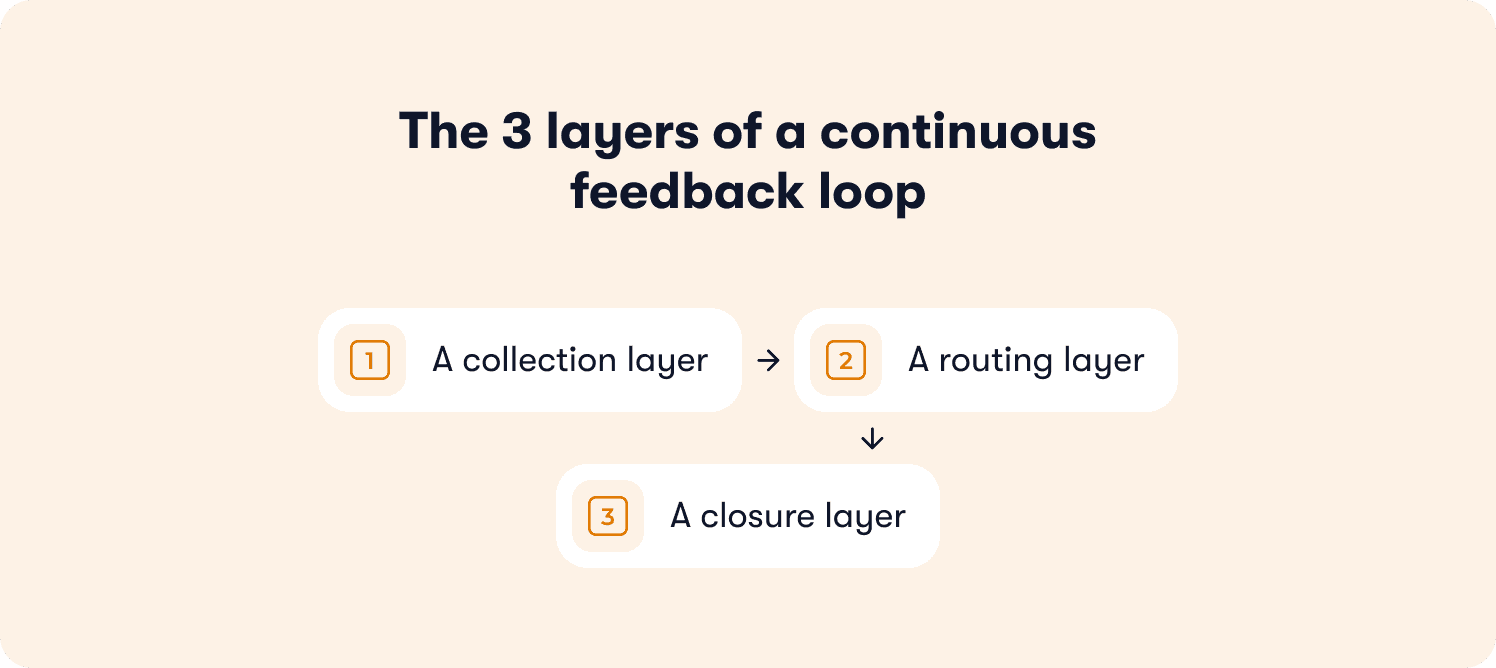
That system has three layers:
A collection layer: feedback embedded into the product flows that generate it, triggered by specific user behavior rather than a calendar invite
A routing layer: responses that move from the product into the development process automatically, without a manual triage step sitting between signal and decision
A closure layer: a system that communicates back to users and to the development team in a way that keeps response quality and signal specificity improving over time
Each layer is a configuration decision, not a program-management exercise. The rest of this article covers how to build each one.
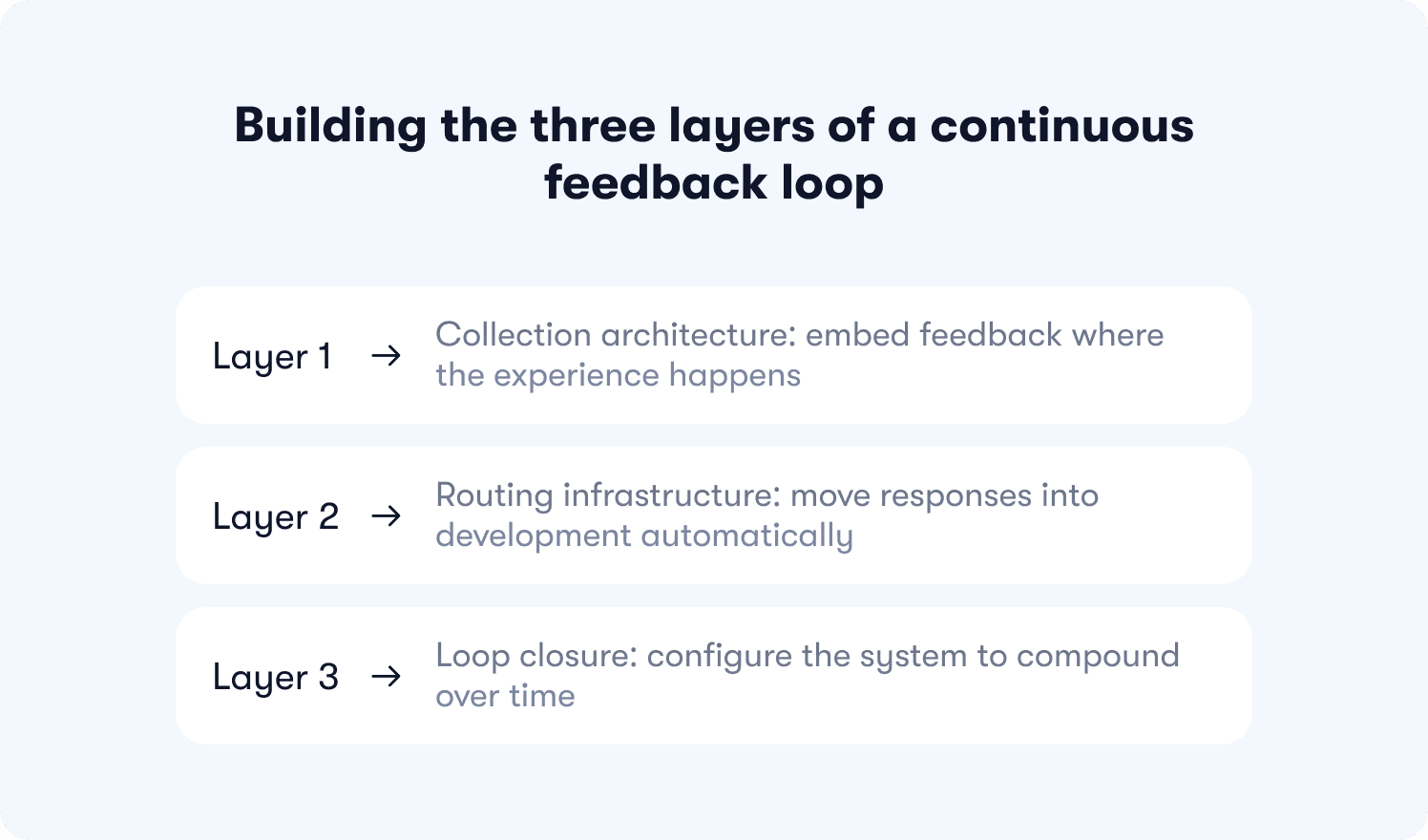
Building the three layers of a continuous feedback loop
The sections below cover each layer as a configuration decision: what it consists of, what it requires the PM to set up, and what it produces when it is working correctly.
The layers are sequential: collection feeds routing, and routing feeds closure, but each can be audited and improved independently if one part of the loop is breaking down before the others.
Layer 1: Collection architecture: embed feedback where the experience happens
The most impactful change a PM can make to a broken feedback loop is changing where surveys are deployed, not how often they go out.
A survey sent to the user base on a fixed schedule asks users to reconstruct an experience from memory. An in-app survey triggered at a specific moment inside the product captures the experience while it is happening. The signal quality difference between the two is significant. Recalled friction is vague. Live friction is specific, actionable, and far more likely to produce a response the development team can do something with.
The three trigger points that belong in every continuous feedback loop:
Onboarding completion: Triggered at the moment a user reaches the end of the guided onboarding path, before context degrades. This is the highest-value collection moment for first-impression signal. For more on what outcomes this signal connects to, see how to improve customer onboarding and what success looks like on the other side of it.
First feature interaction: Triggered the first time a user completes a meaningful action inside a specific capability. Captures feature discovery friction at the exact moment it occurs, before the user forms a fixed impression or abandons the feature without explanation.
Session drop-off: Triggered when a user abandons a flow or session depth drops below a defined threshold. A single focused question at this point captures the reason before it disappears. This is the signal most teams never collect because they do not have the trigger infrastructure to reach users at the moment it matters.
Trigger logic: how collection fires without engineering dependency
Behavior-triggered messaging is the mechanism that makes embedded collection possible without a sprint ticket. The PM configures the condition: which user action, which threshold, which flow. The survey fires automatically when the condition is met.
For guidance on designing the questions that go inside these triggers, the Jimo NPS survey guide covers the question formats that produce the most actionable signal at each moment in the user journey.
What this layer produces
When Layer 1 is configured correctly, the feedback queue stops filling with reconstructed impressions and starts filling with specific, moment-anchored responses tied to the exact flows where friction lives.
Layer 2: Routing infrastructure: move responses into development automatically
Embedding collection at the right moment solves the signal quality problem. Building the routing infrastructure solves the operationalization problem. If responses require a human to review them before they influence a development decision, the loop is not continuous. It is a queue with a feedback-shaped label on it.
The goal of Layer 2 is to remove the manual processing step between signal and development decision without removing the PM's judgment from the prioritization process.
The routing infrastructure consists of:
Tagging at the point of collection: Surveys configured with theme tags so responses arrive pre-categorized before anyone reads them. A survey deployed at the reporting feature drop-off point arrives tagged as "reporting friction." A survey deployed at onboarding completion arrives tagged by the flow it belongs to. The development team receives structured input, not a raw comments list requiring interpretation before it can be acted on.
Volume thresholds: When a friction theme accumulates responses past a defined number, it surfaces automatically as a development priority flag. The PM sets the threshold. The system flags the item. No one needs to manually count responses and decide when the volume justifies the development team's attention — that decision is encoded into the configuration.
Behavioral correlation: Responses cross-referenced with product analytics data using behavior metrics so the PM can see whether users reporting friction on a specific flow are also showing drop-off in funnel analysis at the same point. This is what turns a feedback theme into a defensible development priority.
A friction report without behavioral correlation is an opinion. A friction report with behavioral correlation is a brief.
What the development team receives
When routing infrastructure works correctly, the development team does not open a feedback tool and scroll through responses. They receive:
Friction themes ranked by response volume
Behavioral drop-off data tied to the same flows
Feature adoption signals showing which capabilities users are engaging with after the friction point and which they are abandoning
A direct line between each flagged theme and the specific product flow where it originates
Why this changes the speed of the loop
The activation rate impact of compressing the time between signal and development decision is compounding. When routing infrastructure works, users who surface friction today do not wait for the next planning cycle to be heard. The development team acts on live signal rather than a quarterly review of accumulated responses. For teams looking to understand how to measure the behavioral outcomes that follow, how to measure product adoption covers the metrics that indicate whether development decisions are landing.
Layer 3: Loop closure: configure the system to compound over time
A feedback loop without closure is a data collection exercise. The responses come in, the development team acts on some of them, and the user who surfaced the friction never knows whether their input changed anything. Response rates drift downward. Signal quality degrades. The loop becomes periodic again by default.
Closure has two distinct outputs directed at two distinct audiences. Conflating them is where most teams lose the compounding benefit.
Closing the loop with users
When a product change ships in response to feedback, the users whose signal informed it need to know, and they need to find out inside the product, not in a changelog email they will not open.
An in-app announcement targeted to the segment that surfaced the friction is the highest-credibility channel for this communication. It reaches users at the moment they are inside the product, where the context of the original experience is still present. An email sent three days later asks them to re-engage with a frustration they have already moved past.
What this produces over time:
Users who see their input changed something respond to future surveys at higher rates
Responses become more specific because users believe the specificity matters
The collection layer generates better raw material for the routing layer without any configuration change
Closing the loop with the development team
The development team needs ongoing visibility into three things: which friction themes are generating the highest response volumes, which are correlated with behavioral drop-off, and which have already been addressed in a previous sprint.
Actionable reports give the development team a structured view that connects the feedback queue to product decisions. Without this view, the same themes surface repeatedly across planning cycles because there is no shared record of what has already been actioned. With it, the team builds on previous iterations rather than re-litigating the same friction points from scratch.
What a closed loop produces over time
When both closure outputs are working, the system compounds:
Response rates increase as users learn their input changes what they experience
Signal quality improves as users become more specific in their responses
Development priorities are grounded in live behavioral data rather than planning-cycle assumptions
The PM spends less time driving the program manually and more time interpreting what the system surfaces
For teams building guided onboarding flows alongside this infrastructure, closure is what ensures the feedback those flows generate feeds back into their own improvement over time rather than accumulating in a queue that nobody owns.
What a continuous feedback loop looks like inside a real B2B SaaS product
The average SaaS activation rate sits at 36%, with a median of 30%, across a benchmarking study of more than 500 products. Research from FairMarkit puts a revenue figure on closing that gap: a 25% improvement in activation rate correlates with a 34% increase in revenue. The feedback loop described in this article is one of the primary mechanisms for closing it, because activation does not improve until the team knows precisely where users are losing the thread and can act on that signal before the session ends.
Here is what all three layers look like operating together inside a real product.
A PM at a B2B SaaS company, 120 employees, PLG motion, instruments three trigger points using Jimo: onboarding completion, first interaction with the analytics dashboard, and session drop-off on the account setup flow. Each survey is pre-tagged by flow. Within ten days, a friction theme on the setup flow crosses the volume threshold. The routing layer surfaces it automatically with behavioral correlation data showing drop-off at the same step in funnel analysis. No one had to count responses or decide whether the volume justified escalation. The flag appeared.
The development team receives the theme, the behavioral context, and the specific flow it originates from. A fix ships in the following sprint. An in-app announcement goes to the segment that surfaced the friction. In the next collection cycle, response rates on the setup flow survey increase and the responses become more specific.
The loop has closed. The next iteration starts with better raw material than the last one.
📖 For a broader view of the product adoption metrics that sit downstream of a working feedback loop, and how to track whether activation improvements are holding, the Jimo B2B SaaS activation playbook covers 19 data-backed tactics for moving users from sign-up to first value.
The ILG outcome: when the feedback loop becomes a product capability
In a product-led growth (PLG) model, the feedback loop is a program. Someone owns it. Someone reviews the queue. Someone translates friction themes into tickets and takes them to the planning cycle. The loop functions, but it functions periodically and every handoff point depends on a person to drive it forward.
When all three layers are configured correctly, that dependency disappears. Collection fires at the moment of experience. Routing moves responses into development without a triage step. Closure communicates changes back to users and keeps signal quality improving. The loop runs without someone manually driving each stage.
This is the operational premise of Intelligence-Led Growth (ILG). The product collects signal at the moment of friction, routes it into the development process in real time, and responds through contextual in-product guidance without requiring a human to process the queue between signal and response. Analysis of 1,025 product tours created on Jimo in early 2026 found that AI-powered onboarding achieves 44% tour completion compared to a 27% average for standard tours. When the product's response to a feedback signal is a well-configured contextual experience rather than a manually written email, the outcome is measurable.
The PM's role in this model shifts from managing a program to configuring a system. Jimo embeds surveys into product flows, connects responses to behavioral data, and surfaces development-ready signal automatically. The full loop, from what a user reported to how their experience changed afterward, closes inside the product.
For teams already running a structured NPS program and looking to connect it to this operational layer, see how to increase product adoption for the downstream strategies that a working feedback infrastructure enables. For teams ready to measure whether the loop is producing behavioral outcomes, the next article in this series covers how to track feedback impact in product development.
From feedback program to product capability: the infrastructure difference
The reason most user feedback never influences what gets built is not a process problem. Teams that add more review meetings or more disciplined tagging produce a more organized version of the same periodic loop. The signal still moves slowly. The development team still acts on assumptions rather than live data. The user still does not know whether their input changed anything.
The infrastructure answer is different in kind, not in degree. When collection is embedded in the flows that generate friction, when routing moves responses into development without a manual processing step, and when closure keeps signal quality compounding over time, the feedback loop stops depending on effort to function. Each iteration produces cleaner signal, faster development decisions, and a user base that trusts the product is listening.
Each of the three layers can be configured without engineering dependency. The PM owns the trigger conditions, the routing thresholds, and the closure communication. What changes is not the workload but the infrastructure the feedback runs through.
Jimo embeds in-app surveys directly into onboarding and feature flows, connects responses to behavioral data, and routes development-ready signal automatically. Book a demo to see how all three layers work together in practice.
FAQs
What is a product feedback loop and why does it matter for product development?
A product feedback loop is a continuous cycle in which a product team collects user input, routes it into the development process, acts on it, and communicates the outcome back to users before the cycle begins again. The reason it matters is structural: without a feedback loop, product decisions default to internal assumptions rather than live signal from the people using the product. When the loop is working, each feedback cycle produces cleaner data, faster development decisions, and a user base that trusts the product is responding to what they report. When it is broken, the same pain points resurface at every planning cycle and the development team spends its time re-litigating priorities rather than shipping improvements.
What are the most effective feedback collection methods for product teams?
The most effective methods are the ones triggered by user behavior inside the product rather than sent on a fixed schedule. In-app surveys deployed at specific moments in the user journey (onboarding completion, first feature interaction, session drop-off) consistently outperform email-based feedback requests because they capture experience rather than memory. Beyond in-app collection, user interviews and direct customer conversations surface the qualitative reasoning behind behavioral data, which quantitative feedback alone cannot explain. Support ticket analysis identifies recurring friction themes that users are actively escalating. The combination of in-app surveys for quantitative data and user interviews for qualitative depth gives product teams the most complete picture of where the product is working and where it is not.
What is the difference between positive and negative feedback loops in product development?
Positive feedback loops amplify a signal that is already moving in the right direction. When users discover a feature, engage with it repeatedly, and that engagement data triggers further investment in the feature, the loop reinforces itself. Negative feedback loops correct deviation from a target state. When support tickets spike around a specific flow, the volume threshold triggers a development response, the fix ships, and ticket volume returns to baseline. Both types are necessary in a well-configured feedback system. Positive feedback loops identify what to protect and scale. Negative feedback loops identify what to fix before it compounds into churn. Most product teams run negative loops informally through support triage but lack the infrastructure to run positive loops deliberately.
How do product managers avoid feedback overload when gathering input from the entire user base?
Feedback overload happens when collection is broad and routing is manual. The solution is not to collect less feedback. It is to build the infrastructure that processes it automatically. Three practices prevent overload from accumulating. First, surveys should be targeted by user segment rather than broadcast to the entire user base, so responses arrive pre-filtered by the audience most relevant to each question. Second, tagging at the point of collection means responses arrive categorized rather than as raw feedback requiring interpretation before they can be acted on. Third, volume thresholds replace manual review: rather than a product manager reading every response, the system flags a friction theme when it crosses a defined response count. The result is a structured feedback loop that surfaces the most valuable insights automatically without requiring someone to process the full queue.
How should product teams prioritize feedback when multiple channels produce competing signals?
Prioritization becomes defensible when feedback is evaluated on two dimensions simultaneously: frequency and behavioral correlation. A pain point raised by 40% of users in in-app surveys carries weight on its own. The same pain point correlated with measurable drop-off in usage metrics at the same stage in the customer journey becomes a development priority that is difficult to argue against. Feature requests that come exclusively from a vocal minority outside the core ICP, regardless of volume, should be documented but deprioritized in favor of friction themes that affect the user segments most closely tied to customer retention. The customer effort score for a specific flow is a useful supplementary signal: high effort scores at a specific point in the customer journey, combined with qualitative feedback from user interviews at the same point, produce the clearest possible brief for the development team.
TL;DR
Most product teams have a feedback collection problem and an operationalization problem, and they only ever solve the first one. Surveys go out, responses come in, and the queue sits untouched until someone finds time to review it before the next planning cycle. This article addresses the second problem: how to build the infrastructure that ensures user feedback continuously influences what gets built, without depending on manual effort to keep the loop running. It covers three operational layers every continuous feedback loop requires: a collection architecture that embeds surveys directly into the product flows that generate friction, a routing infrastructure that moves responses into the development process automatically, and a closure layer that keeps signal quality improving over time. It also covers what each layer looks like in practice inside a B2B SaaS product, and why getting all three working together is what separates a periodic feedback program from a genuine product capability.
Your team is collecting user feedback. It is sitting in a tool. And the development backlog was built last sprint on the same assumptions it was built on the sprint before that.
This is not a feedback shortage. It is an infrastructure gap. The feedback and the product flows that generate user friction exist in separate systems, and without the infrastructure to connect them, the loop never becomes continuous. Someone has to manually drive it at every stage. This includes reviewing responses, grouping themes, translating them into tickets, as well as the moment that person's attention moves elsewhere.
This article is about closing that gap. It is not a guide to running better surveys or building a feedback culture. It is a framework for configuring the three operational layers that make a feedback loop continuous: where collection is embedded inside the product, how responses move into development automatically, and how the system closes back on itself in a way that compounds over time. For teams already measuring whether their feedback program is producing outcomes, see how to track feedback impact in product development. This article covers what needs to be built before that measurement is possible.
What a continuous feedback loop actually requires
Most teams that struggle to operationalize feedback reach for a process fix. They add a weekly review meeting, create a Notion template for tagging responses, or assign someone to own the feedback queue. These interventions help at the margins. None of them makes the loop continuous because the problem is not discipline, it is architecture.
A process answer produces a more organized version of the same periodic loop. An infrastructure answer produces something structurally different: a system that runs without someone manually driving each stage.
That system has three layers:
A collection layer: feedback embedded into the product flows that generate it, triggered by specific user behavior rather than a calendar invite
A routing layer: responses that move from the product into the development process automatically, without a manual triage step sitting between signal and decision
A closure layer: a system that communicates back to users and to the development team in a way that keeps response quality and signal specificity improving over time
Each layer is a configuration decision, not a program-management exercise. The rest of this article covers how to build each one.
Building the three layers of a continuous feedback loop
The sections below cover each layer as a configuration decision: what it consists of, what it requires the PM to set up, and what it produces when it is working correctly.
The layers are sequential: collection feeds routing, and routing feeds closure, but each can be audited and improved independently if one part of the loop is breaking down before the others.
Layer 1: Collection architecture: embed feedback where the experience happens
The most impactful change a PM can make to a broken feedback loop is changing where surveys are deployed, not how often they go out.
A survey sent to the user base on a fixed schedule asks users to reconstruct an experience from memory. An in-app survey triggered at a specific moment inside the product captures the experience while it is happening. The signal quality difference between the two is significant. Recalled friction is vague. Live friction is specific, actionable, and far more likely to produce a response the development team can do something with.
The three trigger points that belong in every continuous feedback loop:
Onboarding completion: Triggered at the moment a user reaches the end of the guided onboarding path, before context degrades. This is the highest-value collection moment for first-impression signal. For more on what outcomes this signal connects to, see how to improve customer onboarding and what success looks like on the other side of it.
First feature interaction: Triggered the first time a user completes a meaningful action inside a specific capability. Captures feature discovery friction at the exact moment it occurs, before the user forms a fixed impression or abandons the feature without explanation.
Session drop-off: Triggered when a user abandons a flow or session depth drops below a defined threshold. A single focused question at this point captures the reason before it disappears. This is the signal most teams never collect because they do not have the trigger infrastructure to reach users at the moment it matters.
Trigger logic: how collection fires without engineering dependency
Behavior-triggered messaging is the mechanism that makes embedded collection possible without a sprint ticket. The PM configures the condition: which user action, which threshold, which flow. The survey fires automatically when the condition is met.
For guidance on designing the questions that go inside these triggers, the Jimo NPS survey guide covers the question formats that produce the most actionable signal at each moment in the user journey.
What this layer produces
When Layer 1 is configured correctly, the feedback queue stops filling with reconstructed impressions and starts filling with specific, moment-anchored responses tied to the exact flows where friction lives.
Layer 2: Routing infrastructure: move responses into development automatically
Embedding collection at the right moment solves the signal quality problem. Building the routing infrastructure solves the operationalization problem. If responses require a human to review them before they influence a development decision, the loop is not continuous. It is a queue with a feedback-shaped label on it.
The goal of Layer 2 is to remove the manual processing step between signal and development decision without removing the PM's judgment from the prioritization process.
The routing infrastructure consists of:
Tagging at the point of collection: Surveys configured with theme tags so responses arrive pre-categorized before anyone reads them. A survey deployed at the reporting feature drop-off point arrives tagged as "reporting friction." A survey deployed at onboarding completion arrives tagged by the flow it belongs to. The development team receives structured input, not a raw comments list requiring interpretation before it can be acted on.
Volume thresholds: When a friction theme accumulates responses past a defined number, it surfaces automatically as a development priority flag. The PM sets the threshold. The system flags the item. No one needs to manually count responses and decide when the volume justifies the development team's attention — that decision is encoded into the configuration.
Behavioral correlation: Responses cross-referenced with product analytics data using behavior metrics so the PM can see whether users reporting friction on a specific flow are also showing drop-off in funnel analysis at the same point. This is what turns a feedback theme into a defensible development priority.
A friction report without behavioral correlation is an opinion. A friction report with behavioral correlation is a brief.
What the development team receives
When routing infrastructure works correctly, the development team does not open a feedback tool and scroll through responses. They receive:
Friction themes ranked by response volume
Behavioral drop-off data tied to the same flows
Feature adoption signals showing which capabilities users are engaging with after the friction point and which they are abandoning
A direct line between each flagged theme and the specific product flow where it originates
Why this changes the speed of the loop
The activation rate impact of compressing the time between signal and development decision is compounding. When routing infrastructure works, users who surface friction today do not wait for the next planning cycle to be heard. The development team acts on live signal rather than a quarterly review of accumulated responses. For teams looking to understand how to measure the behavioral outcomes that follow, how to measure product adoption covers the metrics that indicate whether development decisions are landing.
Layer 3: Loop closure: configure the system to compound over time
A feedback loop without closure is a data collection exercise. The responses come in, the development team acts on some of them, and the user who surfaced the friction never knows whether their input changed anything. Response rates drift downward. Signal quality degrades. The loop becomes periodic again by default.
Closure has two distinct outputs directed at two distinct audiences. Conflating them is where most teams lose the compounding benefit.
Closing the loop with users
When a product change ships in response to feedback, the users whose signal informed it need to know, and they need to find out inside the product, not in a changelog email they will not open.
An in-app announcement targeted to the segment that surfaced the friction is the highest-credibility channel for this communication. It reaches users at the moment they are inside the product, where the context of the original experience is still present. An email sent three days later asks them to re-engage with a frustration they have already moved past.
What this produces over time:
Users who see their input changed something respond to future surveys at higher rates
Responses become more specific because users believe the specificity matters
The collection layer generates better raw material for the routing layer without any configuration change
Closing the loop with the development team
The development team needs ongoing visibility into three things: which friction themes are generating the highest response volumes, which are correlated with behavioral drop-off, and which have already been addressed in a previous sprint.
Actionable reports give the development team a structured view that connects the feedback queue to product decisions. Without this view, the same themes surface repeatedly across planning cycles because there is no shared record of what has already been actioned. With it, the team builds on previous iterations rather than re-litigating the same friction points from scratch.
What a closed loop produces over time
When both closure outputs are working, the system compounds:
Response rates increase as users learn their input changes what they experience
Signal quality improves as users become more specific in their responses
Development priorities are grounded in live behavioral data rather than planning-cycle assumptions
The PM spends less time driving the program manually and more time interpreting what the system surfaces
For teams building guided onboarding flows alongside this infrastructure, closure is what ensures the feedback those flows generate feeds back into their own improvement over time rather than accumulating in a queue that nobody owns.
What a continuous feedback loop looks like inside a real B2B SaaS product
The average SaaS activation rate sits at 36%, with a median of 30%, across a benchmarking study of more than 500 products. Research from FairMarkit puts a revenue figure on closing that gap: a 25% improvement in activation rate correlates with a 34% increase in revenue. The feedback loop described in this article is one of the primary mechanisms for closing it, because activation does not improve until the team knows precisely where users are losing the thread and can act on that signal before the session ends.
Here is what all three layers look like operating together inside a real product.
A PM at a B2B SaaS company, 120 employees, PLG motion, instruments three trigger points using Jimo: onboarding completion, first interaction with the analytics dashboard, and session drop-off on the account setup flow. Each survey is pre-tagged by flow. Within ten days, a friction theme on the setup flow crosses the volume threshold. The routing layer surfaces it automatically with behavioral correlation data showing drop-off at the same step in funnel analysis. No one had to count responses or decide whether the volume justified escalation. The flag appeared.
The development team receives the theme, the behavioral context, and the specific flow it originates from. A fix ships in the following sprint. An in-app announcement goes to the segment that surfaced the friction. In the next collection cycle, response rates on the setup flow survey increase and the responses become more specific.
The loop has closed. The next iteration starts with better raw material than the last one.
📖 For a broader view of the product adoption metrics that sit downstream of a working feedback loop, and how to track whether activation improvements are holding, the Jimo B2B SaaS activation playbook covers 19 data-backed tactics for moving users from sign-up to first value.
The ILG outcome: when the feedback loop becomes a product capability
In a product-led growth (PLG) model, the feedback loop is a program. Someone owns it. Someone reviews the queue. Someone translates friction themes into tickets and takes them to the planning cycle. The loop functions, but it functions periodically and every handoff point depends on a person to drive it forward.
When all three layers are configured correctly, that dependency disappears. Collection fires at the moment of experience. Routing moves responses into development without a triage step. Closure communicates changes back to users and keeps signal quality improving. The loop runs without someone manually driving each stage.
This is the operational premise of Intelligence-Led Growth (ILG). The product collects signal at the moment of friction, routes it into the development process in real time, and responds through contextual in-product guidance without requiring a human to process the queue between signal and response. Analysis of 1,025 product tours created on Jimo in early 2026 found that AI-powered onboarding achieves 44% tour completion compared to a 27% average for standard tours. When the product's response to a feedback signal is a well-configured contextual experience rather than a manually written email, the outcome is measurable.
The PM's role in this model shifts from managing a program to configuring a system. Jimo embeds surveys into product flows, connects responses to behavioral data, and surfaces development-ready signal automatically. The full loop, from what a user reported to how their experience changed afterward, closes inside the product.
For teams already running a structured NPS program and looking to connect it to this operational layer, see how to increase product adoption for the downstream strategies that a working feedback infrastructure enables. For teams ready to measure whether the loop is producing behavioral outcomes, the next article in this series covers how to track feedback impact in product development.
From feedback program to product capability: the infrastructure difference
The reason most user feedback never influences what gets built is not a process problem. Teams that add more review meetings or more disciplined tagging produce a more organized version of the same periodic loop. The signal still moves slowly. The development team still acts on assumptions rather than live data. The user still does not know whether their input changed anything.
The infrastructure answer is different in kind, not in degree. When collection is embedded in the flows that generate friction, when routing moves responses into development without a manual processing step, and when closure keeps signal quality compounding over time, the feedback loop stops depending on effort to function. Each iteration produces cleaner signal, faster development decisions, and a user base that trusts the product is listening.
Each of the three layers can be configured without engineering dependency. The PM owns the trigger conditions, the routing thresholds, and the closure communication. What changes is not the workload but the infrastructure the feedback runs through.
Jimo embeds in-app surveys directly into onboarding and feature flows, connects responses to behavioral data, and routes development-ready signal automatically. Book a demo to see how all three layers work together in practice.
FAQs
What is a product feedback loop and why does it matter for product development?
A product feedback loop is a continuous cycle in which a product team collects user input, routes it into the development process, acts on it, and communicates the outcome back to users before the cycle begins again. The reason it matters is structural: without a feedback loop, product decisions default to internal assumptions rather than live signal from the people using the product. When the loop is working, each feedback cycle produces cleaner data, faster development decisions, and a user base that trusts the product is responding to what they report. When it is broken, the same pain points resurface at every planning cycle and the development team spends its time re-litigating priorities rather than shipping improvements.
What are the most effective feedback collection methods for product teams?
The most effective methods are the ones triggered by user behavior inside the product rather than sent on a fixed schedule. In-app surveys deployed at specific moments in the user journey (onboarding completion, first feature interaction, session drop-off) consistently outperform email-based feedback requests because they capture experience rather than memory. Beyond in-app collection, user interviews and direct customer conversations surface the qualitative reasoning behind behavioral data, which quantitative feedback alone cannot explain. Support ticket analysis identifies recurring friction themes that users are actively escalating. The combination of in-app surveys for quantitative data and user interviews for qualitative depth gives product teams the most complete picture of where the product is working and where it is not.
What is the difference between positive and negative feedback loops in product development?
Positive feedback loops amplify a signal that is already moving in the right direction. When users discover a feature, engage with it repeatedly, and that engagement data triggers further investment in the feature, the loop reinforces itself. Negative feedback loops correct deviation from a target state. When support tickets spike around a specific flow, the volume threshold triggers a development response, the fix ships, and ticket volume returns to baseline. Both types are necessary in a well-configured feedback system. Positive feedback loops identify what to protect and scale. Negative feedback loops identify what to fix before it compounds into churn. Most product teams run negative loops informally through support triage but lack the infrastructure to run positive loops deliberately.
How do product managers avoid feedback overload when gathering input from the entire user base?
Feedback overload happens when collection is broad and routing is manual. The solution is not to collect less feedback. It is to build the infrastructure that processes it automatically. Three practices prevent overload from accumulating. First, surveys should be targeted by user segment rather than broadcast to the entire user base, so responses arrive pre-filtered by the audience most relevant to each question. Second, tagging at the point of collection means responses arrive categorized rather than as raw feedback requiring interpretation before they can be acted on. Third, volume thresholds replace manual review: rather than a product manager reading every response, the system flags a friction theme when it crosses a defined response count. The result is a structured feedback loop that surfaces the most valuable insights automatically without requiring someone to process the full queue.
How should product teams prioritize feedback when multiple channels produce competing signals?
Prioritization becomes defensible when feedback is evaluated on two dimensions simultaneously: frequency and behavioral correlation. A pain point raised by 40% of users in in-app surveys carries weight on its own. The same pain point correlated with measurable drop-off in usage metrics at the same stage in the customer journey becomes a development priority that is difficult to argue against. Feature requests that come exclusively from a vocal minority outside the core ICP, regardless of volume, should be documented but deprioritized in favor of friction themes that affect the user segments most closely tied to customer retention. The customer effort score for a specific flow is a useful supplementary signal: high effort scores at a specific point in the customer journey, combined with qualitative feedback from user interviews at the same point, produce the clearest possible brief for the development team.

Level-up your onboarding in 30 mins
Discover how you can transform your product with experts from Jimo in 30 mins

Level-up your onboarding in 30 mins
Discover how you can transform your product with experts from Jimo in 30 mins
Level-up your onboarding in 30 mins
Discover how you can transform your product with experts from Jimo in 30 mins
Level-up your onboarding in 30 mins
Discover how you can transform your product with experts from Jimo in 30 mins
Keep Reading
Product Updates
How to Write Release Notes That Drive Feature Adoption

Fahmi Dani
Product Designer @Jimo

Product Updates
Increase User Engagement : Master New Feature Emails!

Thomas Moussafer
Co-Founder @Jimo

Product Updates
7 Examples Of What Not To Do In Your Changelog and How To Do It Better

Louis Darques
Product @Jimo
Product Updates
How to Write Release Notes That Drive Feature Adoption
Fahmi Dani
Product Designer @Jimo
Product Updates
Increase User Engagement : Master New Feature Emails!
Thomas Moussafer
Co-Founder @Jimo
Product Updates
7 Examples Of What Not To Do In Your Changelog and How To Do It Better
Louis Darques
Product @Jimo
Product Updates
Top 7 Best Changelog Tools for SaaS Companies in 2023 and How to Choose
Louis Darques
Product @Jimo