TL;DR
The average SaaS activation rate sits at 36%, with a median of 30%, across a benchmarking study of more than 500 products. For most B2B SaaS organizations, that number does not improve because the onboarding process is broken at the execution layer. It runs differently across teams, gets rebuilt with every new hire, and exists in a document that no one is accountable for maintaining. This article is written for Directors of Product Management who need to solve a different problem than their practitioners do: not how to run onboarding, but how to build a documented process standard that specifies what teams must do, enforces it inside the product so execution is consistent regardless of who is running it, and surfaces process adherence data without requiring manual oversight. It covers what a documented SaaS customer onboarding process must specify to be auditable across teams, why documentation alone breaks without an enforcement layer built into the product, how to configure that enforcement layer as a Director-level decision rather than a practitioner task, and what the shift to Intelligence-Led Growth means for Directors accountable for onboarding consistency at scale.
Most B2B SaaS organizations have an onboarding process. Very few have a documented process standard that enforces itself.
The distinction matters at scale. When user friction accumulates across teams running onboarding differently, the Director of Product Management cannot diagnose the problem from a single vantage point. One team interprets the process one way. Another team skips a stage because a product manager made a judgment call. A new hire rebuilds the flow from scratch because the handbook is three product versions out of date. The activation rate variance across teams is real and measurable, but the process document that was supposed to prevent it has no mechanism to enforce its own delivery.
This article is not a guide to running onboarding. For that, see how to run a SaaS onboarding process and product onboarding best practices. This article is about the layer above execution: what a documented process standard must specify, why it breaks without enforcement, and how to build the enforcement layer inside the product so the Director does not have to manage consistency manually.
What a documented SaaS customer onboarding process must specify
A process document that describes onboarding in general terms is not an enforceable standard. It is a reference guide. The difference between the two is precision: an enforceable standard states exactly what must happen, under what conditions, and how compliance is verified. Without that precision, individual team members fill the gaps with their own judgment and the standard exists in name only.
Four things every documented SaaS customer onboarding process must specify to be auditable across teams:
The activation milestone: stated as a binary, auditable event
The process document must name the exact user action that defines onboarding success for each product line or user segment. Not a description of what activation means in principle. That is covered in the activation rate glossary. A specific, verifiable event: "user has connected one data source and generated one report" or "user has completed the setup checklist and triggered the first automated workflow."
Without this specification, different teams define onboarding success differently. The Director has no shared baseline to audit against and no way to compare activation outcomes across teams or product lines.
The sequence logic: stated as conditions, not suggestions
The process document must specify the conditions under which each onboarding step fires and the conditions under which the sequence advances. Progressive onboarding is the sequencing principle, but the process document must state which user actions advance the sequence, not simply that sequencing should be progressive.
Without specified conditions, individual team members make sequencing decisions in real time. One team advances users after a single login. Another waits for a feature interaction. The documented standard exists but produces different user experiences depending on who is running the flow.
The friction monitoring protocol: stated as a routing obligation
The process document must specify which signals constitute a friction event at each onboarding stage, and where those signals are routed when they occur. For execution detail on how friction monitoring is built into onboarding flows, see how to improve customer onboarding. The process document's job is narrower: state the routing obligation so that friction signals reach the right person automatically, without a team member deciding whether the signal is worth escalating.
The enforcement layer: stated as a product configuration requirement
The process document must specify that the onboarding standard is enforced through the product, not through team coordination. This is the component most documented processes omit entirely. A SaaS onboarding checklist is a useful operational tool. It is not an enforcement layer. Without a product configuration requirement in the process document, the standard describes what should happen and leaves delivery to individual discretion.
Why documented processes break without an enforcement layer
A process document that exists only as a document has a finite useful life. It is accurate at the moment it is written. It begins diverging from the live product experience the first time a feature changes, a new team member joins, or a new customer segment requires a different onboarding path.
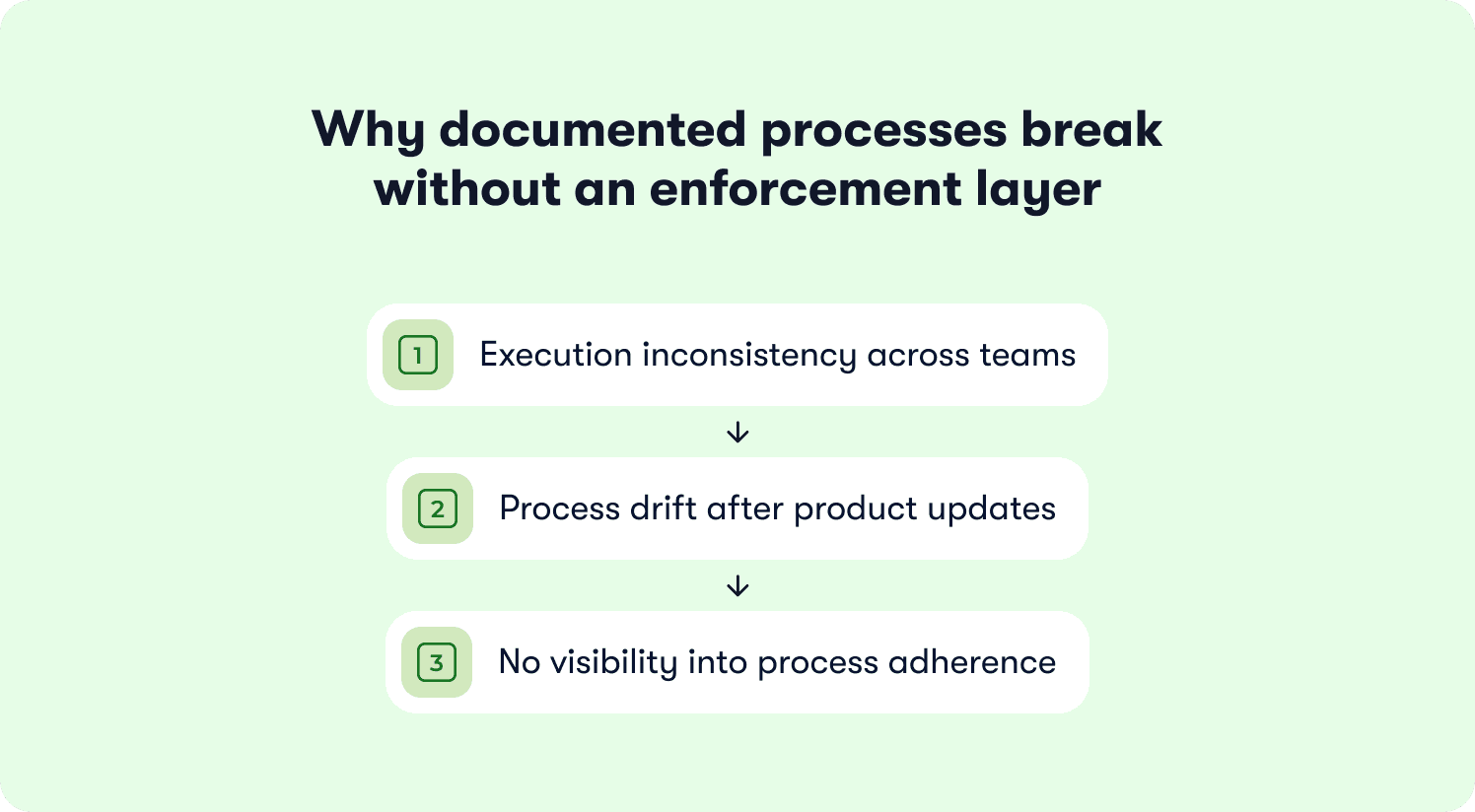
Three failure modes occur consistently when the enforcement layer is absent.
Execution inconsistency across teams
Different product managers interpret the documented standard differently. One team configures a five-step onboarding sequence. Another delivers the same stages across eight steps with different trigger conditions. The standard exists on paper. The user experience it produces varies by team.
The Director cannot resolve this through better documentation. Clearer language in the process document still requires individual interpretation at the point of configuration. Consistency requires the standard to be delivered by the product itself, not read from a handbook and applied by a practitioner.
Process drift after product updates
Every feature change creates a gap between the documented standard and the live onboarding experience. Without an enforcement layer built into the product, that gap goes undetected. The Director discovers the divergence when a support spike appears or when activation rate drops across a specific cohort. By then the process document and the product experience have been misaligned for weeks.
Data from Jimo's analysis of 1,025 product tours in early 2026 found that the average tour completion rate sits at 27%, with a median of 15%. One of the primary drivers of low completion is sequence logic that has drifted out of alignment with how the product actually works. Users encounter steps that reference features or flows that have changed, and they abandon. The process document said one thing. The product delivered another.
No visibility into process adherence
Without an enforcement layer, the Director has no mechanism for knowing whether the documented standard is being followed across teams. Auditing by anecdote, such as asking team members whether they followed the process, is not a scalable visibility model.
Actionable reports and the Success Tracker provide the visibility layer that makes process adherence measurable without manual review cycles. They surface which onboarding flows are performing against the defined activation milestone, where users are dropping off relative to the specified sequence, and which friction signals are being routed correctly. Without them, the Director is managing consistency from a position of structural blindness.
How to build a SaaS customer onboarding process that enforces itself
Moving the process standard from a document into the product is a Director-level configuration decision, not a practitioner task. The question is not how to build a guided tour or design a survey: those decisions belong to the teams executing the process. The question is which configuration choices the Director makes once, and what cross-team consistency those choices enforce automatically without ongoing manual oversight.
Three configuration decisions build the enforcement layer:
Configure guided flows as the process delivery mechanism: Guided flows are not just execution tools. When configured correctly at the Director level, they become the mechanism through which the process standard reaches every user consistently, regardless of which team is responsible for that onboarding instance.
Configuration decision: Which onboarding flows are covered by the documented standard, and which product experiences deliver each stage of that standard to users consistently across teams.
Accountability output: Every user who enters onboarding encounters the same sequence and the same activation milestone trigger, regardless of which team configured their account or which product manager is on duty.
For execution detail on how guided flows are built and optimised, see guided onboarding and interactive onboarding strategies. The Director's configuration decision is upstream of those choices: which flows the standard must cover, and that the standard is delivered through the product rather than through team coordination.
Jimo embeds the process standard into onboarding tactics and product tours so the configuration is done once and delivers consistently without requiring team alignment at every onboarding instance.
Configure behavior-triggered sequencing as the enforcement logic
A documented sequence that relies on team members manually advancing users through onboarding stages is not an enforced standard. It is a set of instructions that may or may not be followed. Behavior-triggered sequencing replaces that dependency by making the product itself responsible for advancing the process based on what users actually do.
Configuration decision. Which user actions advance the sequence, which trigger a re-engagement step, and which signal that an onboarding stage is complete for process adherence reporting purposes.
Accountability output. The process enforces its own sequence based on what users actually do inside the product, not on individual team members remembering to send the next resource or manually advance the onboarding stage.
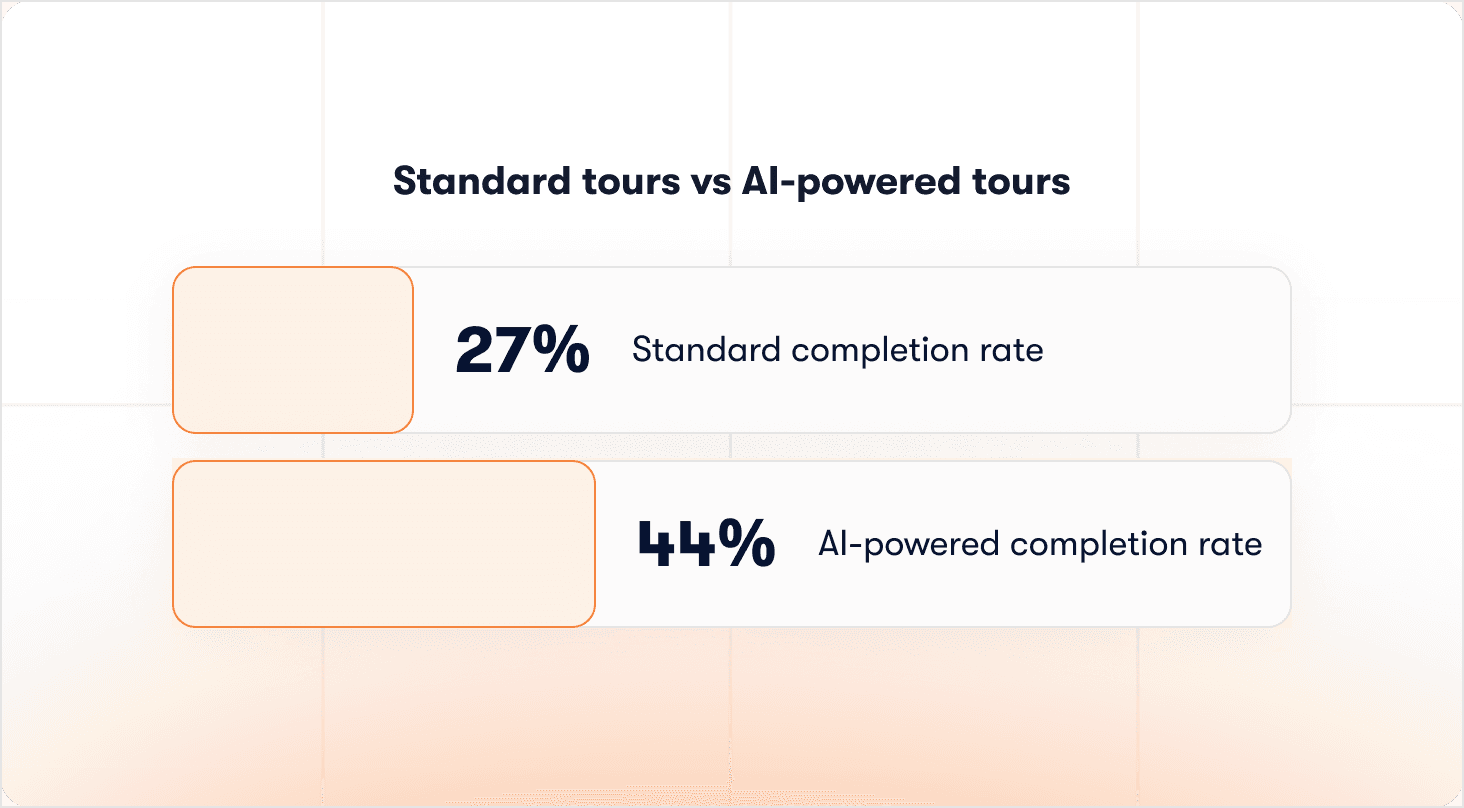
Data from Jimo's analysis of 1,025 product tours in early 2026 found that AI-powered interactive tours achieve 44% completion compared to a 27% average for standard tours. The completion gap between standard and behavior-triggered delivery is not a design problem. It is a configuration problem: sequences that advance based on real user actions produce measurably better outcomes than sequences that advance on a timer or a manual trigger.
Configure the feedback mechanism as part of the process, not around it
Most organizations treat feedback collection as a programme that runs alongside onboarding rather than as a component of the process standard itself. That separation is where visibility breaks down. When feedback is built into the process as a specified configuration decision, the Director receives process performance data automatically rather than waiting for a manual review cycle to surface it.
Configuration decision. At which onboarding milestones in-app surveys fire, what signal they are designed to capture, and where that signal is routed for process review at Director level.
Accountability output. The Director receives a continuous stream of process performance data without requiring manual review cycles, team-by-team audits, or anecdotal reporting from individual product managers.
This configuration decision produces two outputs simultaneously. It gives the Director visibility into where the process is working and where it is not. And it gives the product the signal it needs to route friction events back into the process improvement cycle automatically. For execution detail on survey design and response routing, see how to implement user feedback into product development.
Jimo connects in-app survey responses directly to process adherence data, so the Director can see in a single view which onboarding stages are generating friction signals, which are routing those signals correctly, and which are producing the behavioral outcomes the process standard was designed to deliver. The feedback mechanism is not a separate programme sitting alongside the onboarding process. It is the component that tells the Director whether the process is working and where it needs to be updated, without requiring a manual audit cycle to surface that information.
What a documented SaaS customer onboarding process looks like in practice
Consider a Director of Product Management at a B2B SaaS company: 150 employees, Series B, hybrid GTM motion, three distinct product lines each with a separate onboarding path. Activation rate variance across the three lines is significant and growing. The cause is not product quality.
It is execution inconsistency: each product line's onboarding is configured differently by different product managers, none of whom are working from a shared, enforceable standard.
The Director commissions a documented process standard. It specifies three things:
The activation milestone for each product line, stated as a binary auditable event that every team can verify without interpretation
The sequence conditions under which each onboarding stage advances, configured in the product rather than described in a handbook
The friction monitoring protocol, specifying which signals are captured at onboarding completion and where they are routed automatically
Three months after Jimo is used to embed the standard into the product flows across all three lines, activation rate variance across the product lines compresses measurably. The Director reviews process adherence through actionable reports without scheduling team-by-team reviews.
When a feature update in one product line creates a sequence misalignment, the friction signal surfaces in the weekly report before a support spike confirms it.
Zenchef applied a comparable approach under Florian Labadens, SVP Product: onboarding time was cut in half, support tickets dropped, and every tracked metric improved after the onboarding process was standardised and enforced through Jimo's guided tours and Success Tracker. See the full story in Jimo customer stories.
The ILG shift: from process document to product standard
In a product-led growth (PLG) model, the onboarding process standard is a document. It depends on team members reading it, interpreting it correctly, and applying it consistently across every onboarding instance. The document is the standard. The team is the enforcement mechanism. This works at a small scale with experienced practitioners who share a common understanding of what the process requires. It does not scale across teams, product lines, rapid hiring cycles, or organisations where onboarding accountability is distributed across multiple product managers with different levels of experience.
In an Intelligence-Led Growth (ILG) model, the process standard lives inside the product. It enforces itself through behaviorally triggered flows that advance based on what users actually do, adaptive sequences that adjust to individual user behavior without requiring practitioner intervention, and feedback mechanisms that route process performance signal back to the Director automatically. The product is the enforcement mechanism. The document becomes the specification that the product configuration is built from, not the delivery mechanism itself.
For someone accountable for onboarding consistency at scale, this distinction changes the nature of the role in three specific ways:
From maintaining to configuring. The Director's job shifts from keeping a process document current to specifying the configuration decisions that the product enforces. When a feature changes, the update happens in the product configuration, not in a handbook that practitioners may or may not have read.
From auditing to monitoring. Manual team-by-team audits of process adherence are replaced by process performance data surfaced automatically through actionable reporting. The Director monitors rather than investigates.
From coordinating to scaling. Onboarding consistency no longer depends on the Director coordinating across teams to ensure the standard is applied uniformly. The product delivers the standard. New teams, new product lines, and new customer segments inherit the configuration rather than rebuilding the process from scratch.
Jimo embeds the onboarding process standard directly into product flows, enforces sequence logic through behavior-triggered guidance, and surfaces process adherence data through the Success Tracker and actionable reports. The Director configures the standard once. The product delivers it continuously.
For the downstream strategies that a consistently enforced onboarding standard enables, see SaaS onboarding strategy and increase product adoption.
Building a SaaS customer onboarding process that scales
The activation problem in most B2B SaaS organisations is not a product problem or a team quality problem. It is a standards problem. The average SaaS activation rate of 36% does not improve through better execution of an undocumented process. It improves when the process standard is specific enough to be auditable, embedded in the product so it is enforced consistently, and connected to a feedback mechanism that tells the Director when the standard needs to be updated.
Three things a scalable SaaS customer onboarding process requires that documentation alone cannot provide:
A defined activation milestone stated as a binary, auditable event that every team and every product flow is built around, so the Director has a consistent baseline to measure against across the organization
An enforcement layer embedded in the product that delivers the standard to every user consistently, without depending on individual practitioner judgment at the point of configuration
A feedback mechanism that routes process performance signal back to the Director automatically, so the standard can be updated in the product when it needs to change rather than in a document that practitioners may not have access to or read
When all three are in place, the process does not depend on the Director to maintain its own consistency. New teams inherit the configuration. New product lines are built from the same specification. New customer segments get the same auditable standard applied to a different activation milestone. The Director scales the process without scaling the oversight burden.
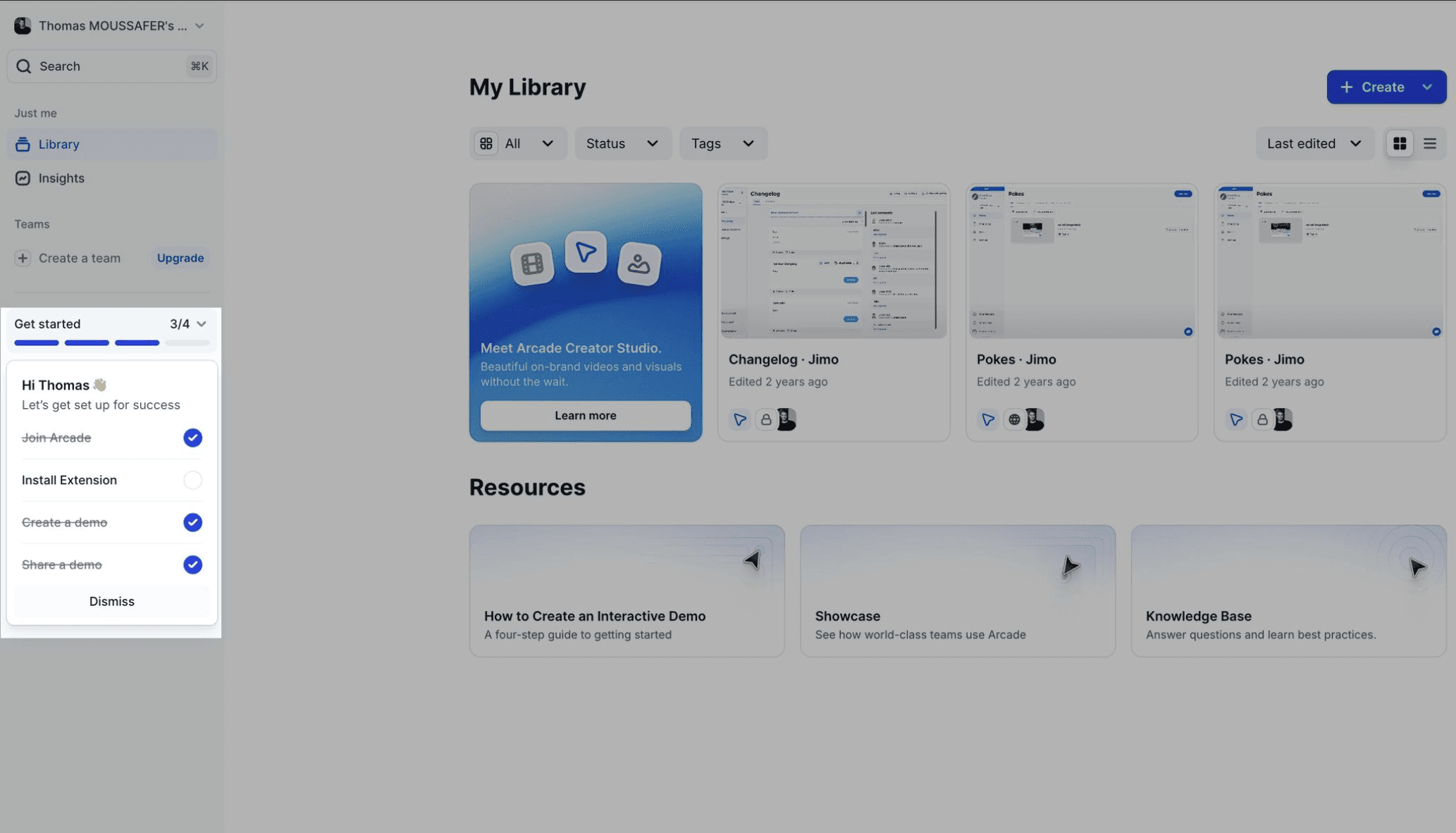
Jimo documents and enforces the SaaS customer onboarding process directly inside the product, embedding the standard into onboarding flows and surfacing process adherence data automatically. Book a demo to see how the enforcement layer works in practice.
FAQs
What is a SaaS customer onboarding process and why does it matter?
A SaaS customer onboarding process is the structured sequence of steps that guides new users from account setup through to their first experience of meaningful product value. It covers everything from the initial signup process and welcome experience through to feature discovery, user engagement milestones, and the activation event that predicts long-term retention. For SaaS businesses, the onboarding process is the highest-leverage stage in the entire customer journey: users who reach their activation milestone are significantly more likely to become active users, reduce customer support ticket volume, and convert from trial to paid. Users who do not reach it churn quietly, often without telling the customer success team why. The average SaaS activation rate sits at 36%, with a median of 30%, across a benchmarking study of more than 500 products. For most organisations, improving that number starts with standardising the onboarding process, not redesigning the product.
What should a SaaS onboarding checklist include?
A SaaS onboarding checklist is most useful when it is built backward from the activation milestone rather than forward from the signup process. The items that belong on it are the ones a user must complete to reach their first value moment, not every feature the product offers. For most B2B SaaS products, a well-structured onboarding checklist covers: account setup and initial configuration, connection of the user's existing data or workflows, completion of the first meaningful action inside the core feature, and a confirmation that the user has received enough in-app messaging and contextual guidance to navigate the product independently. The checklist is an operational tool for practitioners. It is not a substitute for a documented process standard that specifies how the checklist is delivered, under what conditions each item is triggered, and how completion is verified across teams.
What metrics should product teams use to measure SaaS onboarding success?
The most reliable customer onboarding metrics are behavioral rather than attitudinal. Customer satisfaction scores and survey responses tell you how users feel at a point in time. Behavioral metrics tell you whether the onboarding process is actually working. The four metrics that give Directors the clearest picture of onboarding performance are: activation rate, which measures the percentage of new users who complete the defined activation event; time-to-value, which measures how long it takes users to reach that event; Day 7 and Day 30 retention, which measure whether users who activated are returning; and customer support ticket volume generated during the onboarding journey, which is one of the most direct signals of user friction in the process. A well-enforced onboarding process should move all four metrics in the same direction simultaneously. If activation rate improves but Day 30 retention does not, the activation milestone is likely defined too early in the customer journey.
What is the difference between personalized onboarding and a standardised onboarding process?
Personalized onboarding and a standardised process are not mutually exclusive. A standardised process defines what must happen for every user: the activation milestone, the sequence conditions, the friction monitoring protocol, and the enforcement layer. Personalized onboarding determines how those elements are delivered to different user segments. User segmentation allows product teams to configure different onboarding flows for different roles, company sizes, or use cases, while still enforcing the same underlying process standard across all of them. The risk of treating personalization and standardization as opposites is that teams end up with fully bespoke onboarding flows for every segment, each configured differently, none of them auditable against a shared standard. The Director ends up managing multiple undocumented processes rather than one documented standard with configurable delivery paths.
How does a customer success team fit into a product-led SaaS onboarding process?
In a product-led onboarding model, the customer success team's role shifts from delivering the onboarding process to monitoring it and intervening at specific trigger points. When the onboarding process is enforced inside the product through guided flows and behavior-triggered sequencing, the customer success manager does not need to manually walk users through each stage. They monitor onboarding metrics, identify users who are not progressing toward the activation milestone within the expected timeframe, and intervene with direct outreach or additional support at the moments where in-product guidance has not been sufficient. This model reduces the volume of routine onboarding activity handled by the customer success team and concentrates their effort on the users most at risk of churning before they complete the onboarding journey. The result is a more scalable onboarding program that does not require the customer success team to grow proportionally with the user base.
What onboarding tools do SaaS product teams typically use to enforce process standards?
The most effective onboarding tools for enforcing process standards are those that embed the standard into the product experience rather than sitting alongside it as a separate system. Product tour tools, in-app messaging platforms, and contextual guidance systems allow Directors to configure the onboarding sequence inside the product so users encounter the standard automatically rather than being directed to an external knowledge base or a customer portal. The key capability to look for is behavior-triggered delivery: tools that advance the onboarding sequence based on what users actually do, rather than on a timer or a manual trigger from the customer success team.
How do you reduce customer churn through a better SaaS onboarding process?
Customer churn that originates in the onboarding journey is almost always traceable to one of three causes: users did not reach the activation milestone, users reached it but were not guided to the features that deliver ongoing value, or users encountered friction during account setup that was never resolved. A documented onboarding process that specifies the activation milestone as a binary auditable event, enforces the sequence through the product rather than through team coordination, and routes friction signals back to the Director automatically addresses all three causes systematically rather than reactively. The compounding benefit of getting this right extends beyond churn reduction: users who complete a successful onboarding journey generate fewer customer support tickets, require less customer success intervention during renewal, and are more likely to become loyal customers who expand their usage over time.