TL;DR
User activation is not signup, not tour completion, not checklist completion. It's the specific behavior that predicts whether a new user sticks around, and most teams either don't define it clearly or track the wrong proxy for it entirely. Industry benchmarks suggest activation and revenue move together closely: FairMarkit found that a 25% increase in activation rate was tied to a 34% increase in revenue. This article defines activation correctly, makes the case for why it deserves attention beyond "improve onboarding," and lays out the four strategic levers available to you.
Your signup numbers look healthy. Your activation numbers don't, and "improve onboarding" isn't specific enough to act on. You need to know what you're actually trying to move, why it matters enough to prioritize, and where to start. This article gives you a clear definition of user activation, the revenue case for treating it as a priority, and the four strategic levers you have to actually move it.
What User Activation Actually Means (and What It Isn't)
User activation is the specific behavior that predicts a new user will stick around. Most teams get this definition wrong, not because they don't care about it, but because they default to measuring whatever's easiest to track instead of what actually predicts retention.
Here's what activation isn't:
Signup. A user creating an account measures curiosity, not value delivered. Signups tell you your marketing worked. They tell you nothing about whether the product did what it promised.
Tour completion. A user clicking through every step of a product tour measures whether they followed instructions, not whether they understood or experienced anything real.
Checklist completion. Checking every box on an onboarding checklist measures compliance with a sequence you designed, not whether that sequence actually got the user to value.
Time spent in-app. Session length is a lagging signal at best. A confused user poking around looking for a feature isn't more activated than one who found it in thirty seconds.
None of these are wrong to track. They're just not activation, and treating them as a substitute is how teams end up optimizing a completion rate that climbs every quarter while the retention curve underneath it doesn't move at all.
The classic examples make the real distinction concrete. Slack didn't define activation as account creation. They defined it as a team sending a set number of messages, the point where the product's core value, real-time team communication, actually became visible to the people using it. Dropbox didn't define it as signing up for storage. They defined it as a user saving their first file, the exact moment the product started doing the one thing it exists to do.
Your activation event is specific to your own product, but the underlying principle transfers directly: it's the key action that reliably separates users who go on to become engaged, retained customers from users who sign up and quietly disappear a few weeks later. Everything else, the tour, the checklist, the welcome email sequence, exists in service of getting a user to that moment faster. None of it is the moment itself, and confusing the two is the single most common mistake in how teams approach their onboarding process.
Why Time-to-Aha-Moment Is a Revenue Problem, Not a UX Problem
It's tempting to file activation under "onboarding polish," something worth improving when there's time, not something that belongs on a roadmap with real revenue attached to it. The data doesn't support that framing, and treating activation as a UX nice-to-have is usually where teams undersell its actual importance to leadership.
Industry benchmarks suggest the relationship between activation and revenue is direct and significant. FairMarkit's data showed that a 25% increase in activation rate correlated with a 34% increase in revenue, a ratio that makes the case on its own: activation isn't a soft metric sitting next to the real ones. It's upstream of the real ones.
The mechanism is straightforward once you see it laid out:
A user who never reaches your product's core value doesn't become a retained customer
A user who isn't retained doesn't expand their usage or upgrade to premium features
A customer who never experiences real value doesn't renew without a fight, and doesn't become a reference customer either
Every dollar of expansion revenue, every renewal, every case study you'll eventually want to write, starts downstream of a user reaching that first real value point
Push activation up, and you're not just improving a UX metric buried in a product dashboard. You're widening the top of the funnel that your entire revenue model depends on, from initial conversion through long-term customer loyalty. This is why time-to-value deserves a place in the same conversation as pipeline and retention, reviewed by leadership, not a separate conversation reserved for product teams alone.
The Four Strategic Levers for Improving Activation
There are four strategic levers available to you here, and it's worth staying at this level before diving into tactics.
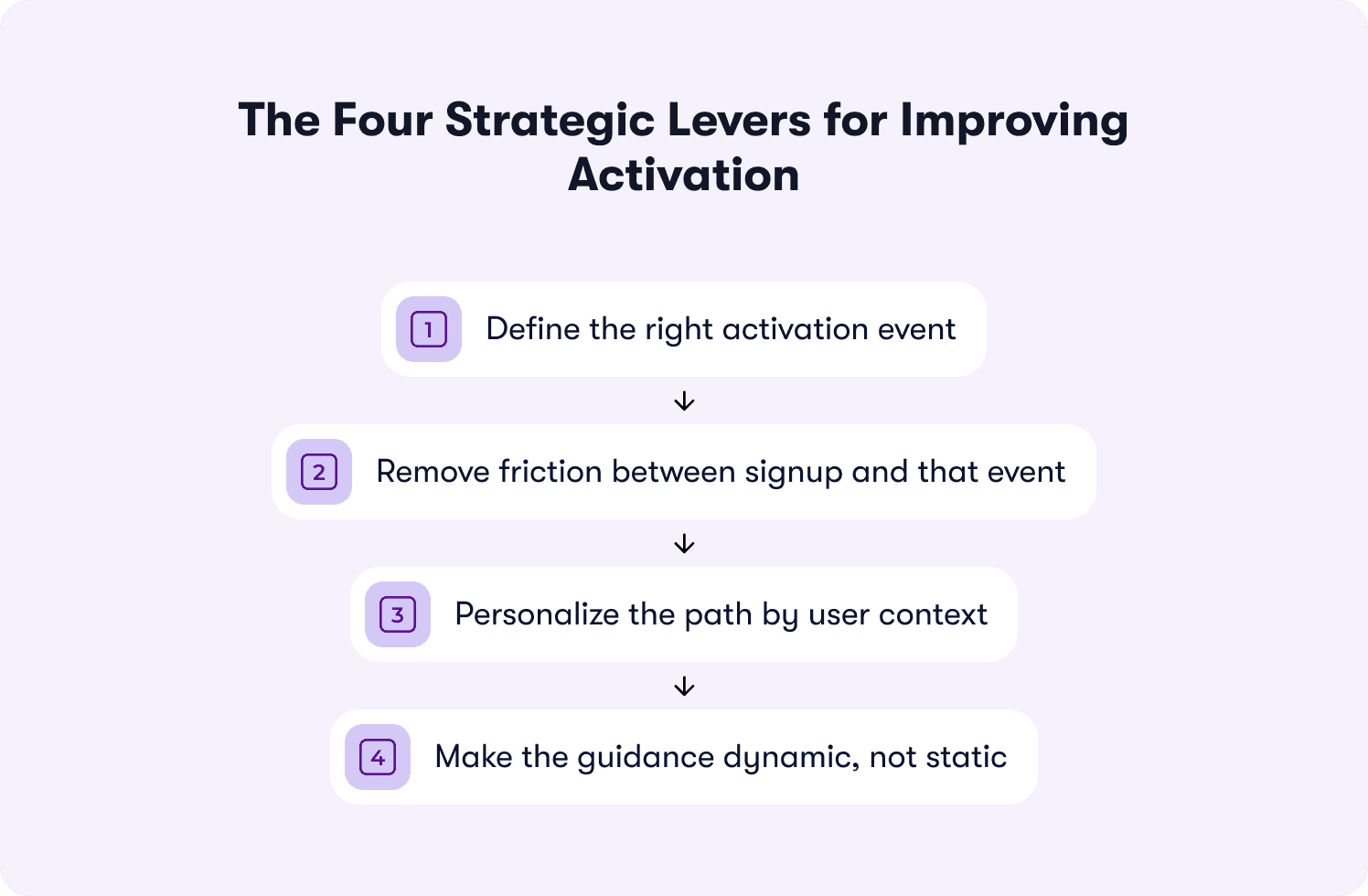
Get the category wrong, and no amount of tactical execution inside it will move the number you're actually trying to move.
Lever | What it addresses | Where to go deeper |
Define the right activation event | What you're actually optimizing for | This section |
Remove friction between signup and that event | Where users drop off before reaching value | |
Personalize the path by user context | Why one flow doesn't fit every user | |
Make the guidance dynamic, not static | Why fixed sequences underperform real-time guidance |
Define the right activation event
Before you can improve activation, you need to know what you're actually optimizing for, and that means identifying the single behavior that predicts retention, not a feature tour or a signup form. Get this wrong and you can execute flawlessly against the wrong target: a beautifully polished checklist that drives completion rates up while your actual retention curve doesn't move at all.
This is a data exercise as much as a product one. Look at your existing customer base, segment users by whether they stuck around, and find the early behavior that reliably separates the two groups. That behavior, not a milestone you picked because it felt significant, is your activation event. A few practical starting points:
Pull a cohort of users from six to twelve months ago and split them into retained versus churned groups
Compare early-week behavior between the two groups and look for the action that shows up almost universally in the retained group and rarely in the churned one
Resist the urge to pick an activation event just because it's easy to instrument. The right one is the one the data actually supports, not the one that's convenient to track
Remove friction between signup and that event
Once you know the event, the next lever is the path to it: every step, click, and decision point standing between a new signup and that moment. Each one is a place a user can drop off before ever reaching real value, and the cumulative effect of several small friction points is often bigger than any single obvious one.
This is where most of the tactical work lives, and it's also exactly where this piece stops going deep. Mapping every friction point in your activation funnel and fixing it systematically, including how to prioritize which friction points to tackle first, is covered step by step in the full tactical playbook, which is worth reading once you've got your activation event defined and you're ready to execute against it.
Personalize the path by user context
Not every user needs the same path to your activation event. User context, someone's role, their specific use case, their existing familiarity with similar products, changes what's actually standing in their way. Guidance built for a generic user persona misses the friction specific to the actual person in front of it, which means a single one-size-fits-all flow will always underperform for at least some meaningful share of your user segments.
Jimo's approach to onboarding personalization covers this mechanism in full: how AI-based onboarding personalization works.
Make the guidance dynamic, not static
A static onboarding flow shows the same steps to every user, in the same order, regardless of what that user is actually doing in the product. Dynamic guidance responds to real user behavior data, adjusting based on where someone's actually stalling rather than marching them through a fixed sequence they may not need.
Jimo guides users to their activation moment dynamically, adapting to behavior in real time rather than relying on a one-size-fits-all sequence. The mechanism behind this is covered in depth here: how AI-powered onboarding adapts to users.
User Activation Metrics That Actually Matter
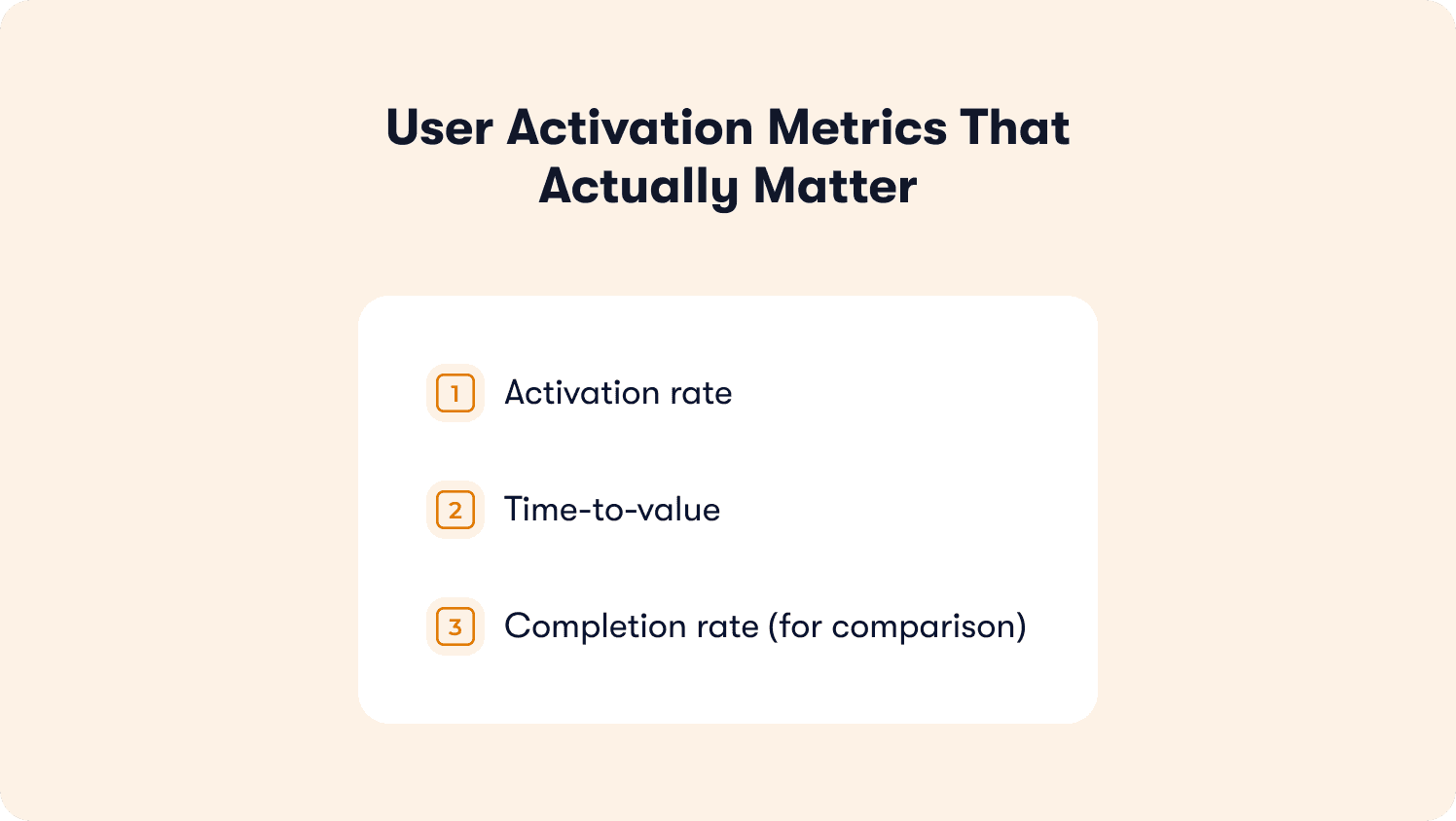
Once your activation event is defined, three metrics tell you whether your activation strategy is actually working:
Metric | What it measures | Why it matters |
Activation rate | The percentage of new users who reach your defined activation event | The core number your strategic levers are trying to move |
Time-to-value | How long it takes a user to go from signup to that event | Speed matters as much as whether users eventually get there at all |
Completion rate (for comparison) | The percentage of users who finish onboarding steps like a tour or checklist | Useful context, but not a substitute for activation rate, since completion and activation can move independently |
A good user activation rate varies by product complexity and pricing model, so treat any single industry benchmark cautiously. What matters more than hitting an average is whether your own activation rate is moving in the right direction over time, and whether time-to-value is shrinking as you remove friction from the activation flow.
This is a definitional overview, not a full measurement framework. For the deeper build, both product adoption strategy and our dedicated guide on ways to measure user onboarding success cover instrumentation, segmentation by acquisition channel, and ongoing tracking in the depth this piece intentionally doesn't.
Where to Start If Activation Hasn't Been a Deliberate Focus Yet
If activation hasn't been a deliberate focus for your team, don't try to fix everything at once. Pick the single highest-drop-off point in your current funnel, the step where you lose the most users before they reach your activation event, and start there.
A simple way to find that point:
Map your current onboarding flow from signup through your defined (or best-guess) activation event
Pull drop-off data at each step, looking for the single largest cliff, not the sum of several small ones
Ask why users are dropping there specifically: confusion, missing context, a technical blocker, or simply not seeing why the next step matters
Fix that one point before moving to the next
That one point of intervention will teach you more about your actual activation funnel than a broad initiative touching five things at once. Fix it, measure the impact on activation rate and time-to-value, and use what you learn to decide where to focus next. This iterative process, one fix, one measurement, one decision, compounds faster than trying to overhaul the entire activation journey in a single sprint.
📖 Ready to go deeper? Our 19 Tactics to Improve User Activation covers the specific plays, in order of impact.
Activation Is the Lever, Not the Afterthought
Signups tell you people are curious. Activation tells you whether your product actually delivered on that curiosity. If you're optimizing for the first number and not the second, you're measuring interest, not the thing that actually predicts revenue.
For a product manager weighing where to invest next quarter, activation is one of the few levers that touches retention, expansion, and revenue at the same time, which makes it a harder case to deprioritize once the connection is actually visible to the people signing off on roadmap decisions. Your product doesn't just sell itself, it activates itself, guiding users to their core value moment dynamically instead of hoping a static flow gets them there eventually.
Curious to know how a new approach and platform can improve your activation funnel. Book a demo with Jimo, or start with the complete tactical playbook if you're still mapping your own activation event.
FAQs
What is user activation in SaaS?
User activation is the specific behavior a new user completes that predicts they'll stick around and become a retained customer. It's distinct from signup, which only measures interest, and distinct from onboarding completion, which measures whether someone finished a flow, not whether they reached real value. A good activation event is specific to your product's core functionality.
What's the difference between user activation and onboarding?
Onboarding is the process, the flow, tutorials, and guidance that walks a new user through your product. Activation is the outcome, the specific moment a user experiences real value for the first time. Onboarding exists to get users to activation faster; it's the means, not the end. A user can finish onboarding without ever activating.
What are good user activation metrics to track?
Activation rate, the percentage of new users who reach your defined activation event, and time-to-value, how long that takes, are the two core metrics. Completion rate is worth tracking for context, but it measures whether users finished onboarding steps, not whether they reached actual product value, so it shouldn't be treated as a substitute for activation rate.
How is new user activation different from ongoing feature adoption?
New user activation is about a first-time behavior, the initial moment a new signup reaches your product's core value. Feature adoption is an ongoing measure of whether existing customers are using more of what your product offers over time, often tied to premium features or advanced functionality. Activation happens once, early. Adoption is continuous, across a customer's full lifecycle. For the tactics that drive that ongoing adoption, see how to increase product adoption.
What's a realistic activation rate benchmark for a B2B SaaS product?
This varies significantly by product complexity, pricing model, and user segment, so a single benchmark number is less useful than tracking your own rate's trajectory. A product with a straightforward core action will typically see a higher activation rate than one requiring a multi-step setup process. Focus on whether your activation rate is improving over time rather than chasing an industry average that may not reflect your product's actual complexity.