TL;DR
Most "AI for product managers" content in 2026 is about AI tools for your own job: PRD copilots, roadmap prioritization, research synthesis. This isn't that. This is about what AI changes for the people using your product, not the people building it. The real shift is Intelligence-Led Growth (ILG): onboarding stops being a static sequence you launch once and becomes a system that reads each user individually, in real time, and adapts to them. That changes what your team owns, what you measure, and what "done" means for onboarding.
Search "AI for product managers" and you'll get a wall of copilots: tools that draft your PRDs, summarize your user interviews, prioritize your backlog. If that's what you came here for, this isn't that article. This is about the other half of the question nobody's answering clearly enough: what AI actually changes about the experience your users go through when they onboard and adopt your product, not the experience you go through building it.
That distinction matters more than it sounds like it should. Every product org has an AI line item on the 2026 roadmap now, and most of what gets written about AI in product management stops at that line item instead of what happens after it ships. Far fewer teams can say, specifically, what that line item is supposed to change for the person signing up for their product next Tuesday.
Here's why that gap is a CPO problem specifically, not only a product-team detail: Gartner projects more than 80% of enterprises will have deployed generative AI applications in production by 2026, up from under 5% in 2023.
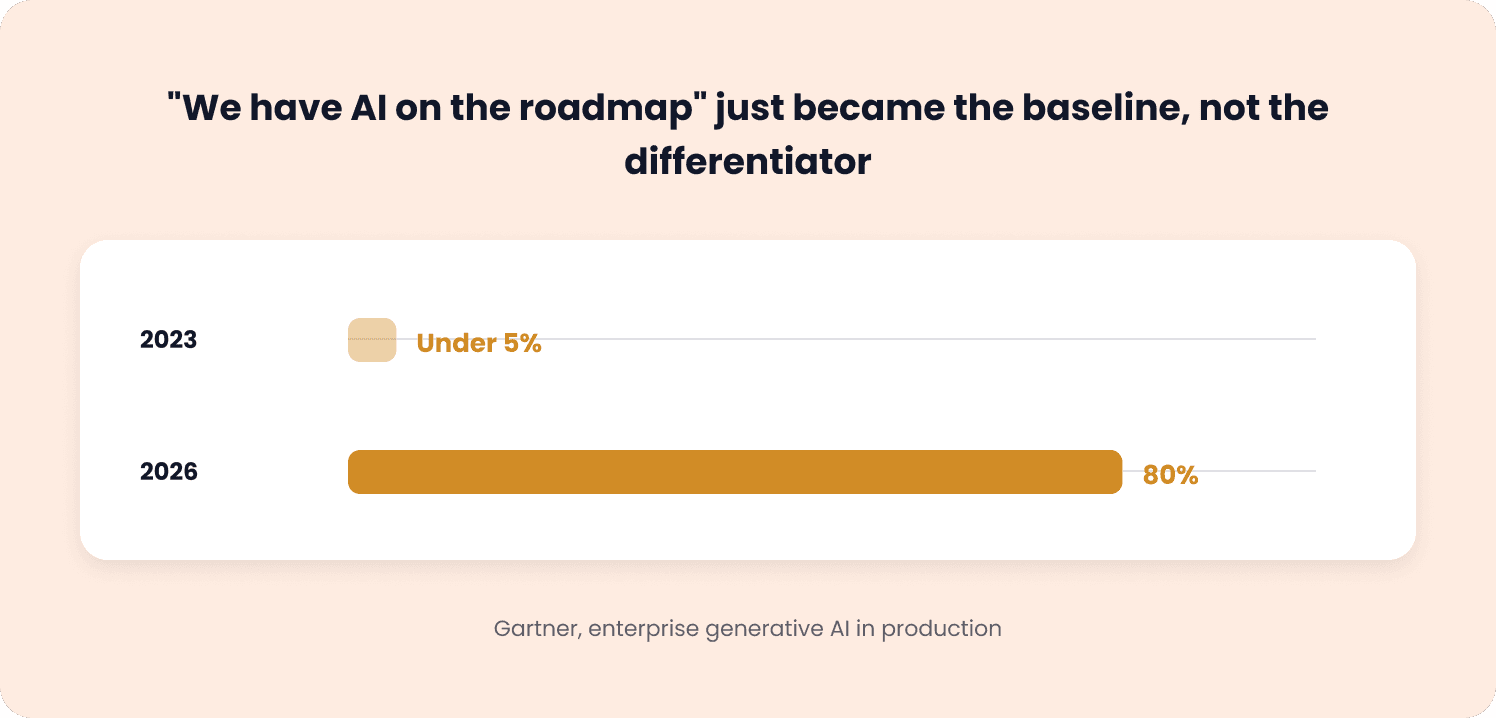
At that adoption level, "we have AI on the roadmap" stops being a differentiator a board wants to hear and starts being the baseline they assume. The question that follows isn't whether you have it, it's what it changed, and a CPO who can't answer that specifically for onboarding and activation is walking into a board conversation with a credibility gap, not only a missed opportunity.
What "bolting on AI" actually looks like
Walk through most 2026 product roadmaps and the AI entry usually resolves to one of three things:
A chatbot dropped into the help center
A "smart" onboarding checklist that's a static one with a new label
AI-generated tooltips that fire on a schedule instead of a trigger
None of these change the fundamental shape of onboarding. They're additions to a sequence that was already fixed before a single real user touched it.
The tell is simple: if your onboarding flow still looks the same for a solo user testing the product as it does for an admin rolling it out to forty teammates, adding an AI label to it hasn't changed anything structural. You've made the old thing sound newer. You haven't made it respond to anyone.
That's the pattern CPOs are running into when they say AI is everywhere on the roadmap but nothing about activation has moved. The AI is real. It's aimed at the wrong layer.
The real shift: from a sequence to a system that reads individuals
The actual change isn't a feature, it's a category. Jimo calls this Intelligence-Led Growth (ILG): a go-to-market and product strategy where AI-driven personalization replaces static onboarding and engagement flows as the primary way you activate, retain, and expand users. It builds on product-led growth, but it addresses something PLG alone can't fix: in a traditional PLG motion, onboarding flows are built for a persona, not a person.
Every user who signs up as "admin" or "solo user" sees the same sequence, regardless of what they actually do once they're in the product. Under ILG, the activation path adapts to the individual, based on what they explore, where they hesitate, and what they skip.
The gap this closes is not small. OpenView's Product Benchmarks research found that only 20–30% of new signups reach activation even at standout PLG companies, meaning the freelancer-or-admin mismatch described above isn't an edge case, it's most of your funnel. That has a direct organizational consequence most 2026 roadmap planning skips past: onboarding stops being something your team ships once and revisits quarterly, and becomes something your team owns continuously, the same way you'd own a live pricing page or a production API.
The question shifts from "did we launch the new onboarding flow" to "is the system still reading our users correctly this month," a genuinely different operating rhythm and a genuinely different thing to staff for.
We've written in detail about how adaptive AI onboarding actually reads and responds to behavioral signals, and separately about the ROI case for AI-based onboarding personalization once you're already running static, segment-based flows. This piece isn't trying to re-cover that ground. What's worth sitting with here is the org-level implication: if onboarding becomes a live system, "we shipped onboarding" stops being a real milestone.
There's no finish line to point to on a roadmap slide anymore, and that's an uncomfortable thing to explain to a board that's used to seeing launch dates.
Picture two versions of the same signup flow, both hitting the same two users: a solo freelancer testing the product on a Friday afternoon, and an IT admin rolling it out to a 40-person team on a Monday morning.
Static onboarding | ILG (adaptive) onboarding | |
Solo freelancer | Sees the same five-step checklist as everyone else; ignores step three because it doesn't apply to how they work | System notices step three was skipped and never nags about it again, since later behavior already shows they don't need it |
IT admin, 40-person rollout | Gets stuck on step four because it assumes permissions they don't have yet | System notices the stall on a permissions-dependent step and surfaces the specific unblocking action, before a support ticket gets filed |
Neither drop-off in the static version shows up as a bug. It shows up as a slow leak in your activation rate that nobody can point to a specific cause for. Nothing about the underlying product changes between the two columns above. What changes is that the guidance layer starts reading behavior instead of assuming a single path, and that's the entire difference between "AI-powered" as a label and AI-powered as something a CPO can actually point to in an activation curve.
The skepticism is fair, and worth answering directly
A CPO who's sat through three straight years of vendor decks claiming "AI-powered" everything has earned the right to be skeptical, and that skepticism is doing useful work, not getting in the way. The honest test isn't whether a vendor says the word AI. It's whether the guidance a user sees actually changes based on something that specific user did, or whether it was written once by a human and is now being delivered by a system that happens to also do other AI things elsewhere in the product.
A practical way to apply that test during evaluation: ask what happens when two users with identical signup attributes, same role, same company size, same plan, take different actions in their first session.
If the guidance they see next week is identical regardless of what they each did, the system is still fundamentally rule-based dressed in AI language, whatever the vendor calls it. If the guidance diverges based on their actual behavior, that's the real thing. It's a blunt test, and it's also the fastest way to cut through a sales deck.
This is also where the org-level shift from earlier connects back to evaluation criteria: a team that's already accepted onboarding is a live system, not a shipped project, tends to ask this question naturally, because "does it keep reading behavior correctly" is already how they think about the system day to day. A team still treating onboarding as a project asks "did we turn AI on," which is the wrong question and produces exactly the chatbot-bolted-onto-a-help-center outcome described earlier.
What this means for the next 12 months
If onboarding is becoming a live system rather than a shipped project, four things follow for how a product org should actually operate through 2026, on top of the general case for why increasing product adoption pays for itself:
Shift | What changes |
Ownership | Moves from whoever designed the flow to an owner who checks it the way an SRE checks uptime: is the system still reading behavior correctly, are the triggers still firing on the right signals, is anything drifting stale. Usually a product ops or growth function, not a one-time design project. |
The metric that matters | Completion rate on a fixed flow stops being meaningful, since there's no single flow left to complete. Trial-to-paid conversion, cohort-over-cohort, becomes the number that actually reflects whether the system is doing its job. |
Reporting cadence | "Did we launch it" stops working as a proxy for "is it working." A live system doesn't give you a launch date every quarter, so the reporting cadence has to change to match, or the team ends up optimizing for the wrong signal. |
Budget | Moves from a one-time build to infrastructure: a small, continuous line item on the roadmap, the way the pricing page gets budgeted, not a launch-and-move-on project cost. |
Skipping the ownership shift is the one most teams underestimate: a team that scopes ILG as a one-time build underfunds exactly the work the table above depends on.
What this looks like with real numbers behind it
None of this is theoretical for the companies already running Jimo in production:
Customer | Result |
Live, adaptive onboarding tour built in 90 minutes; 2,000 users in its first week; CSAT roughly doubled against their previous static flow | |
Onboarding time cut 53% after moving from a fixed sequence to one that adjusts based on account type and usage signals | |
3x lift in click-through rate on action-driving, behaviorally targeted in-product banners |
None of those numbers came from a chatbot bolted onto a help center. That's what real AI product adoption looks like: it comes from treating onboarding as a system that reads its users.
Back to the actual question
If you came here because "AI for product managers" sounded like the next tool to add to your own workflow, that tool exists and it's worth evaluating on its own terms. But the bigger 2026 decision for a CPO isn't which AI copilot to buy for your team.
It's whether your product's onboarding is still a thing you launch once, or whether you're ready to run it as a system that has to keep reading your users correctly every day it's live. That's the actual shift ILG describes as an operating discipline for product adoption, and everything else on the roadmap slide is downstream of that call.
If you want to see what an ILG-driven onboarding system looks like running on a real product, book a demo and we'll walk you through it with an invitation to try your free trial.
FAQs
What does AI for product managers mean in 2026, beyond AI tools for the PM's own job?
Most content under that search term covers tools for a PM's own workflow: PRD copilots, roadmap prioritization, research synthesis. The other half of the question, the one this article covers, is what AI changes about the experience the end user goes through when they onboard and adopt the product.
How is ILG different from standard product-led growth (PLG)?
In a traditional PLG motion, onboarding flows are built for a persona, admin or solo user, so everyone in that bucket sees the same sequence regardless of what they actually do. Under ILG, the activation path adapts based on what each individual explores, where they hesitate, and what they skip.
How do you tell if "AI-powered" onboarding is genuinely adaptive or a relabeled static flow?
Check what happens when two users with identical signup attributes take different actions in their first session. If the guidance they see next week is identical regardless of what they did, it's still a static, rule-based system dressed in AI language. If the guidance diverges based on actual behavior, it's the real thing.
Who should own an AI-driven onboarding system once it's live, and how should it be measured?
Ownership typically moves to a product ops or growth function, since a responsive system needs to be checked the way uptime is checked, not designed once and left alone. Completion rate on a fixed flow stops being a meaningful metric; trial-to-paid conversion, cohort-over-cohort, becomes the number that actually reflects whether the system is working.