TL;DR
A product qualified lead (PQL) is a user whose in-product behavior, not their engagement with marketing content, signals they're likely to convert or expand. Most teams already know the PQL definition. What they're missing is a validated, product-specific set of PQL scoring criteria, built from their own activation event and tested against their own historical conversions, not a generic trigger list copied from a blog post.
Sales teams chase marketing qualified leads because MQLs are what's in the pipeline report, not because they convert well. An MQL means someone downloaded a whitepaper or filled out a form: real interest, but interest in the content, not necessarily in buying. Sales ends up working a list sorted by engagement with marketing assets instead of a list sorted by who's actually ready to become a customer, and the close rate on that list shows it.
A product qualified lead is supposed to fix that by scoring readiness based on what someone actually does inside the product instead of what they clicked on beforehand. Most teams already know that much. What they don't have is a clean, defensible way to decide which specific behaviors count for their product, which is a different and much harder problem than knowing the term exists.
That gap matters more than it looks like it should for whoever owns the PLG motion. OpenView's Product Benchmarks research found that only 19% of sales-led SaaS companies and 45% of freemium companies had a formal PQL metric in place, even though most standout PLG companies do. This isn't a category most companies have solved, it's one the leaders have and most of the field hasn't. A CPO or VP PLG who ships a validated PQL definition isn't catching up to common practice, they're doing what the standouts do while most of the market is still behind, which is exactly why a generic trigger list earns so little trust from sales once it's handed over.
What "product-qualified" means, briefly
Jimo's own glossary defines a PQL as a user who has experienced meaningful value inside a product, typically through a free trial or freemium tier, and whose in-product behavior signals a high likelihood of converting to a paid customer. The distinguishing feature: a PQL is identified by what the user has done inside the product itself, not by engagement with marketing materials, which is the entire reason PQLs convert at meaningfully higher rates than MQLs.
That's the one-paragraph version, worth stating plainly once and moving past, the glossary entry linked above is the place for the fuller definition-and-comparison treatment. The PQL definition itself isn't where teams get stuck. Where they get stuck is the next step: turning that definition into a specific, validated set of criteria for their own product, which almost never looks the same from one product to the next.
The methodology: building PQL scoring criteria that actually hold up
Start from your activation event, not a generic action list. Every PQL framework needs a floor: the behavior that separates someone still evaluating the product from someone who's gotten real value out of it. That's the same activation event covered in what user activation actually predicts, and it should anchor your PQL criteria the same way it anchors your broader adoption metrics. If you haven't already defined that event clearly, PQL scoring is going to be built on sand, because everything downstream depends on being able to tell the difference between "signed up" and "actually got something out of it."
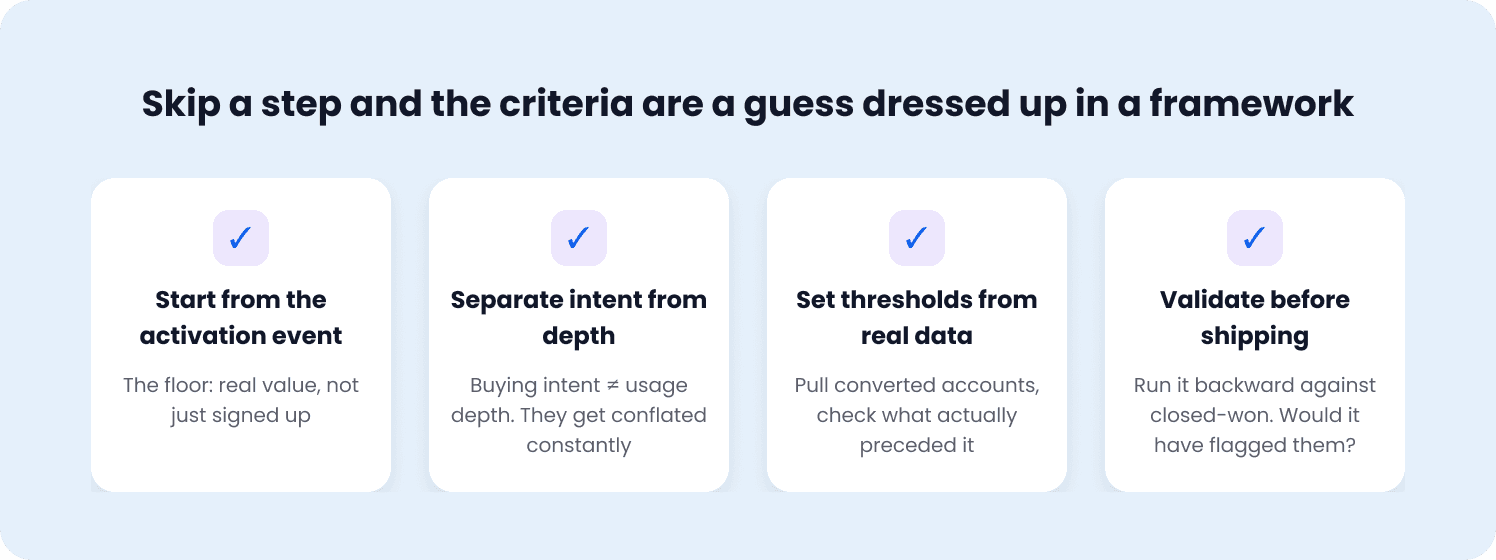
Separate buying-intent behaviors from usage-depth behaviors. These get conflated constantly, and it's the single biggest reason PQL definitions turn into noise. Usage depth tells you someone is engaged: they're logging in often, they've explored several features, the same depth-of-adoption signal that matters for retention more broadly. Buying intent tells you someone is bumping against the constraints of their current plan or is preparing to bring the product to more of their organization. A single power user who's used every feature in the free tier for six months is deeply engaged and may never convert. The more useful signal isn't any one generic trigger on its own, like inviting a teammate or hitting a usage threshold, those are the same examples every PQL explainer reaches for. It's the combination that turns out to be predictive for your specific product, which only shows up once you validate it.
Set thresholds from actual historical conversion data, not intuition. The core idea here: run a cohort analysis comparing users who converted against users who didn't, and flag behaviors that show up significantly more often in the converting group. Worth taking one step further before trusting the result: check how far in advance each behavior actually shows up, and rule out anything that also shows up almost as often in accounts that never converted. A behavior present in 80% of converted accounts but also in 75% of accounts that never converted isn't a useful signal, no matter how intuitive it sounds as buying intent. This is the step that separates a validated PQL from a guess dressed up in a framework.
Validate before you ship it to sales. Take your proposed criteria and run them backward against your last cohort of closed-won accounts: would this definition have flagged them, and roughly how many days before they actually converted? If the answer is "most of them, with a meaningful lead window," you have something sales can trust. If the answer is "about half, with wildly inconsistent timing," the criteria need another pass before anyone acts on them. Skipping this step is the most common reason PQL programs lose sales team buy-in within the first quarter: the list gets handed over unvalidated, sales works it, conversion doesn't match the promise, and the whole model gets quietly abandoned.
Scoring it on an actual product
Take a project-management SaaS product with a generous free tier. The team's first instinct is to score PQLs on total actions taken: tasks created, comments left, projects opened. It's an intuitive-sounding list, and it's also almost entirely usage-depth, not buying intent, so it produces a lead list that overlaps heavily with accounts that will happily use the free tier forever.

Running the validation step against the last two quarters of closed-won accounts turns up a tighter, less obvious pattern instead: converted accounts disproportionately created a second project and invited a teammate to it within the same seven-day window, a specific combination not captured by any single usage-depth metric on its own. Neither behavior alone was a strong predictor; a single-project team using the product solo converts at roughly the same low rate as a barely-engaged account. But the combination, a second project plus a teammate invited to it inside a week, showed up ahead of roughly two-thirds of the accounts that eventually converted, with a median lead time of eleven days before the deal closed. That's a validated, product-specific set of product qualified lead examples, not the generic "engaged user" list the team started with, and not something that would have been obvious without checking the criteria against real outcomes first.
PQL vs. MQL vs. SQL, in practice
The three don't compete, they hand off, and where a company sits on the PLG-to-SLG spectrum changes how much weight the handoff carries.
Signals | Tells you | |
MQL | Downloaded a whitepaper, filled out a form, attended a webinar | Someone is worth nurturing |
PQL | In-product behavior meets validated scoring criteria | Someone has shown product-level readiness worth a conversation |
SQL | A rep has confirmed budget, authority, and timeline | Someone is ready for a real sales process |
That's the short version of the distinction. What matters more for a PLG motion is where the handoff actually breaks: the breakdown most teams hit isn't a missing category, it's a vague or unvalidated PQL definition sitting between the two. Sales stops trusting the "qualified" label the first time a supposedly product-qualified account turns out to have no budget or no real buying process behind the account activity at all. Once that trust breaks, reps quietly go back to working whatever list marketing hands them instead, which is the exact problem the PQL was supposed to solve.
That trust, once lost, is expensive to rebuild, which is the real cost of skipping validation rather than a soft inconvenience. A rep who gets burned by three unqualified "PQLs" in a row stops opening the list at all, and no amount of re-explaining the scoring model after the fact wins that attention back quickly. It's worth protecting that trust deliberately: share the validation data itself with sales leadership when the criteria launch, not only the resulting list, so the first objection a skeptical rep raises has already been answered before they raise it.
Where PQL programs go wrong even after the definition is right
Two failure patterns show up repeatedly, even in teams that did the validation work correctly the first time.
Letting the definition go stale. A PQL definition validated against last year's conversion data reflects last year's product, last year's pricing tiers, and last year's onboarding flow. A new feature that becomes a strong intent signal six months from now won't show up in a definition nobody's revisited since launch. Treat PQL scoring criteria as something to re-validate on a fixed cadence, at minimum every couple of quarters or after any change to pricing or packaging, not as a one-time project with a start and end date.
Scoring individuals when the buying unit is an account. In most B2B products, especially ones sold to teams rather than individuals, the behavior that indicates readiness is distributed across several people: one person explores the advanced settings, another invites teammates, a third hits a usage cap. None of those three individuals looks product-qualified alone. Rolled up to the account level, using the same account-level segmentation that underlies most product-led growth motions, the pattern is obvious. Scoring only at the user level misses this entirely and under-counts real PQLs, particularly in products where the economic buyer and the day-to-day user are different people.
The behavioral lead scoring data layer this requires
None of the criteria-building above works without reliable behavioral event tracking and the ability to segment accounts by the specific actions that matter, not only aggregate usage. That's an infrastructure requirement more than a feature request: the events used as PQL signals need to be tracked consistently across the product, attributable to the right account and role, and available to segment on without an engineering request every time the criteria get revisited. Teams that treat this as a one-time export from an analytics tool tend to find their PQL definition goes stale within a couple of quarters, because the underlying event tracking wasn't built to be revisited and re-validated on an ongoing basis.
That's also where account-level rollup either gets solved or doesn't: it takes tracking that has a concept of "these people belong to the same buying unit" in the first place, not three disconnected user records with no way to tell they're related. Jimo tracks behavioral events at the user level with firmographic context (company, plan tier, role) attached to each one, which is the raw material account-level PQL scoring has to be built from. It's the same event layer behind the PQL rate metric in a full PLG dashboard, aimed here at building the definition rather than reporting it.
The list sales actually trusts
A product qualified lead is only as good as the validation behind it. Copying a generic PQL definition, or a generic list of "signals that indicate intent," produces a list that looks credible in a slide deck and falls apart the first time sales works it against real accounts. Building criteria from your own activation event, testing them against your own historical conversions, and revisiting them as the product changes is what turns "product-qualified" from a label sales has learned to discount into one they actually trust enough to prioritize.
FAQs
What is a product qualified lead (PQL)?
A PQL is a user who has experienced meaningful value inside a product, typically through a free trial or freemium tier, and whose in-product behavior signals a high likelihood of converting to a paid customer. The distinguishing feature is that a PQL is identified by what the user has done inside the product, not by engagement with marketing content.
How is a PQL different from an MQL or SQL?
An MQL tells marketing someone is worth nurturing, based on engagement with content like a whitepaper or webinar. A PQL tells sales someone has shown product-level readiness, based on in-product behavior. A sales qualified lead is what a PQL becomes once a rep has actually confirmed budget, authority, and timeline in a real conversation. The three hand off in sequence rather than compete.
What behaviors should count toward PQL scoring criteria?
Start from your product's activation event, then separate usage-depth behaviors (logging in often, exploring several features) from buying-intent behaviors (bumping against plan constraints, preparing to bring the product to more of the organization). A single generic trigger, like inviting a teammate or hitting a usage threshold, is rarely predictive on its own; a validated combination of behaviors specific to your product usually is.
How do you validate PQL criteria before handing them to sales?
Pull the accounts that converted over the last two or three quarters, check which candidate behaviors actually preceded their conversion and how far in advance, then run the proposed criteria backward against that cohort. If the definition would have flagged most of them with a meaningful lead window, it's ready for sales. If it only catches about half with inconsistent timing, it needs another pass first.
Why do PQL programs lose sales team trust, and how do you prevent it?
Trust breaks the first time a supposedly product-qualified account turns out to have no budget or real buying process behind it. Once that happens a few times, reps quietly stop working the list. Validating criteria against historical conversions before shipping them, and sharing that validation data with sales leadership up front, is what keeps the list credible.