TL;DR
PLG lets the product drive acquisition, conversion, and expansion with minimal sales involvement. SLG relies on a sales team to guide prospects through demos, negotiations, and close. In 2026, the most competitive SaaS companies run a hybrid motion: PLG to land efficiently, SLG to expand strategically. And on the horizon, agent-led growth is pushing free-to-paid conversion rates that traditional PLG cannot match. The deciding factor is not the model. It is whether your product delivers value fast enough to make self-serve adoption stick.
Your product isn't broken. Most companies are just approaching growth wrong.
Growth teams know the PLG theory. What they're wrestling with is execution: how do you convert free users into paying customers at scale, without a sales rep in every deal?
This guide covers the full PLG vs. sales-led growth (SLG) landscape: definitions, 2026 benchmarks, real-world examples, a cross-functional team playbook, and a decision framework. We've also added sections on in-product guidance and AI, because that's where most GTM motions are leaking right now.
What are product-led growth and sales-led growth?
Both terms describe how a company structures its entire go-to-market motion, from how it acquires customers to how it retains and expands them. The difference comes down to one question: who does the selling, the product or a person?
Product-led growth (PLG)
Product-led growth is a go-to-market (GTM) strategy where the product itself drives customer acquisition, conversion, and expansion. Users discover the product, experience its value through free trials or freemium tiers, and upgrade without a sales rep involved.
The core idea: the product communicates its own value. Users come for the product, stay for the outcomes, and pull their organizations in behind them.
Sales-led growth (SLG)
Sales-led growth relies on a structured sales process to acquire and retain customers. Reps identify prospects, run demos, negotiate deals, and manage relationships throughout the customer lifecycle.
SLG is the right motion when products are complex, buyers are risk-averse, or contract values justify the cost of high-touch selling. The key distinction: in SLG, the sales team communicates the product's value. The product doesn't speak for itself.
PLG vs. SLG: the key differences
Factor | Product-led growth | Sales-led growth |
Customer journey | Bottom-up: individuals adopt, then pull the org in | Top-down: decision-makers buy, then roll out to users |
Minutes to hours (self-serve activation) | Weeks to months (demos, negotiations, onboarding) | |
Acquisition cost | Lower CAC: the product does the selling | Higher CAC: sales salaries, tools, and cycles add up |
Revenue model | Freemium, usage-based, per-seat self-service | Custom pricing, annual contracts, enterprise agreements |
Scaling model | Revenue scales without linear headcount growth | Revenue growth requires proportional sales hiring |
Best for | Broad markets, intuitive products, under $100/user/month | Complex solutions, enterprise deals, over $10K ACV |
Primary KPIs | Activation rate, PQLs, time to value, NRR, viral coefficient | MQLs, SQLs, ACV, win rate, sales cycle length |
Viral potential | High: users naturally invite collaborators | Low: adoption is org-wide from the start |
Org culture | Product, data, and UX are the growth engine | Sales and marketing are the primary revenue engine |
2026 Benchmarks: what good looks like
Knowing your metrics matters less than knowing where they sit relative to peers. Here is the data for B2B SaaS in 2026. The NPS figure references the Net Promoter Score benchmark for product-led companies.
PLG benchmarks (2026) | SLG benchmarks (2026) |
Free-to-paid conversion: ~9% median | Customer engagement: 20% higher than PLG avg |
Median ACV: $25,000 | Typical ACV: $10K to $500K+ |
Average CAC: $8,000 | Sales cycle: 30 to 180 days (segment-dependent) |
Time to value: 18.3% faster than non-PLG peers | Win rate: 20 to 40% (top performers) |
NPS average: 40 | Customer LTV: higher with CS-led expansion |
Self-serve revenue tied to better unit economics | Implementation: weeks to months |
Real-world examples: how each model works in practice
Theory only takes you so far.
The companies below have built durable growth engines by committing fully to one model or the other. What makes them worth studying isn't their success, it's the specific mechanics that drove it.
PLG examples
Airtable
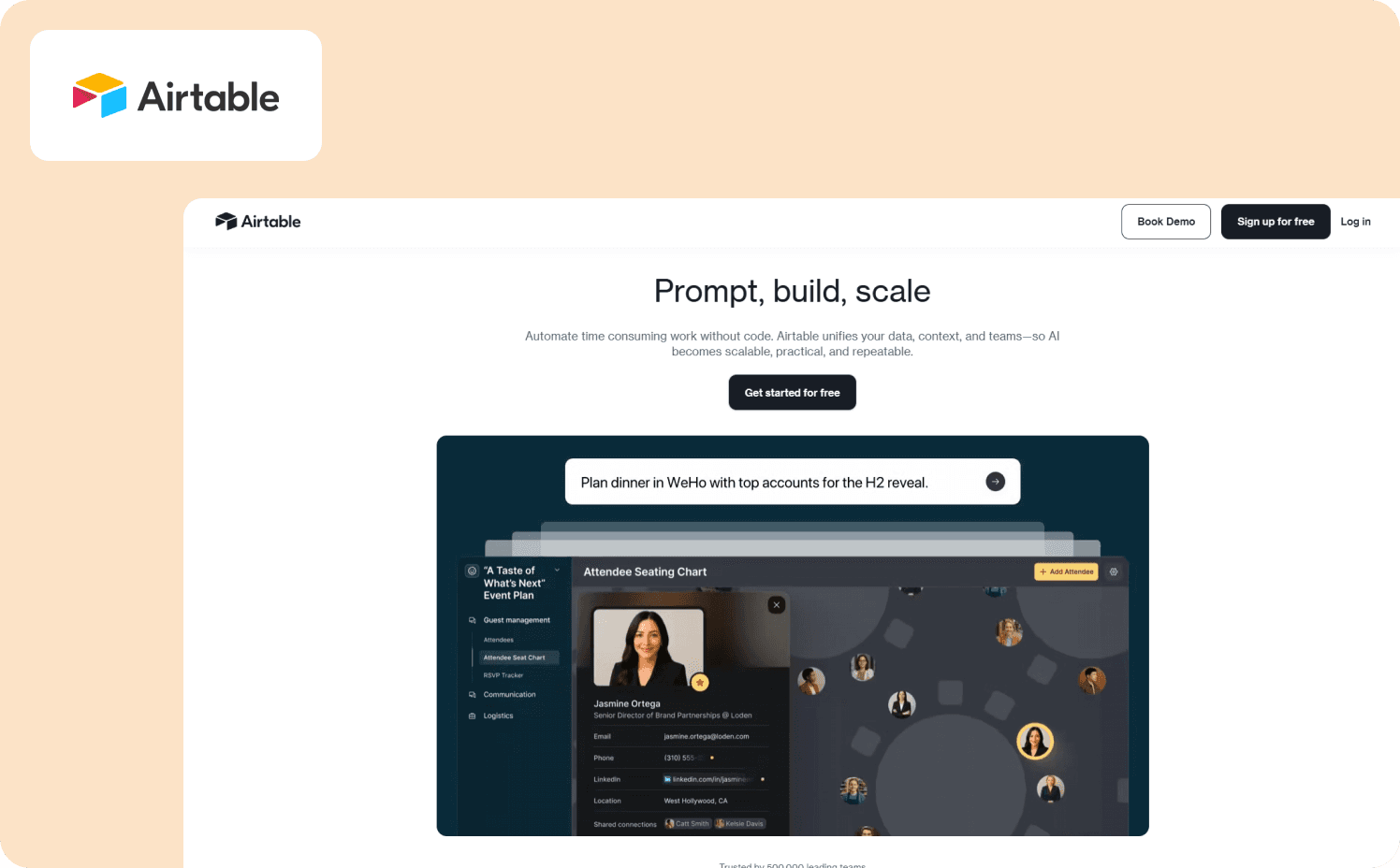
Airtable's formula comes down to two words: build and share. Users fill out a template, sync it with a database, and invite colleagues to collaborate. That collaboration mechanic is what created the virality to scale without a large sales team at the core. The solo-to-team conversion happens the moment a user shares a base. That single share triggers a collaborator invitation, turning a personal productivity tool into a team workspace and surfacing Airtable's first natural upgrade prompt.
Zapier
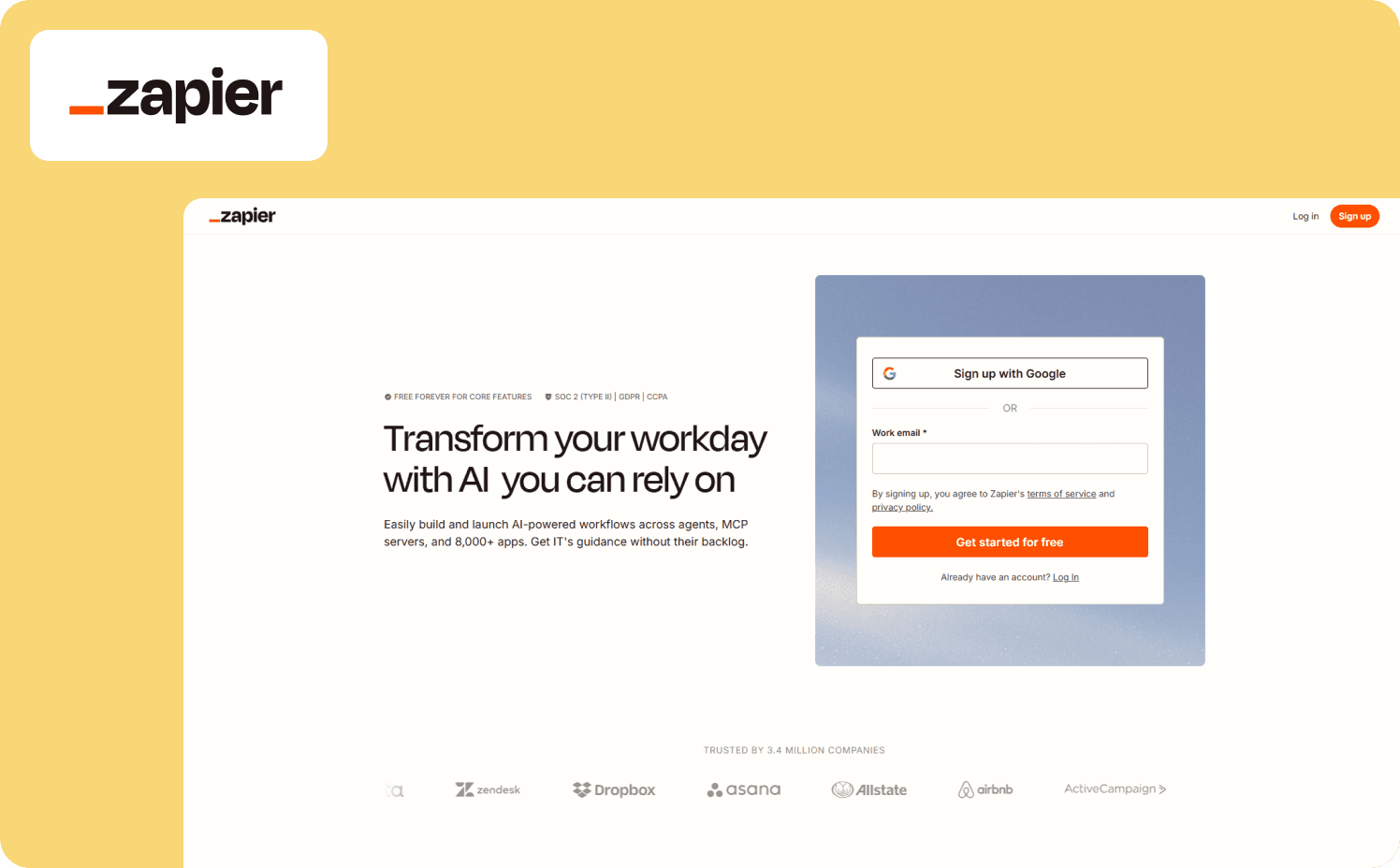
A feedback-driven product roadmap is what makes Zapier durable. They solicit feedback through in-app surveys, monitor community forums, and respond directly to users. The result is a loyal base that stays despite intense competition. That feedback loop translates directly into retention: when users see their requested integrations shipped, they've invested in the product's direction, making switching feel like starting over.
Figma
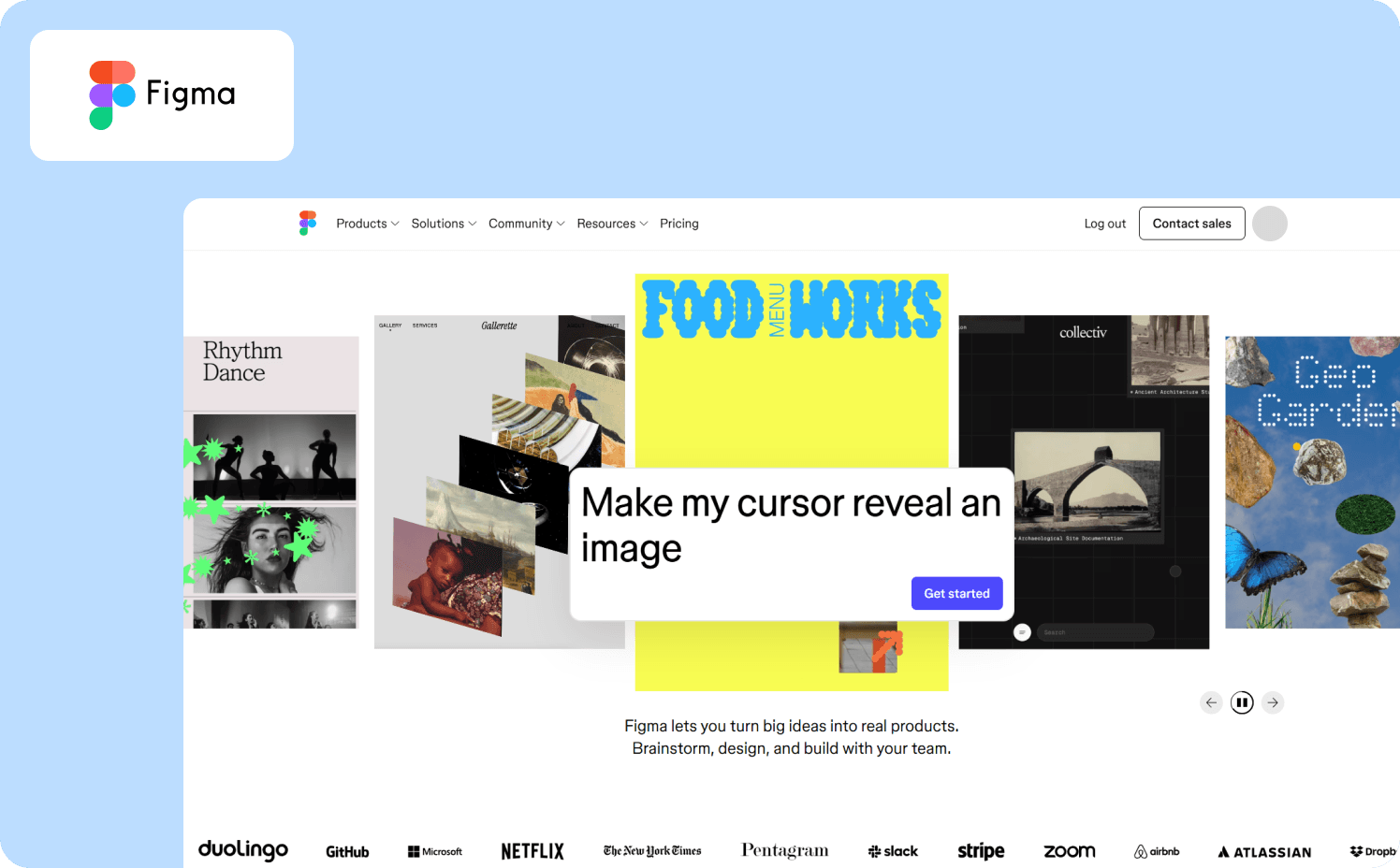
Collaborators get immediate access without downloading anything or signing up. Once one designer in an org uses Figma, the tool spreads across the whole team organically. Sales enters only when organizations are ready to formalize at scale. The free-to-paid trigger is team size. Figma's free plan caps editors at two, so the moment a third collaborator needs to edit (not just view) the team hits a natural paywall that converts without a sales conversation.
SLG examples
Salesforce
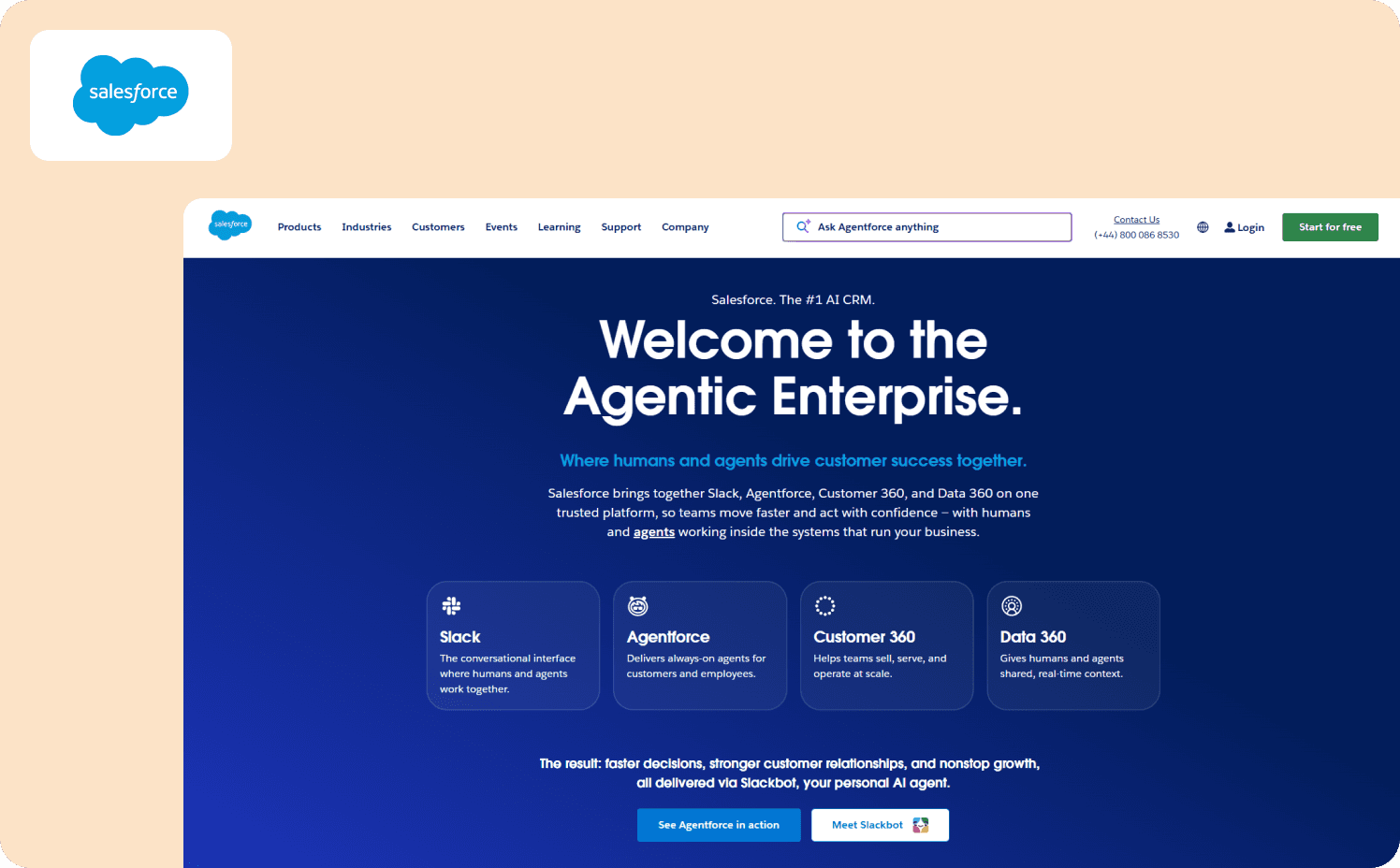
Reps don't demo features: they map Salesforce to specific business challenges. A manufacturing company gets a proposal focused on supply chain visibility. A financial services firm gets one focused on compliance. The value is constructed in conversation, which is exactly when PLG can't do the job.
ServiceNow
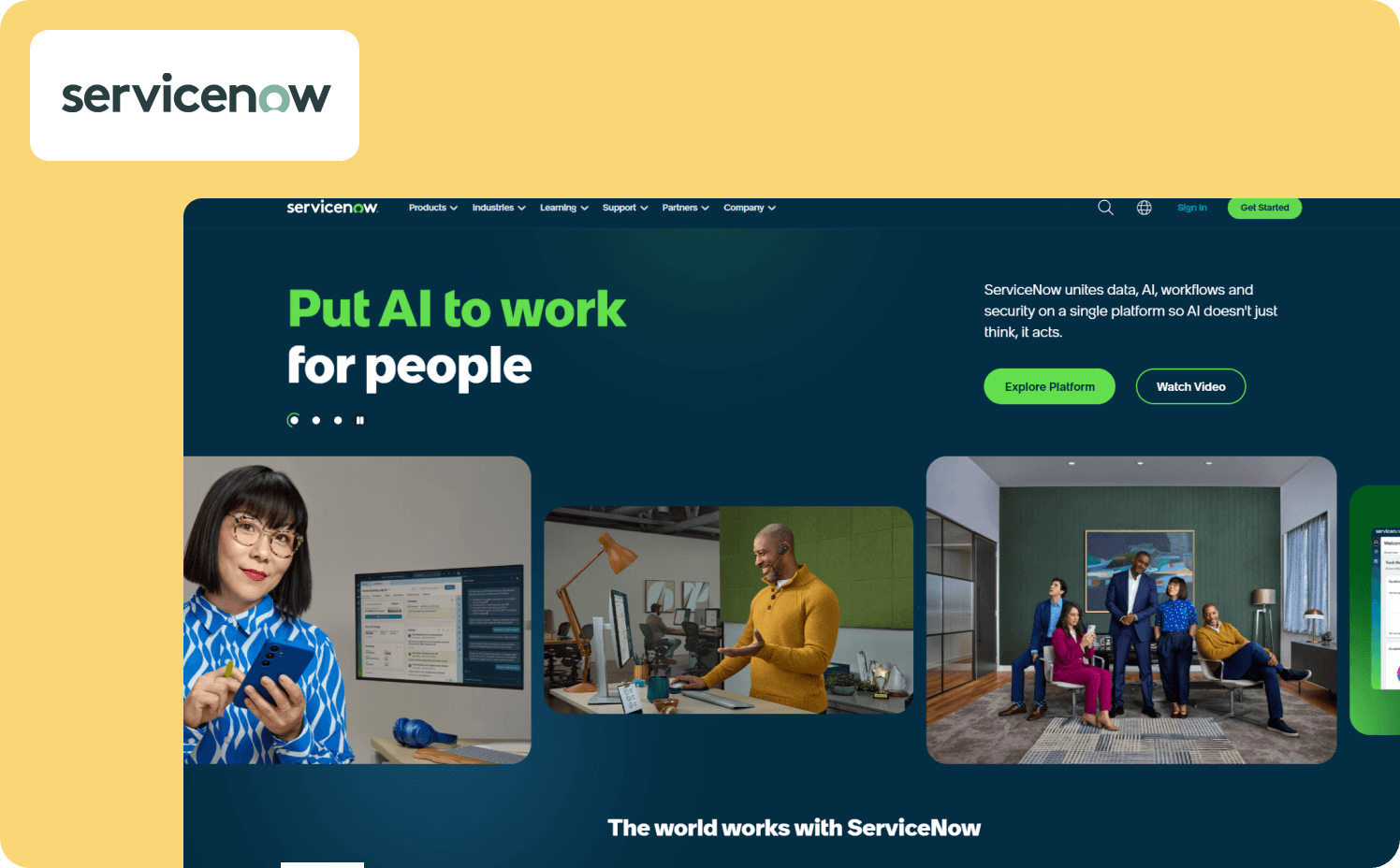
An in-house sales team pairs with a partner ecosystem for regional and industry-specific deals. Channel partners bring specialized implementation knowledge that internal teams can't replicate at scale. With ServiceNow, sales closes, partners deliver.
Oracle
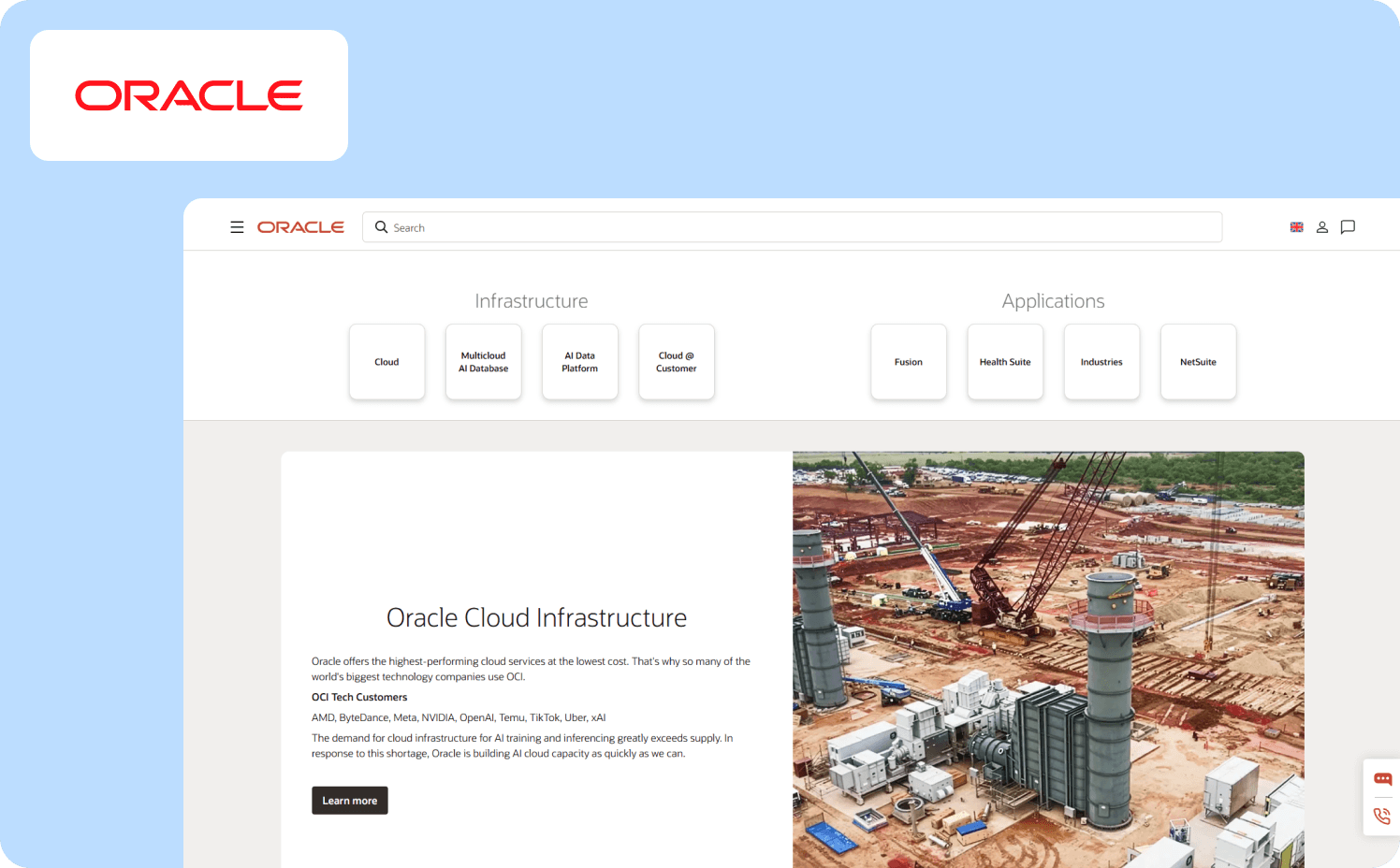
Every potential customer has a dedicated sales rep. Every active customer has a Customer Success Manager. Sales consultants engage at the strategic level, positioning solutions around long-term ROI. This works because Oracle's products touch core infrastructure, where trust matters more than price.
Strengths and challenges of each model
Neither model is universally superior. Each has a distinct set of advantages and failure modes.
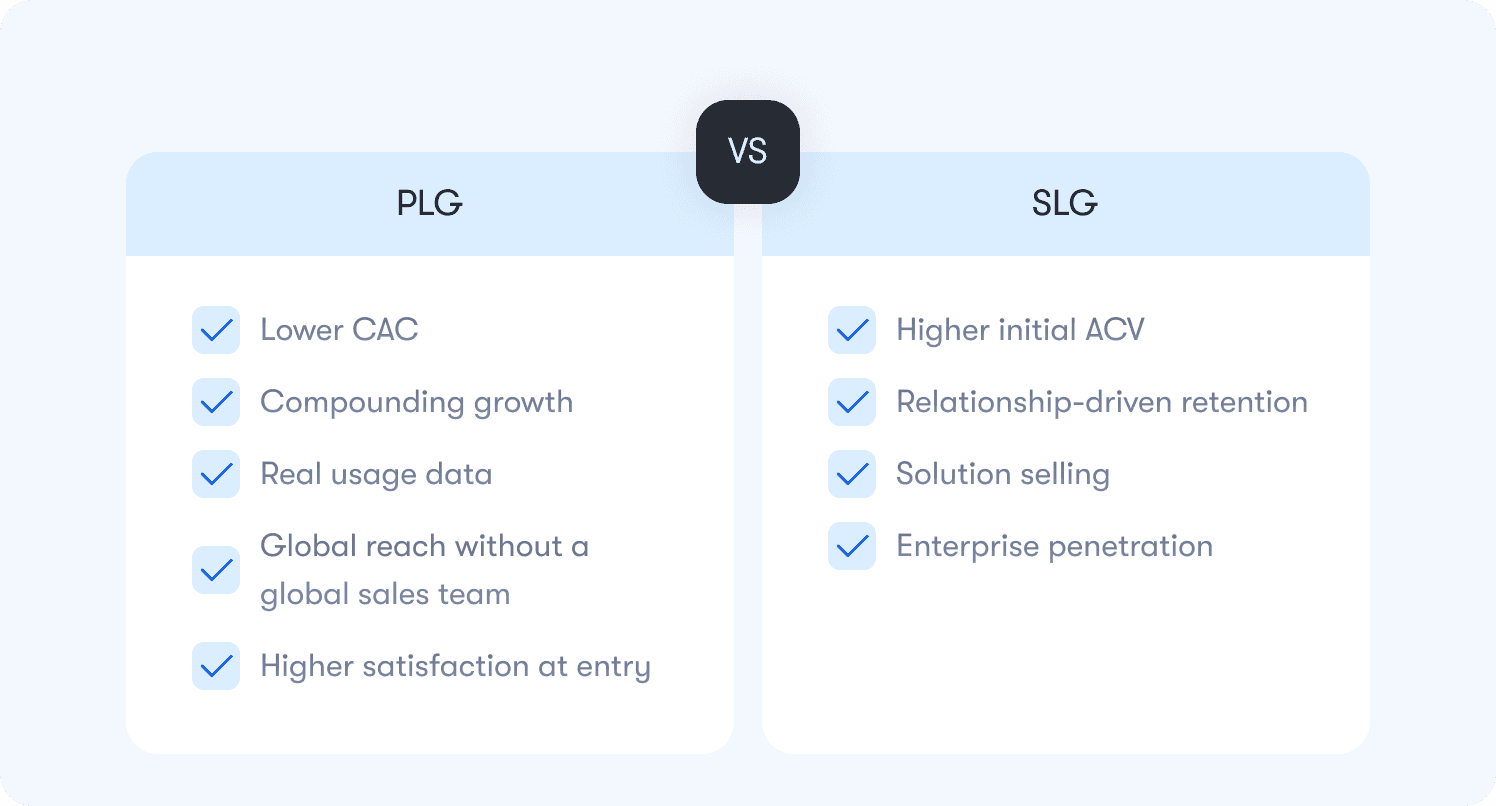
Understanding both is what lets you choose the right one, or the right combination, for your product and market.
PLG: what it gets right
Lower CAC. When the product sells itself, you're not paying for every prospect conversation.
Compounding growth. Each user who invites a colleague is an unpaid acquisition channel.
Real usage data. Self-serve users generate behavioral signals that inform roadmap and expansion decisions.
Global reach without a global sales team. Self-service crosses geographies automatically.
Higher satisfaction at entry. Buyers who self-qualified have clearer expectations and stronger retention.
PLG: where it gets hard
The education gap. Complex products may not deliver immediate value without guidance. Users who don't activate, churn.
Lower initial deal sizes. PLG starts small and expands, which requires strong net revenue retention (NRR) to compound.
The onboarding investment. Building a self-serve experience that reliably guides users to activation takes real product commitment.
The enterprise ceiling. At scale, PLG often stalls without a sales-assist layer for multi-stakeholder deals.
SLG: what it gets right
Higher initial ACV. Sales teams negotiate larger commitments and enterprise agreements from the start.
Relationship-driven retention. High-touch relationships reduce churn and create natural expansion opportunities.
Solution selling. Reps address specific pain points, handle objections, and tailor proposals for complex buying processes.
Enterprise penetration. SLG navigates procurement, legal review, and multi-stakeholder decisions that PLG cannot.
SLG: where it gets hard
High CAC. Salaries, tools, commissions, and management overhead add up fast.
Linear scaling. Growing revenue means growing headcount, which limits margin expansion.
Longer cycles. Enterprise deals routinely take 60 to 180 days, slowing cash flow and complicating forecasting.
Team silos. The sequential marketing, sales, CS handoff model means everyone optimizes for their own stage.
The hybrid model: why most teams end up here
The binary PLG vs. SLG debate has largely moved on. In 2026, the most competitive B2B SaaS companies run hybrid GTM motions that combine PLG's acquisition efficiency with SLG's revenue depth. This isn't hedging. It's a deliberate design.
Four stages of a hybrid GTM motion
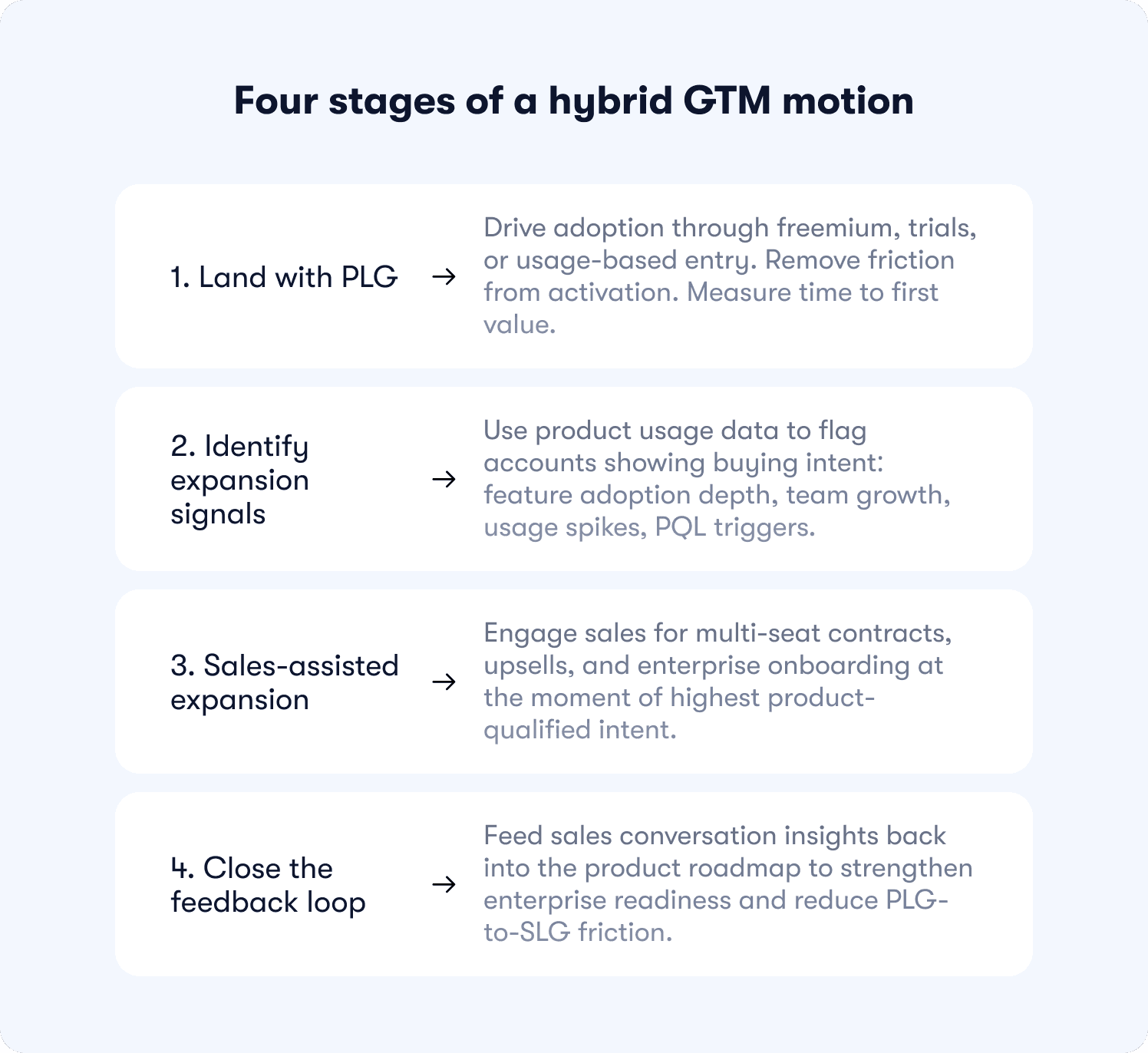
HubSpot runs free tools for bottom-up adoption while a sales team pursues enterprise expansions. DocuSign runs individuals on self-serve while enterprise deployments go through sales. Atlassian built the category on PLG, then added an enterprise sales layer as the business scaled upmarket.
Signs a hybrid approach is right for you
You serve both SMB and enterprise customers with meaningfully different buying behaviors.
Self-serve acquisition is strong, but expansion beyond the initial user requires a sales conversation.
Your product has both simple individual use cases and complex team-wide use cases.
You want efficient acquisition CAC and maximum deal ACV.
From PLG to ALG: agent-led growth is changing the conversion math
AI is not just making PLG and SLG teams more efficient. It is creating a new growth model entirely.
The traditional product-led growth approach was built on a self-serve assumption: the user learns the software. They sign up, explore, struggle through onboarding, and either reach their first value moment or churn. The burden of activation sits with the user. That is what self-serve has always meant in practice.
Agent-led growth (ALG) flips that. The software adapts to the user. Instead of the user learning the product, an AI agent operates the product on their behalf, getting them to value before they have had a chance to drop off. Self-serve becomes self-operate.
The conversion data
The numbers make the case directly. Here is how free-to-paid conversion rates compare across performance tiers in 2026.
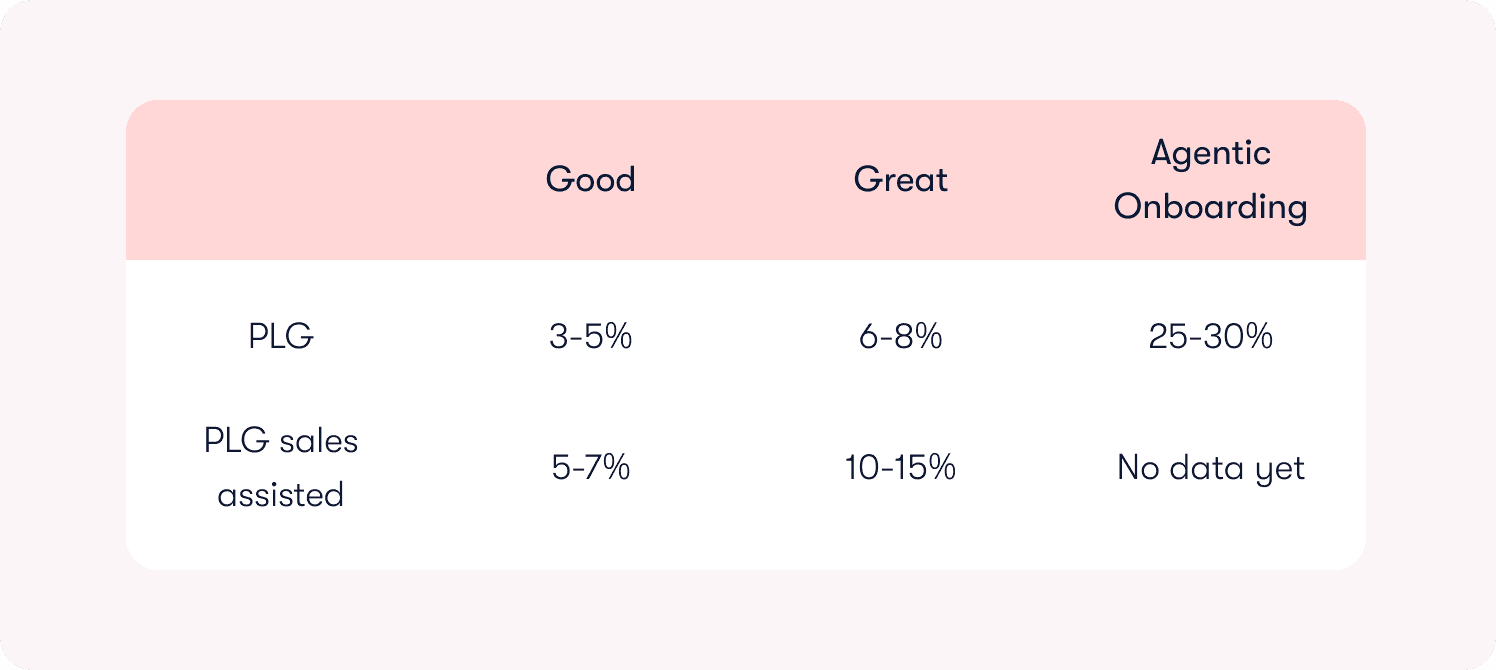
Sources: Foldspace.ai, Lenny's Newsletter, Growth Unhinged.
The gap between great traditional PLG and agentic onboarding is not incremental. It is a different category of outcome. A good PLG motion converts 3 to 5% of free users to paid. A great one hits 6 to 8%. Agentic onboarding pushes that to 25 to 30%. For PLG sales-assisted teams, great execution gets you 10 to 15%.
The ARR data
AI-native companies are reaching scale in two to three years. Cursor hit $1B ARR. Lovable reached $200M. Perplexity reached $150M. Traditional SaaS companies relying on conventional onboarding curves are taking five-plus years to reach $100M. The speed differential is not a fluke. It is the compounding effect of dramatically faster time to value.
For PLG teams, this changes the activation calculus. Jimo AI generates complete onboarding flows from a single recorded walkthrough, cutting build time by 90%. It segments users by behavior in real time, serves different experiences based on role and activation stage, and scores product-qualified leads without manual analysis.
For SLG teams, AI feeds product usage signals directly into CRM, personalizes demo environments per prospect before a sales call, and gives customer success teams early warning on churn risk before a renewal conversation becomes a recovery conversation.
The paradox worth sitting with
There is an honest tension in ALG that is worth naming. When an agent does everything, you gain speed: minimal time to value, zero friction, fully scalable. But you risk losing something too: personal investment in the product, a genuine sense of ownership, and the natural switching costs that come from a user who has actually learned to use something well.
A user who struggled through onboarding and mastered your product is stickier than one who was carried through it by an agent. The question ALG teams are still working out is how to deliver speed without hollowing out the relationship between user and product.
That is not an argument against agentic onboarding. The conversion numbers are too compelling to ignore. It is an argument for designing AI-assisted activation deliberately: fast enough to hook users, human enough to build the habits that retain them.
Cross-functional alignment: who owns what
Here's a problem that kills both PLG and SLG at scale: marketing acquires, sales closes, CS retains — and nobody owns the full funnel.
In a well-run hybrid motion, every team has a role at every stage.
Funnel stage | Marketing | Product | Sales and CS |
Acquisition | Optimize channels, run experiments, drive signups | Build signup infrastructure for marketing's tests; optimize activation flow | Outbound to high-intent accounts; convert top-of-funnel leads |
Activation and monetization | Tailored email campaigns, community content, enablement | Build self-serve in-product experiences that guide users toward upgrade | Work mid- and bottom-of-funnel accounts; identify ICPs; support upgrade conversations |
Retention and expansion | Renewal campaigns; identify high-value segments through usage signals | Optimize sticky features; surface adoption signals; reduce friction points | Check in on accounts; use product usage data to prioritize CS time; drive upsells |
The critical shift: in a hybrid motion, product metrics become everyone's metrics. Activation rate is not just a product KPI. It is a sales efficiency lever. NRR is not just a CS metric. It is a product quality signal. Marketing and product teams share ownership of activation, not just acquisition.
How in-product guidance connects PLG and SLG
PLG only works if users activate. Activation only happens when users reach their first value moment fast enough and clearly enough to stick.
That's where in-product guidance becomes the execution layer that makes your GTM motion real. Without it, even great products lose users at the activation stage, before they ever convert to paid.
What in-product guidance looks like across the funnel
Product tours walk new users through key workflows at signup, reducing time to first value without engineering involvement.
Onboarding checklists give users a clear path to activation, breaking the first session into achievable milestones.
Contextual hints and tooltips surface exactly when users encounter a feature, eliminating the 'I didn't know that existed' churn driver.
In-app announcements keep existing users informed about new features, driving feature adoption without relying on email or sales follow-up.
Behavioral surveys capture friction signals at scale, so product teams can fix activation blockers before they become churn events.
Jimo in practice: AB Tasty
AB Tasty cut their feature launch cycle from three months to two weeks using Jimo product tours and announcements. Their team reached 2,000 users in week one of a new feature release, with a 2x improvement in CSAT response rates. That's the difference between a feature that drives activation and one that gets ignored.
How Jimo runs a product-led motion itself
Jimo is a product-led activation platform. We grow it with a product-led motion. That's not positioning: it's how the product is actually discovered and used.
New users can build their first product tour and deploy it to real users without ever speaking to a sales rep. The product is designed to deliver that first activation moment in under 30 minutes.
When accounts reach a certain adoption depth, with multiple use cases, growing team usage, or expansion signals, our customer success teams engage. Product-qualified accounts, not cold outreach. The product does the qualifying.
Key metrics to track
PLG metrics
Product qualified leads (PQLs): users showing buying intent through product behavior
Activation rate: percentage of new users who reach their first value milestone
Time to value (TTV): how long from signup to first meaningful usage
Free-to-paid conversion rate: industry median is approximately 9% in 2026
Net revenue retention (NRR): the compounding metric that separates durable PLG from leaky growth
Viral coefficient: how many new users each existing user generates
SLG metrics
MQLs and SQLs: volume and conversion rate through each pipeline stage
Average contract value (ACV): 2026 median is $25,000
Sales cycle length: shorter cycles improve forecasting accuracy and cash flow
Customer acquisition cost (CAC): 2026 average is $8,000
Win rate: top performers sit at 30 to 40%
How to choose your growth model
Start by answering these questions honestly. The model where you tick more boxes is the right starting point.
Consider PLG if... | Consider SLG if... |
Your product delivers value in the first session | Your product needs configuration or onboarding support |
Users can implement without assistance | Implementation involves IT, security, or compliance review |
Entry price is under $100/user/month | ACV exceeds $10K (especially $50K+) |
You're targeting a broad market or SMBs | You're targeting enterprise buyers with complex procurement |
Users have purchasing authority | Multiple stakeholders are involved in the purchase decision |
Your product has natural viral or sharing mechanics | Your category requires significant buyer education |
You have strong product and UX resources | You have strong sales capabilities available or buildable |
You might want to consider a hybrid approach if...
You serve both SMB and enterprise customers with different buying behaviors
Your product has both simple individual use cases and complex org-wide ones.
The role of sales teams in PLG companies
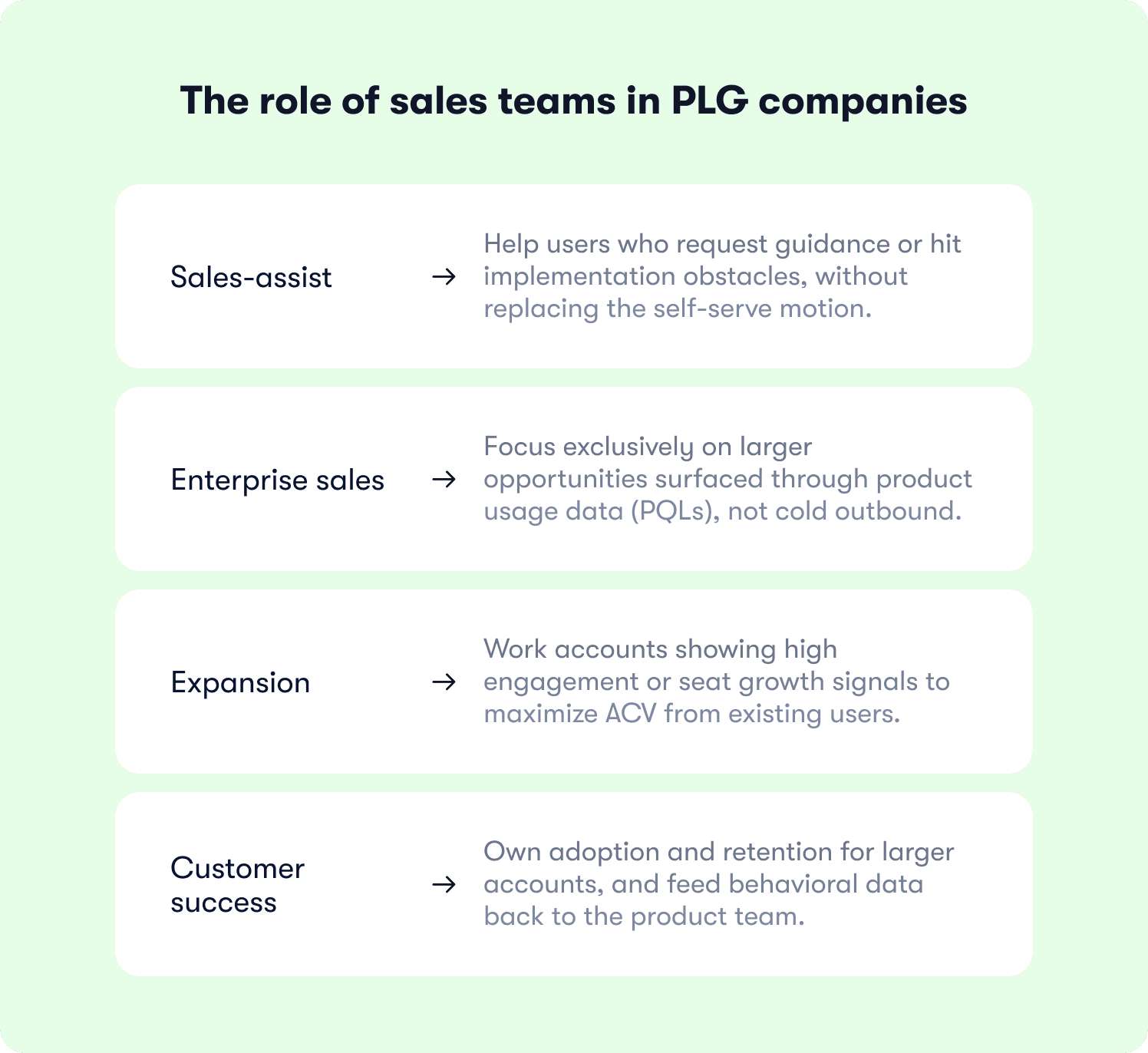
Even in product-led companies, sales teams play critical roles. They just operate differently.
Sales-assist: help users who request guidance or hit implementation obstacles, without replacing the self-serve motion.
Enterprise sales: focus exclusively on larger opportunities surfaced through product usage data (PQLs), not cold outbound.
Expansion: work accounts showing high engagement or seat growth signals to maximize ACV from existing users.
Customer success: own adoption and retention for larger accounts, and feed behavioral data back to the product team.
The key difference from SLG: PLG sales teams are reactive to product signals, not proactive with cold outreach. They focus on accounts that have already demonstrated intent.
The real competition is at activation
Most growth leaders already know the PLG vs. SLG debate is settled. The answer is hybrid. What teams are still solving is the execution problem: how do you make users actually activate, adopt, and expand without a sales rep in every deal?
The fastest-growing SaaS teams in 2026 aren't choosing between PLG and SLG. They're investing in the activation infrastructure that makes both motions work: product tours that guide users to their first value moment, behavioral analytics that surface expansion signals before accounts stall, and in-app guidance that replaces the onboarding call without sacrificing the outcome.
Get activation right and your GTM motion compounds. Get it wrong and no amount of sales investment or PLG infrastructure fixes the leak.
See how Jimo powers product-led activation and join more than 500+ product teams who learned to activate users faster, reduce support load, and drive expansion revenue — without engineering dependencies.
FAQs
What's the main difference between PLG and SLG?
PLG relies on the product to attract, qualify, and convert users. The product communicates its own value. SLG relies on a sales team to identify prospects, build relationships, and close deals. In PLG, the user initiates. In SLG, the rep initiates. Both produce strong businesses when matched to the right product and market.
Can a company run PLG and SLG at the same time?
Yes, and increasingly the most competitive SaaS companies do. The hybrid model uses PLG to drive efficient self-serve acquisition and SLG to maximize deal size at the enterprise tier. The challenge is building the cross-functional alignment and product usage infrastructure that makes the PLG-to-SLG handoff signal-based rather than manual.
What is a product-qualified lead (PQL)?
A PQL is a user or account that has demonstrated buying intent through product behavior: reaching a usage threshold, adopting a high-value feature, or inviting teammates. Unlike marketing-qualified leads, which are based on engagement with content, PQLs are based on evidence of value delivery inside the product itself.
What metrics matter most in a PLG motion?
Activation rate and time to value are the foundation. If users don't reach their first value moment, everything else breaks. NRR is the compounding metric that separates durable PLG from leaky growth. PQL conversion rate tells you whether product usage data is being turned into revenue.
How does in-product guidance affect PLG outcomes?
In-product guidance is the execution layer that makes PLG work at the activation stage. Product tours, onboarding checklists, contextual tooltips, and in-app announcements reduce friction between signup and first value. Zenchef cut onboarding time by 53% using guided in-app flows. AB Tasty reached 2,000 users in week one of a new feature launch using Jimo's product tours and announcements. Guidance doesn't replace a good product: it ensures users actually discover the value your product already delivers.
What's the difference between PLG and SLG in terms of customer acquisition costs?
Customer acquisition costs tell the story clearly. In a sales-led growth model, customer acquisition costs are high by design: you're paying for sales representatives, sales calls, demo cycles, and the management overhead that holds it all together. Sales efforts don't scale without proportional investment in people. In a product-led growth approach, lower customer acquisition costs come from the product doing the work that sales reps would otherwise do. User acquisition happens through free trials, word of mouth, and organic growth rather than outbound sales efforts. That's not a minor efficiency difference. For high-volume, broad-market products, it's the entire business model.
How do sales cycles differ between PLG and SLG?
Longer sales cycles are one of the defining characteristics of the sales-led approach. A dedicated sales team running discovery calls, demos, proposals, and negotiations across enterprise customers can take 60 to 180 days to close a single deal. That's not a failure of the sales-led model: it's appropriate for complex products where human interaction and relationship-building genuinely drive the outcome. In a product-led growth motion, the sales cycle compresses dramatically. Potential customers try the product through self-service options, experience value directly, and make purchasing decisions without ever speaking to a sales rep. The tradeoff: PLG sales cycles work when the product can demonstrate its own value. When it can't, skipping the human interaction creates more friction, not less.
What does a product-led growth strategy actually look like in practice?
A product-led growth strategy puts the product at the center of every growth decision, from how you structure pricing models to how you define your target market. In practical terms, it means building self-service options that let potential customers try the product before committing, designing onboarding around user behavior rather than sales scripts, and using product usage data to identify which customer segments are ready to expand. Successful SaaS companies running a product-led growth model share one pattern: they obsess over the experience between signup and first value, because that's where organic growth either takes hold or falls apart. The product-led growth approach isn't just a go-to-market choice. It shapes how teams are structured, what gets built, and how business growth gets measured.
How do PLG and SLG affect customer satisfaction and revenue growth?
Both models can drive revenue growth, but they do it differently and they produce different customer satisfaction profiles. Product-led growth tends to produce higher customer satisfaction at entry, because users have already validated the product for themselves before paying. There's no gap between what was sold and what was delivered. The result, when activation works, is higher revenue growth rates driven by expansion within the existing base rather than constant new acquisition. Sales-led growth companies often secure higher-value contracts upfront, which can produce strong revenue growth in the short term. The risk is that deals closed by sales-led companies sometimes outpace what the product actually delivers on day one, creating a satisfaction gap that customer success teams then have to close. Neither outcome is inevitable. But the model you choose shapes where the work happens: before the sale or after it.
TL;DR
PLG lets the product drive acquisition, conversion, and expansion with minimal sales involvement. SLG relies on a sales team to guide prospects through demos, negotiations, and close. In 2026, the most competitive SaaS companies run a hybrid motion: PLG to land efficiently, SLG to expand strategically. And on the horizon, agent-led growth is pushing free-to-paid conversion rates that traditional PLG cannot match. The deciding factor is not the model. It is whether your product delivers value fast enough to make self-serve adoption stick.
Your product isn't broken. Most companies are just approaching growth wrong.
Growth teams know the PLG theory. What they're wrestling with is execution: how do you convert free users into paying customers at scale, without a sales rep in every deal?
This guide covers the full PLG vs. sales-led growth (SLG) landscape: definitions, 2026 benchmarks, real-world examples, a cross-functional team playbook, and a decision framework. We've also added sections on in-product guidance and AI, because that's where most GTM motions are leaking right now.
What are product-led growth and sales-led growth?
Both terms describe how a company structures its entire go-to-market motion, from how it acquires customers to how it retains and expands them. The difference comes down to one question: who does the selling, the product or a person?
Product-led growth (PLG)
Product-led growth is a go-to-market (GTM) strategy where the product itself drives customer acquisition, conversion, and expansion. Users discover the product, experience its value through free trials or freemium tiers, and upgrade without a sales rep involved.
The core idea: the product communicates its own value. Users come for the product, stay for the outcomes, and pull their organizations in behind them.
Sales-led growth (SLG)
Sales-led growth relies on a structured sales process to acquire and retain customers. Reps identify prospects, run demos, negotiate deals, and manage relationships throughout the customer lifecycle.
SLG is the right motion when products are complex, buyers are risk-averse, or contract values justify the cost of high-touch selling. The key distinction: in SLG, the sales team communicates the product's value. The product doesn't speak for itself.
PLG vs. SLG: the key differences
Factor | Product-led growth | Sales-led growth |
Customer journey | Bottom-up: individuals adopt, then pull the org in | Top-down: decision-makers buy, then roll out to users |
Minutes to hours (self-serve activation) | Weeks to months (demos, negotiations, onboarding) | |
Acquisition cost | Lower CAC: the product does the selling | Higher CAC: sales salaries, tools, and cycles add up |
Revenue model | Freemium, usage-based, per-seat self-service | Custom pricing, annual contracts, enterprise agreements |
Scaling model | Revenue scales without linear headcount growth | Revenue growth requires proportional sales hiring |
Best for | Broad markets, intuitive products, under $100/user/month | Complex solutions, enterprise deals, over $10K ACV |
Primary KPIs | Activation rate, PQLs, time to value, NRR, viral coefficient | MQLs, SQLs, ACV, win rate, sales cycle length |
Viral potential | High: users naturally invite collaborators | Low: adoption is org-wide from the start |
Org culture | Product, data, and UX are the growth engine | Sales and marketing are the primary revenue engine |
2026 Benchmarks: what good looks like
Knowing your metrics matters less than knowing where they sit relative to peers. Here is the data for B2B SaaS in 2026. The NPS figure references the Net Promoter Score benchmark for product-led companies.
PLG benchmarks (2026) | SLG benchmarks (2026) |
Free-to-paid conversion: ~9% median | Customer engagement: 20% higher than PLG avg |
Median ACV: $25,000 | Typical ACV: $10K to $500K+ |
Average CAC: $8,000 | Sales cycle: 30 to 180 days (segment-dependent) |
Time to value: 18.3% faster than non-PLG peers | Win rate: 20 to 40% (top performers) |
NPS average: 40 | Customer LTV: higher with CS-led expansion |
Self-serve revenue tied to better unit economics | Implementation: weeks to months |
Real-world examples: how each model works in practice
Theory only takes you so far.
The companies below have built durable growth engines by committing fully to one model or the other. What makes them worth studying isn't their success, it's the specific mechanics that drove it.
PLG examples
Airtable
Airtable's formula comes down to two words: build and share. Users fill out a template, sync it with a database, and invite colleagues to collaborate. That collaboration mechanic is what created the virality to scale without a large sales team at the core. The solo-to-team conversion happens the moment a user shares a base. That single share triggers a collaborator invitation, turning a personal productivity tool into a team workspace and surfacing Airtable's first natural upgrade prompt.
Zapier
A feedback-driven product roadmap is what makes Zapier durable. They solicit feedback through in-app surveys, monitor community forums, and respond directly to users. The result is a loyal base that stays despite intense competition. That feedback loop translates directly into retention: when users see their requested integrations shipped, they've invested in the product's direction, making switching feel like starting over.
Figma
Collaborators get immediate access without downloading anything or signing up. Once one designer in an org uses Figma, the tool spreads across the whole team organically. Sales enters only when organizations are ready to formalize at scale. The free-to-paid trigger is team size. Figma's free plan caps editors at two, so the moment a third collaborator needs to edit (not just view) the team hits a natural paywall that converts without a sales conversation.
SLG examples
Salesforce
Reps don't demo features: they map Salesforce to specific business challenges. A manufacturing company gets a proposal focused on supply chain visibility. A financial services firm gets one focused on compliance. The value is constructed in conversation, which is exactly when PLG can't do the job.
ServiceNow
An in-house sales team pairs with a partner ecosystem for regional and industry-specific deals. Channel partners bring specialized implementation knowledge that internal teams can't replicate at scale. With ServiceNow, sales closes, partners deliver.
Oracle
Every potential customer has a dedicated sales rep. Every active customer has a Customer Success Manager. Sales consultants engage at the strategic level, positioning solutions around long-term ROI. This works because Oracle's products touch core infrastructure, where trust matters more than price.
Strengths and challenges of each model
Neither model is universally superior. Each has a distinct set of advantages and failure modes.
Understanding both is what lets you choose the right one, or the right combination, for your product and market.
PLG: what it gets right
Lower CAC. When the product sells itself, you're not paying for every prospect conversation.
Compounding growth. Each user who invites a colleague is an unpaid acquisition channel.
Real usage data. Self-serve users generate behavioral signals that inform roadmap and expansion decisions.
Global reach without a global sales team. Self-service crosses geographies automatically.
Higher satisfaction at entry. Buyers who self-qualified have clearer expectations and stronger retention.
PLG: where it gets hard
The education gap. Complex products may not deliver immediate value without guidance. Users who don't activate, churn.
Lower initial deal sizes. PLG starts small and expands, which requires strong net revenue retention (NRR) to compound.
The onboarding investment. Building a self-serve experience that reliably guides users to activation takes real product commitment.
The enterprise ceiling. At scale, PLG often stalls without a sales-assist layer for multi-stakeholder deals.
SLG: what it gets right
Higher initial ACV. Sales teams negotiate larger commitments and enterprise agreements from the start.
Relationship-driven retention. High-touch relationships reduce churn and create natural expansion opportunities.
Solution selling. Reps address specific pain points, handle objections, and tailor proposals for complex buying processes.
Enterprise penetration. SLG navigates procurement, legal review, and multi-stakeholder decisions that PLG cannot.
SLG: where it gets hard
High CAC. Salaries, tools, commissions, and management overhead add up fast.
Linear scaling. Growing revenue means growing headcount, which limits margin expansion.
Longer cycles. Enterprise deals routinely take 60 to 180 days, slowing cash flow and complicating forecasting.
Team silos. The sequential marketing, sales, CS handoff model means everyone optimizes for their own stage.
The hybrid model: why most teams end up here
The binary PLG vs. SLG debate has largely moved on. In 2026, the most competitive B2B SaaS companies run hybrid GTM motions that combine PLG's acquisition efficiency with SLG's revenue depth. This isn't hedging. It's a deliberate design.
Four stages of a hybrid GTM motion
HubSpot runs free tools for bottom-up adoption while a sales team pursues enterprise expansions. DocuSign runs individuals on self-serve while enterprise deployments go through sales. Atlassian built the category on PLG, then added an enterprise sales layer as the business scaled upmarket.
Signs a hybrid approach is right for you
You serve both SMB and enterprise customers with meaningfully different buying behaviors.
Self-serve acquisition is strong, but expansion beyond the initial user requires a sales conversation.
Your product has both simple individual use cases and complex team-wide use cases.
You want efficient acquisition CAC and maximum deal ACV.
From PLG to ALG: agent-led growth is changing the conversion math
AI is not just making PLG and SLG teams more efficient. It is creating a new growth model entirely.
The traditional product-led growth approach was built on a self-serve assumption: the user learns the software. They sign up, explore, struggle through onboarding, and either reach their first value moment or churn. The burden of activation sits with the user. That is what self-serve has always meant in practice.
Agent-led growth (ALG) flips that. The software adapts to the user. Instead of the user learning the product, an AI agent operates the product on their behalf, getting them to value before they have had a chance to drop off. Self-serve becomes self-operate.
The conversion data
The numbers make the case directly. Here is how free-to-paid conversion rates compare across performance tiers in 2026.
Sources: Foldspace.ai, Lenny's Newsletter, Growth Unhinged.
The gap between great traditional PLG and agentic onboarding is not incremental. It is a different category of outcome. A good PLG motion converts 3 to 5% of free users to paid. A great one hits 6 to 8%. Agentic onboarding pushes that to 25 to 30%. For PLG sales-assisted teams, great execution gets you 10 to 15%.
The ARR data
AI-native companies are reaching scale in two to three years. Cursor hit $1B ARR. Lovable reached $200M. Perplexity reached $150M. Traditional SaaS companies relying on conventional onboarding curves are taking five-plus years to reach $100M. The speed differential is not a fluke. It is the compounding effect of dramatically faster time to value.
For PLG teams, this changes the activation calculus. Jimo AI generates complete onboarding flows from a single recorded walkthrough, cutting build time by 90%. It segments users by behavior in real time, serves different experiences based on role and activation stage, and scores product-qualified leads without manual analysis.
For SLG teams, AI feeds product usage signals directly into CRM, personalizes demo environments per prospect before a sales call, and gives customer success teams early warning on churn risk before a renewal conversation becomes a recovery conversation.
The paradox worth sitting with
There is an honest tension in ALG that is worth naming. When an agent does everything, you gain speed: minimal time to value, zero friction, fully scalable. But you risk losing something too: personal investment in the product, a genuine sense of ownership, and the natural switching costs that come from a user who has actually learned to use something well.
A user who struggled through onboarding and mastered your product is stickier than one who was carried through it by an agent. The question ALG teams are still working out is how to deliver speed without hollowing out the relationship between user and product.
That is not an argument against agentic onboarding. The conversion numbers are too compelling to ignore. It is an argument for designing AI-assisted activation deliberately: fast enough to hook users, human enough to build the habits that retain them.
Cross-functional alignment: who owns what
Here's a problem that kills both PLG and SLG at scale: marketing acquires, sales closes, CS retains — and nobody owns the full funnel.
In a well-run hybrid motion, every team has a role at every stage.
Funnel stage | Marketing | Product | Sales and CS |
Acquisition | Optimize channels, run experiments, drive signups | Build signup infrastructure for marketing's tests; optimize activation flow | Outbound to high-intent accounts; convert top-of-funnel leads |
Activation and monetization | Tailored email campaigns, community content, enablement | Build self-serve in-product experiences that guide users toward upgrade | Work mid- and bottom-of-funnel accounts; identify ICPs; support upgrade conversations |
Retention and expansion | Renewal campaigns; identify high-value segments through usage signals | Optimize sticky features; surface adoption signals; reduce friction points | Check in on accounts; use product usage data to prioritize CS time; drive upsells |
The critical shift: in a hybrid motion, product metrics become everyone's metrics. Activation rate is not just a product KPI. It is a sales efficiency lever. NRR is not just a CS metric. It is a product quality signal. Marketing and product teams share ownership of activation, not just acquisition.
How in-product guidance connects PLG and SLG
PLG only works if users activate. Activation only happens when users reach their first value moment fast enough and clearly enough to stick.
That's where in-product guidance becomes the execution layer that makes your GTM motion real. Without it, even great products lose users at the activation stage, before they ever convert to paid.
What in-product guidance looks like across the funnel
Product tours walk new users through key workflows at signup, reducing time to first value without engineering involvement.
Onboarding checklists give users a clear path to activation, breaking the first session into achievable milestones.
Contextual hints and tooltips surface exactly when users encounter a feature, eliminating the 'I didn't know that existed' churn driver.
In-app announcements keep existing users informed about new features, driving feature adoption without relying on email or sales follow-up.
Behavioral surveys capture friction signals at scale, so product teams can fix activation blockers before they become churn events.
Jimo in practice: AB Tasty
AB Tasty cut their feature launch cycle from three months to two weeks using Jimo product tours and announcements. Their team reached 2,000 users in week one of a new feature release, with a 2x improvement in CSAT response rates. That's the difference between a feature that drives activation and one that gets ignored.
How Jimo runs a product-led motion itself
Jimo is a product-led activation platform. We grow it with a product-led motion. That's not positioning: it's how the product is actually discovered and used.
New users can build their first product tour and deploy it to real users without ever speaking to a sales rep. The product is designed to deliver that first activation moment in under 30 minutes.
When accounts reach a certain adoption depth, with multiple use cases, growing team usage, or expansion signals, our customer success teams engage. Product-qualified accounts, not cold outreach. The product does the qualifying.
Key metrics to track
PLG metrics
Product qualified leads (PQLs): users showing buying intent through product behavior
Activation rate: percentage of new users who reach their first value milestone
Time to value (TTV): how long from signup to first meaningful usage
Free-to-paid conversion rate: industry median is approximately 9% in 2026
Net revenue retention (NRR): the compounding metric that separates durable PLG from leaky growth
Viral coefficient: how many new users each existing user generates
SLG metrics
MQLs and SQLs: volume and conversion rate through each pipeline stage
Average contract value (ACV): 2026 median is $25,000
Sales cycle length: shorter cycles improve forecasting accuracy and cash flow
Customer acquisition cost (CAC): 2026 average is $8,000
Win rate: top performers sit at 30 to 40%
How to choose your growth model
Start by answering these questions honestly. The model where you tick more boxes is the right starting point.
Consider PLG if... | Consider SLG if... |
Your product delivers value in the first session | Your product needs configuration or onboarding support |
Users can implement without assistance | Implementation involves IT, security, or compliance review |
Entry price is under $100/user/month | ACV exceeds $10K (especially $50K+) |
You're targeting a broad market or SMBs | You're targeting enterprise buyers with complex procurement |
Users have purchasing authority | Multiple stakeholders are involved in the purchase decision |
Your product has natural viral or sharing mechanics | Your category requires significant buyer education |
You have strong product and UX resources | You have strong sales capabilities available or buildable |
You might want to consider a hybrid approach if...
You serve both SMB and enterprise customers with different buying behaviors
Your product has both simple individual use cases and complex org-wide ones.
The role of sales teams in PLG companies
Even in product-led companies, sales teams play critical roles. They just operate differently.
Sales-assist: help users who request guidance or hit implementation obstacles, without replacing the self-serve motion.
Enterprise sales: focus exclusively on larger opportunities surfaced through product usage data (PQLs), not cold outbound.
Expansion: work accounts showing high engagement or seat growth signals to maximize ACV from existing users.
Customer success: own adoption and retention for larger accounts, and feed behavioral data back to the product team.
The key difference from SLG: PLG sales teams are reactive to product signals, not proactive with cold outreach. They focus on accounts that have already demonstrated intent.
The real competition is at activation
Most growth leaders already know the PLG vs. SLG debate is settled. The answer is hybrid. What teams are still solving is the execution problem: how do you make users actually activate, adopt, and expand without a sales rep in every deal?
The fastest-growing SaaS teams in 2026 aren't choosing between PLG and SLG. They're investing in the activation infrastructure that makes both motions work: product tours that guide users to their first value moment, behavioral analytics that surface expansion signals before accounts stall, and in-app guidance that replaces the onboarding call without sacrificing the outcome.
Get activation right and your GTM motion compounds. Get it wrong and no amount of sales investment or PLG infrastructure fixes the leak.
See how Jimo powers product-led activation and join more than 500+ product teams who learned to activate users faster, reduce support load, and drive expansion revenue — without engineering dependencies.
FAQs
What's the main difference between PLG and SLG?
PLG relies on the product to attract, qualify, and convert users. The product communicates its own value. SLG relies on a sales team to identify prospects, build relationships, and close deals. In PLG, the user initiates. In SLG, the rep initiates. Both produce strong businesses when matched to the right product and market.
Can a company run PLG and SLG at the same time?
Yes, and increasingly the most competitive SaaS companies do. The hybrid model uses PLG to drive efficient self-serve acquisition and SLG to maximize deal size at the enterprise tier. The challenge is building the cross-functional alignment and product usage infrastructure that makes the PLG-to-SLG handoff signal-based rather than manual.
What is a product-qualified lead (PQL)?
A PQL is a user or account that has demonstrated buying intent through product behavior: reaching a usage threshold, adopting a high-value feature, or inviting teammates. Unlike marketing-qualified leads, which are based on engagement with content, PQLs are based on evidence of value delivery inside the product itself.
What metrics matter most in a PLG motion?
Activation rate and time to value are the foundation. If users don't reach their first value moment, everything else breaks. NRR is the compounding metric that separates durable PLG from leaky growth. PQL conversion rate tells you whether product usage data is being turned into revenue.
How does in-product guidance affect PLG outcomes?
In-product guidance is the execution layer that makes PLG work at the activation stage. Product tours, onboarding checklists, contextual tooltips, and in-app announcements reduce friction between signup and first value. Zenchef cut onboarding time by 53% using guided in-app flows. AB Tasty reached 2,000 users in week one of a new feature launch using Jimo's product tours and announcements. Guidance doesn't replace a good product: it ensures users actually discover the value your product already delivers.
What's the difference between PLG and SLG in terms of customer acquisition costs?
Customer acquisition costs tell the story clearly. In a sales-led growth model, customer acquisition costs are high by design: you're paying for sales representatives, sales calls, demo cycles, and the management overhead that holds it all together. Sales efforts don't scale without proportional investment in people. In a product-led growth approach, lower customer acquisition costs come from the product doing the work that sales reps would otherwise do. User acquisition happens through free trials, word of mouth, and organic growth rather than outbound sales efforts. That's not a minor efficiency difference. For high-volume, broad-market products, it's the entire business model.
How do sales cycles differ between PLG and SLG?
Longer sales cycles are one of the defining characteristics of the sales-led approach. A dedicated sales team running discovery calls, demos, proposals, and negotiations across enterprise customers can take 60 to 180 days to close a single deal. That's not a failure of the sales-led model: it's appropriate for complex products where human interaction and relationship-building genuinely drive the outcome. In a product-led growth motion, the sales cycle compresses dramatically. Potential customers try the product through self-service options, experience value directly, and make purchasing decisions without ever speaking to a sales rep. The tradeoff: PLG sales cycles work when the product can demonstrate its own value. When it can't, skipping the human interaction creates more friction, not less.
What does a product-led growth strategy actually look like in practice?
A product-led growth strategy puts the product at the center of every growth decision, from how you structure pricing models to how you define your target market. In practical terms, it means building self-service options that let potential customers try the product before committing, designing onboarding around user behavior rather than sales scripts, and using product usage data to identify which customer segments are ready to expand. Successful SaaS companies running a product-led growth model share one pattern: they obsess over the experience between signup and first value, because that's where organic growth either takes hold or falls apart. The product-led growth approach isn't just a go-to-market choice. It shapes how teams are structured, what gets built, and how business growth gets measured.
How do PLG and SLG affect customer satisfaction and revenue growth?
Both models can drive revenue growth, but they do it differently and they produce different customer satisfaction profiles. Product-led growth tends to produce higher customer satisfaction at entry, because users have already validated the product for themselves before paying. There's no gap between what was sold and what was delivered. The result, when activation works, is higher revenue growth rates driven by expansion within the existing base rather than constant new acquisition. Sales-led growth companies often secure higher-value contracts upfront, which can produce strong revenue growth in the short term. The risk is that deals closed by sales-led companies sometimes outpace what the product actually delivers on day one, creating a satisfaction gap that customer success teams then have to close. Neither outcome is inevitable. But the model you choose shapes where the work happens: before the sale or after it.
Level-up your onboarding in 30 mins
Discover how you can transform your product with experts from Jimo in 30 mins

Level-up your onboarding in 30 mins
Discover how you can transform your product with experts from Jimo in 30 mins
Level-up your onboarding in 30 mins
Discover how you can transform your product with experts from Jimo in 30 mins
Level-up your onboarding in 30 mins
Discover how you can transform your product with experts from Jimo in 30 mins
Keep Reading

SaaS
What Counts as a Product Qualified Lead

Fahmi Dani
Product Designer @Jimo

SaaS
Product Usage as an Early Customer Health Score

Thomas Moussafer
Co-Founder @Jimo
SaaS
AI for Product Managers in 2026: What Actually Changes for Product Adoption

Raphaël Alexandre
CPO @Jimo
SaaS
What Counts as a Product Qualified Lead
Fahmi Dani
Product Designer @Jimo
SaaS
Product Usage as an Early Customer Health Score
Thomas Moussafer
Co-Founder @Jimo
SaaS
AI for Product Managers in 2026: What Actually Changes for Product Adoption
Raphaël Alexandre
CPO @Jimo

SaaS
Enterprise SaaS Onboarding Strategies That Scale in 2026
Raphaël Alexandre
CPO @Jimo