Tl;DR
Pendo excels at analytics but creates engineering dependencies that stall activation improvements. The right alternative depends on your bottleneck. If you need behavioral forensics, choose analytics-first platforms. If users abandon onboarding and you can't iterate fast enough, choose activation-focused tools like Jimo that let PMs deploy fixes without dev cycles. Switching works when you measure activation lift in parallel before canceling Pendo. Check out the top eight Pendo alternative competitors.
Most teams don’t leave Pendo because it lacks features. They leave because the platform isn’t helping them prove impact. Onboarding gets harder to iterate, activation remains a black box, and pricing becomes difficult to justify as usage grows.
If your team is shipping guides but still guessing what drives conversion or retention, the issue isn’t tooling coverage. It’s whether your platform connects user behavior to revenue outcomes.
This guide breaks down eight Pendo competitors worth evaluating in 2026. We look beyond feature checklists to evaluate how well they help you improve activation, reduce drop-off, and justify onboarding investment to leadership.
Why teams look for Pendo alternatives
Pendo is a best-in-class digital insights platform for product analytics and onboarding. But three friction points consistently push teams to explore alternatives. And all three connect directly to trial-to-paid conversion, retention, and the ability to secure budget approval.
Complex conditional branching requires expensive add-ons and technical setup
While Pendo does offer conditional branching through “Guide Logic” in their Guides Pro plan, the implementation creates significant friction. Branching only works with radio button polls, requires manual syntax tags like {branching/} and {goto-<step>/} rather than visual configuration, limits each step to one poll, and demands custom code blocks for advanced scenarios.
When onboarding requires technical resources to configure conditional logic, iteration velocity stalls. Product teams lose weeks reconfiguring tours for each segment while competitors using behavioral triggers ship experiments daily. The Guide Logic feature requires a paid Guides Pro add-on, adding expense on top of Pendo's already high base pricing.
“There is definitely a learning curve, and it takes some trial and error to capture the right pages/features,” says a G2 user. “Non-technical users might struggle with it.”
No visibility into activation funnel drop-offs
Pendo excels at showing where users abandon, whether that’s page-level drop-off rates, feature click-throughs, or funnel completion percentages. While it offers guide A/B testing, it struggles to prove whether guide interventions actually improve activation or just shift drop-off points around. Product tour completion doesn't automatically translate to activation rate lift or trial-to-paid conversion improvement.
Retention and expansion suffer when customer success teams can't connect feature usage patterns to churn risk or upgrade signals. You know Feature A was used 50 times last month. You don't know whether accounts using Feature A upgrade at higher rates. Without automated churn risk signals tied to product behavior, teams react to cancellations instead of preventing them.
MAU-based pricing opacity that stalls budget approval
One of the most frequently cited complaints in Pendo reviews is the cost.
“While Pendo offers powerful insights and in-app tooling, the pricing quickly becomes hard to justify — especially for startups or scaling teams,” says one G2 reviewer. “The cost ramps up significantly as your MAU increase, making it feel like you’re penalized for product growth.”
Board-ready business cases stall when finance teams can't predict total cost of ownership. Pendo's pricing starts with a free tier capped at 500 MAUs, then scales based on active users plus add-ons, but doesn’t display any public pricing.
How to evaluate Pendo alternatives for product adoption
Most comparison shopping focuses on feature checklists. They compare if platforms have tooltips, if they can track events, if they integrate with Slack.
Those questions get you equally capable tools that all track tour completion but none prove whether completion improves activation rate. Instead pay attention to these criteria.
Activation mechanics
Can PMs iterate onboarding flows without waiting on engineering sprints? This determines iteration velocity, how fast you can test “show power users workflow A, show beginners workflow B” hypotheses. Static tools require manual reconfiguration for each segment. AI-native platforms like Jimo use behavioral triggers to adjust flows automatically based on what the user just did.
But speed without measurement creates busy work. The second question matters even more. Can you prove whether your intervention improved activation rate, not just tour completion? Many platforms only tell you the percentage of users that completed the tour. That's an engagement metric. You need a platform that tells you whether users who completed the tour convert to paid at higher rates than control groups. Without native activation-to-revenue measurement, you're building onboarding tactics that feel productive but can't prove ROI.
Feature-level adoption visibility
Can you connect feature usage patterns to upgrade likelihood or churn risk? Customer success teams need retention insights that surface insights like “accounts using Feature X expand at 2.1x rates” or “declining engagement in Feature Y predicts cancellation within 45 days.” Descriptive analytics show what happened. Predictive signals tell you which accounts to prioritize before churn occurs.
TCO and pricing model
Transparent pricing versus enterprise “contact sales” models creates different planning realities. When platforms publish their rates (whether per-MAU, per-seat, or flat-rate), finance teams can build board-ready business cases that answer: “If we hit our activation targets, what will this cost in 18 months?”
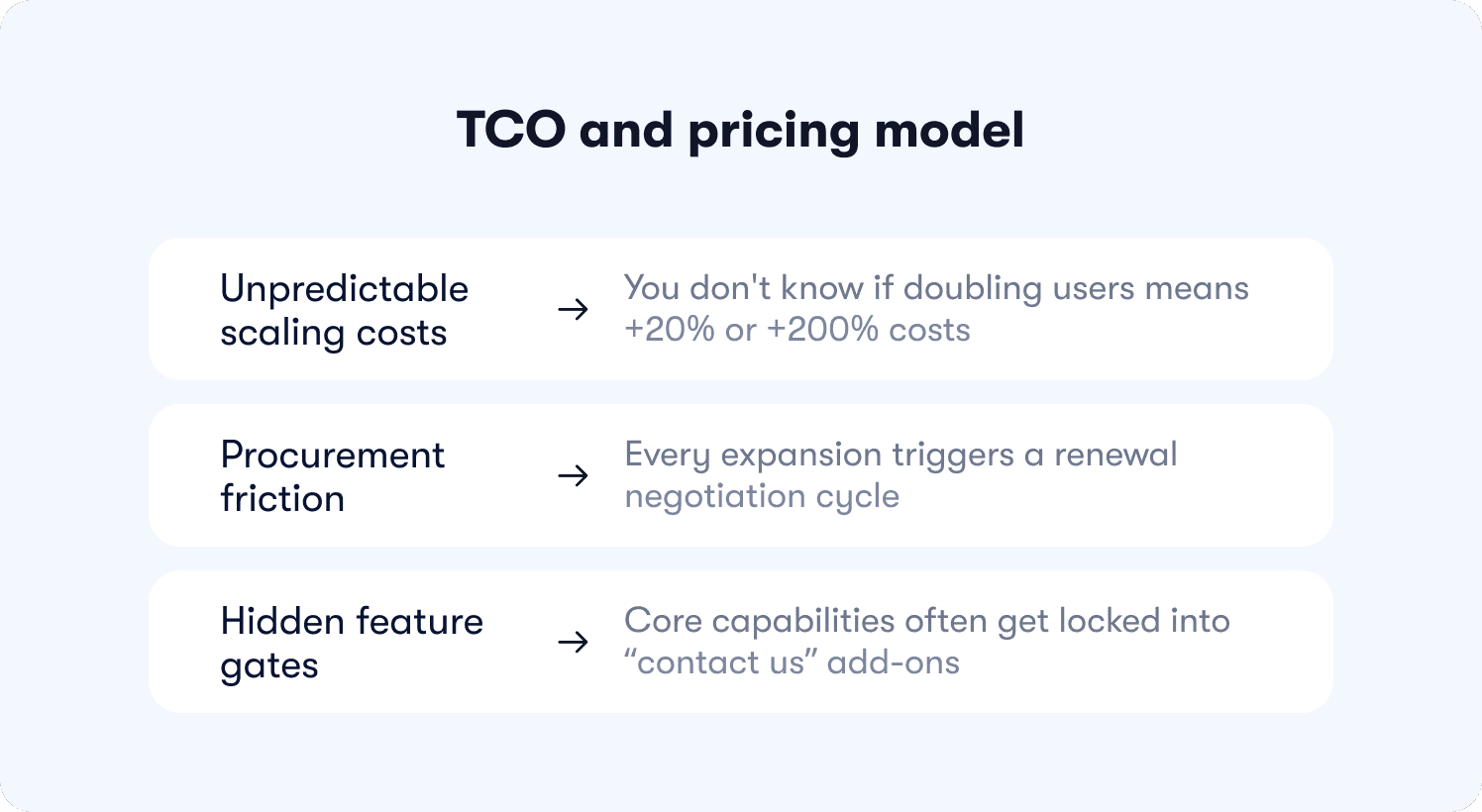
Opaque pricing makes that calculation impossible. Enterprise platforms that require custom quotes create three problems:
Unpredictable scaling costs: You don't know if doubling users means +20% or +200% costs
Procurement friction: Every expansion triggers a renewal negotiation cycle
Hidden feature gates: Core capabilities often get locked into “contact us” add-ons
Transparent pricing lets you model growth scenarios. The predictability itself becomes a decision-making advantage.
Criterion | What to look for | Revenue outcome |
|---|---|---|
Activation mechanics | PMs iterate without engineering + native activation-to-revenue measurement | Trial-to-paid conversion lift you can prove to leadership |
Feature adoption visibility | Feature usage patterns tied to upgrade/churn predictions | CS can prioritize high-value accounts and prevent cancellations |
TCO transparency | Published pricing with public calculator | Finance models scaling costs without procurement surprises |
8 alternatives to Pendo for in-app guidance and user onboarding
If Pendo isn’t solving your activation or onboarding challenges, there’s no shortage of alternatives — but most solve different problems. The tools below aren’t ranked by features, but by how they help teams improve onboarding outcomes, iterate faster, and connect user behavior to revenue.
1. Jimo — Best for activation-focused teams who need to prove ROI to leadership
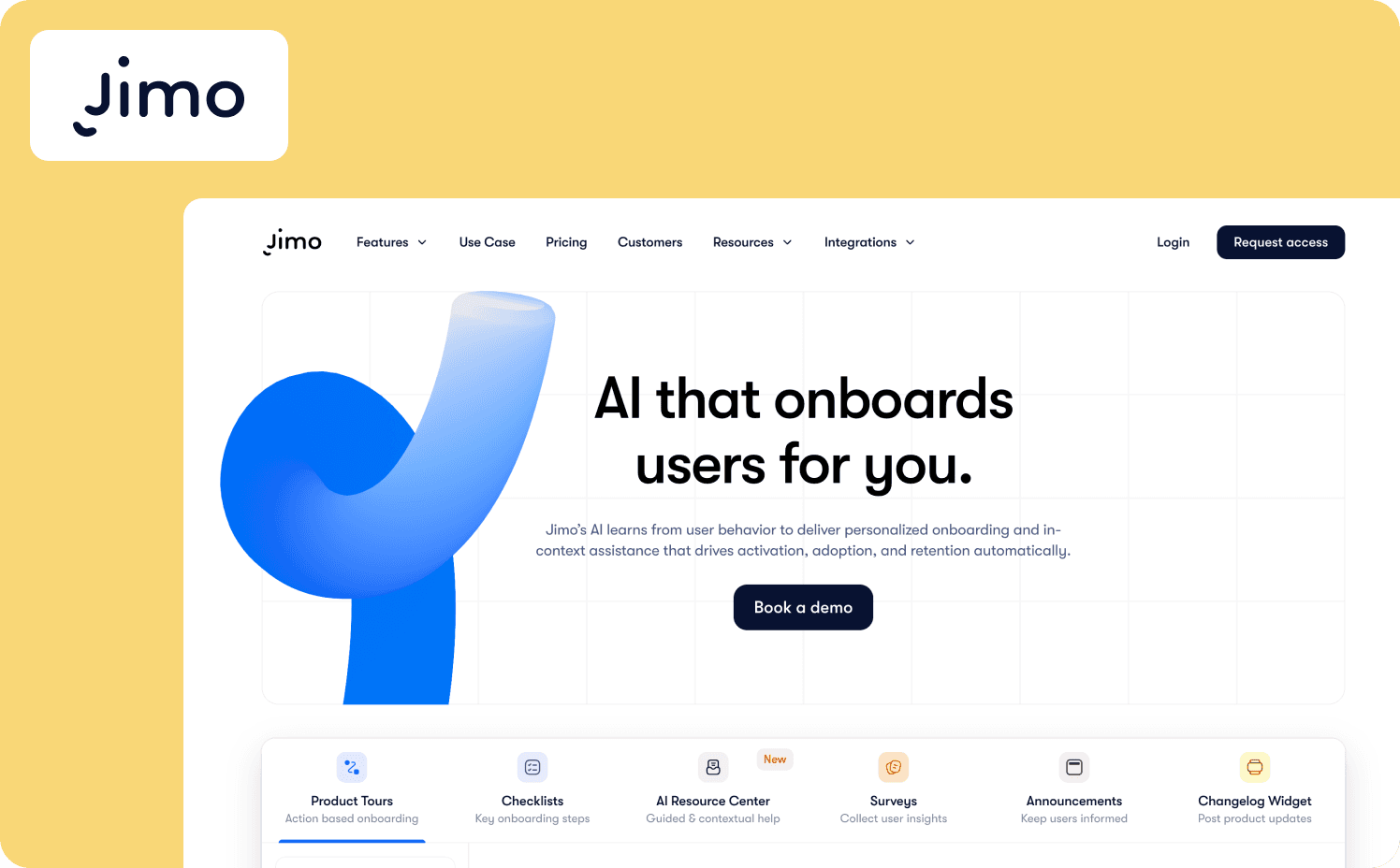
Jimo is a leading digital adoption platform built for product-led B2B SaaS teams where activation drop-off is the primary bottleneck and leadership demands proof that onboarding investments move retention, not just engagement metrics. The platform distinguishes itself through action-based Smart Cursor tours that eliminate the traditional "Next" button, replacing linear click-through sequences with event-driven progression tied to real user behavior analytics.
Key differentiator: Most SaaS products scatter help across five disconnected places. Jimo's Resource Center consolidates everything into a single in-app widget. Ask AI for instant answers, guided tours that launch directly, persistent checklists, embedded videos, docs, and support chat shortcuts. The interface adapts dynamically by user segment, page, and user journey stage.
This consolidation pairs with tours that advance when users perform actual activation behaviors. AI generates complete tours in 30 seconds, letting teams ship 20+ experiments in two hours. And Jimo’s Success Tracker proves causation with actionable insights like “Users who completed the onboarding checklist converted to paid at 2.3x the rate of self-guided users.”
Strengths:
Native integrations with Segment, HubSpot, Salesforce consolidate activation data across the growth stack.
Built-in cohort analysis connects tours to activation lift and retention outcomes with statistical significance.
Bundled surveys, NPS, and user feedback collection enable tight iterate-test-deploy cycles.
Multiple tour formats (tooltips, modals, checklists, hints, banners) adapt to different activation contexts without rebuilding flows.
Limitations: Jimo focuses on web applications rather than native iOS/Android mobile apps. The platform is not suited for enterprises needing cross-application guidance or teams requiring heavy enterprise features, governance, audit trails, and role-based approval workflows for heavily regulated industries
Why pick this over Pendo: Jimo's action-based tours advance only when users complete real activation behaviors, directly addressing Pendo's limitation where conditional branching requires expensive add-ons and manual syntax configuration. The Success Tracker provides proof of activation impact through cohort-level attribution showing how guidance moves retention.
Starter: $249/mo (2,500 MAUs)
Growth: $479/mo (2,500 MAUs)
Enterprise: Custom
2. Appcues — Best Pendo alternative for cross-channel engagement without developer dependency
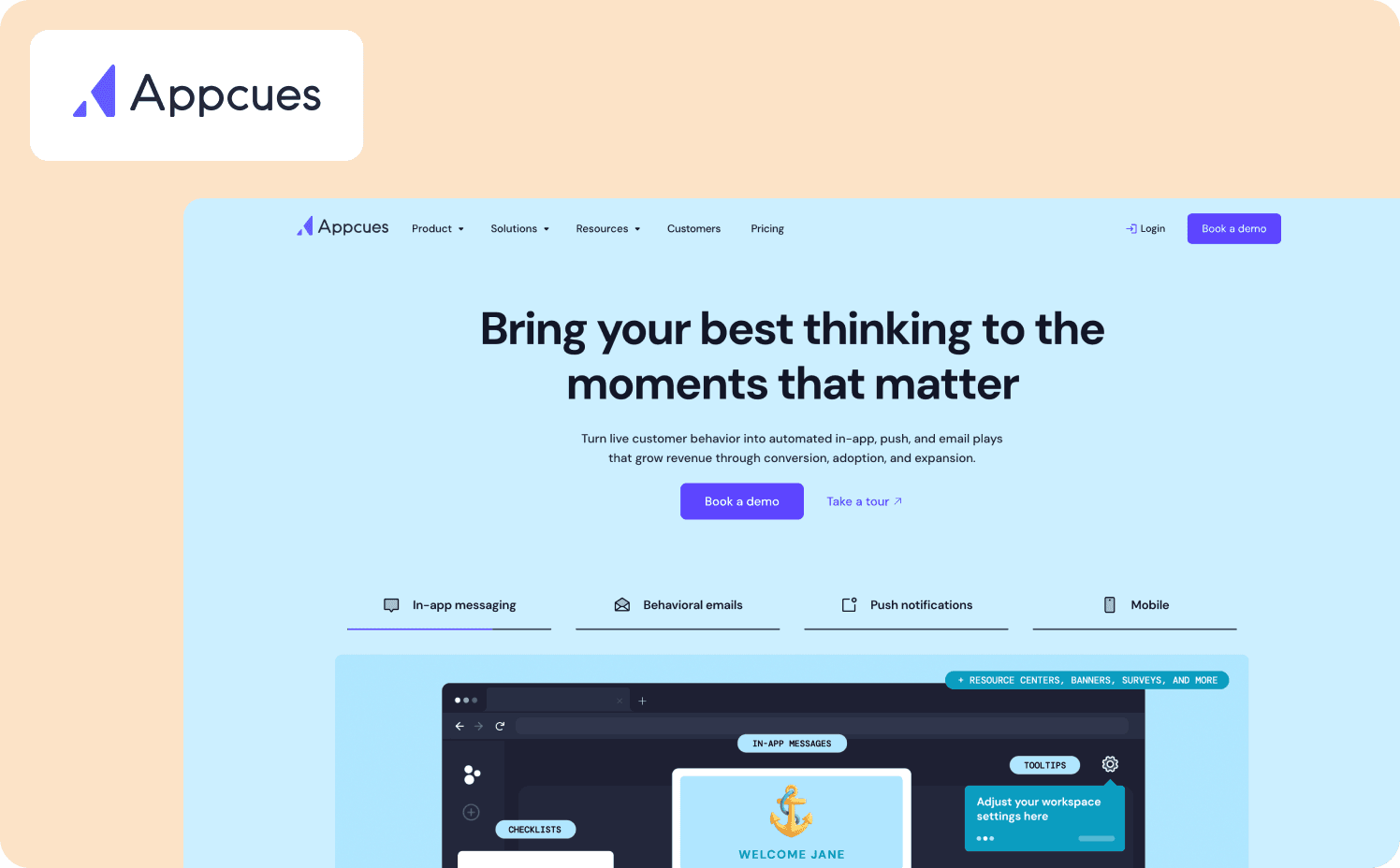
Appcues is a no-code customer engagement platform that lets product, growth, and marketing teams create in-app experiences, behavioral emails, and push notifications without engineering help.
Key differentiator: Workflow orchestration connects in-app messages, email, and push notifications across up to 75 workflow nodes with branching logic, enabling teams to coordinate multi-channel campaigns without technical resources.
Strengths:
Visual builder creates brand-native experiences without CSS knowledge.
Pre-built templates for common onboarding patterns accelerate deployment.
Native integrations with Segment, Amplitude, Mixpanel, Salesforce, and HubSpot.
Limitations: Tours require manual configuration for each segment, meaning behavioral triggers don't automatically adjust flows based on real-time user actions. While Appcues supports control group experiments and activation rate measurement, teams must manually configure tests and interpret results.
Why pick this over Pendo: Appcues extends engagement beyond in-product messaging with cross-channel workflows that coordinate email, push notifications, and in-app experiences through a single platform. Choose Appcues when product marketing or growth teams need to orchestrate multi-channel campaigns without managing separate tools for each channel.
Pricing:
Grow: $750/mo for 1,000 MAUs
Enterprise: Custom pricing
3. Userpilot — Best for activation-focused teams who need consolidated analytics and engagement
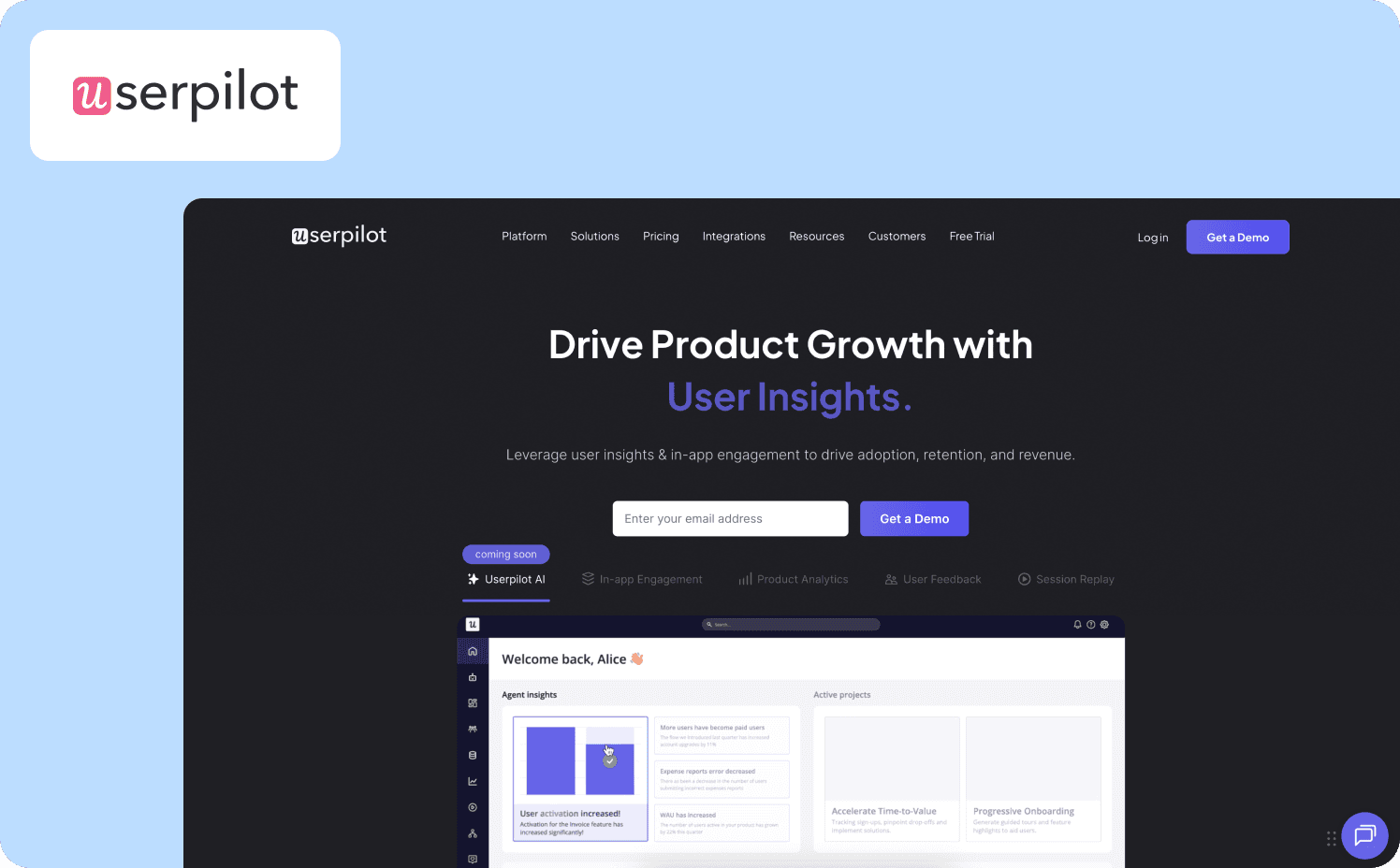
Userpilot is a no-code product growth platform combining user onboarding, in-app engagement, product analytics, the ability to collect user feedback, and session replay for web and mobile apps.
Key differentiator: The all-in-one platform consolidates tools that teams typically buy separately, like onboarding flows, product analytics, NPS surveys, session replay, and resource centers.
Strengths:
Visual flow builder supports modals, tooltips, slideouts, banners, checklists, and hotspots.
Native analytics track custom events, funnels, retention cohorts, and feature usage with automatic event capture.
Built-in A/B testing validates which onboarding variations improve activation rates.
Limitations: Teams get many capabilities with Userpilot, but fewer specialized, key features compared to point solutions. Advanced analytics users may find funnel customization options less granular than dedicated analytics tools.
Why pick this over Pendo: Choose Userpilot when activation and retention matter more than exhaustive retrospective analytics..
Pricing:
Starter: $299/mo (includes 2,000 MAUs)
Growth: Custom (includes 5,000 MAUs)
Enterprise: Custom (includes 10,000 MAUs)
4. Whatfix — Best for cross-application workflows spanning employee and customer-facing systems
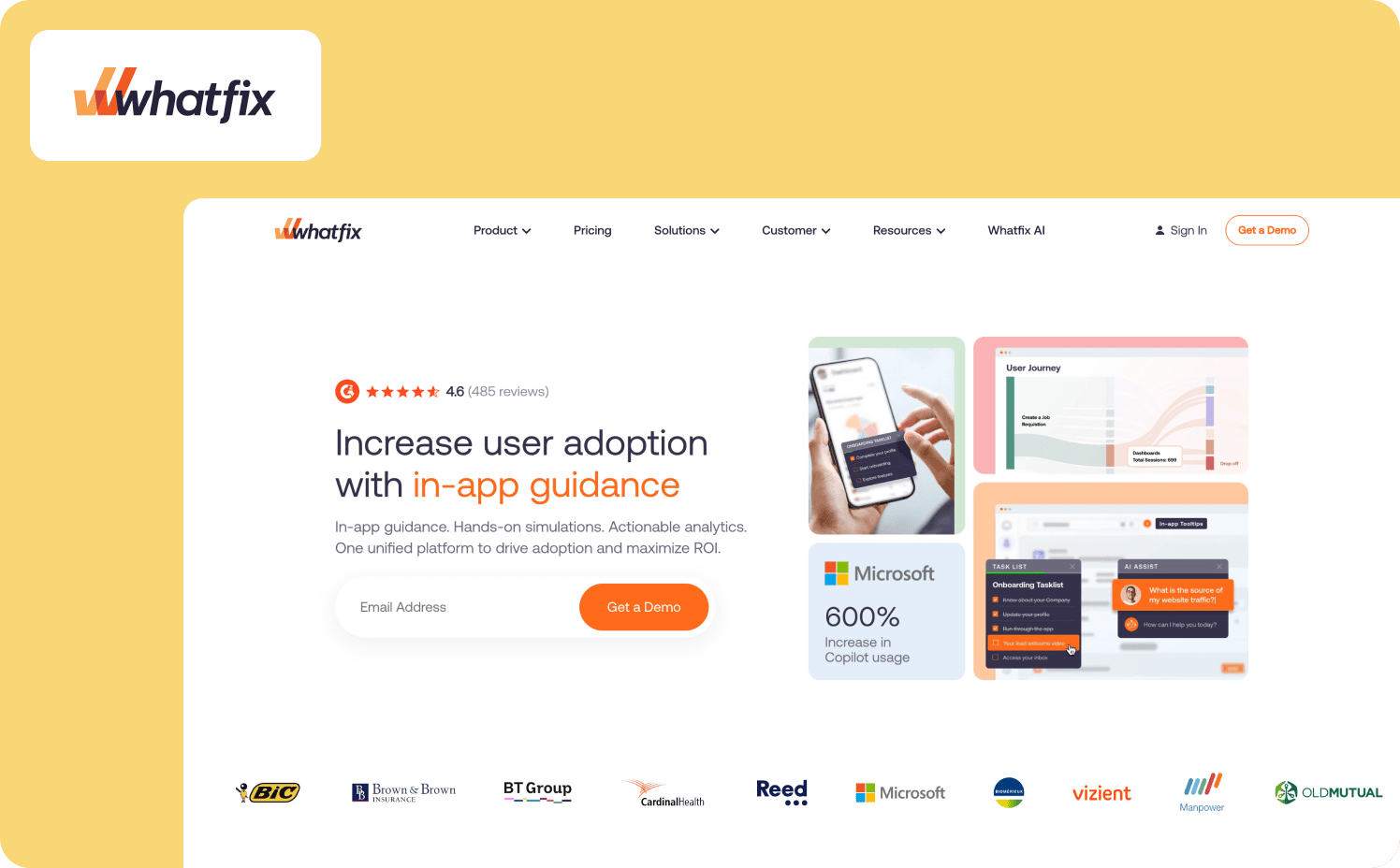
Whatfix is an AI-powered digital adoption platform delivering contextual in-app guidance across desktop, web, and mobile applications for both internal employees and external customers.
Key differentiator: Whatfix’s cross-application workflow support in-app guides users through processes that span multiple enterprise systems without disruption. Mirror sandbox environments provide hands-on software training in interactive replicas of applications without risking live data.
Strengths:
AI agents accelerate content creation, provide contextual user support, and generate insights from user behavioral data.
Self Help widget with user feedback collection, size adjustment, multilingual audio, and segmented content delivery.
Product Analytics module offers no-code event tracking, funnels, cohorts, and real-time insights.
Limitations: Since Whatfix is an enterprise-focused platform, it has higher implementation complexity compared to tools designed for product teams only. Mirror sandboxes also require separate setup and maintenance for each application replica.
Why pick this over Pendo: Whatfix Mirror creates turnkey sandbox replicas for hands-on training without engineering dependencies, while Pendo requires organizations to create and maintain separate staging environments where Pendo can then be installed.
Pricing:
Standard: Custom
Premium: Custom
Enterprise: Custom
5. WalkMe — Best for enterprise-scale automation across complex multi-application workflows
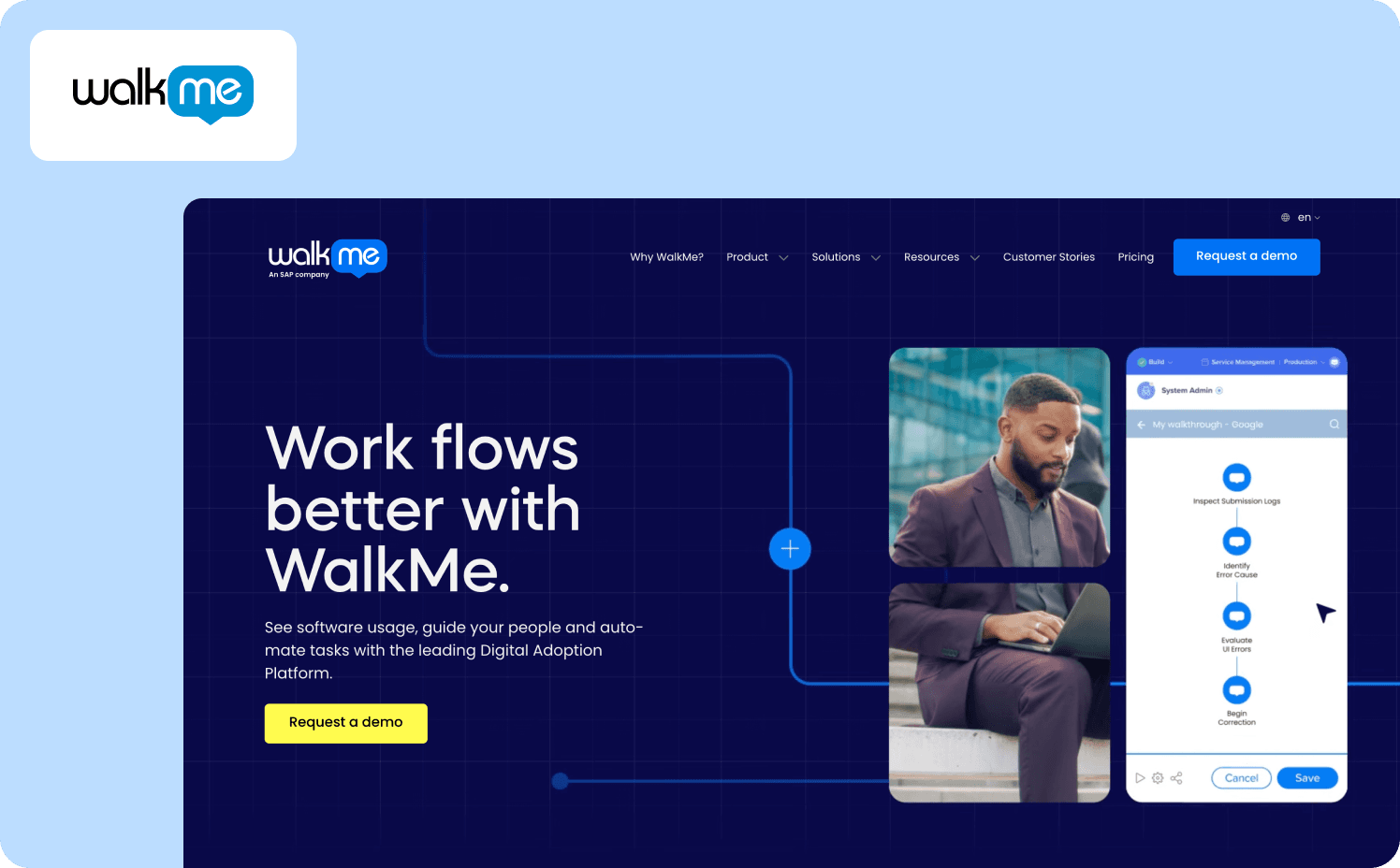
WalkMe is a digital adoption platform that overlays AI-driven guidance, automation, and analytics onto web, desktop, and mobile applications.
Key differentiator: WalkMe’s contextual AI copilot delivers next-best-action recommendations, workflow automation, and adaptive guidance that learns from user behavior across applications.
Strengths:
ActionBot automates tasks without API integration.
Smart Walk-Thrus, Task Lists, Smart Tips, Pop-Ups, and Beacons guide users through processes.
Learning Arc embeds microlearning, simulations, and reinforcement directly into workflows.
Limitations: WalkMe requires dedicated resources and longer deployment timelines compared to lighter product adoption tools. Pricing transparency is also limited.
Why pick this over Pendo: Pendo offers limited in-guide automation (auto-clicks, auto-fills) but lacks cross-application task execution capabilities whereas WalkMe's AI-powered ActionBot automates repetitive workflows.
Pricing:
WalkMe for employees: Custom
WalkMe for customer: Custom
6. Chameleon — Best Pendo alternative for teams that need fine-tuned control over every design element
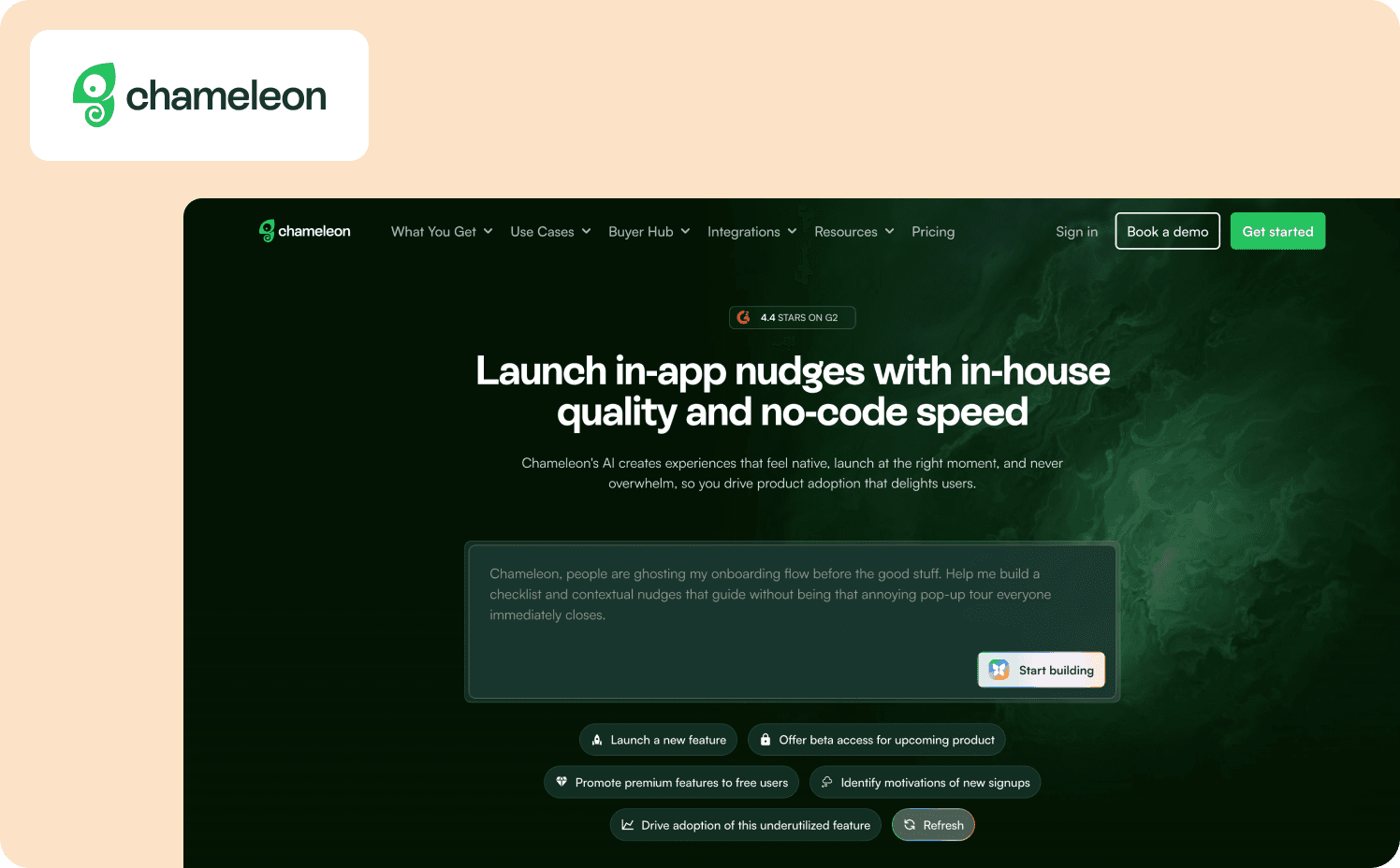
Chameleon is a product adoption platform that creates in-app experiences through tours, tooltips, banners, checklists, microsurveys, and launchers without code.
Key differentiator: Copilot AI agent creates production-ready campaigns through conversational prompts, handling research, strategy validation, experience building, and targeting configuration while teams focus on final refinements.
Strengths:
CSS-level customization ensures experiences match product design systems precisely.
Interactive demos enable product education and evaluation beyond basic onboarding.
Two-way analytics integrations with Mixpanel, Amplitude, Heap, and FullStory consolidate accurate data.
Limitations: Chameleon’s advanced features carry a learning curve. Small teams with basic onboarding needs may find it offers more capability than required.
Why pick this over Pendo: Choose Chameleon when AI-driven optimization matters more than Pendo's retrospective analytics depth. While both platforms offer native A/B testing, Chameleon's Copilot can automatically generate test variants whereas Pendo requires manual variant creation.
Pricing:
Free: Unlimited product-connected interactive demos
Startup: From $279/mo (1,000 MAUs)
Growth: From $15,000/year (1,000 MAUs)
Enterprise: Custom
7. Userlane — Best for enterprise employee training with standardized adoption measurement
Userlane is a no-code digital adoption platform built for enterprise organizations training employees across complex software stacks.
Key differentiator: HEART Analytics framework provides a standardized model to measure digital adoption success across enterprise applications with five core dimensions.
Strengths:
Drag-and-drop editor creates interactive Guides without coding.
AI-powered Assistant delivers contextual, agentic support across all applications with Microsoft Azure integration.
Content Analytics tracks Guide performance with completion rates, drop-offs, and failure metrics.
Limitations: Userlane prioritizes employee training workflows over product-led growth activation mechanics that SaaS teams typically need. It also doesn’t have public pricing available.
Why pick this over Pendo: Userlane trains employees on internal enterprise systems (SAP, Workday, Salesforce) while Pendo helps you understand user behavior in your SaaS product. If your goal is to standardize employee training across complex enterprise software, then pick Userlane.
Pricing:
No published pricing
8. Gainsight PX — Best for teams running product and customer success from one platform
Gainsight PX combines product analytics with in-app engagement and user feedback tools, and also natively integrates with Gainsight's Customer Success platform.
Key differentiator: AI-powered Product Mapper automatically instruments your entire product hierarchy without manual tagging or coding.
Strengths:
Native email campaigns triggered by product usage behavior eliminate separate ESP integrations.
Unified PX-CS data model connects feature adoption metrics directly to customer health scores and renewal forecasting.
Feature-level customer retention analysis identifies "Golden Features" that correlate with long-term customer value.
Limitations: There’s a steep learning curve that requires significant time investment across product, marketing, and customer success teams to master both basic functions and advanced key features.
Why pick this over Pendo: If coordinating product adoption insights with CS operations matters more than Pendo's standalone analytics depth, go with Gainsight PX.
Pricing:
No published pricing
When to pick an analytics platform over Pendo
The best product analytics tools like Heap, Mixpanel, PostHog, and Smartlook represent a fundamentally different architectural choice than Pendo. These platforms excel at behavioral measurement with automatic event tracking. They can track retention curves, cohort analysis, and feature adoption with a data science layer to analyze product usage. But, they either lack native in-app guide builders entirely or offer lightweight implementations that don't match dedicated adoption tools.
Heap and Mixpanel measure guide performance beautifully but require integrating with a product adoption platform to actually create tours, tooltips, and walkthroughs. PostHog includes basic Surveys and Workflows for triggered messages, while Smartlook pairs session recordings with event tracking, but both acknowledge they can't replace Pendo's visual editor for sophisticated onboarding flows
The decision comes down to stack architecture. If you already run Amplitude, Mixpanel, or Heap for user analytics and just need adoption onboarding tools, adding Appcues as a lightweight layer costs less than replacing your entire analytics infrastructure with Pendo. Or, if you're starting fresh or want non-technical teams shipping onboarding experiments without engineering dependency, Pendo's bundled analytics-plus-guidance eliminates vendor fragmentation and delivers faster time-to-value.
The real cost of Pendo (and what alternatives charge)
Transparent pricing versus enterprise contact sales models creates different planning realities. When pricing isn’t public, it makes it impossible to calculate growth. “Their pricing model makes growing with them very costly, especially if part of your growth strategy includes acquisition,” one G2 reviewer says.
Pendo's opacity problem is that base pricing requires sales negotiations. Core capabilities like session replay, white-labeled NPS, and advanced guides get sold as separate add-ons with undisclosed pricing. The problem isn't whether they charge per MAU or per seat. It's that you can't model future costs without triggering a procurement cycle.
Jimo delivers pricing clarity with transparent MAU-based rates. That means no discovery calls, no custom quotes, no hidden feature gates. The 21-day trial provides full functionality so teams prove activation lift before budget conversations.
What switching from Pendo actually looks like
If you’re convinced that a Pendo competitor on this list makes more sense for your team, know that full platform migration typically takes 2–4 weeks once contracts finalize. The timeline variation depends less on technical barriers and more on how much you're porting versus rebuilding.
What migrates easily
User segmentation definitions, basic tour logic, and event tracking structures transfer with minimal rework. Most platforms export messaging templates, targeting rules, and survey configurations through CSV or API handoffs that preserve content structure. The lift-and-shift portion, getting your user data, account hierarchies, and simple tooltip sequences into the new system, completes quickly once snippet installation validates.
What requires rebuilding
Complex multi-step flows need manual recreation because each platform uses different event architectures and CSS selector syntax. Deep analytics integrations reset entirely, so your existing Pendo dashboards, custom reports, and historical cohort data typically don't transfer. Third-party connector logic (Mixpanel, Amplitude, Salesforce) requires rebuilding from scratch.
The critical measurement happens in the first 30 days. What’s your activation rate for users exposed to new onboarding versus those who aren't. Run both platforms in parallel with a holdout test. If the new platform drives meaningfully higher activation, the switch worked. If activation stays flat or drops, the issue was flow design, not Pendo. That diagnosis happens before you cancel the old contract. This controlled comparison isolates tool impact from seasonal variation or product changes, giving leadership the attribution proof that migration investment requires.
Your alternative to Pendo depends on what's actually broken
The right Pendo alternative hinges on whether your core problem is analytics depth or activation drop-off. If you need behavioral forensics, the best alternatives to Pendo for analytics include platforms like Heap or Mixpanel. If your problem is that users don't finish onboarding and you can't prove why tours fail, you need a measurement-first activation platform.
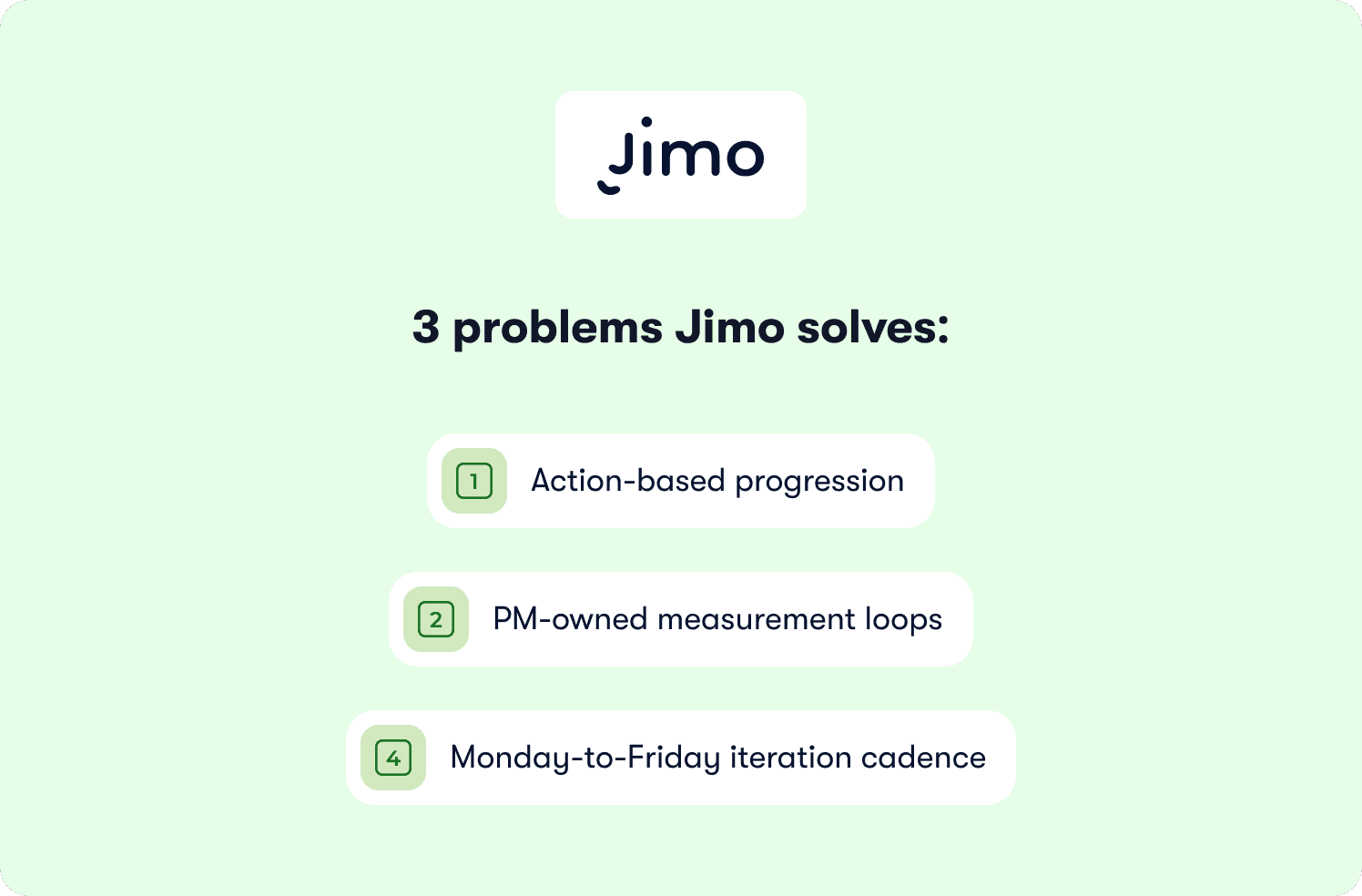
For teams where activation is the gap, Jimo solves three problems Pendo leaves unaddressed:
Action-based progression with gaming mechanics ensures tours advance only when users complete the required behavior, so completion equals activation, not clickthrough theatre.
PM-owned measurement loops eliminate engineering dependencies for proving lift
Monday-to-Friday iteration cadence turns activation into a testable system: Review funnel Monday, ship targeted fix same day, measure lift by Friday.
See how activation measurement works at scale and book a demo with Jimo today.
FAQ
What's the biggest limitation of Pendo for product-led growth teams?
Pendo excels at product analytics and tracking user behavior, but fixing drop-offs requires engineering sprints. While the platform captures user interactions and reveals where users abandon, implementing changes to improve user engagement demands developer resources most product teams lack. The result is you see the problem but can't iterate fast enough to solve it without technical dependencies that slow activation improvements.
Can I use Google Analytics or Amplitude with Pendo alternatives for in-app guidance?
Yes, many teams use external analytics tools like Google Analytics, Amplitude, or Mixpanel for product usage data while adopting specialized onboarding platforms for in-app guidance. This hybrid approach works when you want best-in-class behavioral analytics depth alongside no-code engagement tools. The trade-off is synchronizing advanced user segmentation between systems and ensuring product usage data flows consistently to both platforms for unified user journey mapping.
What should I look for in a Pendo alternative if activation is my bottleneck?
Prioritize platforms with automatic data capture that prove whether users complete tasks and whether completion improves conversion rates. Look for advanced user segmentation that targets experiences based on real-time product usage data, PM-owned deployment that eliminates engineering dependencies, and built-in measurement showing activation lift versus control groups. The best Pendo alternatives for activation combine user journey mapping with rapid iteration cycles, not just tracking user behavior but enabling teams to fix drop-offs within days.
Why do some teams pay more for Pendo as they scale?
Pendo's MAU-based pricing increases as monthly tracked users grow, creating unpredictable costs when activation improvements succeed. Key features require separate add-ons with undisclosed pricing negotiated through sales.
Which Pendo alternatives are more affordable for product-led growth?
Jimo, Appcues, and Userpilot deliver the strongest value for startups needing product analytics platform capabilities without enterprise pricing. Jimo provides transparent MAU-based pricing with action-based progression and built-in measurement proving activation lift. Appcues and Userpilot offer solid onboarding tools with real-time analytics and no cost barriers. Even cheaper Pendo alternatives tend to lack advanced product analytics and customer satisfaction measurement capabilities that growing teams eventually need.