TL;DR
WalkMe was built for employee training on enterprise applications, and it's good at that. But most SaaS teams evaluating WalkMe alternatives in 2026 have a different problem. There’s trial users who don't convert, activation gaps that compound monthly, and they’re locked in with an onboarding tool that can't connect its own output to revenue. This guide covers nine WalkMe competitors across three tracks: enterprise IT, analytics-first, and those primarily focused on activation.
Digital adoption platforms serve three fundamentally different use cases: employee training on third-party enterprise software, product analytics for understanding user behavior, and customer activation for converting trial users to paid accounts. Pick the wrong category and your digital adoption platform investment compounds your activation problem instead of solving it.
WalkMe dominates the first category. But the recent SAP acquisition, 15-month ROI timelines, and four-month implementations make it increasingly hard to justify for the second and third.
Some enterprise IT teams simply want WalkMe's capabilities without the SAP dependency. Others need analytics-first platforms or activation-focused tools that connect onboarding flows directly to revenue. This guide covers nine WalkMe alternatives across all three tracks so you can verify which architecture actually matches your problem before signing another multi-year contract.
Why teams look for WalkMe competitors
WalkMe was one of the early players in the digital adoption platform category. With roughly 2,000 corporate customers, including about 155 Fortune 500 firms and 243 of the Global 2000, WalkMe's enterprise credentials are legitimate. The platform handles cross-application workflows, maintains compliance certifications (FedRAMP, ISO, SOC2), and supports desktop applications alongside web-based systems.
For large organizations training employees on SAP, Salesforce, and Workday, WalkMe remains the industry standard for digital transformation.
For enterprise IT teams — four switch triggers
Four business outcomes drive enterprise IT teams to reevaluate WalkMe in 2026. Each trigger connects to measurable cost, whether that’s budget uncertainty, implementation delays, ongoing maintenance, or roadmap risk.
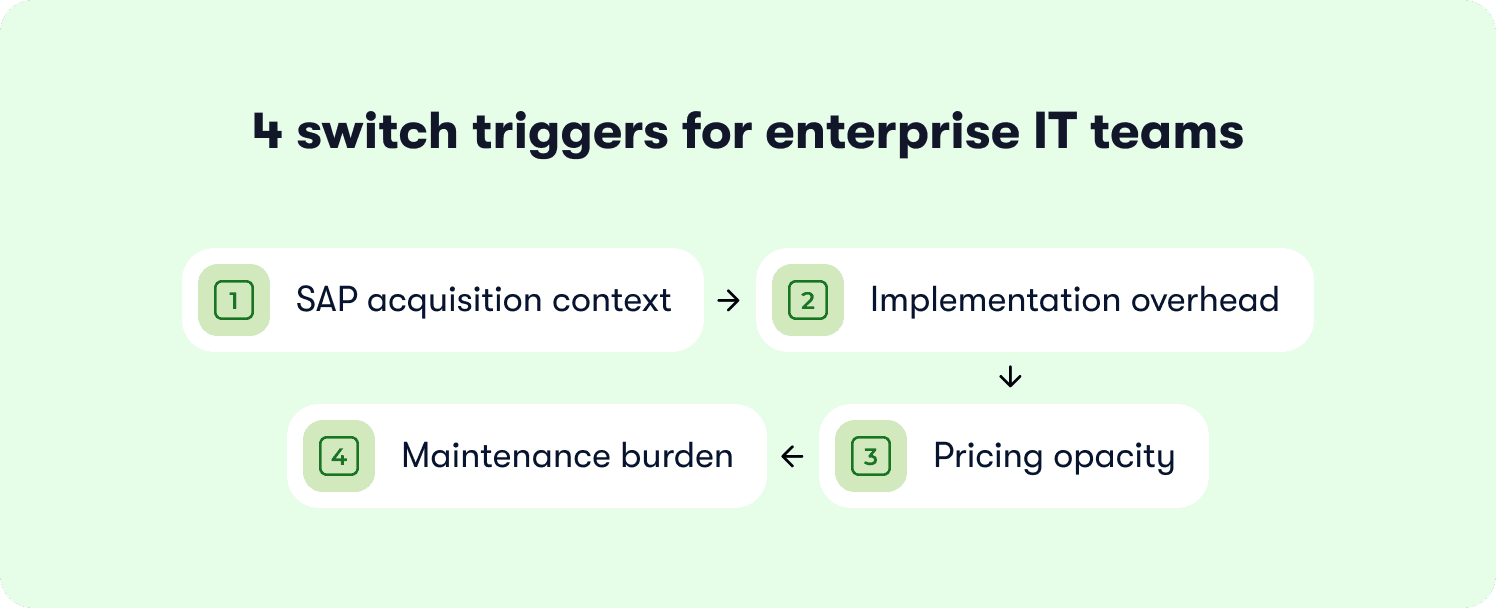
SAP acquisition context: SAP closed the WalkMe acquisition in September, 2024. For SAP customers, this creates tighter Joule integration and S/4HANA alignment. For non-SAP buyers running Workday, Oracle, Salesforce, and custom SaaS stacks, the acquisition introduces uncertainty about R&D priorities and roadmap direction under SAP ownership.
Implementation overhead: The average WalkMe deployment can take 3-6 months (typically 4 months) for Fortune 500 large enterprises. “Setting up walkthroughs or customizing guidance can sometimes feel a bit time-consuming and complicated,” notes one G2 user. When activation rate is the bottleneck, a four-month implementation means four more months of flat trial-to-paid conversion.
Pricing opacity: WalkMe doesn’t publish pricing, all their plans require custom enterprise pricing with multi-year lock-ins. Add-ons (analytics modules, mobile support, advanced automation) are priced separately, making it difficult for finance teams to model costs as you scale from 5,000 to 50,000 Monthly Active Users.
Maintenance burden: WalkMe relies on CSS selectors for element identification, creating fragility when products ship updates. “It often requires a dedicated team to keep the content current, otherwise, the guidance can become unreliable or outdated fast,” says a G2 reviewer. PM cycles are spent on ongoing maintenance instead of shipping new features and fixing tours rather than launching experiments that lift activation rate.
For product-led SaaS teams — the wrong tool problem
WalkMe is employee-training-first. It's architected for IT teams rolling out Salesforce and Workday to 10,000 employees, not for product teams improving customer trial-to-paid conversion in a self-serve SaaS product.
The average SaaS activation rate is 36%. That's data from 500+ products surveyed by Lenny Rachitsky's benchmarking study. When signups grow but conversion stays flat, you're wasting CAC on users who never reach their first value moment.
WalkMe's average time to measurable ROI is 15 months. Modern product-led SaaS companies talk about “60-second Aha moments” — the instant a new user first experiences real value. When your CFO asks why trial-to-paid conversion is stuck at 22% despite $400K in marketing spend, the answer isn't “we're 11 months into a WalkMe implementation.”
What you should consider when evaluating WalkMe competitors
Five criteria determine whether a WalkMe alternative actually serves your use case better.
💡 Enterprise buyers should verify compliance posture before shortlisting:
SOC 2 Type II audit recency
GDPR-compliant data handling (especially for EU customers)
Audit log availability for compliance reviews.
These requirements are non-negotiable table stakes. Surface these blockers during evaluation, not after contract signature.
1. Use case fit: Employee training vs product-facing adoption
WalkMe is designed for employee training on third-party enterprise applications like SAP, Workday, Salesforce. That's a fundamentally different problem than customer activation. Product-led SaaS companies need to know whether trial users complete the behaviors that predict paid conversion.
Can you tag any UI element without filing an engineering support ticket? Do tours auto-progress on real user actions, or do users click “Next” three times and forget everything? The wrong architecture for the wrong use case wastes both budget and pipeline.
2. Implementation speed & time-to-value
WalkMe deployments average 4 months. Modern WalkMe alternatives range from days (Jimo, Userflow) to weeks (Userpilot, Appcues). That gap is opportunity cost. If 1,000 trials arrive monthly and 64% abandon before first value, that's $64,000 in wasted acquisition spend at $100 CAC. Every week you delay fixing activation is another week it compounds.
“I spent so much time building the tours with WalkMe that at some point you just get discouraged,” says Jacqueline LE, Project Manager at Hivebrite who switched from WalkMe to Jimo. “You don’t update them anymore, which is not a good thing.”
3. SAP ecosystem dependency
The SAP acquisition creates a straightforward conflict of interest question. Does your stack align with SAP's strategic priorities, or are you running tools SAP now competes with?
For everyone outside the SAP ecosystem, this is a reason to evaluate digital adoption platforms cleanly. Whatfix handles enterprise multi-app guidance without SAP ties. Jimo, Pendo, and Userpilot operate where SAP has no stake.
4. Pricing model & total cost of ownership
Published pricing enables faster procurement and predictable budgeting as you scale. Custom enterprise pricing introduces opacity. WalkMe, Whatfix, Pendo, and Gainsight PX are all competitors to WalkMe that require custom quotes with pricing varying significantly by negotiation leverage. Multi-year commitments lock you in before you know if activation rates actually improve.
5. Behavioral adaptability and measurement loop
Traditional digital adoption platforms report static tour completion rates. But static tours average 27% completion. Action-based tours that auto-progress when users complete real tasks achieve 44% completion, nearly 2× better. Plus, if your tool only reports tour clickthrough rates, you can't make the CFO case that software adoption spend drives revenue.
Criterion | WalkMe approach | Modern WalkMe alternatives |
Use case | Employee training on enterprise software | Customer activation in product-led SaaS |
Implementation | 4+ months, professional services typical | Days to weeks, rapid deployment |
Pricing | Custom enterprise pricing only, multi-year commitments | Transparent MAU-based or custom depending on vendor |
Measurement | Tour completion tracking | Connects activation behavior to retention and revenue outcomes |
Best WalkMe alternatives at a glance
The nine WalkMe competitors are grouped by evaluation track (enterprise IT, analytics-first, and activation-focused) based on the primary outcome each platform is built to deliver.
Of the nine competitors of WalkMe in this guide, Whatfix is the only platform that directly replicates WalkMe's enterprise IT architecture. If cross-application employee training at Fortune 500 enterprise scale is your primary requirement whether that's structured training for enablement teams, internal training on Salesforce or Workday, or knowledge management across business units, the rest of this list serves a different problem.
Tool | Best for | Evaluation track | Pricing starts at |
Jimo | Measuring activation-to-revenue impact | Activation-focused | $249/mo (2,500 MAUs) |
Appcues | Cross-channel engagement & PLG experimentation | Activation-focused | $750/mo (1,000 MAUs) |
Userflow | Fast deployment for lean product-led SaaS teams | Activation-focused | $240/mo (3,000 MAUs) |
Chameleon | Maximum CSS customization & brand matching | Activation-focused | $279/mo (1,000 MAUs) |
Userpilot | All-in-one activation with built-in adoption analytics | Activation-focused | $299/mo (2,000 MAUs) |
Tandem | AI-agent onboarding for complex workflows | Activation-focused | $149/mo (500 MTUs) |
Whatfix | Enterprise employee + customer app guidance | Enterprise IT | Custom |
Pendo | Deep product analytics + in-app guidance | Analytics-first | Custom |
Gainsight PX | Linking product usage to CS health scores | Analytics-first | Custom |
9 WalkMe competitors you should consider in 2026
These nine WalkMe alternatives split into three evaluation tracks: enterprise IT teams needing multi-app guidance without SAP dependency, product-led growth teams measuring customer activation, and CS-led organizations tying product usage to health scores. Self-identify your track based on whether your primary outcome is employee productivity, trial-to-paid conversion, or customer retention.
1. Jimo — Best for product-led SaaS teams measuring activation-to-revenue impact
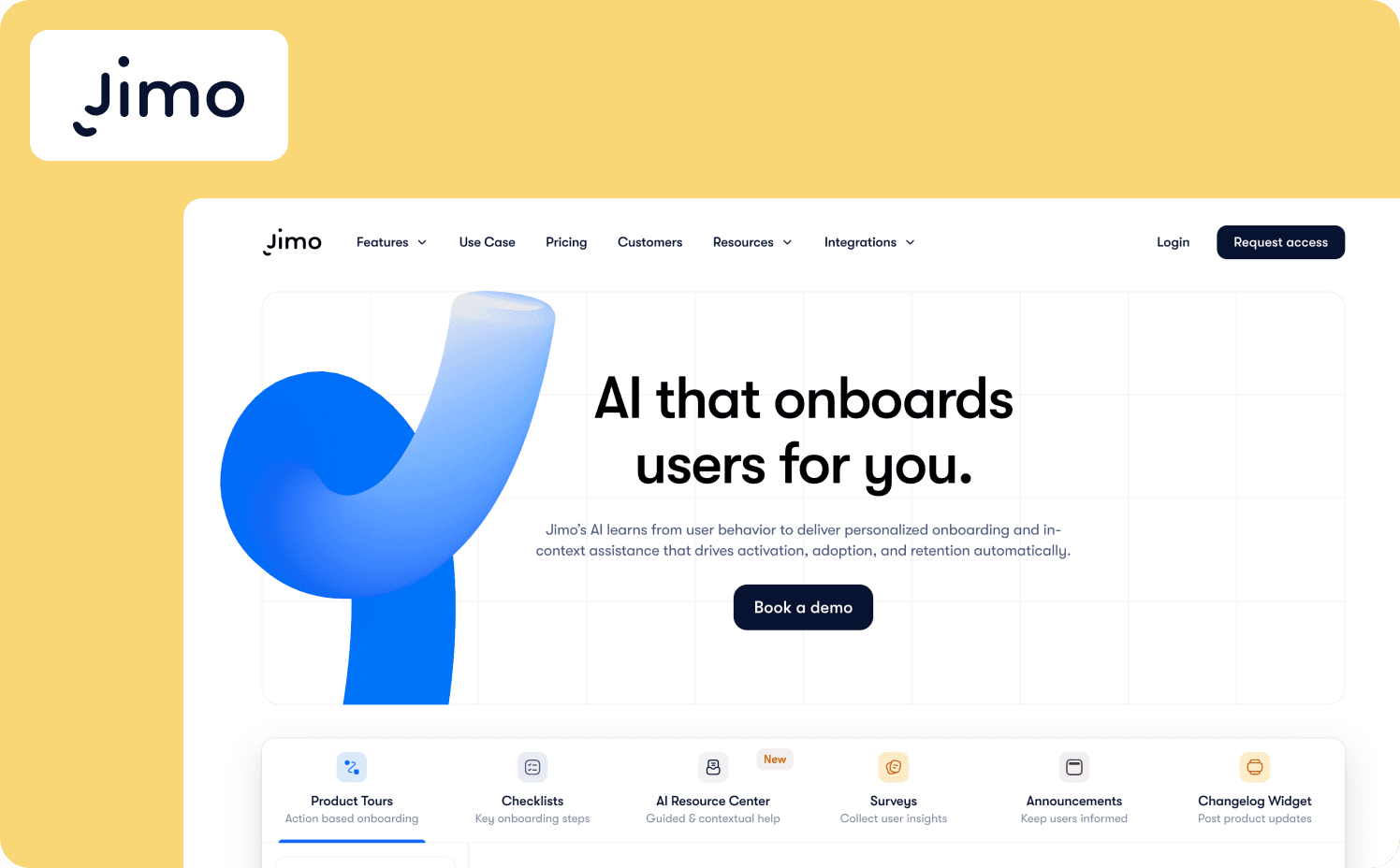
Jimo is an AI-native digital adoption platform built for B2B SaaS product teams where activation rate directly affects bookings. The platform combines no-code product analytics with in-app guidance, enabling product managers to detect drop-offs and launch interventions without engineering dependencies.
Key differentiators:
Success Tracker: No-code feature usage analytics with step-by-step drop-off visualization. PMs tag any feature, set goals, and view drop-offs without engineering involvement.
Action-based product tours: Tours auto-progress based on actual user actions. The gaming-inspired cursor mechanism shows users what to do.
Closed-loop activation: Detect a drop-off in adoption analytics, launch a targeted hint, modal, or checklist in minutes. Connect onboarding interactions directly to retention-predictive events without manual CRM mapping.
Where it falls short: If your primary need is enterprise employee training across SAP, Salesforce, Workday, or Oracle, Jimo isn’t the right fit. Jimo is built for a different problem: B2B SaaS teams improving customer trial-to-paid conversion and feature adoption without months of implementation complexity.
When to choose Jimo over WalkMe:
You're measuring activation rate as a revenue metric and need to connect onboarding behavior to conversion outcomes.
Trial-to-paid conversion is flat despite signup growth.
Your product team needs to ship onboarding experiments without engineering sprint dependencies.
You need closed-loop: analytics → intervention → measurement in one platform.
Starter: $249/mo (2,500 MAUs)
Growth: $479/mo (2,500 MAUs)
Enterprise: Custom
2. Appcues — Best for cross-channel engagement & PLG experimentation
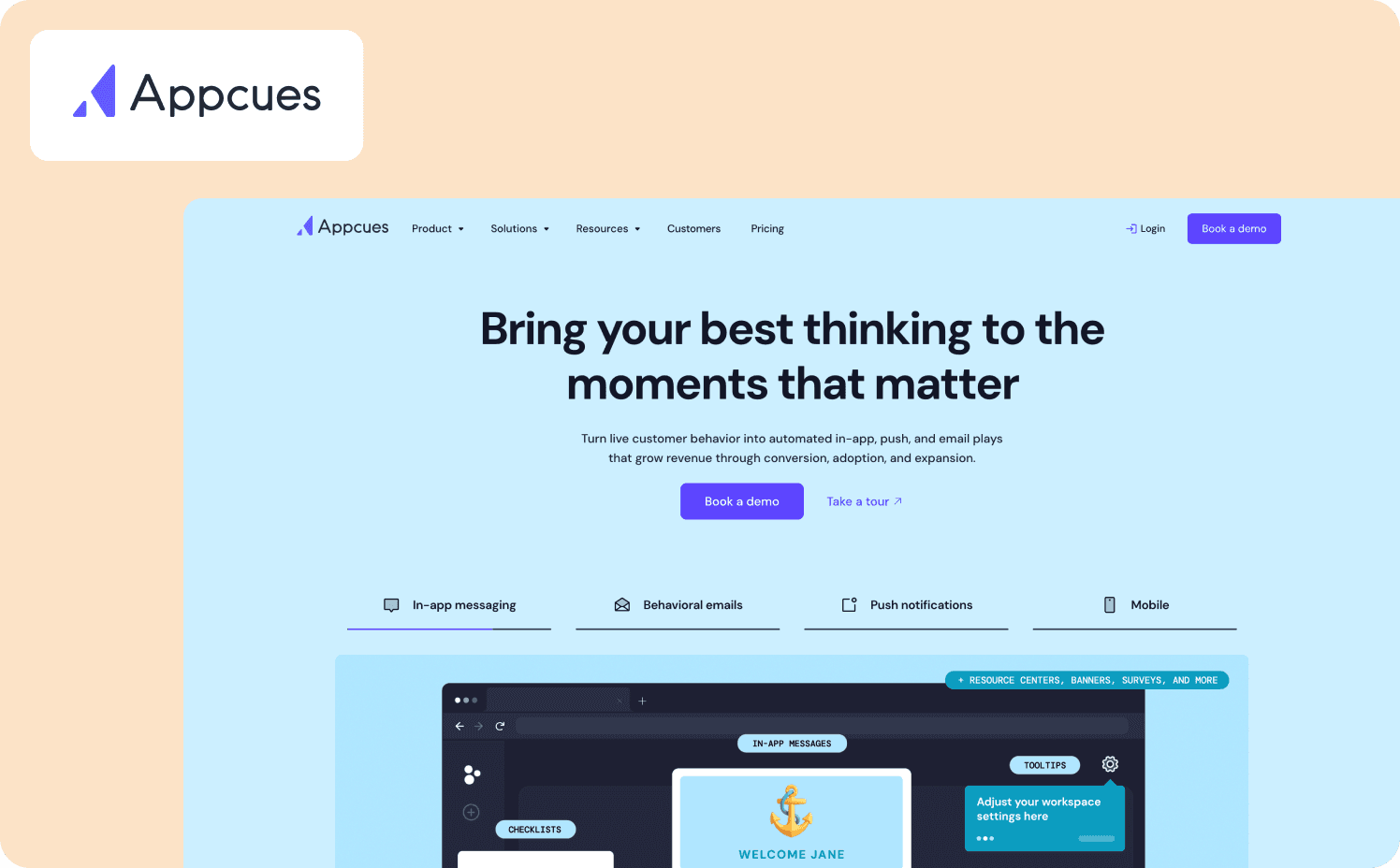
Appcues is a no-code engagement platform built for experimentation velocity. The platform's workflow orchestration connects in-app messages, behavioral emails, and push notifications in automated sequences. It eliminates the need to manage separate tools for each channel and enables teams to coordinate multi-channel campaigns without technical resources.
Key differentiators:
Multi-channel workflows: Deliver in-app guidance, email, and push notifications in one builder.
Native A/B testing: Built-in experimentation with Audience Randomizer for traffic splitting.
Workflow task automation: Re-engage user segments across channels and direct them to the right onboarding flows or follow-ups based on previous user behavior.
Where it falls short: Appcues uses standard linear tours rather than action-based progression that adapts to user behavior. Analytics stop at flow-level metrics (views, completions) with no funnel or cohort analysis.
When to choose Appcues over WalkMe:
Non-technical teams (growth, PMM, CS) need full autonomy without engineering dependencies.
Your primary use cases are feature announcements and sequential onboarding, not complex conditional workflows.
Cross-channel campaign coordination matters more than analytics depth.
Pricing:
Grow: $750/mo for 1,000 MAUs
Enterprise: Custom pricing
3. Userflow — Best for lean product-led SaaS teams needing fast deployment
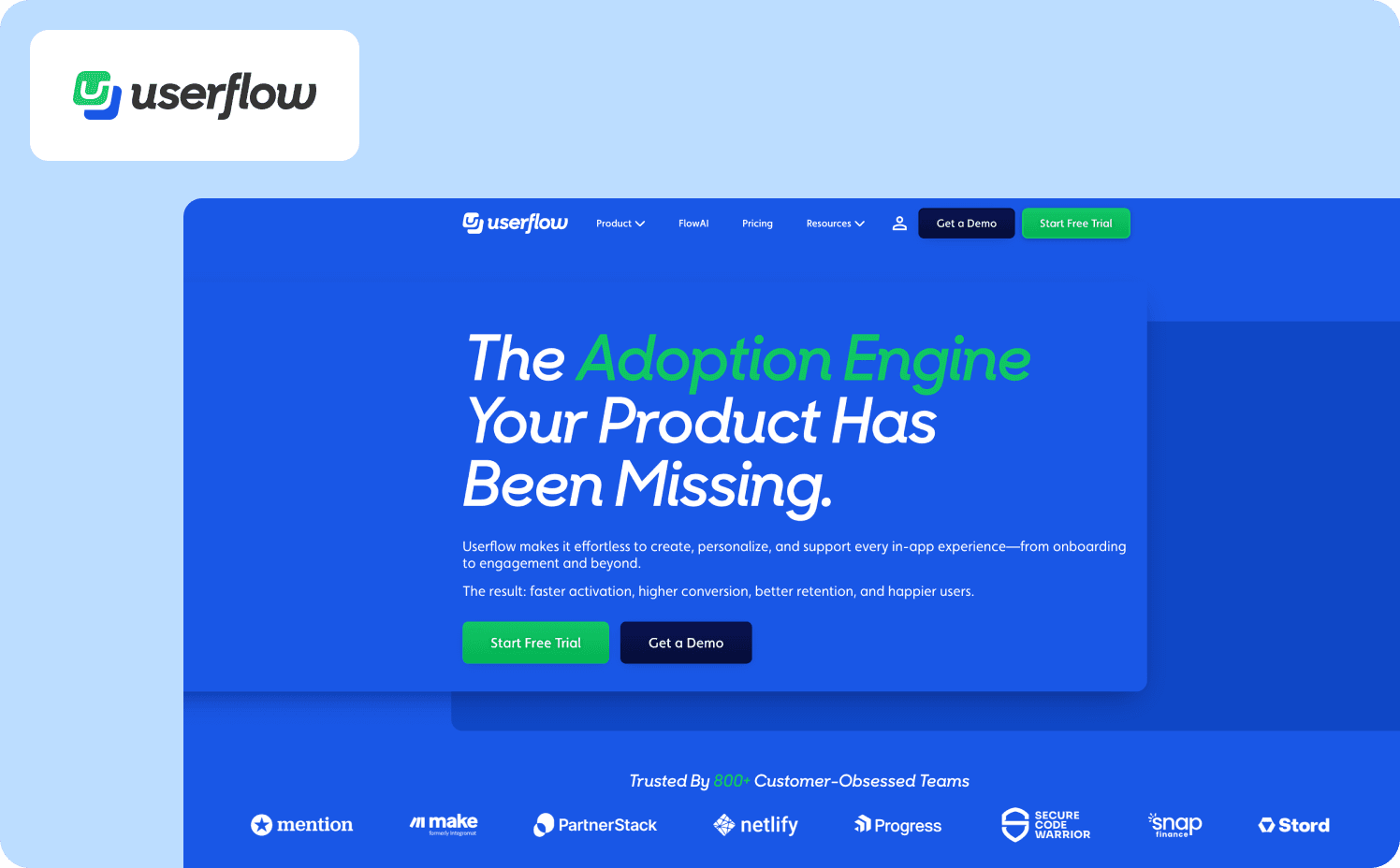
Userflow is a no-code onboarding platform built for speed. The platform's lightweight performance footprint and developer-friendly documentation enable teams to go from signup to first live flow quickly. The no-code builder keeps product and CS teams fully autonomous.
Key differentiators:
Lightweight performance: Script loads 5–10 times faster than most competing platforms.
FlowAI Insights: AI dashboard that automatically surfaces optimization opportunities without manual funnel analysis.
Multi-environment workflow: Build and test flows in staging environments before replicating to production from a single account, enabling safe iteration.
Where it falls short: No RBAC or enterprise-grade permissions make it a poor fit for large organizations with complex access requirements. Analytics are more basic, meaning teams will still need to integrate with Amplitude or Mixpanel.
When to choose Userflow over WalkMe:
You need onboarding live this sprint, not after a 4-month implementation.
Budget is a real constraint ($240/mo entry point vs. WalkMe's six-figure annual commitments).
Developer-friendly documentation and strong API/webhook support matter to your team.
Pricing:
Startup: From $240/mo (3,000 MAUs)
Pro: From $680/mo (10,000 MAUs).
Enterprise: Custom
4. Chameleon — Best for SaaS teams wanting maximum CSS customization
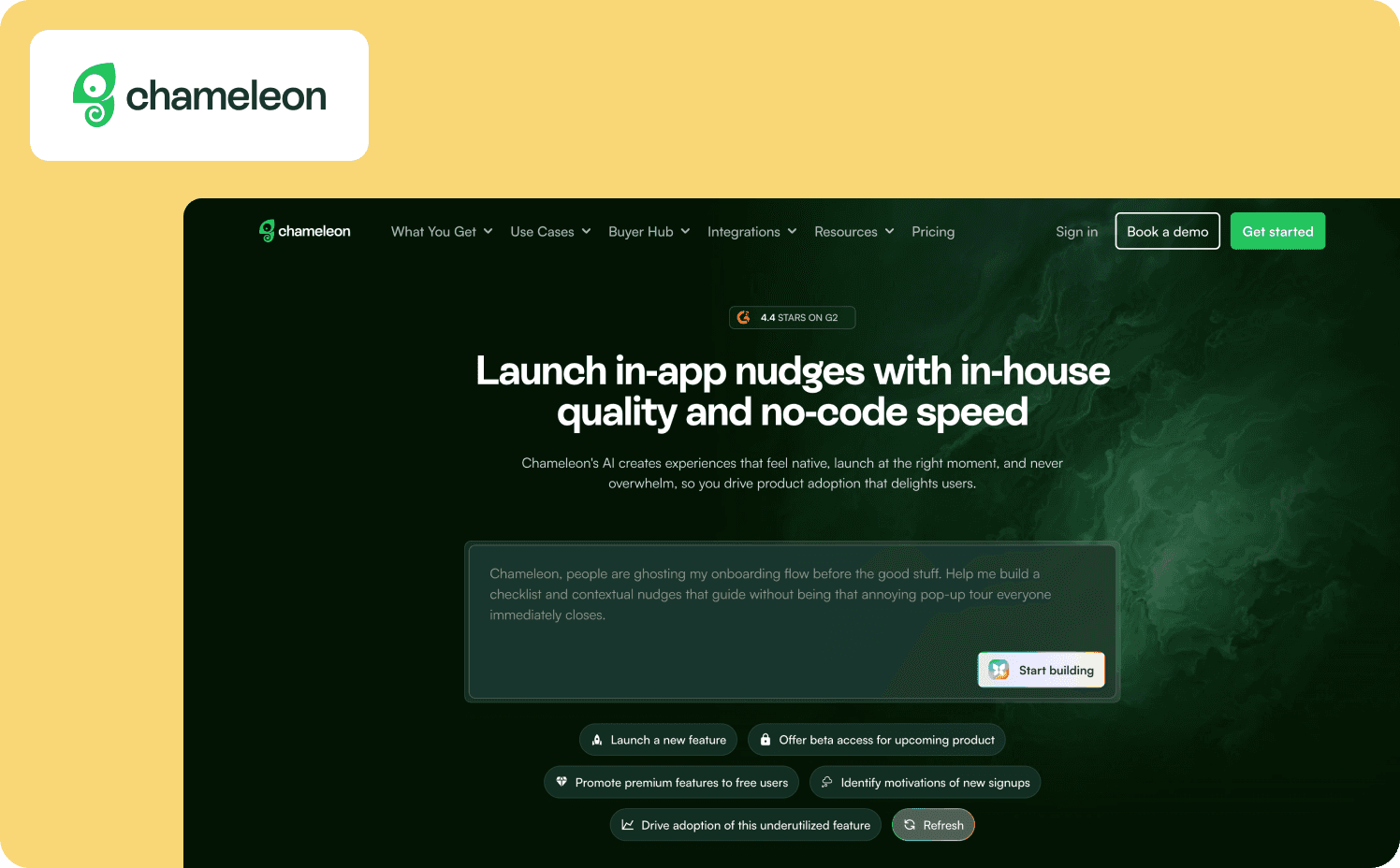
Chameleon is a design-first digital adoption platform built for teams where visual polish is non-negotiable. Where most digital adoption platforms give you templates with limited overrides, Chameleon gives you CSS-level control. The result is in-app guidance that actually feels like part of your product
Key differentiators:
CSS-level customization: Style every pixel of a tour to match your design system.
Embedded Cards: Inline app guidance content blocks that integrate into your UI instead of modal overlays that interrupt user engagement.
Copilot AI: Automatically generates A/B test variants for in-app guidance without manual creation.
Where it falls short: The customization depth requires CSS knowledge, which isn’t ideal for non-technical PMs. Pricing jumps sharply at Growth ($15,000/year) and there’s no native mobile support.
When to choose Chameleon over WalkMe:
Your design team refuses to ship guidance that looks like a third-party overlay.
You have CSS resources on the product or design team.
Analytics are already handled by Mixpanel, Amplitude, or PostHog, so no need to pay twice.
Pricing:
Free: Unlimited product-connected interactive demos
Startup: From $279/mo (1,000 MAUs)
Growth: From $15,000/year (1,000 MAUs)
Enterprise: Custom
5. Userpilot — Best for teams who want affordable all-in-one activation with adoption analytics built in
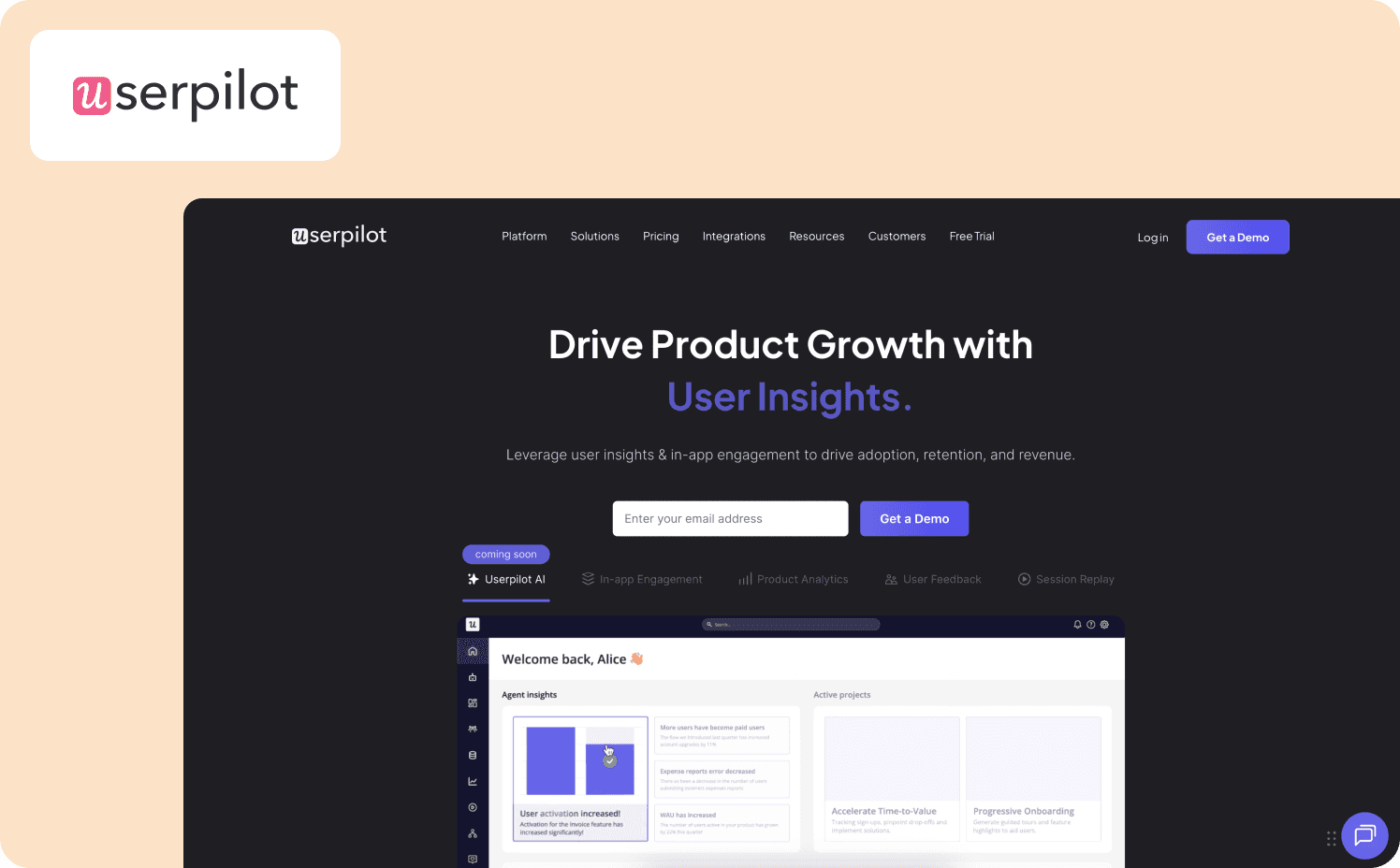
Userpilot is a product growth platform that combines onboarding, analytics, user feedback, and help center into one suite. Its Visual Labeler lets PMs click any UI element to define trackable events without engineering, removing the ticket-filing bottleneck between spotting a drop-off and fixing it.
Key differentiators:
Retroactive event auto-capture: Analyze historical user behavior without prior instrumentation.
Built-in A/B testing: Validates which onboarding variations improve activation rates with statistical significance tracking.
Behavior-triggered flows: Conditional logic that branches based on user actions, roles, and segments rather than forcing everyone down the same path.
Where it falls short: The Starter plan caps at 2,000 MAUs, and price jumps between tiers are steep. Mobile support is an add-on, not core, which limits mobile-first products.
When to choose Userpilot over WalkMe:
Your PM team needs to own the measurement loop without filing engineering tickets.
You want activation analytics without building a separate instrumentation stack.
You're mid-market with a $299/mo budget and no appetite for enterprise procurement cycles.
Pricing:
Starter: $299/mo (includes 2,000 MAUs)
Growth: Custom (includes 5,000 MAUs)
Enterprise: Custom (includes 10,000 MAUs)
6. Tandem — Best for teams where complex multi-step workflows are the activation drop-off
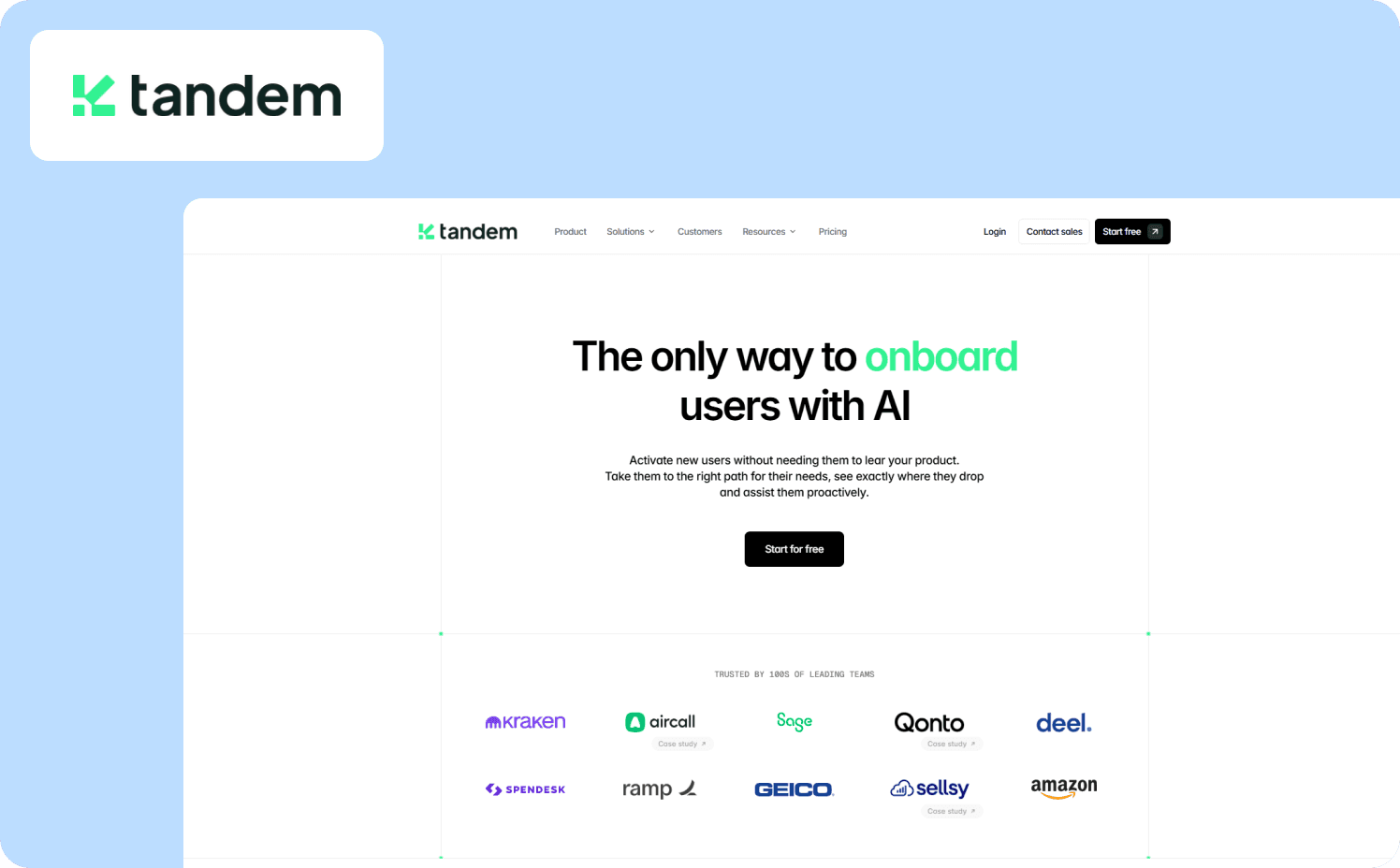
Tandem is a newer entrant in the category. It’s an AI-powered digital adoption platform that executes tasks rather than just showing tooltips. If your analytics prove that workflow complexity, rather than lack of guidance, is where trial users drop off, Tandem's AI agent executes the entire sequence while users watch.
Key differentiators:
Context-aware adaptation: Understands user context and goals in real-time, adapting guidance to what each user is actually trying to accomplish.
DOM analysis adapts automatically: When your UI changes, the architecture detects modifications and adapts action sequences without manual selector fixes.
AI executes tasks: Fills forms, configures permission settings, and completes multi-step integrations.
Where it falls short: The AI-first approach is powerful but less suited to teams wanting quick template-based tours out of the box. Limited governance and compliance features aren’t a match for enterprise teams.
When to choose Tandem over WalkMe:
Your analytics prove complex workflows are the measurable drop-off point in your activation funnel.
Users understand what to do but abandon because the workflow requires too many decisions or steps.
Your funnel data shows a specific drop-off at a complex workflow, not a general activation gap across the full onboarding journey.
Pricing:
Starter: Free (100 MTUs)
Plus: $149/mo (500 MTUs)
Growth: Custom (5,000+ MTUs)
Enterprise: Custom
7. Whatfix — Best for enterprise dual-market positioning (employee + customer apps)
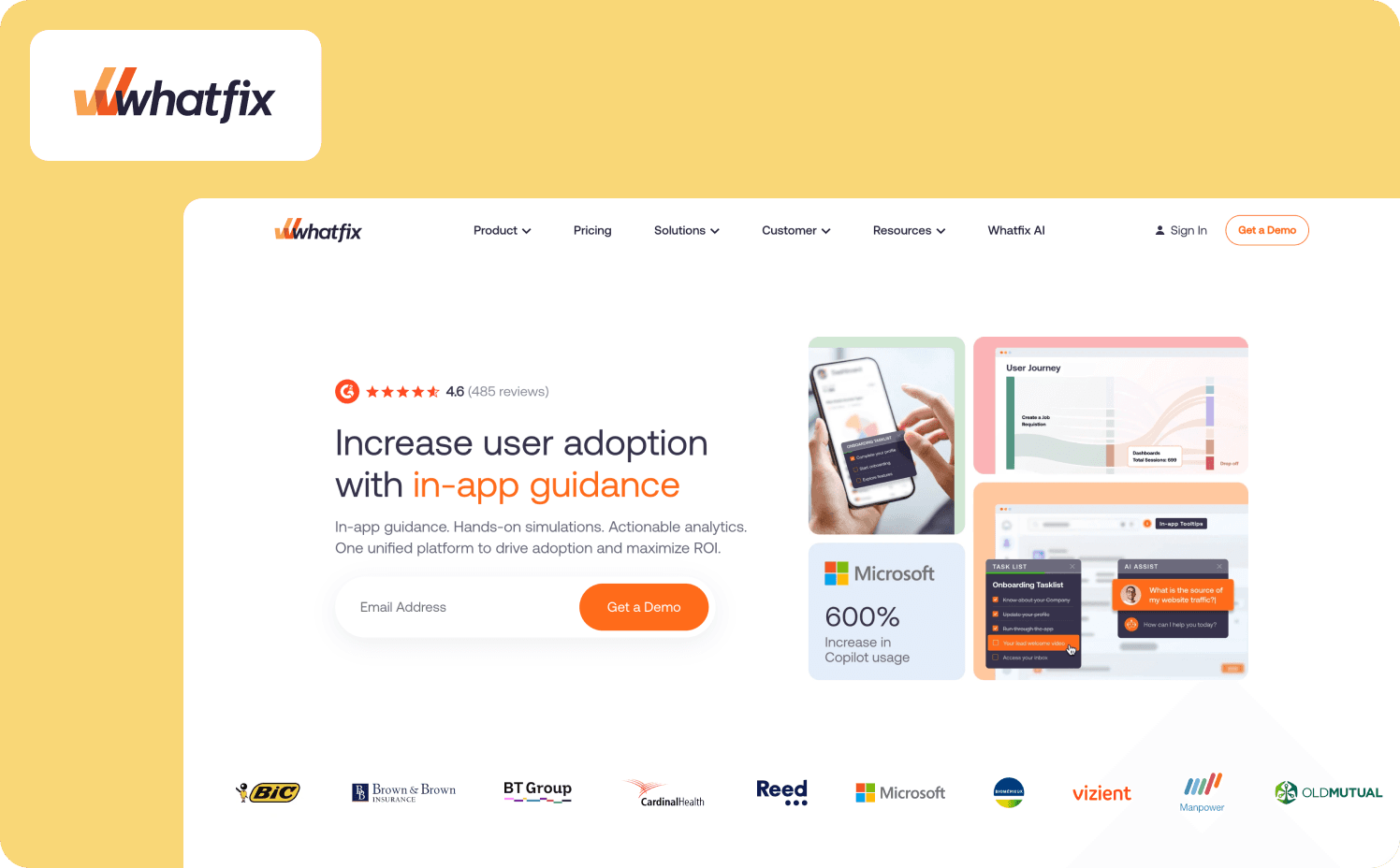
Whatfix is a three-product suite (DAP + Product Analytics + Mirror) built for enterprises serving both training programs and customer-facing applications. The platform bridges these two markets within a single deployment, offering cross-application workflow support and AI-powered content tools.
Key differentiators:
Three-product suite: DAP for guidance, Product Analytics for no-code event tracking, Mirror for risk-free sandbox environments without engineering dependencies.
Cross-application workflows: Guide users across multiple systems (Salesforce → Outlook → custom CRM) maintaining contextual guidance as they navigate between applications.
SCORM-compliant training: Important for enterprises with formal training compliance requirements.
Where it falls short: Similar to WalkMe, typical deployment takes months with professional services often required. Pricing is opaque and separate quotes are needed for each product module (DAP, Analytics, Mirror). Consider these Whatfix alternatives instead.
When to choose Whatfix over WalkMe:
You need WalkMe-like cross-application capabilities without SAP dependency.
Learning management systems alone aren't enough, you need in-app guidance layered on top of internal tools in production.
You need multi-format content exports (convert walkthroughs to PDFs, videos, slideshows for offline user training and training content).
Pricing:
Standard: Custom
Premium: Custom
Enterprise: Custom
8. Pendo — Best for enterprise teams prioritizing deep product analytics
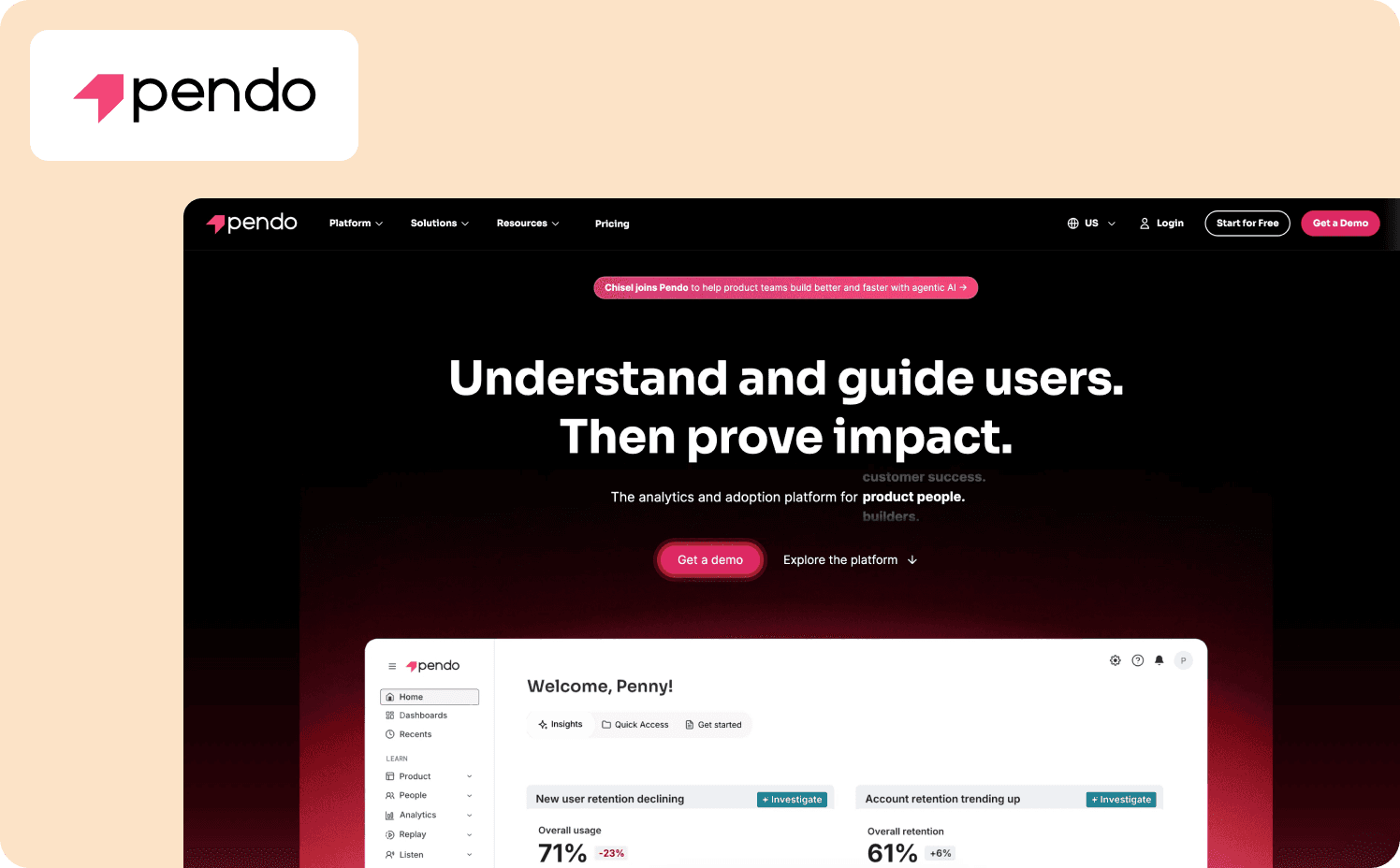
Pendo is an analytics-first product experience platform that bundles product analytics, in-app guides, feedback collection, and session replay into one system. The platform's retroactive analytics capability lets teams view historical data for any click or page view without prior event tagging.
Key differentiators:
Product Engagement Score (PES): Auto-generated health metric combining Adoption (feature breadth), Stickiness (frequency), and Growth (trajectory changes).
Strong native mobile support: iOS/Android SDKs make Pendo one of the few platforms serving mobile-first products well.
Orchestrate: Cross-channel journey builder coordinates in-app messages with emails to drive users back into the product.
Where it falls short: The sheer volume of advanced features makes dashboard navigation difficult for new users, and many capabilities require expensive add-ons. Plus conditional branching in tours requires expensive tiers, so consider these Pendo competitors if you want to prioritize action-based tours.
When to choose Pendo over WalkMe:
Your team needs deep product analytics.
Mobile app support (native iOS/Android SDKs) is critical to your product.
Your product team wants to define custom events without engineering.
Pricing:
Free: For 500 MAU
Base: Custom
Core: Custom
Ultimate: Custom
9. Gainsight PX — Best for customer success teams linking product usage to health scores
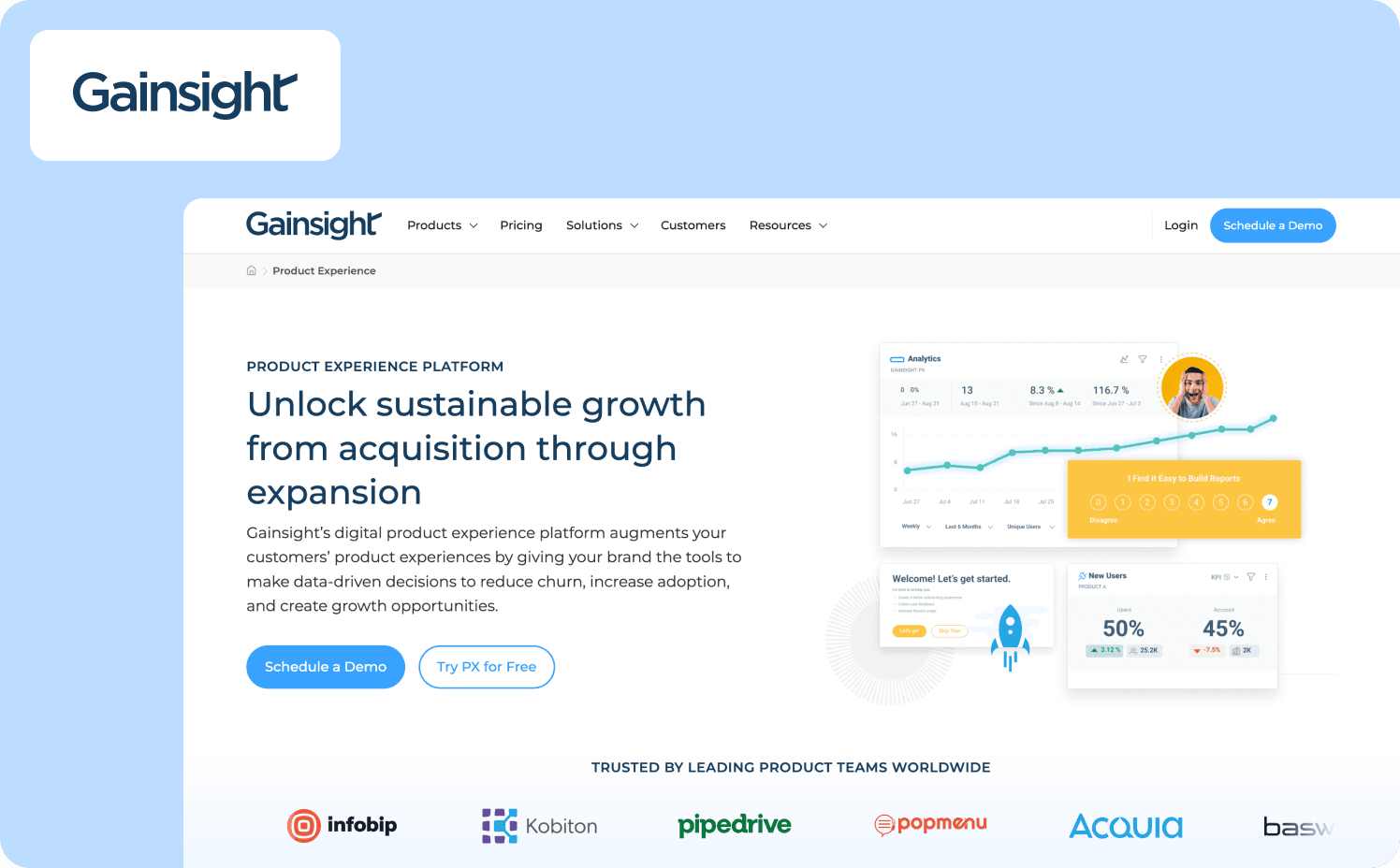
Gainsight PX is a product experience platform built for enterprises where customer success teams drive adoption strategy. The platform's native integration with Gainsight CS pushes product usage data directly into health scores, tying feature adoption to renewal risk and expansion opportunities within a unified PX-CS data model.
Key differentiators:
Native Gainsight CS integration: Product usage data flows automatically into customer health scores.
Golden Features analysis: Identifies which features correlate with long-term retention and higher LTV.
AI-powered Product Mapper: Auto-instruments entire product hierarchy without manual event tagging.
Where it falls short: Gainsight PX is purpose-built for CS-led organizations already running Gainsight CS. Outside that ecosystem, the native health score integration that justifies its complexity doesn't exist.
When to choose Gainsight PX over WalkMe:
You’re already using Gainsight CS and need unified product usage + health scoring without building custom data pipelines.
You have the budget and runway for a 12-18 month implementation.
Your CS team needs product behavior data flowing into their existing CSM workflows and playbooks.
Pricing:
Small Business: Custom (For companies with less than 100 employees)
Enterprise: Custom
Ultimate: Custom
How to evaluate total cost of ownership across platforms
Platform subscription fees are the smallest line on your WalkMe invoice. Implementation services, broken selector fixes, dedicated maintenance headcount, and the engineering hours you didn't budget for are where the real cost lives. Know the pricing model before you sign, not 18 months after.
Published versus unpublished pricing
WalkMe doesn't publish pricing. Every plan requires a custom enterprise sales cycle, meaning multi-year lock-ins are typical and there’s no benchmark to compare your quote against. You enter negotiations blind.
Several modern alternatives publish transparent pricing:
Jimo: $249/mo Starter, $479/mo Growth (both at 2,500 MAUs)
Userflow: $240/mo Startup (3,000 MAUs), $680/mo Pro (10,000 MAUs)
Chameleon: From $279/mo (1,000 MAUs)
Userpilot: $299/mo Starter (2,000 MAUs), custom for Growth/Enterprise
Tandem: Free Starter, $149/mo Plus (500 MTUs), custom for Growth/Enterprise
Appcues: $750/mo Grow (1,000 MAUs), Enterprise custom
Platforms requiring custom quotes:
WalkMe: Enterprise only, no public rates
Whatfix: Custom, with separate quotes per product module — DAP, Analytics, and Mirror priced independently
Pendo: Free tier up to 500 MAUs, all paid tiers require contacting sales
Gainsight PX: Enterprise only, no public pricing
Hidden costs beyond platform licensing
The subscription fee is just the entry point. What compounds the real cost is everything underneath it. Most buyers don't discover the full picture until they're already locked in.
Implementation
WalkMe deployments take months, often requiring a dedicated “WalkMe Builder” or external agency. Whatfix follows a similar pattern with typical 3-month deployments requiring dedicated resources and professional services for complex flows.
Jimo and Userflow deploy in days with no professional services fees. Install a JavaScript snippet, build in the no-code editor, launch. Every month spent implementing WalkMe is another month activation gaps persist and acquisition spend goes to waste.
Ongoing maintenance
Traditional DAPs (WalkMe, Whatfix, Appcues) tend to break when your UI changes. CSS selectors go stale after product releases, and PM time gets consumed fixing tours instead of launching experiments. Chameleon’s deep CSS customization means more fragile selectors and more manual fixes every time your design system updates.
Jimo's action-based progression reduces this brittleness. Tours advance when users complete the actual task, making flows more resilient to UI updates. Tandem's DOM analysis adapts automatically when your product ships changes, removing manual maintenance entirely.
Engineering instrumentation
Some platforms require engineering involvement to define trackable events before PMs can build guides or run analyses. Jimo's Success Tracker and Userpilot's Visual Labeler let PMs tag any UI element as a trackable event without filing a ticket. Pendo's Product Mapper auto-instruments product hierarchy via AI. WalkMe and Whatfix require more manual event configuration, consuming sprint capacity.
Opportunity cost
WalkMe's average time to measurable ROI is 15 months. That's 15 months of waiting while activation gaps compound. Jimo's days-to-deployment means you start improving activation in week one, not month five.
Making the decision for your company
The WalkMe decision in 2026 comes down to two questions. Is WalkMe's architecture actually right for your use case? And does the SAP acquisition change your risk calculation for a multi-year commitment?
Your situation in 2026... | Evaluate first |
Exiting WalkMe post-SAP acquisition and want multi-app enterprise governance without SAP dependency | Whatfix |
Looking to consolidate onboarding flows, adoption analytics, and user feedback into one platform without enterprise pricing | Jimo, Userpilot |
Want deep product analytics and in-app guidance in one platform for a product-led enterprise team | Pendo, Gainsight PX |
Deploying product-facing onboarding flows fast with transparent pricing | Jimo, Appcues, Userflow |
Need to tie product analytics and user behavior data to customer health scores and churn signals | Gainsight PX, Pendo |
Want pixel-perfect brand-matched in-app guidance that feels native rather than a third-party overlay | Chameleon |
Have a documented activation drop-off at a complex workflow that tooltips aren't solving | Tandem |
Signups are growing but trial-to-paid conversion stays flat and you can't figure out why | Jimo |
For enterprise IT teams managing employee training
Whatfix is the most credible lateral move from WalkMe without SAP dependency. It offers multi-app overlay capabilities at enterprise scale with cross-application workflows, compliance certifications, and implementation services for large organization rollouts. Whatfix serves both employee training and customer-facing apps.
For enterprise SaaS product teams measuring customer activation
If trial signups grow but paid conversion stays flat at 22% while competitors convert at 38%, WalkMe is the wrong tool. Its architecture was never designed for this problem.
Jimo’s Success Tracker shows that users who completed the first-integration tour were 2.3× more likely to still be active at 30 days. Action-based tours achieve 44% completion versus the 27% industry median by auto-progressing when users complete real tasks. Hivebrite built 20+ tours with Jimo in three months, the same volume that took a full year with WalkMe.
If activation is the gap, the architecture has to match the problem. Book a demo to see how Jimo connects SaaS onboarding to the activation metrics your CFO cares about
FAQs
Why did SAP acquire WalkMe and what does it mean for enterprise buyers?
SAP acquired WalkMe in September 2024 to integrate it into their Business Transformation Management portfolio and enhance the SAP Joule copilot. For SAP customers, this creates tighter Joule integration and S/4HANA support. For non-SAP enterprises running Workday, Oracle, or Salesforce, it raises legitimate questions about where WalkMe's R&D investment goes when SAP competes with your core systems.
What’s the difference between WalkMe and Jimo?
WalkMe is an enterprise DAP built for employee training on third-party business applications (SAP, Salesforce, Workday), with months-long implementations and six-figure budgets for organizations training 10,000+ employees. Jimo is a product adoption platform alternative to WalkMe built for B2B SaaS teams improving customer trial-to-paid conversion, with days-long implementation and transparent MAU-based pricing starting at $249/month.
How long does it take to migrate from WalkMe to a digital adoption platform?
Fast migration (1-2 weeks) can happen with Jimo and Userflow by installing a JavaScript snippet and launching the first experiences in days. Userpilot, Pendo, and Chameleon require analytics setup but are still faster than WalkMe, taking 2–6 weeks. Slow migration (3-6 months) occurs with Whatfix and Gainsight PX as they mirror WalkMe's enterprise complexity, often requiring professional services.
Is WalkMe only suitable for large enterprises?
WalkMe is architecturally designed for Fortune 500 organizations training 10,000+ employees across SAP, Salesforce, and Workday with six-figure budgets and months-long implementations. Mid-market SaaS teams typically find WalkMe over-engineered. Tools like Jimo, Userpilot, and Userflow serve mid-market teams better with transparent pricing, days-long deployment, and mechanics that tie onboarding to trial-to-paid conversion.
What's the best WalkMe alternative for user onboarding?
For product-led SaaS companies focused on customer activation, Jimo is the strongest WalkMe alternative for user onboarding. Unlike traditional digital adoption platforms that report tour completion rates, Jimo shows which onboarding flows predict retention, not just which ones users clicked through. For teams prioritizing speed, Userflow deploys in days. For cross-channel SaaS onboarding, Appcues coordinates in-app, email, and push in one builder.
TL;DR
WalkMe was built for employee training on enterprise applications, and it's good at that. But most SaaS teams evaluating WalkMe alternatives in 2026 have a different problem. There’s trial users who don't convert, activation gaps that compound monthly, and they’re locked in with an onboarding tool that can't connect its own output to revenue. This guide covers nine WalkMe competitors across three tracks: enterprise IT, analytics-first, and those primarily focused on activation.
Digital adoption platforms serve three fundamentally different use cases: employee training on third-party enterprise software, product analytics for understanding user behavior, and customer activation for converting trial users to paid accounts. Pick the wrong category and your digital adoption platform investment compounds your activation problem instead of solving it.
WalkMe dominates the first category. But the recent SAP acquisition, 15-month ROI timelines, and four-month implementations make it increasingly hard to justify for the second and third.
Some enterprise IT teams simply want WalkMe's capabilities without the SAP dependency. Others need analytics-first platforms or activation-focused tools that connect onboarding flows directly to revenue. This guide covers nine WalkMe alternatives across all three tracks so you can verify which architecture actually matches your problem before signing another multi-year contract.
Why teams look for WalkMe competitors
WalkMe was one of the early players in the digital adoption platform category. With roughly 2,000 corporate customers, including about 155 Fortune 500 firms and 243 of the Global 2000, WalkMe's enterprise credentials are legitimate. The platform handles cross-application workflows, maintains compliance certifications (FedRAMP, ISO, SOC2), and supports desktop applications alongside web-based systems.
For large organizations training employees on SAP, Salesforce, and Workday, WalkMe remains the industry standard for digital transformation.
For enterprise IT teams — four switch triggers
Four business outcomes drive enterprise IT teams to reevaluate WalkMe in 2026. Each trigger connects to measurable cost, whether that’s budget uncertainty, implementation delays, ongoing maintenance, or roadmap risk.
SAP acquisition context: SAP closed the WalkMe acquisition in September, 2024. For SAP customers, this creates tighter Joule integration and S/4HANA alignment. For non-SAP buyers running Workday, Oracle, Salesforce, and custom SaaS stacks, the acquisition introduces uncertainty about R&D priorities and roadmap direction under SAP ownership.
Implementation overhead: The average WalkMe deployment can take 3-6 months (typically 4 months) for Fortune 500 large enterprises. “Setting up walkthroughs or customizing guidance can sometimes feel a bit time-consuming and complicated,” notes one G2 user. When activation rate is the bottleneck, a four-month implementation means four more months of flat trial-to-paid conversion.
Pricing opacity: WalkMe doesn’t publish pricing, all their plans require custom enterprise pricing with multi-year lock-ins. Add-ons (analytics modules, mobile support, advanced automation) are priced separately, making it difficult for finance teams to model costs as you scale from 5,000 to 50,000 Monthly Active Users.
Maintenance burden: WalkMe relies on CSS selectors for element identification, creating fragility when products ship updates. “It often requires a dedicated team to keep the content current, otherwise, the guidance can become unreliable or outdated fast,” says a G2 reviewer. PM cycles are spent on ongoing maintenance instead of shipping new features and fixing tours rather than launching experiments that lift activation rate.
For product-led SaaS teams — the wrong tool problem
WalkMe is employee-training-first. It's architected for IT teams rolling out Salesforce and Workday to 10,000 employees, not for product teams improving customer trial-to-paid conversion in a self-serve SaaS product.
The average SaaS activation rate is 36%. That's data from 500+ products surveyed by Lenny Rachitsky's benchmarking study. When signups grow but conversion stays flat, you're wasting CAC on users who never reach their first value moment.
WalkMe's average time to measurable ROI is 15 months. Modern product-led SaaS companies talk about “60-second Aha moments” — the instant a new user first experiences real value. When your CFO asks why trial-to-paid conversion is stuck at 22% despite $400K in marketing spend, the answer isn't “we're 11 months into a WalkMe implementation.”
What you should consider when evaluating WalkMe competitors
Five criteria determine whether a WalkMe alternative actually serves your use case better.
💡 Enterprise buyers should verify compliance posture before shortlisting:
SOC 2 Type II audit recency
GDPR-compliant data handling (especially for EU customers)
Audit log availability for compliance reviews.
These requirements are non-negotiable table stakes. Surface these blockers during evaluation, not after contract signature.
1. Use case fit: Employee training vs product-facing adoption
WalkMe is designed for employee training on third-party enterprise applications like SAP, Workday, Salesforce. That's a fundamentally different problem than customer activation. Product-led SaaS companies need to know whether trial users complete the behaviors that predict paid conversion.
Can you tag any UI element without filing an engineering support ticket? Do tours auto-progress on real user actions, or do users click “Next” three times and forget everything? The wrong architecture for the wrong use case wastes both budget and pipeline.
2. Implementation speed & time-to-value
WalkMe deployments average 4 months. Modern WalkMe alternatives range from days (Jimo, Userflow) to weeks (Userpilot, Appcues). That gap is opportunity cost. If 1,000 trials arrive monthly and 64% abandon before first value, that's $64,000 in wasted acquisition spend at $100 CAC. Every week you delay fixing activation is another week it compounds.
“I spent so much time building the tours with WalkMe that at some point you just get discouraged,” says Jacqueline LE, Project Manager at Hivebrite who switched from WalkMe to Jimo. “You don’t update them anymore, which is not a good thing.”
3. SAP ecosystem dependency
The SAP acquisition creates a straightforward conflict of interest question. Does your stack align with SAP's strategic priorities, or are you running tools SAP now competes with?
For everyone outside the SAP ecosystem, this is a reason to evaluate digital adoption platforms cleanly. Whatfix handles enterprise multi-app guidance without SAP ties. Jimo, Pendo, and Userpilot operate where SAP has no stake.
4. Pricing model & total cost of ownership
Published pricing enables faster procurement and predictable budgeting as you scale. Custom enterprise pricing introduces opacity. WalkMe, Whatfix, Pendo, and Gainsight PX are all competitors to WalkMe that require custom quotes with pricing varying significantly by negotiation leverage. Multi-year commitments lock you in before you know if activation rates actually improve.
5. Behavioral adaptability and measurement loop
Traditional digital adoption platforms report static tour completion rates. But static tours average 27% completion. Action-based tours that auto-progress when users complete real tasks achieve 44% completion, nearly 2× better. Plus, if your tool only reports tour clickthrough rates, you can't make the CFO case that software adoption spend drives revenue.
Criterion | WalkMe approach | Modern WalkMe alternatives |
Use case | Employee training on enterprise software | Customer activation in product-led SaaS |
Implementation | 4+ months, professional services typical | Days to weeks, rapid deployment |
Pricing | Custom enterprise pricing only, multi-year commitments | Transparent MAU-based or custom depending on vendor |
Measurement | Tour completion tracking | Connects activation behavior to retention and revenue outcomes |
Best WalkMe alternatives at a glance
The nine WalkMe competitors are grouped by evaluation track (enterprise IT, analytics-first, and activation-focused) based on the primary outcome each platform is built to deliver.
Of the nine competitors of WalkMe in this guide, Whatfix is the only platform that directly replicates WalkMe's enterprise IT architecture. If cross-application employee training at Fortune 500 enterprise scale is your primary requirement whether that's structured training for enablement teams, internal training on Salesforce or Workday, or knowledge management across business units, the rest of this list serves a different problem.
Tool | Best for | Evaluation track | Pricing starts at |
Jimo | Measuring activation-to-revenue impact | Activation-focused | $249/mo (2,500 MAUs) |
Appcues | Cross-channel engagement & PLG experimentation | Activation-focused | $750/mo (1,000 MAUs) |
Userflow | Fast deployment for lean product-led SaaS teams | Activation-focused | $240/mo (3,000 MAUs) |
Chameleon | Maximum CSS customization & brand matching | Activation-focused | $279/mo (1,000 MAUs) |
Userpilot | All-in-one activation with built-in adoption analytics | Activation-focused | $299/mo (2,000 MAUs) |
Tandem | AI-agent onboarding for complex workflows | Activation-focused | $149/mo (500 MTUs) |
Whatfix | Enterprise employee + customer app guidance | Enterprise IT | Custom |
Pendo | Deep product analytics + in-app guidance | Analytics-first | Custom |
Gainsight PX | Linking product usage to CS health scores | Analytics-first | Custom |
9 WalkMe competitors you should consider in 2026
These nine WalkMe alternatives split into three evaluation tracks: enterprise IT teams needing multi-app guidance without SAP dependency, product-led growth teams measuring customer activation, and CS-led organizations tying product usage to health scores. Self-identify your track based on whether your primary outcome is employee productivity, trial-to-paid conversion, or customer retention.
1. Jimo — Best for product-led SaaS teams measuring activation-to-revenue impact
Jimo is an AI-native digital adoption platform built for B2B SaaS product teams where activation rate directly affects bookings. The platform combines no-code product analytics with in-app guidance, enabling product managers to detect drop-offs and launch interventions without engineering dependencies.
Key differentiators:
Success Tracker: No-code feature usage analytics with step-by-step drop-off visualization. PMs tag any feature, set goals, and view drop-offs without engineering involvement.
Action-based product tours: Tours auto-progress based on actual user actions. The gaming-inspired cursor mechanism shows users what to do.
Closed-loop activation: Detect a drop-off in adoption analytics, launch a targeted hint, modal, or checklist in minutes. Connect onboarding interactions directly to retention-predictive events without manual CRM mapping.
Where it falls short: If your primary need is enterprise employee training across SAP, Salesforce, Workday, or Oracle, Jimo isn’t the right fit. Jimo is built for a different problem: B2B SaaS teams improving customer trial-to-paid conversion and feature adoption without months of implementation complexity.
When to choose Jimo over WalkMe:
You're measuring activation rate as a revenue metric and need to connect onboarding behavior to conversion outcomes.
Trial-to-paid conversion is flat despite signup growth.
Your product team needs to ship onboarding experiments without engineering sprint dependencies.
You need closed-loop: analytics → intervention → measurement in one platform.
Starter: $249/mo (2,500 MAUs)
Growth: $479/mo (2,500 MAUs)
Enterprise: Custom
2. Appcues — Best for cross-channel engagement & PLG experimentation
Appcues is a no-code engagement platform built for experimentation velocity. The platform's workflow orchestration connects in-app messages, behavioral emails, and push notifications in automated sequences. It eliminates the need to manage separate tools for each channel and enables teams to coordinate multi-channel campaigns without technical resources.
Key differentiators:
Multi-channel workflows: Deliver in-app guidance, email, and push notifications in one builder.
Native A/B testing: Built-in experimentation with Audience Randomizer for traffic splitting.
Workflow task automation: Re-engage user segments across channels and direct them to the right onboarding flows or follow-ups based on previous user behavior.
Where it falls short: Appcues uses standard linear tours rather than action-based progression that adapts to user behavior. Analytics stop at flow-level metrics (views, completions) with no funnel or cohort analysis.
When to choose Appcues over WalkMe:
Non-technical teams (growth, PMM, CS) need full autonomy without engineering dependencies.
Your primary use cases are feature announcements and sequential onboarding, not complex conditional workflows.
Cross-channel campaign coordination matters more than analytics depth.
Pricing:
Grow: $750/mo for 1,000 MAUs
Enterprise: Custom pricing
3. Userflow — Best for lean product-led SaaS teams needing fast deployment
Userflow is a no-code onboarding platform built for speed. The platform's lightweight performance footprint and developer-friendly documentation enable teams to go from signup to first live flow quickly. The no-code builder keeps product and CS teams fully autonomous.
Key differentiators:
Lightweight performance: Script loads 5–10 times faster than most competing platforms.
FlowAI Insights: AI dashboard that automatically surfaces optimization opportunities without manual funnel analysis.
Multi-environment workflow: Build and test flows in staging environments before replicating to production from a single account, enabling safe iteration.
Where it falls short: No RBAC or enterprise-grade permissions make it a poor fit for large organizations with complex access requirements. Analytics are more basic, meaning teams will still need to integrate with Amplitude or Mixpanel.
When to choose Userflow over WalkMe:
You need onboarding live this sprint, not after a 4-month implementation.
Budget is a real constraint ($240/mo entry point vs. WalkMe's six-figure annual commitments).
Developer-friendly documentation and strong API/webhook support matter to your team.
Pricing:
Startup: From $240/mo (3,000 MAUs)
Pro: From $680/mo (10,000 MAUs).
Enterprise: Custom
4. Chameleon — Best for SaaS teams wanting maximum CSS customization
Chameleon is a design-first digital adoption platform built for teams where visual polish is non-negotiable. Where most digital adoption platforms give you templates with limited overrides, Chameleon gives you CSS-level control. The result is in-app guidance that actually feels like part of your product
Key differentiators:
CSS-level customization: Style every pixel of a tour to match your design system.
Embedded Cards: Inline app guidance content blocks that integrate into your UI instead of modal overlays that interrupt user engagement.
Copilot AI: Automatically generates A/B test variants for in-app guidance without manual creation.
Where it falls short: The customization depth requires CSS knowledge, which isn’t ideal for non-technical PMs. Pricing jumps sharply at Growth ($15,000/year) and there’s no native mobile support.
When to choose Chameleon over WalkMe:
Your design team refuses to ship guidance that looks like a third-party overlay.
You have CSS resources on the product or design team.
Analytics are already handled by Mixpanel, Amplitude, or PostHog, so no need to pay twice.
Pricing:
Free: Unlimited product-connected interactive demos
Startup: From $279/mo (1,000 MAUs)
Growth: From $15,000/year (1,000 MAUs)
Enterprise: Custom
5. Userpilot — Best for teams who want affordable all-in-one activation with adoption analytics built in
Userpilot is a product growth platform that combines onboarding, analytics, user feedback, and help center into one suite. Its Visual Labeler lets PMs click any UI element to define trackable events without engineering, removing the ticket-filing bottleneck between spotting a drop-off and fixing it.
Key differentiators:
Retroactive event auto-capture: Analyze historical user behavior without prior instrumentation.
Built-in A/B testing: Validates which onboarding variations improve activation rates with statistical significance tracking.
Behavior-triggered flows: Conditional logic that branches based on user actions, roles, and segments rather than forcing everyone down the same path.
Where it falls short: The Starter plan caps at 2,000 MAUs, and price jumps between tiers are steep. Mobile support is an add-on, not core, which limits mobile-first products.
When to choose Userpilot over WalkMe:
Your PM team needs to own the measurement loop without filing engineering tickets.
You want activation analytics without building a separate instrumentation stack.
You're mid-market with a $299/mo budget and no appetite for enterprise procurement cycles.
Pricing:
Starter: $299/mo (includes 2,000 MAUs)
Growth: Custom (includes 5,000 MAUs)
Enterprise: Custom (includes 10,000 MAUs)
6. Tandem — Best for teams where complex multi-step workflows are the activation drop-off
Tandem is a newer entrant in the category. It’s an AI-powered digital adoption platform that executes tasks rather than just showing tooltips. If your analytics prove that workflow complexity, rather than lack of guidance, is where trial users drop off, Tandem's AI agent executes the entire sequence while users watch.
Key differentiators:
Context-aware adaptation: Understands user context and goals in real-time, adapting guidance to what each user is actually trying to accomplish.
DOM analysis adapts automatically: When your UI changes, the architecture detects modifications and adapts action sequences without manual selector fixes.
AI executes tasks: Fills forms, configures permission settings, and completes multi-step integrations.
Where it falls short: The AI-first approach is powerful but less suited to teams wanting quick template-based tours out of the box. Limited governance and compliance features aren’t a match for enterprise teams.
When to choose Tandem over WalkMe:
Your analytics prove complex workflows are the measurable drop-off point in your activation funnel.
Users understand what to do but abandon because the workflow requires too many decisions or steps.
Your funnel data shows a specific drop-off at a complex workflow, not a general activation gap across the full onboarding journey.
Pricing:
Starter: Free (100 MTUs)
Plus: $149/mo (500 MTUs)
Growth: Custom (5,000+ MTUs)
Enterprise: Custom
7. Whatfix — Best for enterprise dual-market positioning (employee + customer apps)
Whatfix is a three-product suite (DAP + Product Analytics + Mirror) built for enterprises serving both training programs and customer-facing applications. The platform bridges these two markets within a single deployment, offering cross-application workflow support and AI-powered content tools.
Key differentiators:
Three-product suite: DAP for guidance, Product Analytics for no-code event tracking, Mirror for risk-free sandbox environments without engineering dependencies.
Cross-application workflows: Guide users across multiple systems (Salesforce → Outlook → custom CRM) maintaining contextual guidance as they navigate between applications.
SCORM-compliant training: Important for enterprises with formal training compliance requirements.
Where it falls short: Similar to WalkMe, typical deployment takes months with professional services often required. Pricing is opaque and separate quotes are needed for each product module (DAP, Analytics, Mirror). Consider these Whatfix alternatives instead.
When to choose Whatfix over WalkMe:
You need WalkMe-like cross-application capabilities without SAP dependency.
Learning management systems alone aren't enough, you need in-app guidance layered on top of internal tools in production.
You need multi-format content exports (convert walkthroughs to PDFs, videos, slideshows for offline user training and training content).
Pricing:
Standard: Custom
Premium: Custom
Enterprise: Custom
8. Pendo — Best for enterprise teams prioritizing deep product analytics
Pendo is an analytics-first product experience platform that bundles product analytics, in-app guides, feedback collection, and session replay into one system. The platform's retroactive analytics capability lets teams view historical data for any click or page view without prior event tagging.
Key differentiators:
Product Engagement Score (PES): Auto-generated health metric combining Adoption (feature breadth), Stickiness (frequency), and Growth (trajectory changes).
Strong native mobile support: iOS/Android SDKs make Pendo one of the few platforms serving mobile-first products well.
Orchestrate: Cross-channel journey builder coordinates in-app messages with emails to drive users back into the product.
Where it falls short: The sheer volume of advanced features makes dashboard navigation difficult for new users, and many capabilities require expensive add-ons. Plus conditional branching in tours requires expensive tiers, so consider these Pendo competitors if you want to prioritize action-based tours.
When to choose Pendo over WalkMe:
Your team needs deep product analytics.
Mobile app support (native iOS/Android SDKs) is critical to your product.
Your product team wants to define custom events without engineering.
Pricing:
Free: For 500 MAU
Base: Custom
Core: Custom
Ultimate: Custom
9. Gainsight PX — Best for customer success teams linking product usage to health scores
Gainsight PX is a product experience platform built for enterprises where customer success teams drive adoption strategy. The platform's native integration with Gainsight CS pushes product usage data directly into health scores, tying feature adoption to renewal risk and expansion opportunities within a unified PX-CS data model.
Key differentiators:
Native Gainsight CS integration: Product usage data flows automatically into customer health scores.
Golden Features analysis: Identifies which features correlate with long-term retention and higher LTV.
AI-powered Product Mapper: Auto-instruments entire product hierarchy without manual event tagging.
Where it falls short: Gainsight PX is purpose-built for CS-led organizations already running Gainsight CS. Outside that ecosystem, the native health score integration that justifies its complexity doesn't exist.
When to choose Gainsight PX over WalkMe:
You’re already using Gainsight CS and need unified product usage + health scoring without building custom data pipelines.
You have the budget and runway for a 12-18 month implementation.
Your CS team needs product behavior data flowing into their existing CSM workflows and playbooks.
Pricing:
Small Business: Custom (For companies with less than 100 employees)
Enterprise: Custom
Ultimate: Custom
How to evaluate total cost of ownership across platforms
Platform subscription fees are the smallest line on your WalkMe invoice. Implementation services, broken selector fixes, dedicated maintenance headcount, and the engineering hours you didn't budget for are where the real cost lives. Know the pricing model before you sign, not 18 months after.
Published versus unpublished pricing
WalkMe doesn't publish pricing. Every plan requires a custom enterprise sales cycle, meaning multi-year lock-ins are typical and there’s no benchmark to compare your quote against. You enter negotiations blind.
Several modern alternatives publish transparent pricing:
Jimo: $249/mo Starter, $479/mo Growth (both at 2,500 MAUs)
Userflow: $240/mo Startup (3,000 MAUs), $680/mo Pro (10,000 MAUs)
Chameleon: From $279/mo (1,000 MAUs)
Userpilot: $299/mo Starter (2,000 MAUs), custom for Growth/Enterprise
Tandem: Free Starter, $149/mo Plus (500 MTUs), custom for Growth/Enterprise
Appcues: $750/mo Grow (1,000 MAUs), Enterprise custom
Platforms requiring custom quotes:
WalkMe: Enterprise only, no public rates
Whatfix: Custom, with separate quotes per product module — DAP, Analytics, and Mirror priced independently
Pendo: Free tier up to 500 MAUs, all paid tiers require contacting sales
Gainsight PX: Enterprise only, no public pricing
Hidden costs beyond platform licensing
The subscription fee is just the entry point. What compounds the real cost is everything underneath it. Most buyers don't discover the full picture until they're already locked in.
Implementation
WalkMe deployments take months, often requiring a dedicated “WalkMe Builder” or external agency. Whatfix follows a similar pattern with typical 3-month deployments requiring dedicated resources and professional services for complex flows.
Jimo and Userflow deploy in days with no professional services fees. Install a JavaScript snippet, build in the no-code editor, launch. Every month spent implementing WalkMe is another month activation gaps persist and acquisition spend goes to waste.
Ongoing maintenance
Traditional DAPs (WalkMe, Whatfix, Appcues) tend to break when your UI changes. CSS selectors go stale after product releases, and PM time gets consumed fixing tours instead of launching experiments. Chameleon’s deep CSS customization means more fragile selectors and more manual fixes every time your design system updates.
Jimo's action-based progression reduces this brittleness. Tours advance when users complete the actual task, making flows more resilient to UI updates. Tandem's DOM analysis adapts automatically when your product ships changes, removing manual maintenance entirely.
Engineering instrumentation
Some platforms require engineering involvement to define trackable events before PMs can build guides or run analyses. Jimo's Success Tracker and Userpilot's Visual Labeler let PMs tag any UI element as a trackable event without filing a ticket. Pendo's Product Mapper auto-instruments product hierarchy via AI. WalkMe and Whatfix require more manual event configuration, consuming sprint capacity.
Opportunity cost
WalkMe's average time to measurable ROI is 15 months. That's 15 months of waiting while activation gaps compound. Jimo's days-to-deployment means you start improving activation in week one, not month five.
Making the decision for your company
The WalkMe decision in 2026 comes down to two questions. Is WalkMe's architecture actually right for your use case? And does the SAP acquisition change your risk calculation for a multi-year commitment?
Your situation in 2026... | Evaluate first |
Exiting WalkMe post-SAP acquisition and want multi-app enterprise governance without SAP dependency | Whatfix |
Looking to consolidate onboarding flows, adoption analytics, and user feedback into one platform without enterprise pricing | Jimo, Userpilot |
Want deep product analytics and in-app guidance in one platform for a product-led enterprise team | Pendo, Gainsight PX |
Deploying product-facing onboarding flows fast with transparent pricing | Jimo, Appcues, Userflow |
Need to tie product analytics and user behavior data to customer health scores and churn signals | Gainsight PX, Pendo |
Want pixel-perfect brand-matched in-app guidance that feels native rather than a third-party overlay | Chameleon |
Have a documented activation drop-off at a complex workflow that tooltips aren't solving | Tandem |
Signups are growing but trial-to-paid conversion stays flat and you can't figure out why | Jimo |
For enterprise IT teams managing employee training
Whatfix is the most credible lateral move from WalkMe without SAP dependency. It offers multi-app overlay capabilities at enterprise scale with cross-application workflows, compliance certifications, and implementation services for large organization rollouts. Whatfix serves both employee training and customer-facing apps.
For enterprise SaaS product teams measuring customer activation
If trial signups grow but paid conversion stays flat at 22% while competitors convert at 38%, WalkMe is the wrong tool. Its architecture was never designed for this problem.
Jimo’s Success Tracker shows that users who completed the first-integration tour were 2.3× more likely to still be active at 30 days. Action-based tours achieve 44% completion versus the 27% industry median by auto-progressing when users complete real tasks. Hivebrite built 20+ tours with Jimo in three months, the same volume that took a full year with WalkMe.
If activation is the gap, the architecture has to match the problem. Book a demo to see how Jimo connects SaaS onboarding to the activation metrics your CFO cares about
FAQs
Why did SAP acquire WalkMe and what does it mean for enterprise buyers?
SAP acquired WalkMe in September 2024 to integrate it into their Business Transformation Management portfolio and enhance the SAP Joule copilot. For SAP customers, this creates tighter Joule integration and S/4HANA support. For non-SAP enterprises running Workday, Oracle, or Salesforce, it raises legitimate questions about where WalkMe's R&D investment goes when SAP competes with your core systems.
What’s the difference between WalkMe and Jimo?
WalkMe is an enterprise DAP built for employee training on third-party business applications (SAP, Salesforce, Workday), with months-long implementations and six-figure budgets for organizations training 10,000+ employees. Jimo is a product adoption platform alternative to WalkMe built for B2B SaaS teams improving customer trial-to-paid conversion, with days-long implementation and transparent MAU-based pricing starting at $249/month.
How long does it take to migrate from WalkMe to a digital adoption platform?
Fast migration (1-2 weeks) can happen with Jimo and Userflow by installing a JavaScript snippet and launching the first experiences in days. Userpilot, Pendo, and Chameleon require analytics setup but are still faster than WalkMe, taking 2–6 weeks. Slow migration (3-6 months) occurs with Whatfix and Gainsight PX as they mirror WalkMe's enterprise complexity, often requiring professional services.
Is WalkMe only suitable for large enterprises?
WalkMe is architecturally designed for Fortune 500 organizations training 10,000+ employees across SAP, Salesforce, and Workday with six-figure budgets and months-long implementations. Mid-market SaaS teams typically find WalkMe over-engineered. Tools like Jimo, Userpilot, and Userflow serve mid-market teams better with transparent pricing, days-long deployment, and mechanics that tie onboarding to trial-to-paid conversion.
What's the best WalkMe alternative for user onboarding?
For product-led SaaS companies focused on customer activation, Jimo is the strongest WalkMe alternative for user onboarding. Unlike traditional digital adoption platforms that report tour completion rates, Jimo shows which onboarding flows predict retention, not just which ones users clicked through. For teams prioritizing speed, Userflow deploys in days. For cross-channel SaaS onboarding, Appcues coordinates in-app, email, and push in one builder.

Level-up your onboarding in 30 mins
Discover how you can transform your product with experts from Jimo in 30 mins

Level-up your onboarding in 30 mins
Discover how you can transform your product with experts from Jimo in 30 mins
Level-up your onboarding in 30 mins
Discover how you can transform your product with experts from Jimo in 30 mins
Level-up your onboarding in 30 mins
Discover how you can transform your product with experts from Jimo in 30 mins
Keep Reading

SaaS
What Counts as a Product Qualified Lead

Fahmi Dani
Product Designer @Jimo

SaaS
Product Usage as an Early Customer Health Score

Thomas Moussafer
Co-Founder @Jimo
SaaS
AI for Product Managers in 2026: What Actually Changes for Product Adoption

Raphaël Alexandre
CPO @Jimo
SaaS
What Counts as a Product Qualified Lead
Fahmi Dani
Product Designer @Jimo
SaaS
Product Usage as an Early Customer Health Score
Thomas Moussafer
Co-Founder @Jimo
SaaS
AI for Product Managers in 2026: What Actually Changes for Product Adoption
Raphaël Alexandre
CPO @Jimo

SaaS
Enterprise SaaS Onboarding Strategies That Scale in 2026
Raphaël Alexandre
CPO @Jimo