
TL;DR
Product Fruits is a great starter tool for user onboarding, but scaling SaaS teams often outgrow it when they face constraints with user segmentation, limited analytics, and fragile CSS selectors. This article evaluates the five best Product Fruits alternatives based on how they solve these specific growth bottlenecks. Jimo offers AI-driven activation and deep analytics, Userpilot provides strong post-onboarding growth tools, Chameleon delivers pixel-perfect design control, UserGuiding offers budget-friendly linear tours, and Kompassify provides a lightweight no-code builder. Choose the right platform based on your primary scaling constraint.
At one point, Product Fruits solved a real onboarding problem. Fast setup, no engineering dependency, tours, in-app surveys, and a knowledge base in one platform sounds ideal for an early-stage team formalizing onboarding for the first time.
But as your product grew, you likely found that building separate flows for every persona became unmanageable, your analytics couldn't prove if onboarding actually drove trial-to-paid conversion, and fragile CSS selectors caused tours to fail silently without any alerts.
Product Fruits was built for speed at the start, and those limitations are design decisions that reflect a different ICP than where most teams sit when they start looking for alternatives. We evaluated five platforms on their ability to combat the most common user issues with Product Fruits, while still being able to scale reliably.
Why product teams outgrow Product Fruits
It wasn’t a mistake to choose Product Fruits for its fast setup and simplicity. You’ve simply reached the stage where your onboarding program requires deep behavioral data targeting and reliable performance that a lightweight widget can’t support.
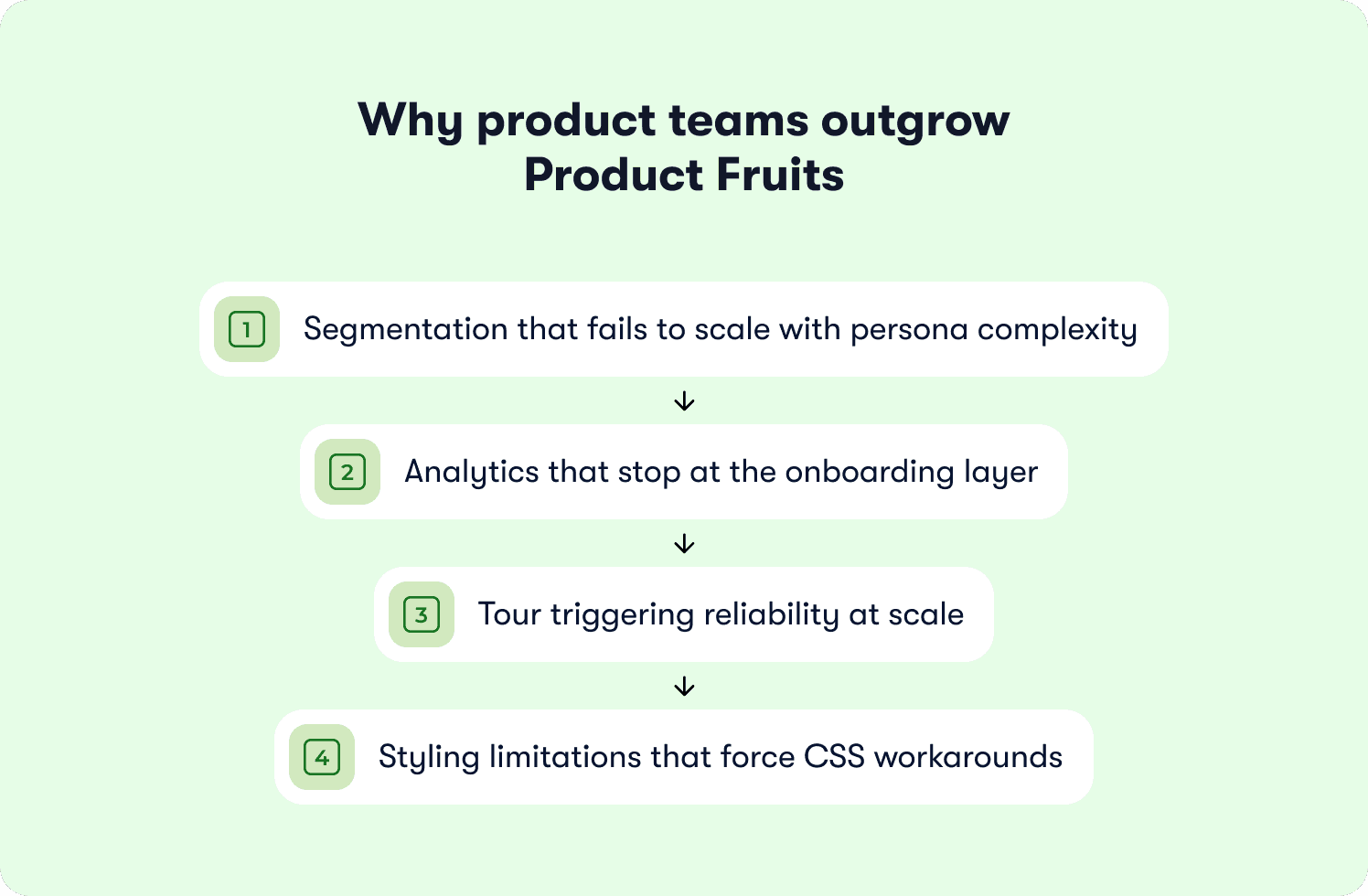
Segmentation that fails to scale with persona complexity
Product Fruits supports basic user attributes and behavioral triggers. Compound segmentation hits a ceiling quickly. Targeting users who've completed a specific feature, are on the enterprise plan, and have remained inactive for 14 days becomes nearly impossible.
As your user groups diversify across roles, lifecycle stages, and plan tiers, building a separate flow for every meaningful segment becomes the only workaround.
Users frequently highlight this limitation regarding CRM integrations. “We've struggled with connecting and mapping it to specific properties in Hubspot which has meant we haven't been able to segment our users as we'd like," notes the Head of Customer Success at a small business. “It seemed to map to some basic properties but does not map to custom properties.”
Analytics that stop at the onboarding layer
Product Fruits shows views and completions but provides no visibility into what users do elsewhere in the product. Teams compensate by layering external tools on top of their stack to analyze user behavior.
For a product manager who needs to answer whether onboarding actually drove activation, the answer lives in a spreadsheet rather than a dashboard. The platform lacks a robust two way sync with CRMs like HubSpot. Segment alignment requires manual uploads or API workarounds.
“Analytics are useful for understanding engagement, but deeper behavioral insights or more advanced reporting options would make it easier to tie onboarding directly to long-term retention or revenue impact,” one G2 reviewer says.
Another user adds that the gap between perceived improvement and actual data can be frustrating when insights lack depth.
Tour triggering reliability at scale
Reviewers consistently flag CSS selector problems, element detection issues, and editor lag when managing large numbers of tours. For a team running five flows across one persona, this is tolerable. For a team running dozens of flows across multiple personas and product surfaces, silent failures become a credibility problem with users and a massive maintenance burden for product managers.
Even the Product Fruits Help Center acknowledges that element detection is a frequent breaking point.
“Sometimes when multiple people are editing, it basically doesn't save, the editor lags at times, or some elements are flaky and disappear,” reports a reviewer on Gartner.
Styling limitations that force CSS workarounds
A no code tool shouldn't require a developer to make basic brand adjustments. Product Fruits offers limited native customization options for its portals and elements. Teams wanting to match their exact brand guidelines or use custom fonts are forced to write custom CSS. This defeats the purpose of a visual builder and creates a bottleneck for design and product teams.
“The customization options for the Customer Portal and other elements are quite limited, which means I often have to rely on CSS to make adjustments that fit my brand,” says a product manager at a small business.
A senior product designer at a mid-market company adds that requiring CSS knowledge for basic design features is a significant hurdle for smaller companies without dedicated in-house developers.
How to evaluate a Product Fruits alternative
Most teams switching from Product Fruits have outgrown its segmentation depth or hit the ceiling on its analytics. These four criteria separate tools that solve that problem from tools that trade one limitation for another.
Segmentation depth
Look for a tool that targets by lifecycle stage, feature usage history, plan tier, and compound conditions without requiring a separate flow for each combination. For product teams managing multiple personas across a growing user base, this is the primary scaling criterion. A tool that forces a new flow every time a condition changes has moved the manual work around, not eliminated it.
Analytics beyond the onboarding layer
Tour completion is an output. What matters is what users did after, whether they adopted the feature, converted from trial to paid, or churned at day 14. The right alternative integrates user feedback and answers the activation question natively, without exporting to a third-party tool.
Tour reliability at scale
At scale, a broken tour on new users’ first session caused by a UI update turns into a recurring operational cost. Look for self-healing selectors, DOM-resilient triggering, and performance stability when running a large volume of concurrent flows. Fragility that's manageable at 500 monthly active users (MAUs) becomes a full-time maintenance job at 50,000.
How many tools does it replace
Product Fruits' appeal was consolidation, putting tours, surveys, a knowledge base, and announcements in one platform. Any alternative should be evaluated on whether it maintains or improves that consolidation, not just on whether it adds individual product adoption features.
The 5 best Product Fruits alternatives for onboarding in 2026

1. Jimo — Best Product Fruits alternative for teams scaling onboarding complexity
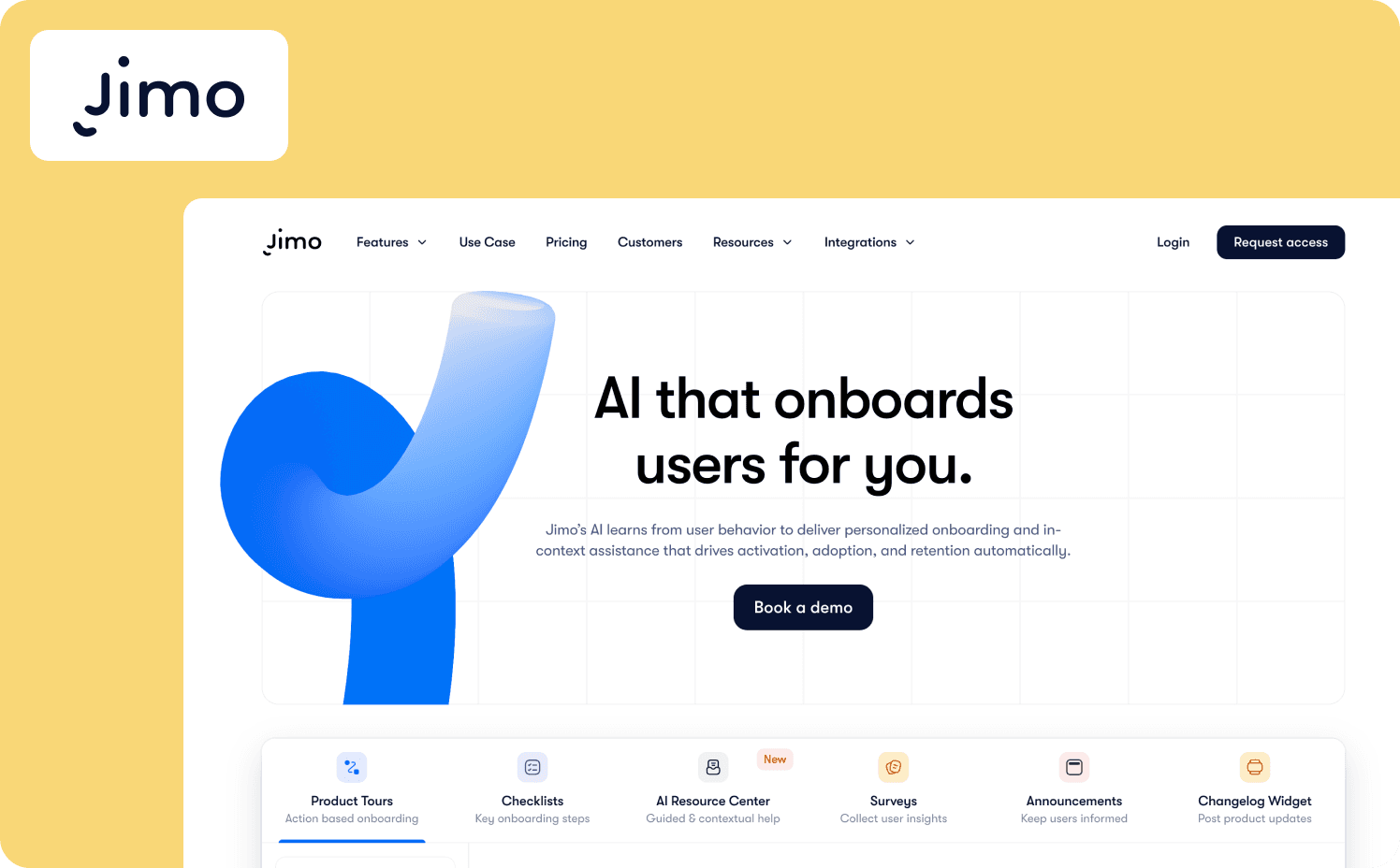
Jimo is the only AI-native digital adoption platform that guides users, answers their questions, and executes tasks on their behalf. It does all of this without engineering involvement, and without the static tour logic that most activation problems have already outgrown. By focusing on in-app lead generation and action-based mechanics, it ensures your onboarding process truly impacts revenue.
Strengths: Jimo only advances when users complete a designated task. AI tour generation produces a full, deployable tour structure from a single recorded flow in 30 seconds.
The AI Copilot operates across three modes:
Guide adapts the walkthrough in real time to what the specific user is actually doing.
Assist surfaces answers from your knowledge base the moment a user gets stuck, before they open a ticket.
Execute handles multi-step tasks on the user's behalf when they describe what they want in natural language.
Jimo’s Success Tracker also closes the loop that most onboarding platforms leave open. Instead of reporting tour completions, it connects each guidance interaction to downstream activation, trial-to-paid conversion, and retention signals. All of this occurs inside the same interface where the flows were built.
When to pick Jimo over Product Fruits:
You need to prove the ROI of your onboarding program by connecting guidance to trial-to-paid conversion and retention.
Your user base requires complex, advanced segmentation capabilities that adapt to individual behavior rather than broad cohorts.
You want to reduce build time significantly using AI that generates full action-based tour structures from a single recording.
Your PLG motion has plateaued and you need the product to activate users individually rather than fire the same sequence at a segment and hope it lands.
Limitations: Jimo isn’t designed for employee training, or for teams under 50 employees. It also exclusively supports web-based SaaS applications.
When Product Fruits wins over Jimo:
You're an early-stage startup with a very limited budget looking for the absolute lowest entry price point.
You need to deploy a basic, linear onboarding widget in under an hour and don't require deep behavioral analytics.
Starter: $249/mo (2,500–10,000 MAUs)
Growth: $479/mo (2,500–100,000 MAUs)
Enterprise: Custom
2. Userpilot — Best for teams who need analytics beyond the onboarding layer
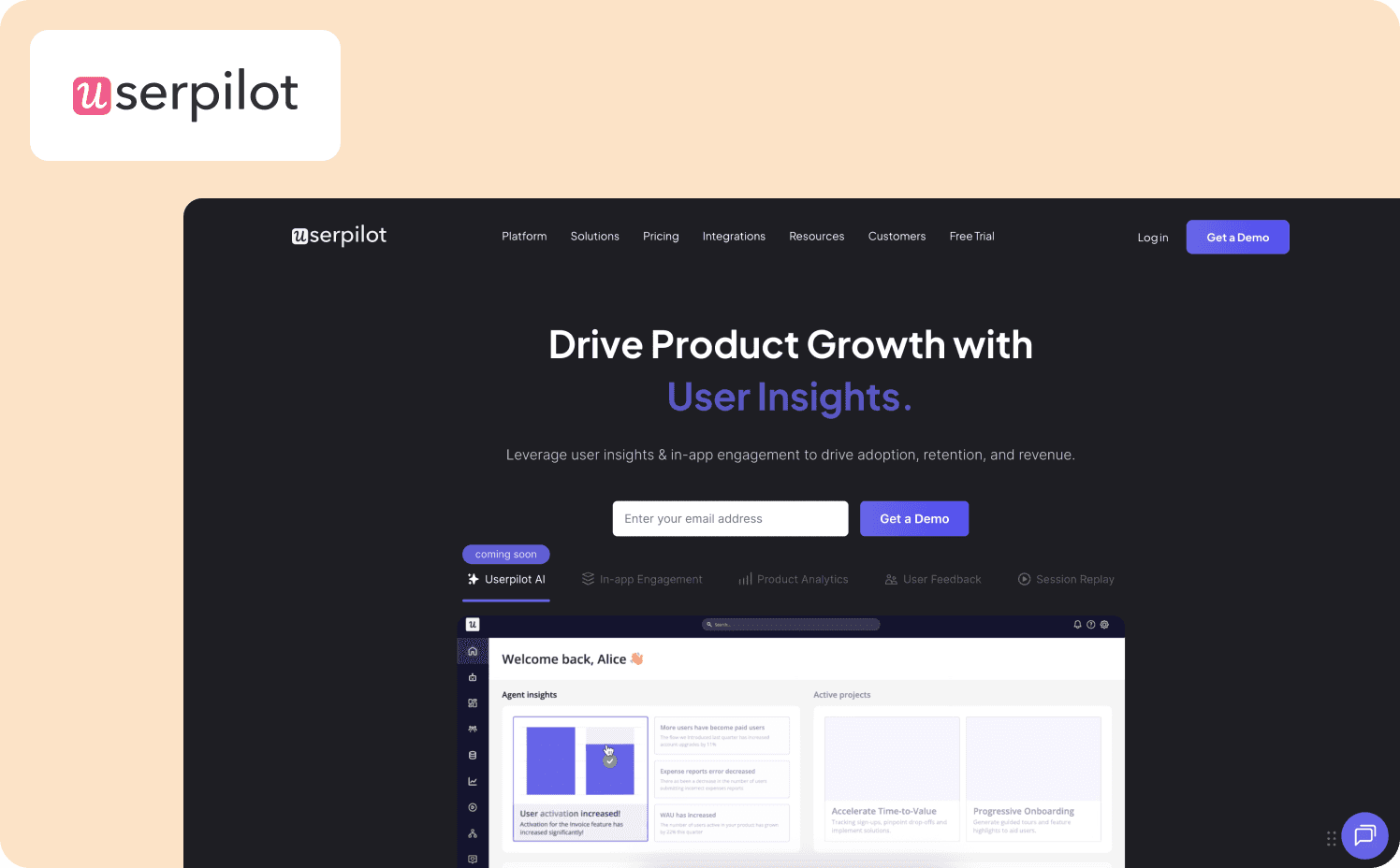
Userpilot combines in-app guidance with product analytics to help teams drive feature adoption and user engagement. It’s designed primarily for post-onboarding product growth and user retention. By blending engagement tools with built-in funnels and cohorts, it helps teams optimize the entire user journey.
Strengths: Userpilot offers strong action-based triggering, allowing teams to build onboarding strategies that respond to specific user segments and behaviors. It provides a solid balance of detailed analytics and engagement tools for segmenting users and optimizing the onboarding experience.
When to pick Userpilot over Product Fruits:
You need built-in funnels, cohorts, and retention analytics without relying on third-party analytics tools like Mixpanel.
You want to trigger flows based on specific user behaviors and custom events rather than just page loads.
Limitations: While it has advanced features, Userpilot’s interface can be clunky, and setting up complex workflow automation is often unintuitive for new users. Some teams report that the Chrome extension builder can be buggy and that the platform suffers from slow load times. Its performance can degrade when managing a large volume of concurrent flows.
When Product Fruits wins over Userpilot:
You prefer a simpler, more stable interface for building basic tours without the steep learning curve.
You're highly budget-conscious and need a lower starting price point for a basic onboarding toolkit.
Pricing:
Starter: $299/mo (up to 2,000 MAUs)
Growth: Custom pricing (starts from 5,000 MAUs)
Enterprise: Custom pricing (custom MAUs)
3. Chameleon — Best for design-conscious teams managing multiple user segments
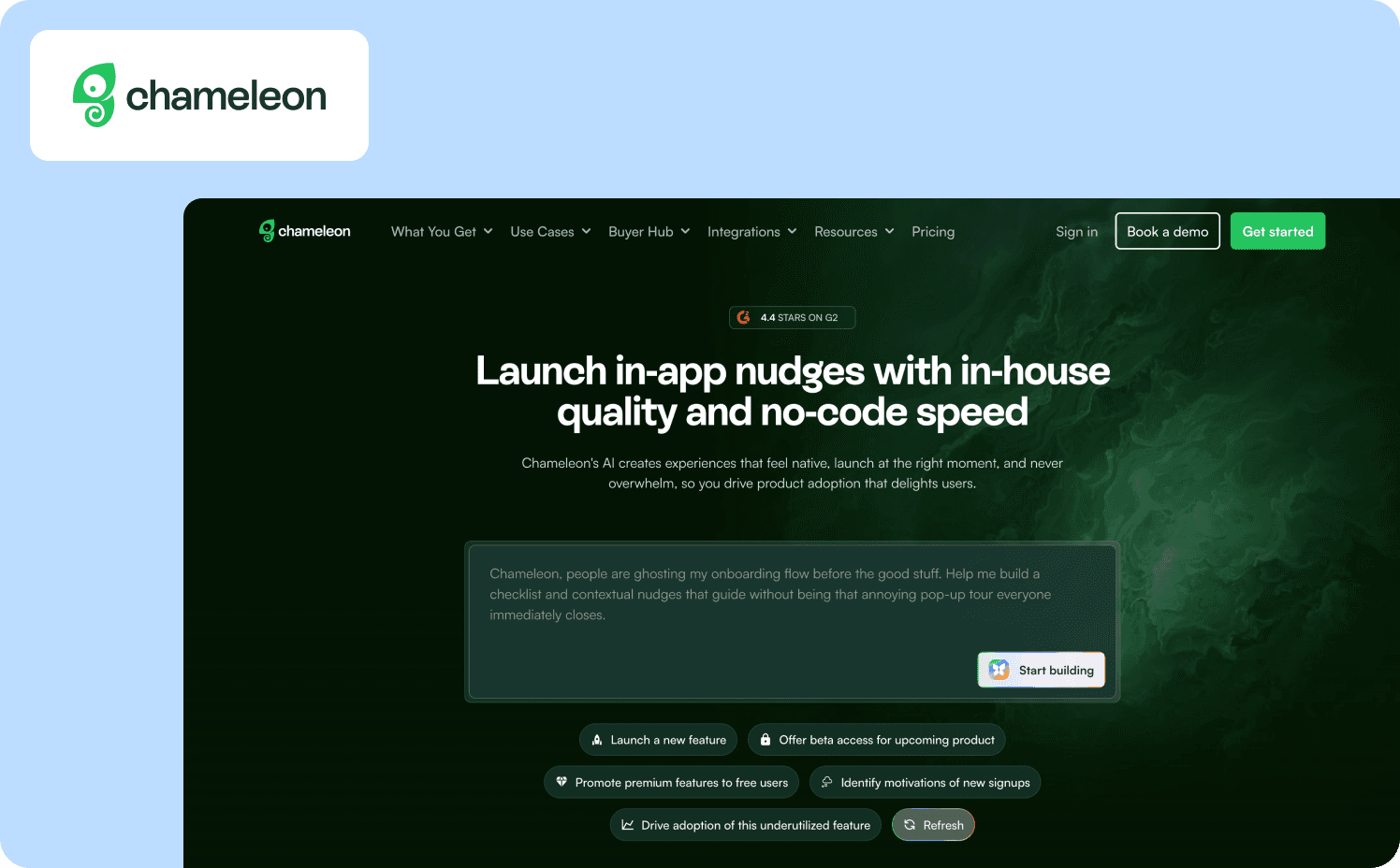
Chameleon is a product adoption platform focused on granular design control and advanced customization. It helps design-conscious teams make in-app guidance feel completely native to their application. If brand consistency is your top priority and you have developer resources, it offers unmatched styling flexibility.
Strengths: Chameleon allows for sophisticated personalization based on real user behavior. Its deep styling capabilities ensure that the onboarding flow integrates with the product's existing UI, avoiding the “bolted-on”look common with other tools. It also offers an API-first architecture for pixel-perfect brand alignment.
When to pick Chameleon over Product Fruits:
Brand consistency is non-negotiable and your design team requires deep CSS-level control over every element.
You need two-way integrations with dedicated analytics platforms like Mixpanel, Amplitude, or Heap.
Limitations: The platform is highly CSS-dependent for its advanced styling, making the learning curve steep for non-technical users who want to move beyond basic templates. It lacks a native analytics platform, requiring teams to stitch together third-party integrations to fully track user progress. The pricing also jumps significantly at the Growth tier, causing many users to outgrow the platform and search for Chameleon alternatives.
When Product Fruits wins over Chameleon:
You need to launch a basic onboarding widget in under an hour and prioritize initial speed over pixel-perfect brand alignment.
You need built-in analytics and a help center without paying for and integrating multiple third-party tools.
Pricing:
Startup: From $279/mo (1,000 MAUs)
Growth: From $15,000/year (1,000 MAUs)
Enterprise: Custom (custom MAUs)
4. UserGuiding — Best direct replacement for teams not ready to change category
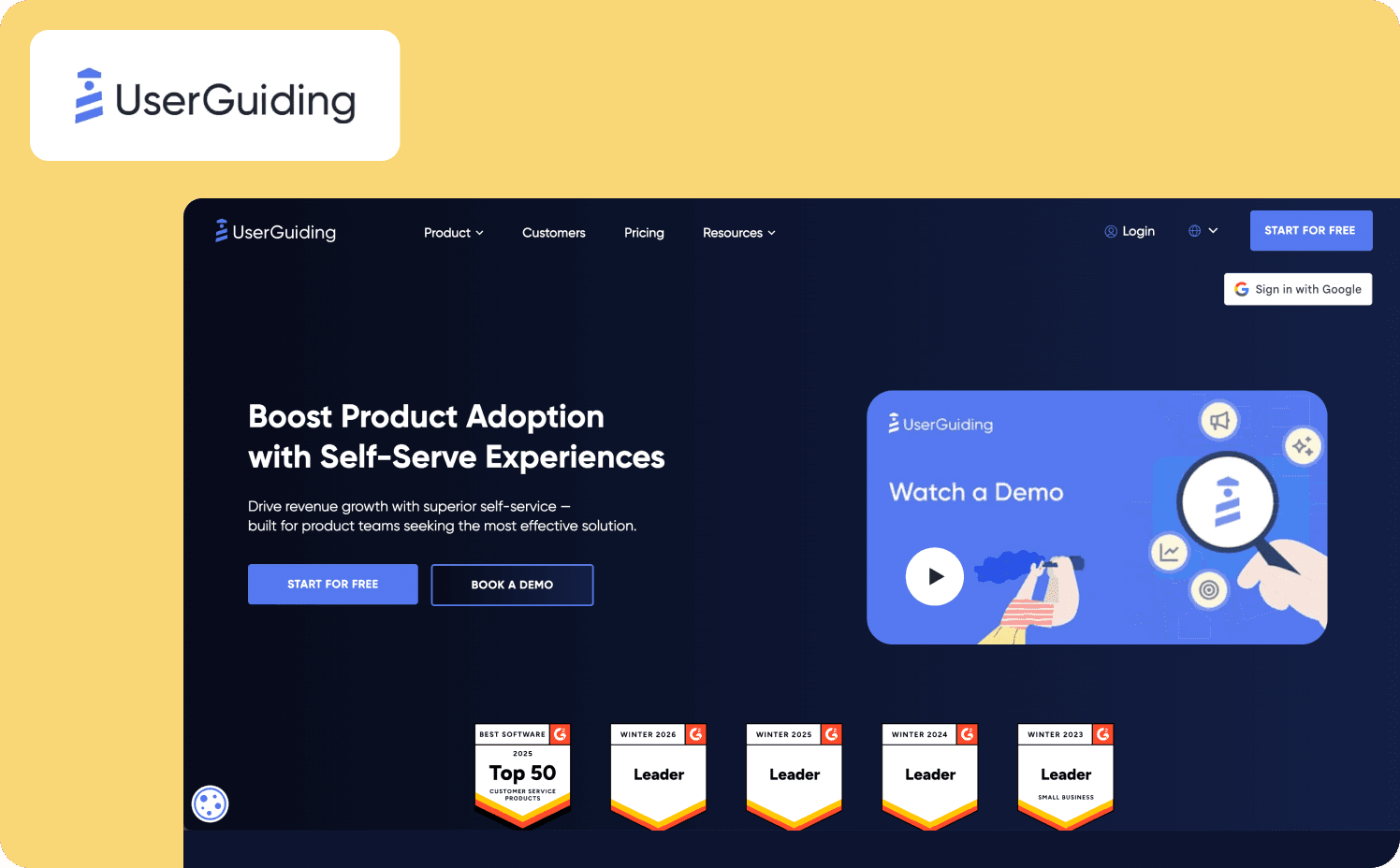
UserGuiding delivers essential onboarding features at a highly accessible price point for early-stage startups and SMBs. It provides rapid deployment with a simple no-code editor, minimal learning curve, and pre-built templates that accelerate setup. If you need basic linear tours without sophisticated behavioral triggers, it's a strong budget alternative to Product Fruits.
Strengths: UserGuiding is highly cost-effective, providing all the essential features needed to launch a basic customer onboarding process quickly without breaking the bank. It offers a straightforward interface that allows non-technical teams to create simple tours, checklists, and basic NPS surveys. The platform also offers monthly billing, eliminating the annual lock-in that many competitors require.
When to pick UserGuiding over Product Fruits:
Budget is your absolute primary constraint and you need the lowest possible entry price point for basic tours.
You want monthly billing flexibility to test an onboarding platform without committing to an annual contract.
Limitations: UserGuiding relies heavily on linear and static flows, lacking the advanced features needed for deep behavioral adaptation or complex workflow automation. It isn’t suited for enterprise teams or teams that need to create highly personalized onboarding experiences based on real-time user interactions.
When Product Fruits wins over UserGuiding:
You need a more comprehensive all-in-one toolkit that includes a solid knowledge base and feature announcements out of the box.
You want AI assistance to help generate tour content and copy to speed up the initial build process.
Pricing:
Free plan
Starter: From $249/mo (2,000 MAUs+)
Growth: From $499/mo (2,000 MAUs+)
Enterprise: Custom
5. Kompassify — Best budget-close alternative with built-in product analytics
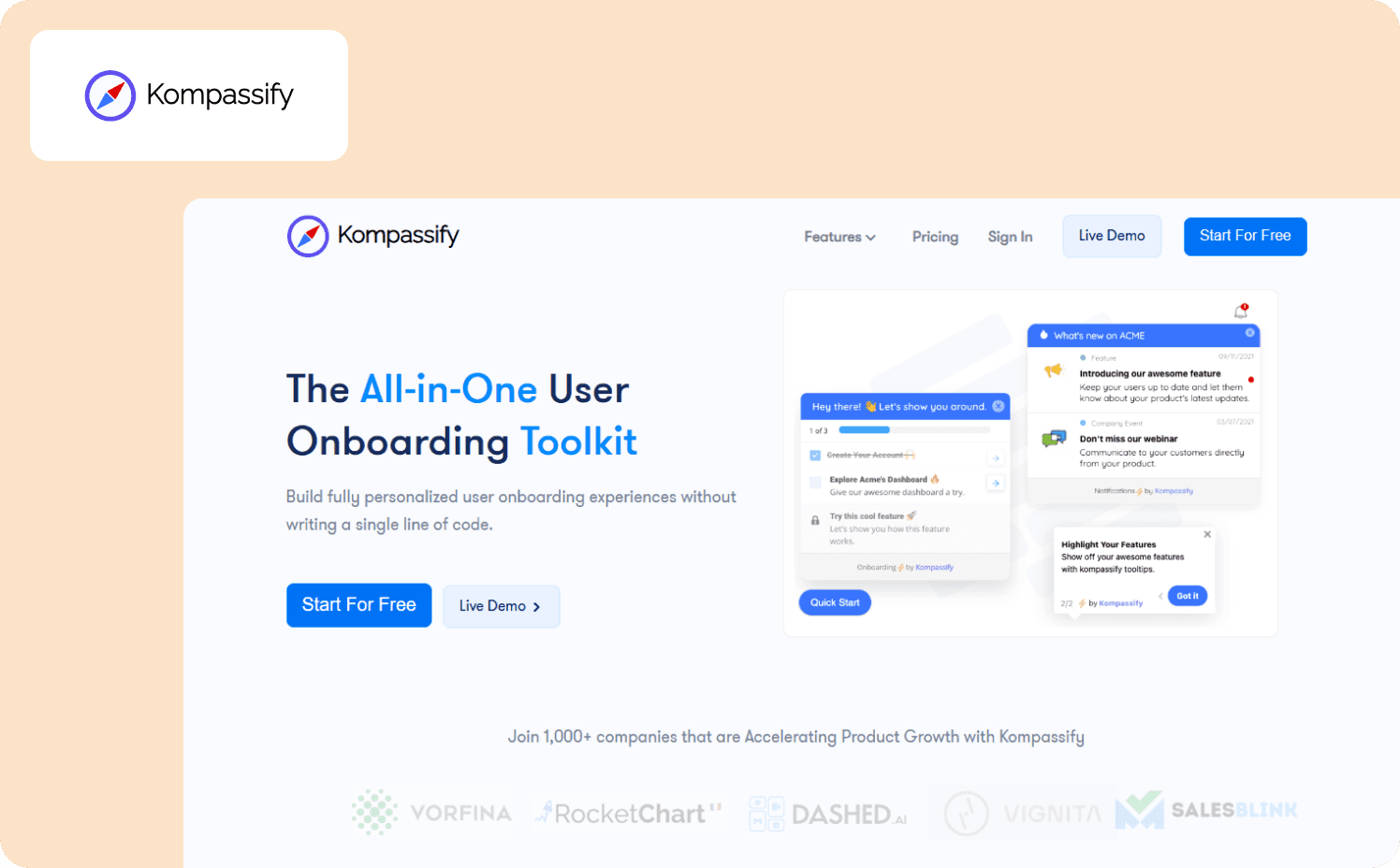
Kompassify is a new entry to the digital adoption platform space. It’s designed to help startups and SMBs create engaging user onboarding experiences. Kompassify focuses heavily on ease of use, allowing product managers to build tours, checklists, and notification widgets using an intuitive Chrome extension. If you want a zero-knowledge design approach that doesn't collect sensitive end-user data, it's a compelling lightweight option.
Strengths: Kompassify is incredibly easy to set up, allowing founders and PMs to build full-fledged product tours in minutes without writing a single line of code. It offers a strong suite of basic tools including onboarding checklists, multi-choice branching, and a notification widget for feature announcements. Users consistently praise its intuitive progress bars and highly responsive customer support.
When to pick Kompassify over Product Fruits:
You want a highly intuitive Chrome extension builder that lets you design and preview tours directly over your live website without altering code.
You need strict data privacy and prefer a platform with a "zero-knowledge design" that doesn't collect sensitive data about your end users.
Limitations: Kompassify lacks the deep enterprise analytics, complex compound segmentation, and cross-channel orchestration found in more mature tools. It also lacks popular built-in integrations.
When Product Fruits wins over Kompassify:
You need a more mature platform with a wider array of integrations and a longer track record in the market.
You require a fully integrated, searchable knowledge base alongside your onboarding tours.
Pricing:
Free plan (up to 100 MAUs)
Starter: From $129/mo (1,000 MAUs+)
Growth: From $249/mo (1,000 MAUs+)
Enterprise: Custom (unlimited MAUs)
Which Product Fruits alternative fits your team
The right alternative depends entirely on your specific scaling constraint. Match your primary bottleneck to the platform built to solve it.
If your bottleneck is... | Best fit | Why |
Scaling onboarding across growing persona complexity | Jimo | AI-native guidance adapts per user, meaning no separate flow per segment is required. |
Analytics beyond tour completion | Jimo or Userpilot | Jimo's Success Tracker and Userpilot's native funnels provide deep cohort analysis. |
Design consistency across multiple user segments | Chameleon | Reusable themes and account-wide rules scale across personas without rebuilding. |
Tour reliability and basic segmentation accuracy | UserGuiding | Offers a more reliable targeting engine at a comparable price point. |
Budget-close upgrade with built-in product analytics | Kompassify | Matches the core feature set and adds full-journey analytics at a lower cost. |
If your bottleneck is scaling onboarding across growing persona complexity or connecting guidance to outcomes beyond tour completion, Jimo is built for that.
And if your PLG motion has hit its ceiling, Jimo is the ILG-era replacement, a product that understands and activates each user individually, not by cohort. Book a demo to see the platform in action.
FAQs
What is the best Product Fruits competitor for scaling teams?
Unlike Product Fruits, Jimo is the best alternative for scaling teams because it acts as a comprehensive product growth platform. It uses AI to tailor onboarding experiences based on how individual users interact with your app in real time. This ensures you aren't just building static tours, but driving measurable activation.
What are the main reasons teams switch from Product Fruits?
Teams typically outgrow this product tour software when they need to deeply track user interactions beyond basic flow completions. As your user base diversifies, building separate flows for every segment becomes a maintenance nightmare for your product and support team. Plus, scaling teams often experience silent triggering failures and CSS selector issues that hurt user satisfaction.
Is there a cheaper alternative to Product Fruits?
Yes, UserGuiding and Kompassify are highly competitive options if you need a budget-friendly onboarding tool. Both platforms deliver the core onboarding features you need to launch basic tours and in-app messages quickly. They offer a lower entry price point while still helping you improve initial user productivity.
How is Jimo different from Product Fruits?
Product Fruits is a traditional digital adoption platform built to deploy static, linear tours quickly. Jimo is an AI-native product experience platform built for Intelligence-Led Growth. Instead of forcing users through rigid walkthroughs, Jimo's AI Copilot guides users based on their actual behavior, assists them by answering questions in-context, and executes tasks on their behalf using natural language. Jimo's Success Tracker connects every interaction directly to trial-to-paid conversion and retention, proving the exact revenue impact of your onboarding efforts.