TL;DR
Whatfix is a strong enterprise-scale digital adoption platform for rolling out CRM, ERP, and HRIS systems with dedicated services support. But three factors often drive teams to evaluate alternatives: implementation timelines, pricing complexity, and rigidity with product changes. The decision comes down to your use case. If activation is the gap and iteration speed is the constraint, the right tool looks very different from an enterprise governance platform.
The budget is approved, the contract is signed, and the implementation clock starts. Months later the first user flows are finally live, but by then the adoption problem that triggered the purchase has already cost another quarter. For enterprise employee training programs, that timeline is manageable. But for product teams trying to fix activation this quarter, it isn't.
Whatfix was built for a specific kind of digital adoption problem. When the use case shifts toward customer-facing product onboarding, faster iteration, or tighter cost scrutiny, three structural limitations tend to surface. Timelines don't match the urgency, pricing gets harder to defend every time a new application is added, and guidance requires manual upkeep every time the product changes.
We look at five Whatfix alternatives, analyzing where each fits, where each falls short, and who each is built for. We’ll also cover what switching from Whatfix looks like in practice, so the decision comes with a realistic picture of what migration takes.
Why teams look for Whatfix alternatives
Whatfix is a capable enterprise digital adoption platform. It has strong professional services, broad application support across web apps, desktop, and mobile, SCORM compliance for formal training programs, and a simulation environment in Mirror for pre-launch training. For large organizations with dedicated IT teams rolling out multiple enterprise applications simultaneously, Whatfix's depth makes sense.
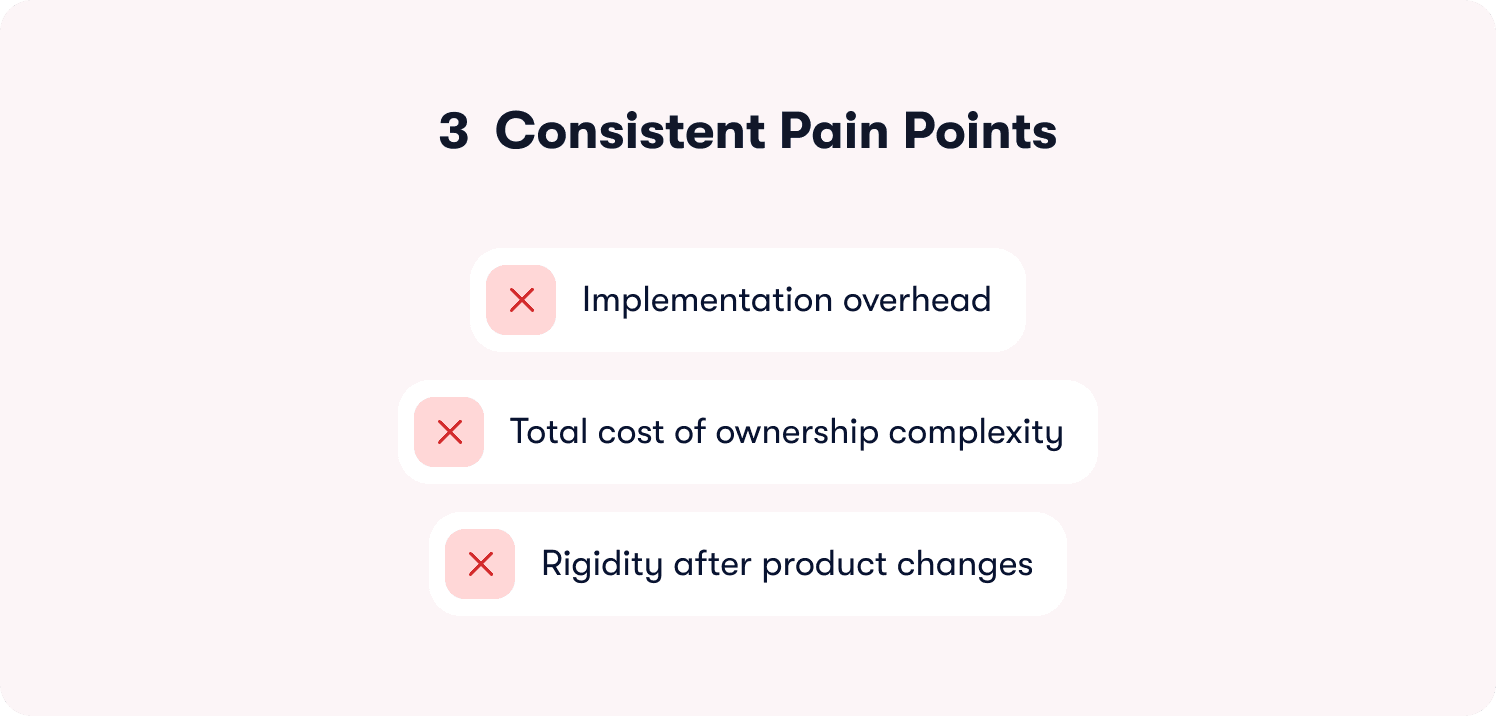
But three specific pain points consistently drive teams to evaluate alternatives.
Implementation overhead
Whatfix implementations can take 1-3 months from contract signature to first live user flow. For teams with an urgent activation problem, that timeline is a dealbreaker. Every week of delay is another week of trial signups that never reach their first value moment.
Activation rates stall while the adoption program waits for professional services to complete setup, customer success teams absorb the gap manually, and acquisition spend gets wasted on users who sign up but never convert. As one customer experience coordinator notes on G2, “Many features seem to require technical support, making it difficult to work independently without some form of guidance.” When the digital adoption budget was approved to solve an urgent activation problem, a 12-week implementation sprint defeats the purpose.
Total cost of ownership complexity
Whatfix prices per application and per user, with Product Analytics and Mirror sold as separate add-ons, and none of which has published pricing. That opacity creates a compounding problem. A senior business development executive says on G2, “Whatfix does not publish clear pricing publicly, and quotes can vary widely depending on use cases, apps supported, and user count, sometimes making budgeting and ROI forecasting difficult.”
Every new application added to the stack triggers another pricing conversation, finance teams have no baseline to forecast costs as the organization scales, and budget approvals get delayed by quarters rather than weeks. For teams trying to build a business case for leadership, an adoption platform with no public pricing is a harder sell than one where the cost tomorrow is visible today.
Rigidity after product changes
Whatfix user flows require manual reconfiguration when UI elements change. Button IDs shift, layouts update, key features get redesigned. For product teams shipping weekly, this creates a maintenance burden that compounds over time.
Flows break silently after deployment, users encounter guidance pointing to elements that no longer exist, and fixing the issue requires either internal resources with specialized Whatfix training or another professional services engagement. “The setup and maintenance can be time-consuming, especially when frequent application updates require walkthroughs to be rebuilt and retested,” says one G2 reviewer. “Complex dynamic business processes are sometimes difficult to model using standard linear walkthroughs.”
Teams end up choosing between shipping fast and keeping guidance functional, which is a tradeoff that shouldn't exist.
How to evaluate Whatfix competitors
Before diving into specific tools, establish your evaluation lens. This framework helps you assess any digital adoption solution and prevents the vendor-biased comparisons that have burned enterprise buyers before.
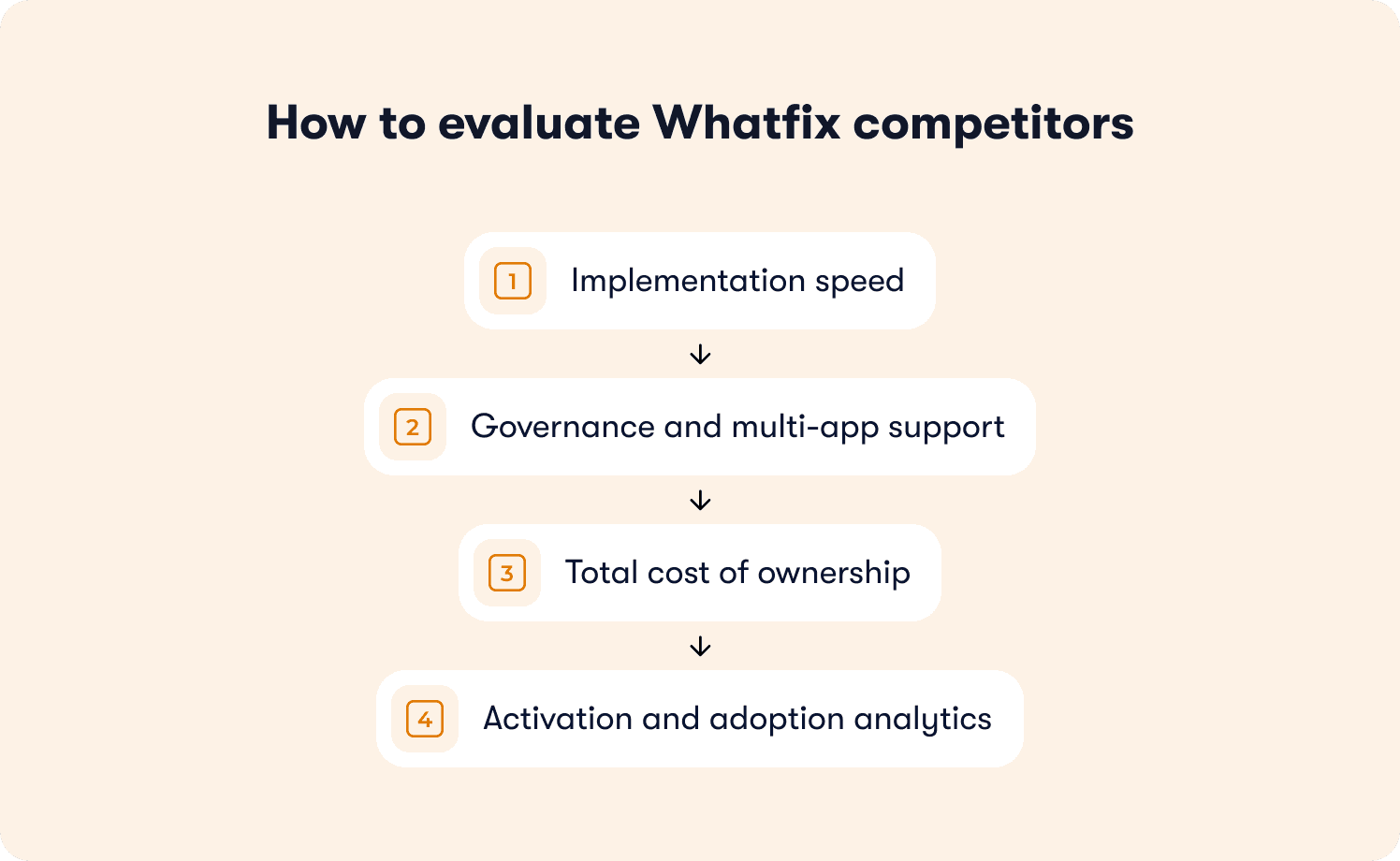
Implementation speed
The real question is whether your team can publish the first live flow in days rather than months. It’s also important to establish whether non-technical users can own that process through a no-code editor without filing engineering tickets.
If a platform requires a dedicated professional services engagement to configure basic user segmentation and flow logic, that timeline cost shows up immediately in your activation metrics.
Governance and multi-app support
Whatfix serves two fundamentally different use cases, and each demands entirely different governance infrastructure.
Internal multi-app deployments, like an HR team replacing Whatfix for SAP, Workday, and Salesforce training, require:
Cross-application workflow orchestration
SOC 2 Type II certification
Role-based content publishing
Audit trails
Enterprise SSO.
These teams are coordinating guidance across applications they don't control, which requires heavyweight governance by necessity.
Customer-facing SaaS onboarding has a completely different requirement set. Your product team is guiding users through your own application. You control the codebase. You need fast iteration cycles. Governance in this context means security documentation that satisfies IT reviewers without multi-month procurement cycles, not enterprise workflow orchestration you will never use.
If you’re replacing Whatfix for the first use case, you need WalkMe, Pendo, Userlane or a platform with equivalent multi-app governance infrastructure. If you’re replacing Whatfix for the second, Jimo or Userpilot provide exactly the governance depth SaaS product teams require: SOC 2 compliance, SSO, role-based access controls, and security documentation that passes IT review without the overhead of cross-application architecture you don't need.
Activation and adoption analytics
Tour completion rates aren’t activation metrics. The platforms worth evaluating can show you where users drop off within a workflow, which segments activate smoothly versus which ones stall, and how guidance interactions connect to downstream outcomes like retention and feature usage.
The tool’s behavior analytics should also be able to show you which user segments struggle versus which different user segments activate smoothly. That connection is what turns a user adoption program from a cost center into a business case you can defend to finance.
Total cost of ownership
Per-application plus per-user pricing compounds fast as you add tools to your stack. Advanced analytics, mobile support, and simulation environments are frequently sold as add-ons rather than included in the base license. And professional services costs for implementation and ongoing maintenance after UI changes can match or exceed the license fee itself. It’s a detail that rarely surfaces until contract renewal.
Criterion | Owner | What to look for | Business outcome |
Implementation speed | Head of Digital Adoption / IT | Days to first flow, no-code editor, no professional services dependency | Faster time-to-value, program doesn't stall |
Governance and multi-app support | CIO / IT Security | Third-party app support, SOC 2/GDPR, access controls | Risk reduction, compliance, centralized governance |
Activation analytics | CPO / Head of Digital Adoption | Drop-off measurement, user behavior analytics, ROI connection | Proof of ROI, data-driven iteration |
Total cost of ownership | CPO / Finance | Pricing model clarity, base vs. add-ons, professional services cost | Board-ready case, predictable scaling |
5 Whatfix alternatives worth evaluating

The right alternative depends entirely on your bottleneck. These five tools cover the full spectrum, from enterprise governance to product-led activation, so the evaluation criteria above matter more than any feature checklist.
1. Jimo — Best for product-led B2B SaaS teams who need measurable activation impact without engineering dependency
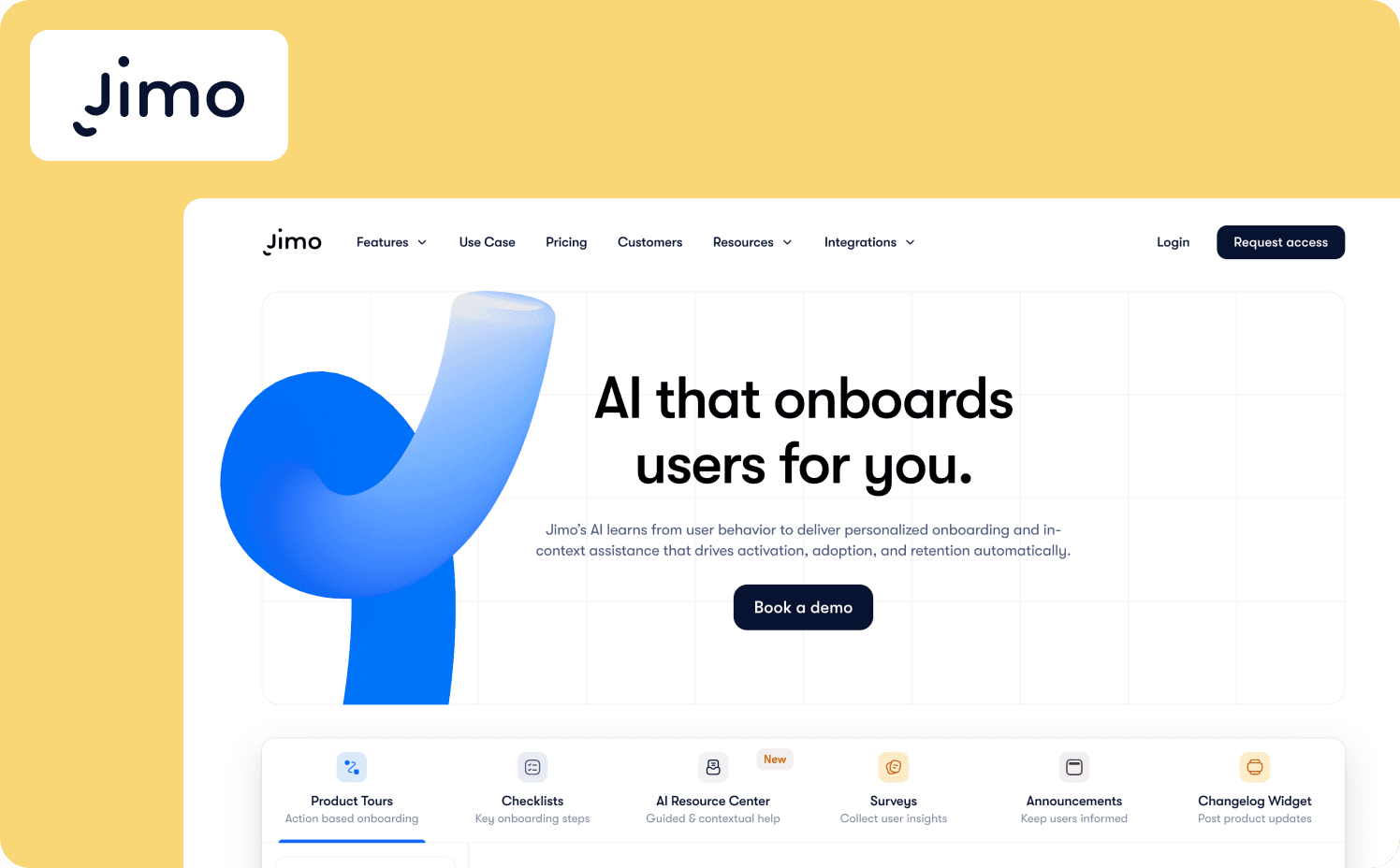
Jimo is an AI-native digital adoption platform built for product teams where activation is the bottleneck and engineering dependency is the constraint. The Success Tracker lets teams tag features and visualize drop-off points without writing code, so the gap between identifying a problem and launching a fix is measured in hours rather than sprints. The AI Builder records a user flow once and generates complete product tours in 30 seconds, including steps, triggers, and progression logic. This means the team that owns activation can own the tooling without filing a single engineering ticket.
Unlike traditional linear walkthroughs where users passively click “Next,” Jimo’s action-based tours auto-progress only when users complete actual behaviors, which means completion equals activation rather than clickthrough. The full toolkit includes contextual hints, in-app announcements, surveys, NPS, checklists, and an AI-powered resource center. Zenchef used the full platform to cut onboarding time by 53%, reducing time-to-value from 30 days to 14 across five languages, and is on track to reach under two hours for self-service onboarding entirely.
Key differentiators: Most adoption platforms treat measurement as a reporting feature. Jimo treats it as the core mechanic, so every intervention is tied to whether users completed the actions that predict retention, and that attribution is native rather than requiring manual data exports or a separate analytics tool. Jimo's own trial conversion improved from 11% to 24% using the same behavior-driven nudges the platform makes available to customers. For product teams that need to prove adoption investments drive revenue, not just user engagement, that closed loop is what makes the business case.
When to consider Jimo over Whatfix:
Your bottleneck is product activation, meaning trial-to-paid conversion is flat despite healthy signup volume
You need to iterate weekly on onboarding flows without filing professional services requests
Leadership demands proof that onboarding investments actually drive retention and revenue, not just tour completion metrics
Where it falls short: Jimo isn’t an employee onboarding tool or built for employee training across legacy on-premise systems. Teams whose primary use case is rolling out SAP, Workday, or Salesforce internally should evaluate WalkMe or Userlane first.
Starter: $249/mo (2,500 MAUs)
Growth: $479/mo (2,500 MAUs)
Enterprise: Custom
2. WalkMe — Best for enterprise-scale employee training and cross-application workflow automation
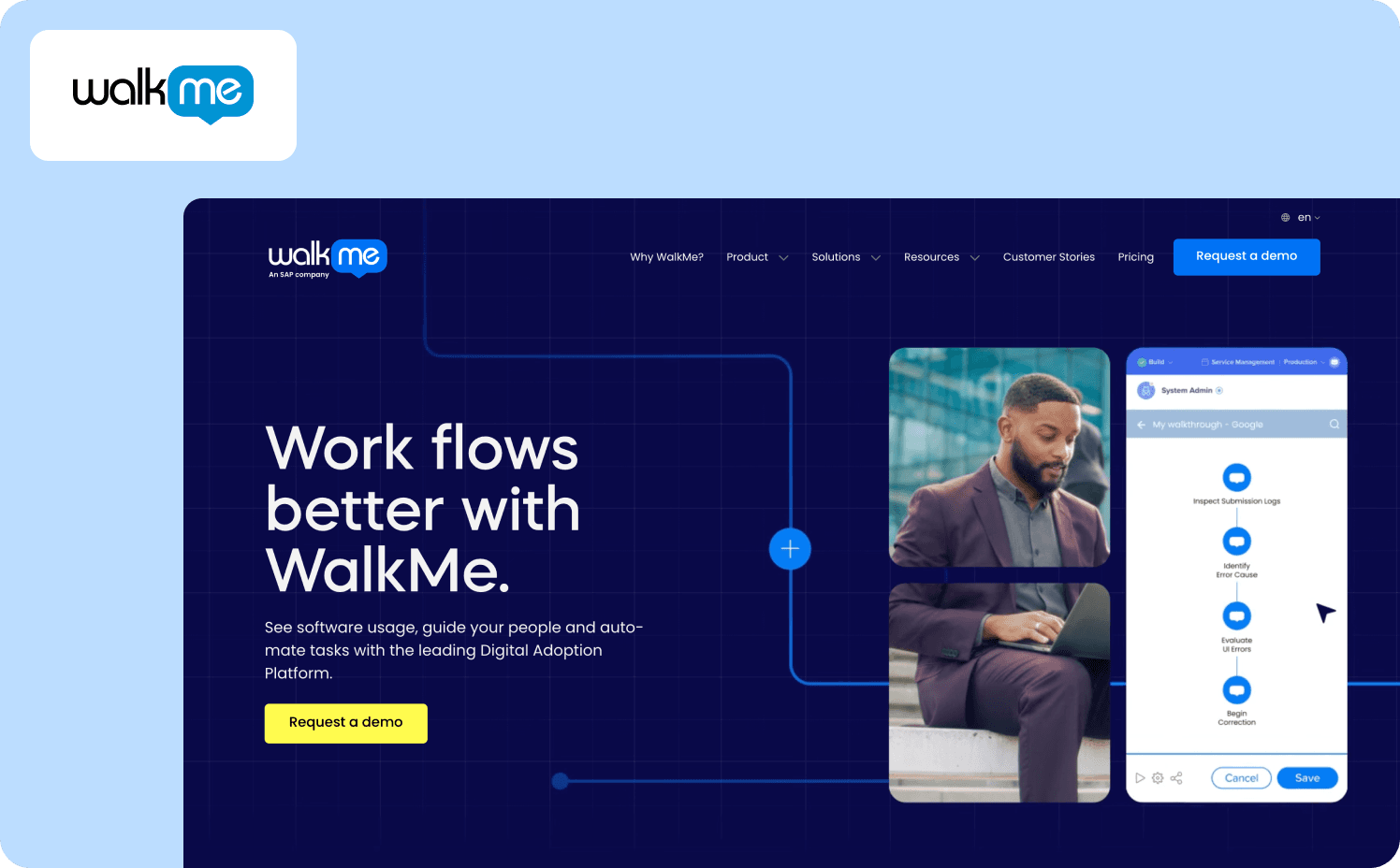
WalkMe is an enterprise digital adoption platform built for the problem that defines large-scale digital transformation programs: Employees who have completed training on a new system but still cannot execute the workflows that justify the software investment.
Cross-application orchestration means guidance follows users across CRM, ERP, and HRIS systems in a single workflow without losing context. This matters most when the business process you need to support does not live inside one application.
Key differentiators: For teams whose success metric is software ROI across a complex enterprise stack, WalkMe's cross-application orchestration is the capability that justifies the investment. Flow Analytics surface bottlenecks that only become visible when you measure across applications rather than within them, giving adoption teams the evidence they need to show a CIO exactly where the productivity gap lives and what closed it.
When to consider WalkMe over Whatfix:
You need proven cross-application workflow automation at enterprise scale, and budget plus timeline support multi-month implementation.
Your primary use case is employee training on third-party enterprise applications, not customer-facing product onboarding.
You have dedicated resources for ongoing content maintenance.
Where it falls short: WalkMe carries similar implementation complexity to Whatfix, deployment can take months and require professional services. The 2024 SAP acquisition is also worth factoring into any long-year decision. WalkMe has committed to supporting non-SAP applications, but organizations running primarily on Workday, Oracle, or Salesforce should pressure-test that commitment before signing a multi-year contract.
Pricing:
WalkMe for employees: Custom
WalkMe for customer: Custom
3. Pendo — Best for enterprise teams needing unified product analytics and in-app guidance
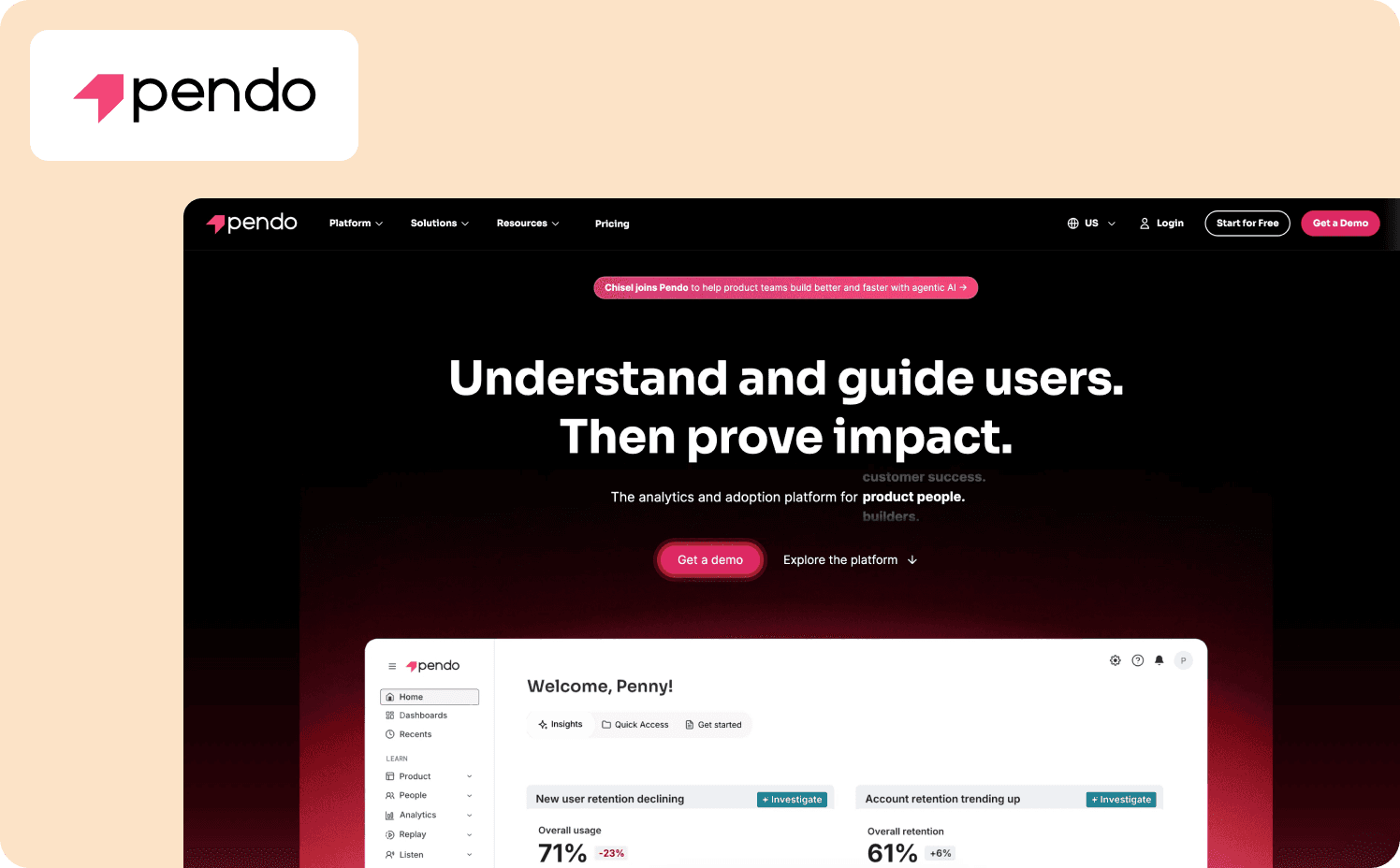
Pendo is an analytics-first adoption platform that combines deep product analytics with onboarding capabilities in one system. Where most adoption platforms measure whether users completed a tour, Pendo measures whether users completed the product milestones that actually predict retention.
Retroactive analytics let you instantly view historical data for any click or page view without prior tagging, which means gaps in instrumentation don't create permanent blind spots. Automatic event capture tracks all customer interactions without requiring pre-configured event definitions.
Key differentiators: For a team whose primary bottleneck is not delivering guidance but understanding why users aren't activating, Pendo's analytics depth is unmatched among platforms that also offer in-app guidance. The all-in-one approach matters here because it eliminates the data synchronization problem that comes with stitching together a separate analytics platform and a separate DAP.
When to consider Pendo over Whatfix:
You need detailed analytics that Whatfix can't match out-of-box.
Your team wants to eliminate the overhead of maintaining separate analytics and onboarding tools.
Your primary gap is measurement depth, not just guidance delivery
Where it falls short: Pendo’s sheer volume of advanced features makes the dashboard overwhelming for new users. It’s less suited to employee training use cases than WalkMe or Userlane, and guidance features aren’t as strong as platforms built specifically for onboarding.
Pricing:
Free: For 500 MAU
Base: Custom
Core: Custom
Ultimate: Custom
4. Userpilot — Best for mid-market teams wanting onboarding, analytics, and feedback without enterprise bloat
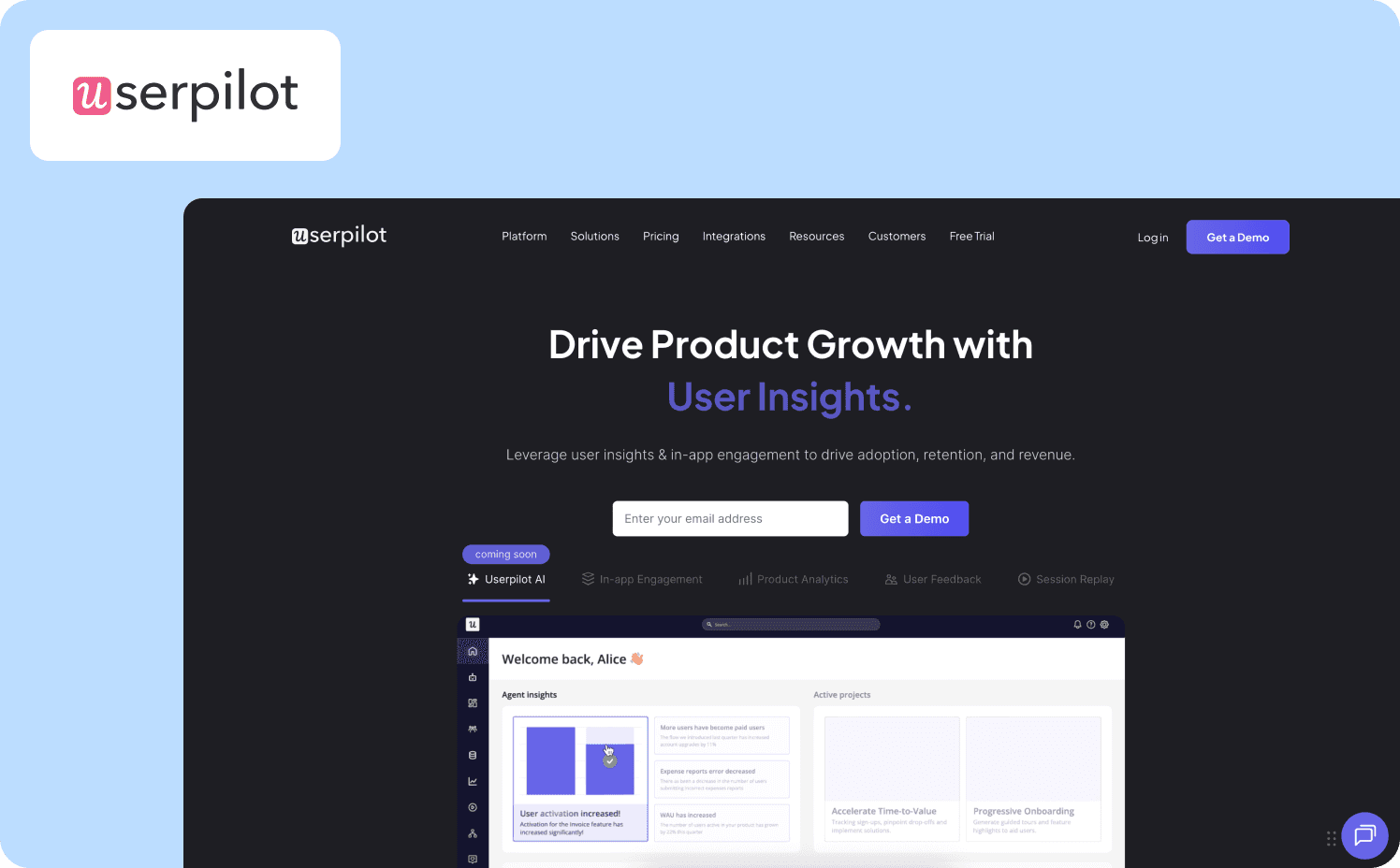
Userpilot is an all-in-one growth platform combining onboarding, behavioral analytics, and in-app feedback collection for product-led growth teams. Unlike Whatfix's static linear flows, Userpilot's behavior-triggered flows adapt based on what users actually do rather than forcing everyone through the same predetermined sequence.
The no-code builder lets non-technical product managers create modals, tooltips, checklists, and surveys without engineering tickets. The integrated NPS and user feedback collection connects onboarding completion to user sentiment in real-time.
Key differentiators: The team that owns activation can tag events, segment users, build flows, collect feedback, and analyze results without leaving the platform or filing a single engineering ticket. For mid-market teams where activation is the revenue bottleneck, that ownership matters. Faster interventions, tighter feedback cycles, and a clearer line between onboarding investment and conversion outcomes are the result.
When to consider Userpilot over Whatfix:
You’re moving away from static linear flows and need behavioral triggers that adapt to what users do.
Your primary use case is web-based SaaS product onboarding for customers, not employee training on enterprise applications.
You want one platform covering onboarding, analytics, and feedback rather than maintaining separate tools that don't talk to each other.
Where it falls short: Userpilot is web-only, with no native mobile or desktop support. Analytics dashboards lack the customization depth of dedicated analytics platforms, and MAU-based pricing creates cost unpredictability for teams projecting significant user growth.
Pricing:
Starter: $299/mo (includes 2,000 MAUs)
Growth: Custom (includes 5,000 MAUs)
Enterprise: Custom (includes 10,000 MAUs)
5. Userlane — Best for enterprise teams needing standardized adoption measurement across applications
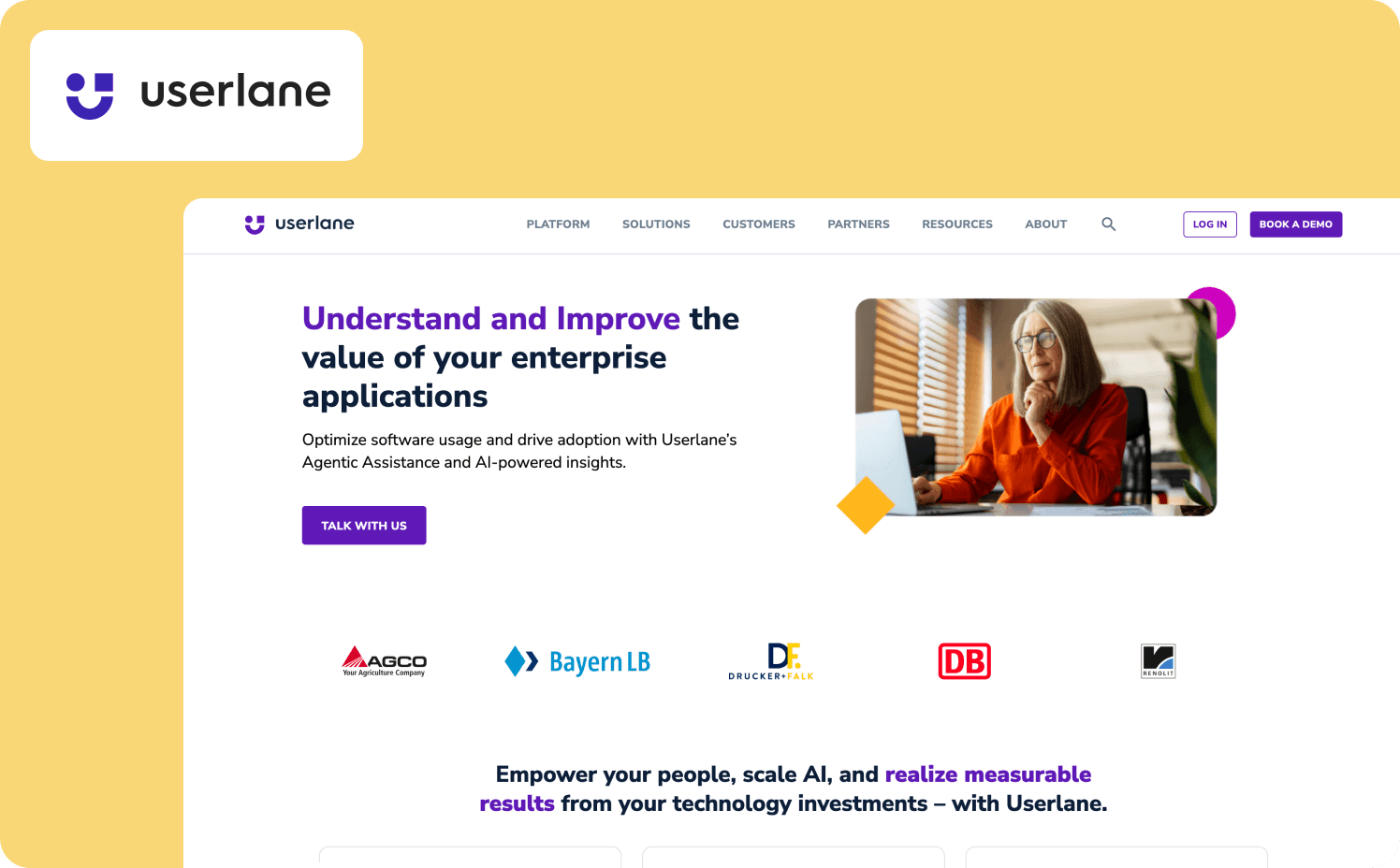
Userlane is a no-code enterprise digital adoption solution focused on employee training across complex enterprise applications like SAP, Workday, and Salesforce. For organizations managing digital transformation across multiple systems, the core problem is rarely building the guidance. It’s proving that the guidance worked. L&D teams can build interactive guides without coding using the drag-and-drop editor, which removes the implementation bottleneck that delays time-to-competency for new employees.
The AI-powered Assistant with Microsoft Azure integration delivers contextual support across applications. This reduces the support ticket volume that typically spikes during system rollouts and migration periods.
Key differentiators: Userlane's HEART Analytics framework applies the same measurement methodology across every application in the stack. That consistency means a CIO or VP reviewing adoption performance is looking at CRM, ERP, and HRIS through the same lens rather than reconciling fragmented, per-tool metrics that measure different things. For teams that need to report holistic digital transformation progress rather than individual tool performance, that standardization is what makes the executive conversation possible.
When to consider Userlane over Whatfix:
You need consistent adoption measurement across all enterprise applications using a standardized framework.
The HEART methodology maps to your existing KPIs and gives you a framework for executive reporting that Whatfix's per-application analytics can’t provide.
Your primary use case is employee training with enterprise-wide adoption metrics.
Where it falls short: Userlane is built for enterprise employee training, not product-led growth activation. Setup requires enterprise-scale implementation timelines, and no public pricing is available, which makes early-stage budget planning difficult.
Pricing:
No published pricing
The real cost of Whatfix (and what to expect from competitors)
Pricing structure matters as much as the headline number, especially for a head of digital adoption building a business case for leadership. Understanding how costs scale as your organization grows determines whether an adoption platform becomes predictable infrastructure or a budget surprise at renewal.
Consider a team deploying across three enterprise applications like CRM, ERP, and HRIS with 1,000 employees. Under Whatfix's per-application plus per-user model, that means three separate application license fees, per-user costs multiplied across all three systems, and additional purchases if the team needs Product Analytics or Mirror simulation for pre-launch training.
Now compare that to a transparently tiered alternative deployed on a single product for the same 1,000 users. The cost structure is predictable from day one. At scale, that difference alone can justify switching tools, and that’s before factoring in the 1-3 month implementation time savings.
Monthly active user (MAU)-based pricing works well when the model is transparent and tiers are clearly published. This lets you forecast costs, model growth scenarios, and build a business case finance can actually approve.
The hidden cost that rarely surfaces in sales cycles is professional services. Enterprise platforms like Whatfix, WalkMe, and Pendo typically require dedicated implementation partners charging thousands for initial setup, plus ongoing retainer fees every time your product UI changes. For lean teams, that makes the enterprise-grade option structurally more expensive than the headline license fee ever suggested.
What switching from Whatfix actually looks like
Most of what you've built ports cleanly, user segment definitions, basic tour logic, event triggers tied to page URLs, and checklist structures all translate directly to most platforms. What requires rebuilding is complex conditional branching, analytics integrations tied to Whatfix's proprietary event model, and any content built specifically for the Mirror simulation environment, which has no direct equivalent in most alternatives.
In the first 30 days post-migration, the one metric worth tracking is activation rate for users who see new onboarding flows versus those who don't. If the new platform drives measurably higher activation in the first month, the migration justifies itself.
Making the switch: Decision guidance by situation
The right alternative to Whatfix depends on your specific bottleneck. Match your primary pain point to the tool category optimized for solving it.
If your primary bottleneck is... | Evaluate first |
Enterprise multi-app adoption program needing governance and compliance | WalkMe, Userlane |
Activation gap where signups grow, but trial-to-paid conversion is flat | Jimo, Userpilot |
Deep product analytics and in-app guidance unified in one platform | Pendo |
Fast setup with no implementation overhead for product-facing onboarding | Jimo |
If your bottleneck is activation velocity, platforms built for product iteration will deliver faster results than those designed for compliance-heavy rollouts. If you need comprehensive analytics that Whatfix lacks, choose an analytics-first competitor of Whatfix. If cross-application workflow automation matters more than onboarding speed, enterprise DAPs still make sense.
If you're switching from Whatfix specifically because activation is flat and the implementation overhead outweighed the value, Jimo is the most direct replacement for that gap. Book a demo to see Jimo in action, or explore customer stories showing how product-led teams achieve measurable activation lift.
FAQs
What is the biggest limitation of Whatfix for product-led growth teams?
Whatfix was built for enterprise employee training and digital transformation initiatives, not product-led activation, so implementation timelines stretching 1-3 months don't match the iteration speed PLG teams require. User onboarding flows can break when UI elements change, requiring manual reconfiguration and often professional services intervention. For product teams shipping weekly releases, this creates an unsustainable maintenance burden that forces a choice between shipping fast and keeping guidance functional.
How long does it take to migrate from Whatfix to a lighter alternative?
Simple product onboarding migrations to platforms like Jimo take 2–5 days for initial flows like script tag installation, basic segment configuration, first tours published. Complex multi-segment configurations with dozens of flows require 2-4 weeks to fully replicate. Enterprise employee training migrations to alternative enterprise DAPs take longer (4-8 weeks), with security and compliance reviews often consuming the majority of the timeline.
Is Whatfix employee-facing or customer-facing?
Whatfix serves both use cases, but its roots are in enterprise employee onboarding. It can be used for customer-facing product onboarding. But the implementation overhead, per-application pricing model, and maintenance burden make it less ideal for fast-moving SaaS products where agility and iteration speed drive competitive advantage.
What should a Head of Digital Adoption look for when evaluating Whatfix alternatives and competitors?
Evaluate four critical criteria: implementation speed, analytics depth connecting guidance to business outcomes, total cost of ownership transparency, and maintenance burden. Compare all tools against these dimensions. The right alternative depends on whether your bottleneck is enterprise governance or product activation.
Why do Whatfix costs increase significantly at scale?
Whatfix uses per-application plus per-user pricing, so as you add enterprise applications (CRM, then ERP, then HRIS), separate license fees compound. Product Analytics and Mirror simulation environments are also sold as add-ons requiring additional budget approvals. Professional services are often required for implementation and ongoing maintenance after UI updates, adding variable costs that are hard to forecast. Platforms with transparent, published pricing make it easier to model costs at scale and build a business case finance can actually approve.
Can I deploy contextual in-app guidance without engineering help?
Yes, with no-code platforms like Jimo and Userpilot. These tools provide visual editors where non-technical users create tours, hints, checklists, and announcements without filing engineering tickets. Product managers, customer success, or marketing teams can own the entire content creation and publishing workflow independently.