TL;DR
This ranking compares five platforms that use artificial intelligence to surface, trigger, and personalize in-app guidance for SaaS products. Rather than testing every DAP on the market, it narrows the field to tools ranked by how deeply AI drives their optimization capabilities. Each entry breaks down what the AI actually does, where the measurement gaps are, and what it costs. Jimo stands out for building outcome tracking into the guidance layer itself, so teams can prove whether their onboarding programs moved activation and retention without bolting on a separate analytics module.
It’s easy for product teams to publish a tour, watch the completion rate climb, and call it a win. But completion rates don’t tell you whether the tour moved users toward activation. A completed tour doesn’t mean there was any impact on user behavior.
A tool that can see where users stall and automatically deliver the right nudge at the right time turns passive guidance into an active driver of activation and retention. This is the shift from Product-Led Growth to Intelligence-Led Growth. PLG said the product sells itself. ILG says the product should also activate itself.
That’s why product teams and product managers are increasingly looking to AI product optimization tools. This ranking evaluates whether they use AI or user behavior to actively surface and trigger adoption opportunities. The category boundary is AI-powered in-app guidance and adoption, not experimentation or standalone analytics.
What “AI product optimization” means in this ranking
Treating optimization as a one-time task is the core optimization problem most teams face. Real performance optimization is a continuous process, not a checkbox.
Product optimization is a broad term that gets applied to everything from A/B testing to SEO to load-speed tuning. But you’re not here for any of those. You need a tool that uses real usage signals to trigger in-app guidance and drive adoption. That’s the scope this ranking covers.
What qualifies as AI product optimization
AI product optimization means tools use AI or behavioral data to actively surface, trigger, or personalize in-app guidance. That includes product tours, checklists, hints, announcements, and contextual assistance. These tools don’t just display guidance. They use signals to decide what to show, when to show it, and to whom.
What doesn’t qualify as AI product optimization
A/B testing and experimentation platforms (Optimizely, VWO) test variations and measure which wins, but they don’t trigger in-app guidance. The same can be said for standalone product data analytics platforms (Amplitude, Mixpanel, Heap) that surface insights about user behavior and user flow, but don’t act on those insights with in-app guidance.
Both categories are valuable, but they solve different problems. If you need to test whether Variant A outperforms Variant B, you need an experimentation tool. If you need to understand where users drop off in a funnel, you need an analytics tools comparison. If you need to automatically guide users to value based on what they’re doing in your product, you need a tool from this ranking.
Why the distinction matters
A tool that blends guidance with analytics or experimentation can look like it does everything. But if its AI lives in the analytics layer and its guidance layer is still manually configured, it can’t be considered an AI-powered optimization tool. It’s a traditional digital adoption platform with an analytics add-on.
The shift from PLG to ILG defines what makes the difference. Funnels become journeys, segments become individuals, reactive becomes proactive, and self-serve becomes AI-assisted. A traditional DAP with an AI bolt-on can’t make that shift.
This ranking evaluates tools strictly on their AI-powered guidance and adoption capability, not their broader platform. A strong optimization strategy depends on knowing which layer actually does the work.
The top AI product optimization tools 2026, ranked
The ranking order reflects AI-driven optimization depth specifically. A tool with strong traditional DAP existing features but no AI-driven optimization layer ranks lower here, even if it would rank well in a broader product optimization software comparison.
1. Jimo: Best for product teams that need to prove guidance moved activation and retention
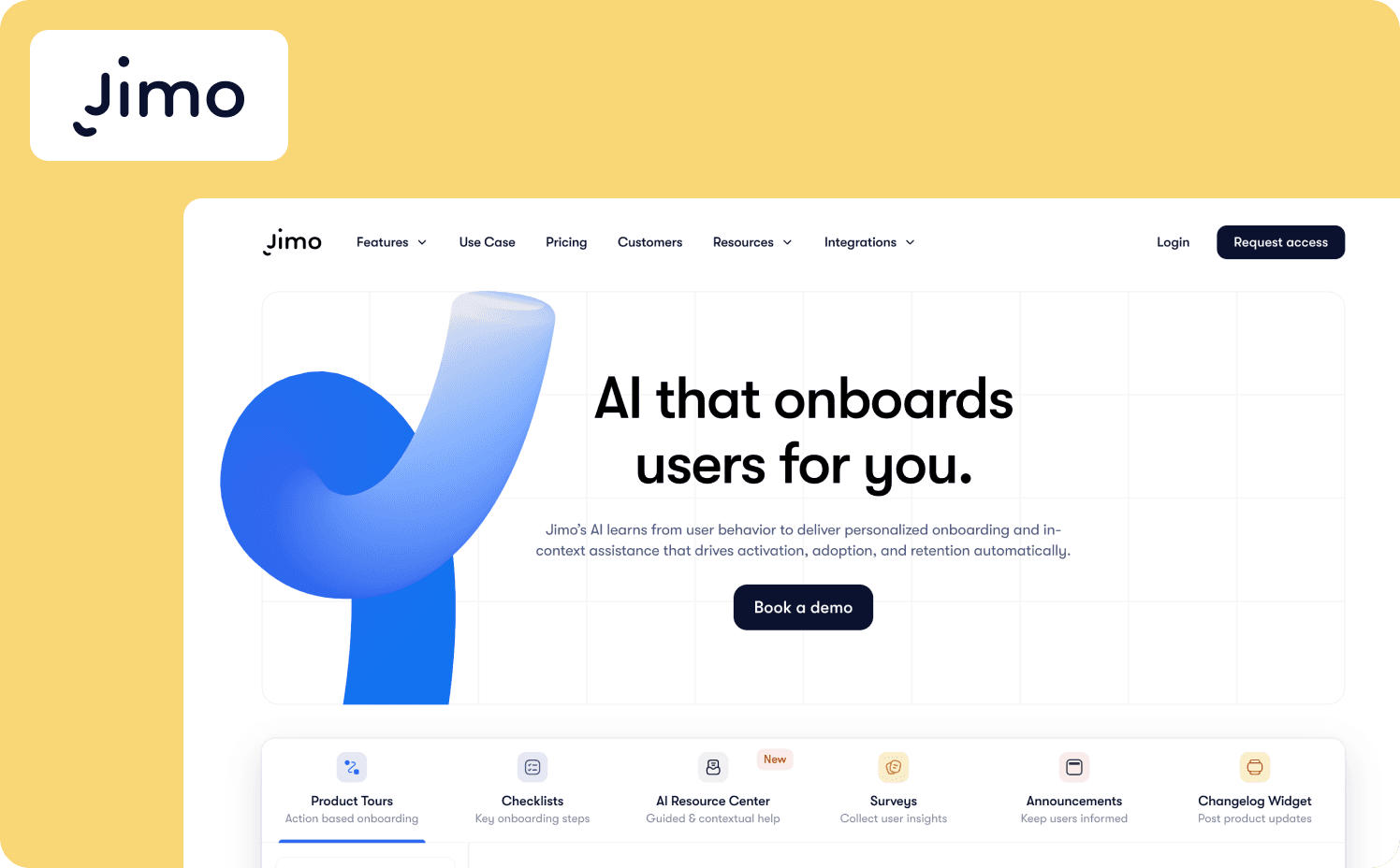
Jimo is an AI-native digital adoption platform that connects every piece of in-app guidance to a measurable outcome, so you know whether it actually worked. While many tools generate guidance or trigger it, Jimo closes the loop by measuring whether a tour, checklist, or hint moved active users toward activation or retention. That makes it the strongest fit for a Head of Digital Adoption whose guidance programs are output-focused and needs to prove outcome impact to leadership.
Key features:
AI-generated product tours, hints, and checklists from a single recorded walkthrough, so product teams ship guidance without manual authoring.
Success Tracker tags specific user segments and in-app events (like “clicked publish” or “invited teammate”) to measure true activation rates with retention insights, not just view counts.
Behavioral triggers fire guidance based on real user behavior and synced attributes from CRM, CDP, or analytics, not static rules applied to every new user.
AI Copilot operates in three modes: Guide (adaptive walkthroughs), Assist (context-aware answers), and Execute (completes actions on behalf of the user).
Feature adoption tracking connects guidance completions to downstream activation and retention, closing the feedback loop between what users see and what they actually do.
Where it falls short: Jimo currently has no mobile support, though that’s on the roadmap. Analytics depth can also be limited compared to standalone analytics platforms.
Starter: From $249/mo (2,500–10,000 MAUs)
Growth: From $479/mo (2,500–100,000 MAUs)
Enterprise: Custom
2. Frigade: Best for teams that want an AI agent to learn their product and generate guidance on demand
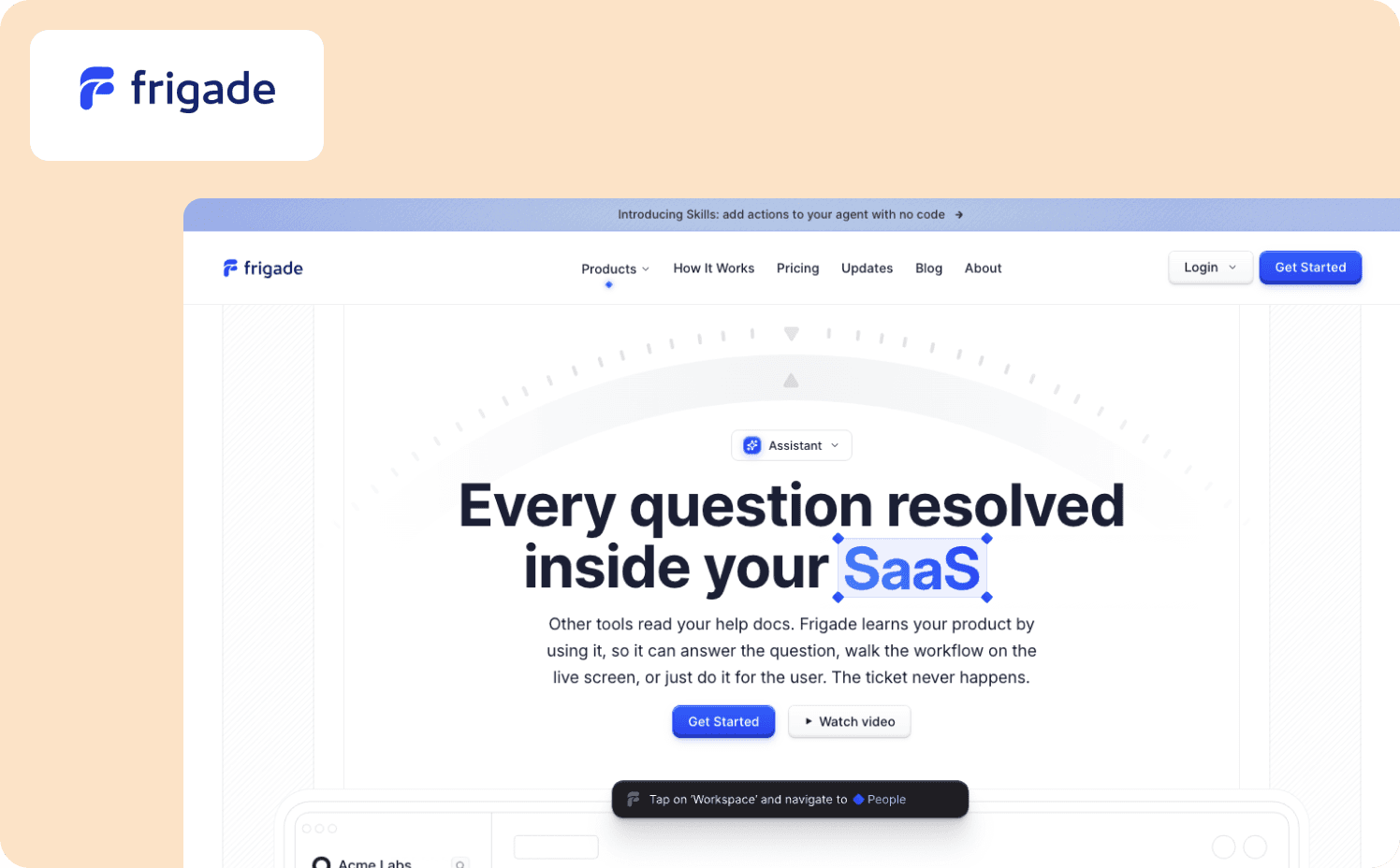
Frigade takes a fundamentally different approach from the other tools in this ranking. Instead of a visual builder where you author flows, Frigade’s AI agent learns your product by using it, navigating through your workflows on staging, documenting the user experience, and generating guidance on demand. There’s no tour builder to learn and no rules to configure. The AI is the product, rather than a feature bolted onto a traditional DAP. This lets product teams make targeted improvements without manually mapping every flow.
Key features:
Skills let the assistant execute real actions on behalf of users, skipping workflows entirely so real users go straight to the outcome.
Suggestions proactively nudge users at the moment of friction, delivered in-app or as shareable links in onboarding emails.
Generative UI renders contextual guidance in real time, adapting to what the user is actually doing rather than following a script.
Where it falls short: Frigade measures analytics in its Insights dashboard, but defers deep funnel and retention analytics to external tools like PostHog or Amplitude. The platform starts at $1,000 per month, which prices out smaller teams.
Pricing:
Assistant Growth: $1,000/mo
Assistant Enterprise: Custom
Engage Growth: $300/mo (2,500 MAUs)
Engage Enterprise: Custom
3. Product Fruits: Best for teams that want annotation-based AI tour generation with behavior-triggered delivery
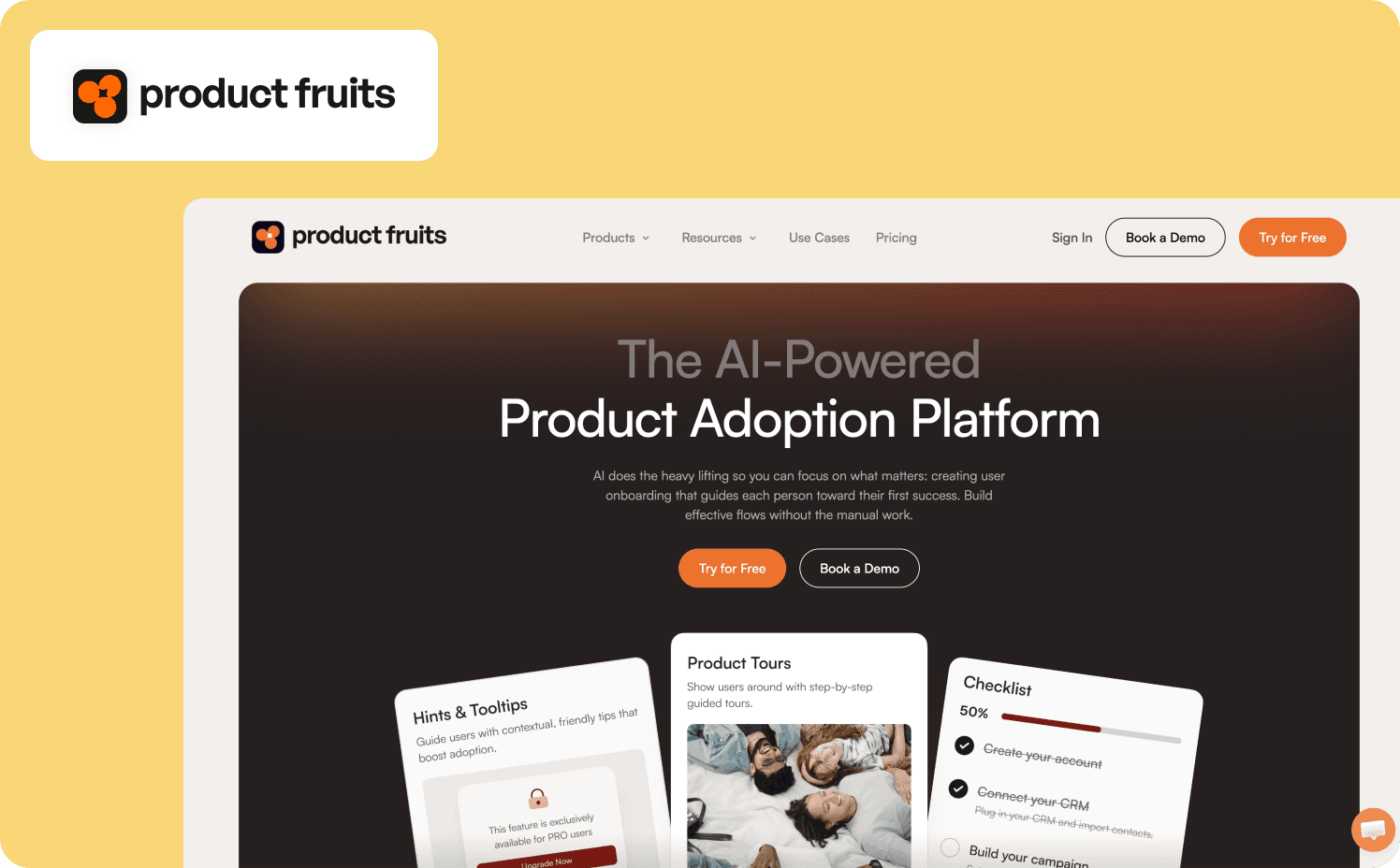
Product Fruits has repositioned from a traditional onboarding tool to an AI-powered product adoption platform built on its Elvin AI engine. Instead of manually authoring every tour step, Product Fruits uses an annotation-teaching process where the AI generates tours dynamically and adapts them based on real-time user behavior. Dual AI agents, one user-facing and one admin-facing, handle both guidance delivery and configuration.
Key features:
Elvin AI engine generates tours dynamically via an annotation-teaching process, reducing manual per-rule authoring.
Real-time, behavior-triggered surfacing delivers guidance at the moment of friction points rather than on a static schedule.
AI-evaluator branching personalizes guidance based on user behavior, adapting the experience without manual segment setup.
Where it falls short: Product Fruits doesn’t have A/B testing. Tour triggering and element-detection reliability have also been reported as inconsistent.
Pricing:
Starter: From $149/mo (1,500–20,000 MAUs)
Pro: From $249/mo (1,500–20,000 MAUs)
Business: From $499/mo (1,500–20,000 MAUs)
4. Userpilot: Best for data-first teams that want an AI agent to monitor analytics and flag adoption opportunities
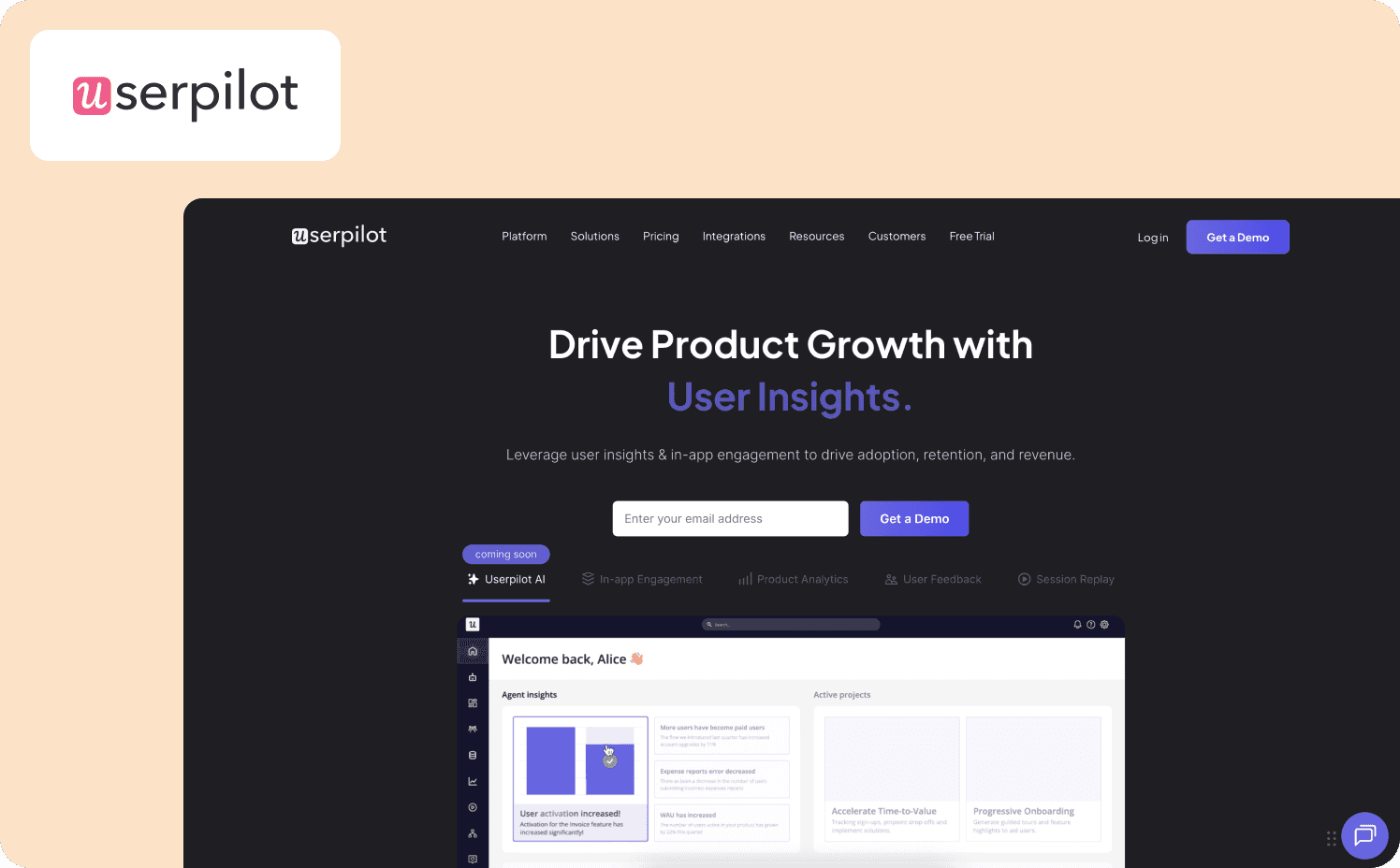
Userpilot is a product growth platform that has layered AI capabilities on top of its traditional no-code DAP foundation. Its Lia agent monitors your product data continuously, flags adoption opportunities, and can analyze activation and retention. Several AI features, including AI content creation and AI-powered insights, are still marked as coming soon.
Key features:
Lia AI agent monitors metrics continuously and flags adoption opportunities, analyzing activation and retention through specialized skills
Agent Analytics tracks every agent’s performance and helps optimize workflows in real time
Powerful user segments engine creates highly specific targeting based on user properties, events, and behavior
Where it falls short: Userpilot’s AI layer sits on top of a traditional DAP rather than being built AI-native from the ground up, and several AI features remain in development.
Pricing:
Starter plan: From $299/mo (up to 2,000 MAUs)
Growth: From $849 (starts from 5,000 MAUs)
Enterprise: Custom pricing (custom MAUs)
5. Chameleon: Best for teams that want a multi-agent system working toward automated friction detection and personalization
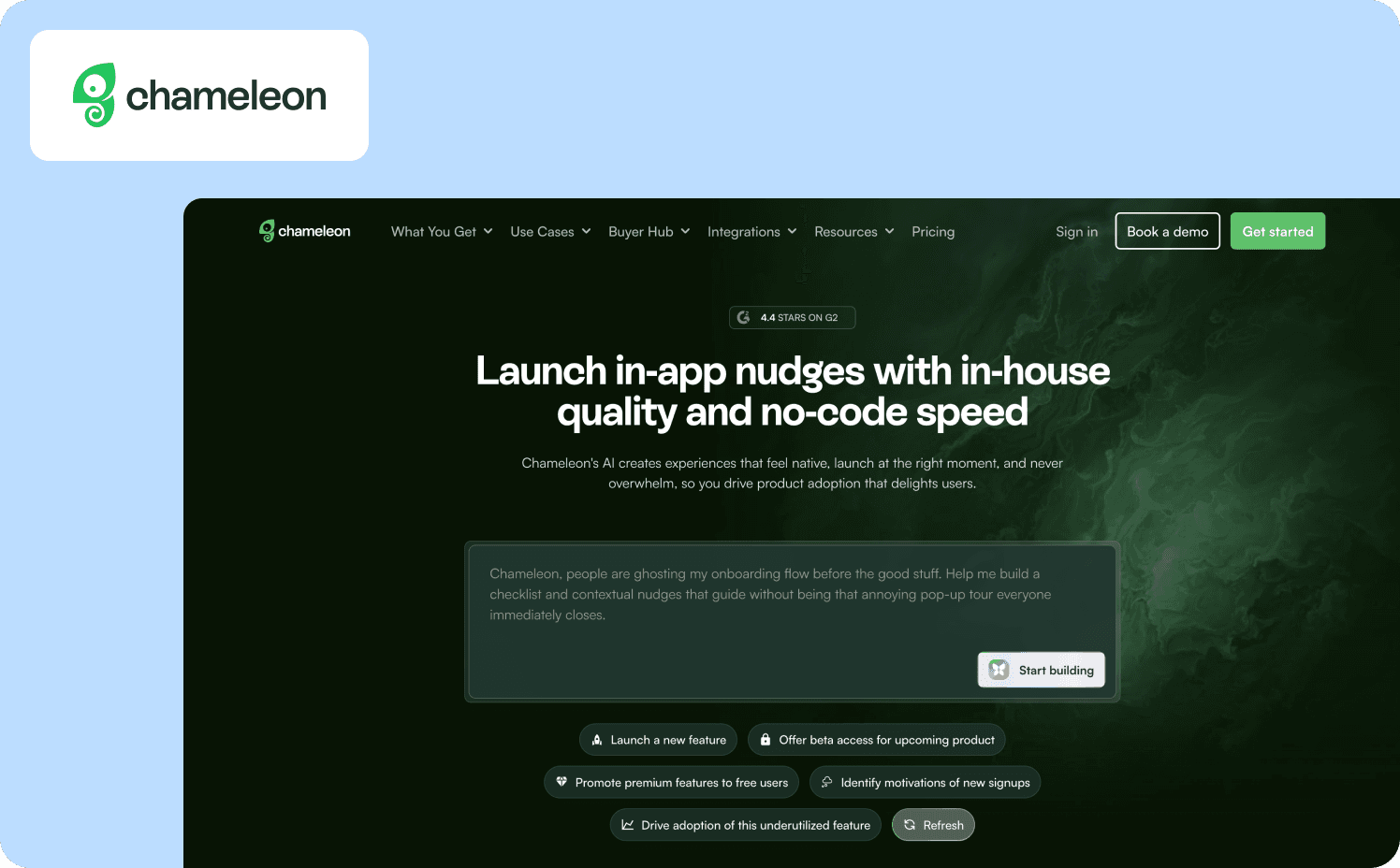
Chameleon runs its AI through four agents intended to form a single loop: sensing friction, building guidance, personalizing it, and keeping the account clean. Two of the four are shipped and in general use; the other two are in early access, so the full loop isn’t fully automated yet.
Key features:
Copilot generates in-app campaigns from a text prompt, handling research, content, targeting, and brand voice.
Ranger scans weekly for detached elements, stale experiences, and account clutter, then suggests fixes for one-click approval.
Compass and Prism, both in early access, are intended to handle the sensing and personalization half of the loop once fully released.
Where it falls short: Two out of the four agents are still in beta, meaning the positioning is ahead of the shipping reality. Chameleon also doesn’t offer true self-healing. Ranger detects broken elements and suggests fixes, but a human must approve every change.
Pricing:
Pro: From $750/mo (5,000–50,000 MTUs)
Growth: From $1,750/mo (5,000–50,000 MTUs)
Enterprise: Custom
How to find the best solution for your product team
Three criteria separate a genuine AI-powered optimization tool from a traditional DAP with AI marketing. To figure out which camp the tool you’re evaluating fits into, ask these questions.
Does the AI act on real usage data, or template suggestions?
The strongest tools in this ranking use behavioral data, what users actually click, where they stall, what they skip, to decide what guidance to surface. The weakest require you to manually configure every rule and hope the template fits. If the AI can’t see what your users are doing, it can’t optimize for them. A strong product optimization strategy starts with this question. And a clear optimization plan maps each target metric to a specific behavior you want to change.
Does it personalize by segment automatically?
Some tools auto-branch guidance based on real-time behavior. Others require you to build every segment by hand. At scale, this makes a big difference. A tool that personalizes automatically handles 50 user paths as easily as it handles five. A tool that doesn’t will create manual work that grows linearly with your user segments. This turns what should be continuous improvement into a maintenance burden.
Does it require ongoing manual tuning?
Every tool in this ranking needs some initial setup. The question is what happens after that. Tools with self-healing or AI-generated guidance adapt when your UI changes. Tools without it break, and someone has to fix them, usually the same person who built the flow in the first place. Optimization efforts should compound over time, not reset every time you ship a redesign.
For readers who want the broader category comparison beyond AI-driven optimization, our best digital adoption platforms ranking covers the full DAP landscape, including tools that excel at general capability but don’t have an AI-driven optimization layer.
Choose the tool that connects guidance to outcomes
If you’re a Head of Digital Adoption reading this ranking, you likely have a specific problem. Your guidance programs are shipping, but the line from a tour or checklist to conversion rates and retention is fuzzy at best. Leadership wants proof and the board wants numbers. Improving product performance and user satisfaction requires more than shipping guidance and hoping it sticks.
The tools in this ranking represent the current state of AI-powered in-app guidance and adoption, each with a different theory of how AI should drive continuous optimization:
Frigade bets that AI agents will replace authored guidance entirely.
Product Fruits bets that AI can generate and adapt tours without manual rules.
Userpilot bets that an AI layer over a traditional DAP is enough.
Chameleon bets that a multi-agent loop can sense friction, build guidance, and personalize it without human intervention.
Jimo bets that the shift from PLG to ILG requires more than AI bolted onto an old model, that the product has to activate itself, and that guidance without outcome measurement is incomplete.
Jimo’s Success Tracker exists because “did they see it” is the wrong question. The right question is “did it move them.” If that’s the standard your guidance programs need to meet, book a demo to see how Jimo connects in-app guidance to measurable activation and retention. You can also review pricing to see how the plans scale with your active users.
FAQs
Can AI product optimization solutions replace manual in-app guidance entirely?
Not yet. These tools reduce manual authoring significantly, but most still require human configuration of triggering rules and content review, whether on web or mobile apps. The ongoing process of narrowing the gap between manual and autonomous is real, but fully self-driving guidance isn’t here.
How do these tools measure whether guidance actually improves activation or retention?
It varies, and that variation separates the top of this ranking from the bottom. Jimo’s Success Tracker tags specific user events to measure true activation rates with retention insights, while Frigade defers to external tools for quantitative data and session recordings. If you’re tracking vanity metrics instead of customer satisfaction scores, the measurement layer matters as much as the guidance generation.
What should a team have in place before adopting an AI-driven optimization tool?
A product team should have three things: clear business goals and success metrics tied to the customer journey, enough behavioral data for the AI to act on, and a willingness to let go of manual rule configuration. Teams that insist on hand-building every onboarding flow will get limited value from AI tools designed to reduce that work. Supplementing behavioral signals with user feedback, user interviews, and qualitative data gives the AI the richest context for incremental improvements.
What should teams look for in AI tools for product optimization?
The best AI tools act on real behavioral data rather than template suggestions, and they connect guidance to measurable outcomes instead of stopping at view counts. Look for platforms that foster a data-driven culture by making it easy to analyze data without a separate analytics team, and that incorporate qualitative feedback alongside quantitative signals. Tools that rely only on session replays or vanity metrics without tying guidance to activation are doing less than they appear to.
How do you build an optimization strategy around AI tools?
Start by setting SMART objectives tied to specific activation or retention outcomes, then let the AI surface where users stall and what guidance could help. A good optimization strategy combines data-driven testing of what the AI suggests with customer feedback and qualitative input from real users to validate that the guidance actually solves their problem. Without that grounding, the AI is optimizing in a vacuum.