/
10 mins read
TL;DR
PLG works when the product shows each user the right thing at the right moment. Static onboarding (the same flow for every user in a segment, regardless of maturity or behavior) is the specific mechanism breaking trial-to-paid conversion for most B2B SaaS companies in 2026. This article makes the strategic case for AI-based personalization: what it produces in conversion terms, where it has the highest impact across the customer journey, what conditions need to be in place before the investment pays off, and how to measure whether it's actually moving revenue. Written for VPs of Product and PLG leaders who own the conversion metric and are evaluating whether to invest in the model shift.
Trial-to-paid conversion has been flat for two quarters. However, acquisition numbers are fine. Signup volume is there. Pricing has been tested. The traffic mix has been analyzed. The product has shipped meaningful improvements. And still the activation rate sits where it was six months ago, and the board is asking questions that don't have good answers yet.
What's left, once everything else has been optimized, is usually onboarding. Specifically, the fact that the onboarding experience shows every user the same path regardless of their role, their maturity level, or what they've already figured out on their own. A first-time user who needs hand-holding to reach their first value moment and a power user exploring an advanced workflow for the first time are routed to the same flow, because they're in the same segment, and segments are what the onboarding system knows how to respond to.
Static onboarding is not a product problem. It's a revenue problem. The gap between a user who signs up and a user who converts is almost always the distance between what they needed at that moment and what the product assumed they needed. AI-based personalization closes that gap not by adding more segments, but by responding to each user's actual behavior as it unfolds.
This article is for VPs of Product and PLG leaders at B2B SaaS companies whose PLG motion is generating signups that aren't converting at the rate the business requires.
Why Static Onboarding Stalls a PLG Motion
PLG works on one assumption: the product sells itself. That assumption is correct, but only when the product shows each user the right thing at the right moment for where they actually are. Static onboarding violates that assumption at scale, because it treats every user in a segment as if they have the same needs, the same maturity level, and the same readiness to move to the next step.
The aggregate result is a trial-to-paid conversion rate that doesn't respond to product improvements. The product gets better. The onboarding doesn't adapt. The gap between what each user needs and what they see stays constant regardless of the roadmap.
There are three specific ways this breaks PLG conversion, each with a different revenue signature:
Failure mode | What it looks like | Revenue consequence |
Maturity mismatch | A first-time user and a power user in the same role see the same onboarding because segmentation stops at job title | Power users who encounter guidance calibrated for beginners convert to paid at a fraction of the rate of users who reached their activation event. First-time users who received guidance calibrated for someone more experienced churn before the trial ends. Both are conversion losses with the same root cause. |
Progress blindness | A user who completed three onboarding steps in their last session is shown those same steps when they return | Users re-exposed to guidance they already acted on disengage and churn at higher rates than users who see the next relevant step for where they actually are. The product is signaling it doesn't know them, at the moment when that trust is most commercially fragile. |
Segment decay | A user onboarded as a "solo operator" has since built a team of eight colleagues and still sees solo-operator guidance | The product is missing the behavioral signal that this user is expansion-ready. The revenue impact is not only churn risk: it's a missed upsell the product itself created the conditions for and then failed to surface. |
The pattern across all three: the onboarding system responds to who the user was at signup. The AI-based alternative responds to who they are right now.
Segment-based personalization was the right design constraint when building individual-level responsiveness wasn't feasible. AI makes it feasible. For product leaders, the question is not whether to personalize at the individual level. It's how long to keep absorbing the conversion cost of not doing it.
For the system-level architecture that supports this kind of segmentation at scale, see Jimo's software onboarding best practices guide.
The Three Modes of AI-Driven Onboarding Personalization
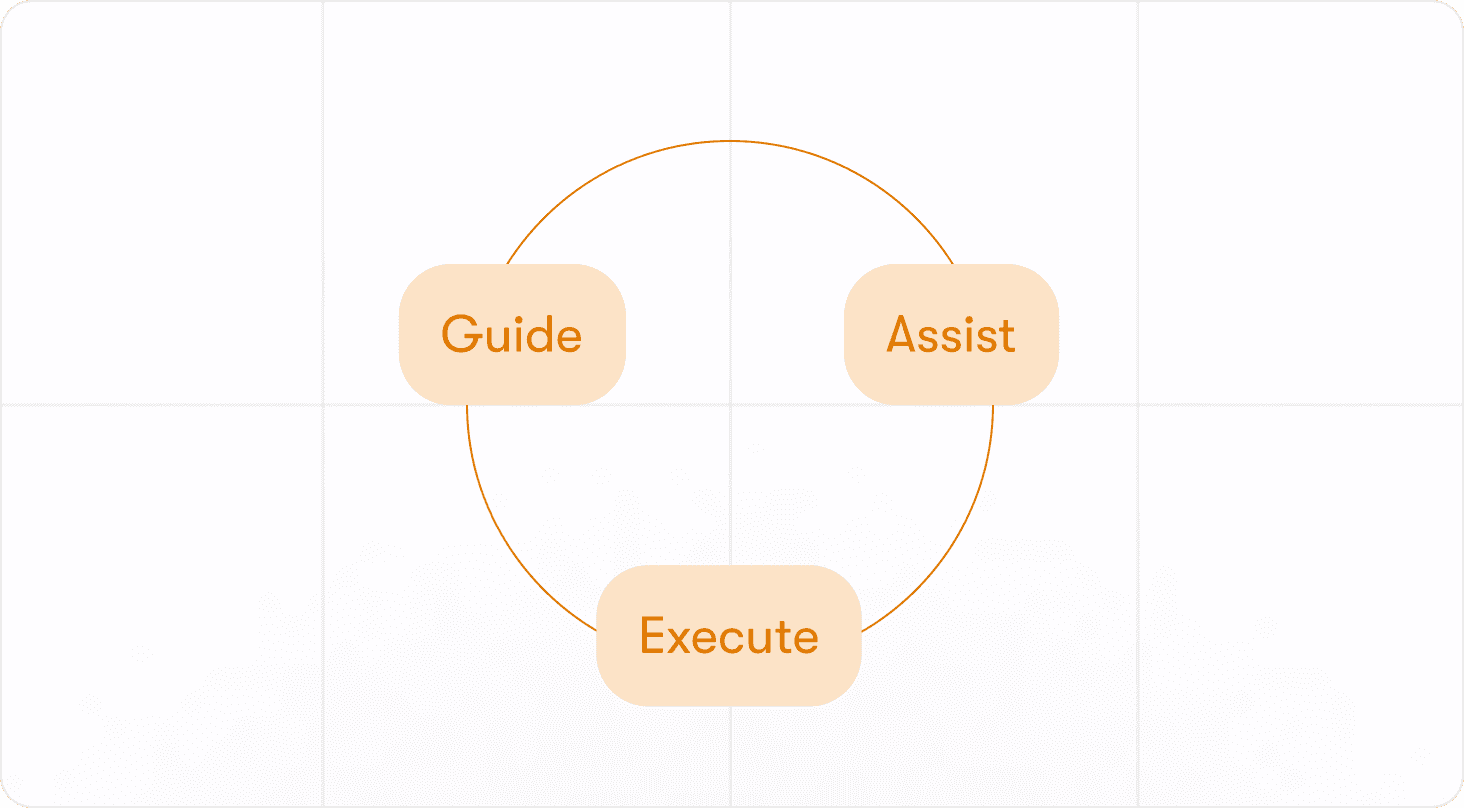
AI-based onboarding personalization operates across three distinct modes, each producing measurable conversion outcomes at a different stage of the user journey. Understanding which mode is absent from your current system tells you where the conversion loss is coming from.
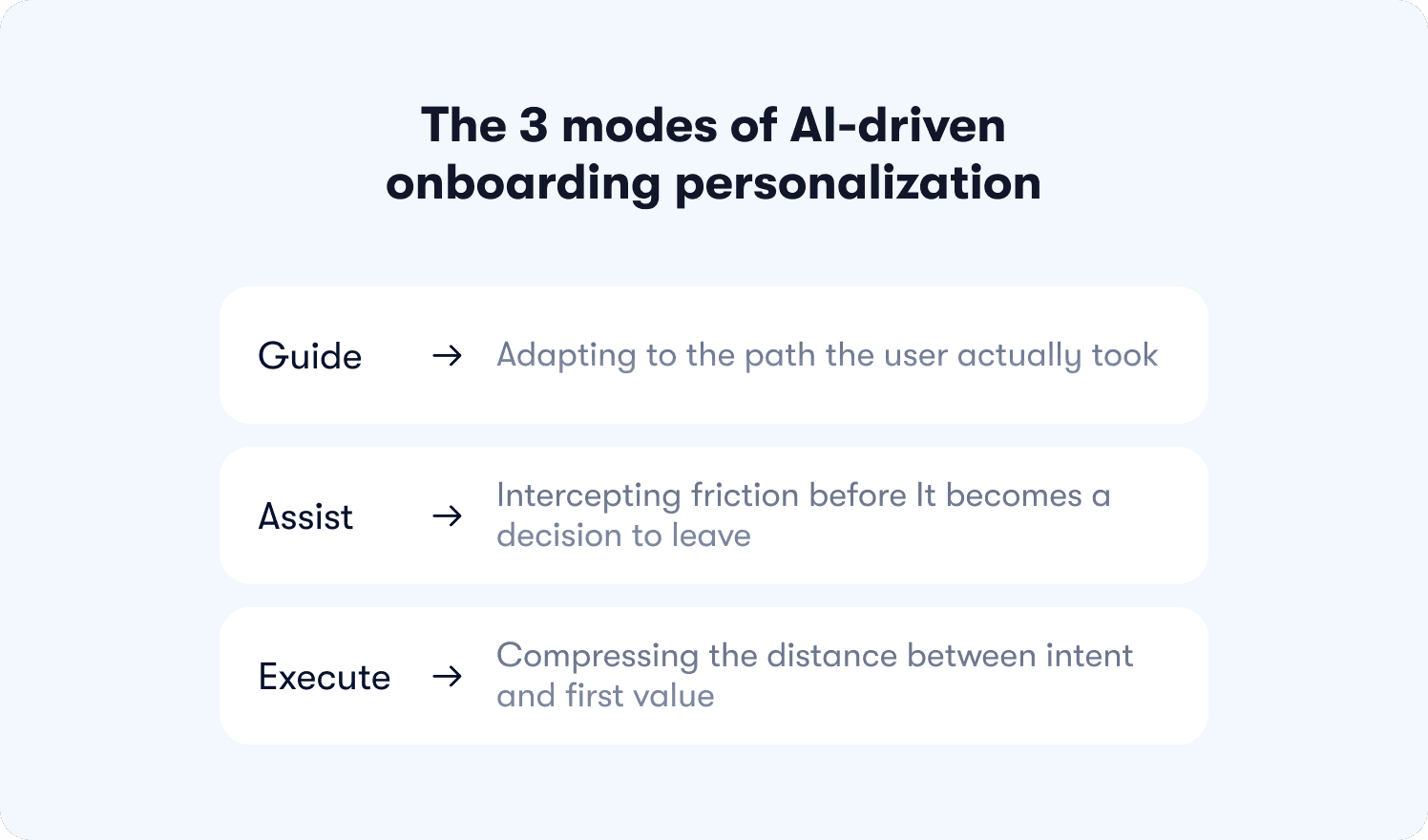
Guide: Adapting to the Path the User Actually Took
What it produces: activation rate improvement across all entry paths, including those the onboarding flow was never designed for.
Static guidance assumes users arrive at features through predictable paths. They don't. A user who discovers your workflow automation feature by clicking a link a teammate sent them is in a different context than a user who found the same feature through the navigation menu after completing their setup. Both users are "first time on this page." Only one is ready for the standard feature introduction.
Guide mode delivers context-aware orientation based on the actual path the user took to arrive at a given moment, not a default "first time on this page" trigger. When users receive guidance calibrated to their actual context rather than their positional state, drop-off before the activation event decreases across all paths.
The executive signal that Guide mode is working:
Activation rate improves across all behavioral cohorts, not only the cohort that followed the expected path
If improvement is visible only for users who followed the standard flow, the guidance is still positional, not adaptive
For the product tours and contextual walkthrough layer that enables Guide mode, see also Jimo's comparison of interactive onboarding strategies that separate adaptive from linear approaches.
Assist: Intercepting Friction Before It Becomes a Decision to Leave
What it produces: as onboarding volume grows, CS team capacity is no longer consumed proportionally by onboarding rescue. It shifts to expansion conversations where it generates revenue rather than absorbs it.
The users who generate support tickets during onboarding are not the users you need to worry about most. They stayed long enough to ask for help. The users who churn without a ticket, who hit a friction point, decided the product wasn't worth the effort, and left without explanation, are the conversion loss that static onboarding produces silently.
Assist mode intercepts the stuck moment in-product, in context, before the user reaches the threshold where leaving becomes the easier option. A user who has spent longer than their typical session pattern on a configuration screen without completing it is not waiting patiently. They're deciding. Contextual assistance at that moment, surfaced in the product and relevant to the exact action they're attempting, shifts that decision.
The executive signal that Assist mode is working:
The ratio of support tickets to new user signups decreases as total signups grow
CS capacity previously absorbed by onboarding rescue becomes available for expansion conversations
That is not an operational efficiency gain. It is a revenue structure change.
See Jimo's resource center for the in-product knowledge layer that powers Assist mode.
Execute: Compressing the Distance Between Intent and First Value
What it produces: drop-off on high-friction setup steps decreases without any change to the product itself. The activation event moves closer to the signup moment.
Industry benchmarks suggest that the gap between "I want to see if this works" and "I have seen it work" is where most PLG trial conversion is lost. Users arrive with intent. They hit a configuration step (an integration to connect, a data import to complete, a permission to configure) and the distance between their current state and the first value moment is longer than their patience for it.
Execute mode closes that distance by completing setup steps on the user's behalf or pre-populating configurations based on what the product knows about users in similar contexts. The user validates instead of configures.
For a developer tools platform, this looks like: a new user who connects their repository is pre-shown a workspace configured to match their tech stack, based on what similar users with that repository type have built. They validate the configuration rather than construct it from scratch. The activation event, their first successful deployment, becomes reachable in the same session they signed up.
The executive signal that Execute mode is working:
Completion rate on historically high-friction steps increases without a product change
Time to activation event shortens across new user cohorts
The product didn't get easier. The onboarding got smarter.
See Jimo's success tracker for the Execute mode layer.
What Has to Be True Before the Investment Pays Off
AI-based personalization is not a product you turn on and watch conversion improve. Three conditions determine whether the investment produces the conversion outcomes above or returns the same flat number with more sophisticated tooling on top of it.
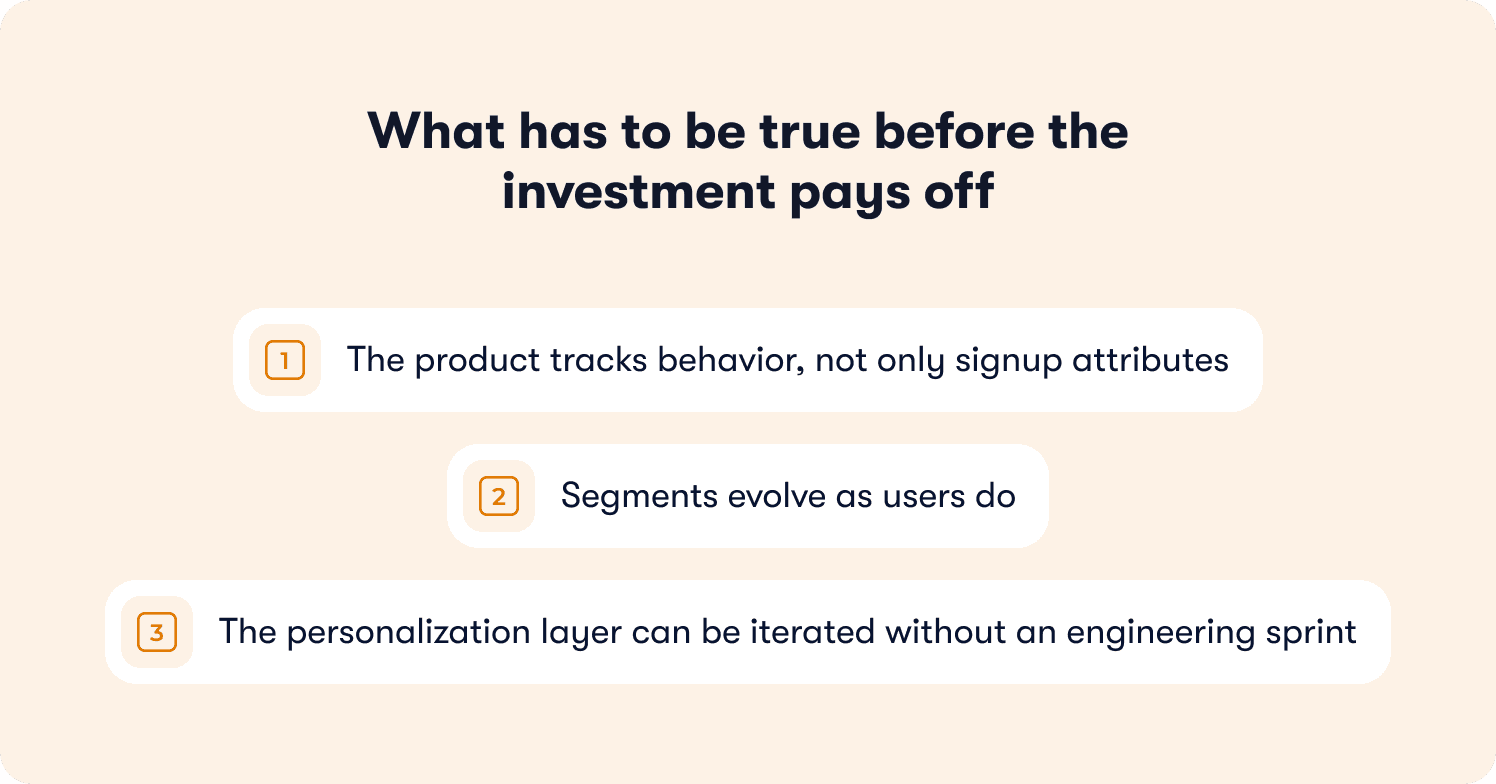
This section is a due-diligence checklist, not an implementation guide. Each condition is a question to confirm before signing a contract.
Condition 1: The product tracks behavior, not only signup attributes
Products that personalize on signup-form data alone (role, company size, stated use case) are running a cohort router. A cohort router produces the same flat conversion rate already on the dashboard, because it responds to who the user said they were, not what they're actually doing.
The due-diligence question: is the product currently tracking in-product behavioral events in a form that can feed a personalization layer? If not, behavioral instrumentation is the first dependency, not the platform.
What behavioral data needs to include:
Which features the user has touched and in what sequence
Where they've stalled or abandoned an action mid-flow
What they've attempted and not completed
How their usage pattern compares to cohorts who activated vs. churned
See behavior metrics for what a properly instrumented behavioral data layer looks like.
Condition 2: Segments evolve as users do
A static segment assigns a user to a cohort at signup and keeps them there permanently. The product team that onboards a user as a "small team admin" in week one and is still surfacing that guidance in week eight, when the user has grown their team and become a strong upsell candidate, is missing the revenue signal the product itself generated.
The due-diligence question: does the current onboarding platform update user segments based on behavioral changes, or does it assign a segment once and maintain it indefinitely?
What adaptive segmentation enables that static segmentation cannot:
Expansion-ready users receive expansion-relevant guidance at the moment of readiness
Disengaged users receive re-engagement content calibrated to their specific stall point
Users who have outgrown their initial use case get guidance appropriate to where they actually are
Condition 3: The personalization layer can be iterated without an engineering sprint
AI-based personalization improves as it learns which guidance variants produce conversion outcomes. That learning only compounds if the product team can act on what it discovers. If deploying a new variant or adjusting a trigger condition requires a sprint cycle, the iteration rate is too slow to compound.
The due-diligence question: does the platform give product and PMM teams full ownership of the personalization logic after initial setup? If the answer is no, the investment will improve baseline conversion once and then plateau.
The ceiling of static onboarding is the precision of your best segment definition. The ceiling of AI-based personalization is the richness of your behavioral data, and that ceiling rises continuously as more users move through the product. It compounds. Static onboarding does not.
For a comparison of platforms that offer full product team ownership vs. those that require engineering involvement for changes, see Jimo's AI-powered onboarding guide for a detailed breakdown of how adaptive systems differ from rule-based ones in practice.
Where to Start: Where AI Personalization Has the Highest Conversion Impact
If the investment is staged (which it should be for most Series A–C SaaS companies), pre-activation personalization is where to start. It is the highest-volume stage of the PLG funnel, it produces the fastest conversion signal visible within a 30-day cohort cycle, and it is where the revenue cost of showing the wrong thing is most commercially damaging.
Stage | Why it matters for PLG conversion | What AI personalization adds |
Pre-activation(signup to first value) | Where most PLG conversion loss occurs | Guidance adapts in real time to the path the user is actually taking, not the path the flow was designed for |
Activation | The moment that determines trial-to-paid conversion | Guidance surfaces in the order that gets this specific user to their activation event fastest |
Post-activation adoption | Determines 90-day retention and expansion eligibility | Feature guidance triggers only for users who haven't yet reached the behaviors that predict expansion for their profile |
Re-engagement | Recovers churned activation attempts that time-based email cannot | Triggered by specific behavioral state, not days since signup — picks up exactly where the user left off |
Pre-activation is where to invest first. Most PLG products lose the majority of their trial conversion before the user reaches their activation event, not because the product fails, but because the onboarding path was designed for a user who doesn't exist at scale. For the checklist layer that AI personalization operates on top of, see Jimo's user onboarding checklist guide.
Activation is where trial-to-paid conversion is won or lost. AI personalization at this stage means the specific user in front of the product sees the guidance sequence most likely to get them to their activation event, not the sequence most likely to work for the median user in their segment. See onboarding tactics.
Post-activation adoption is where expansion revenue is built or missed. The users who activated but haven't yet reached the behaviors that predict expansion represent the highest-conversion opportunity in the product. For the post-activation layer, see retention insights.
Re-engagement is where time-based drip email fails and behavioral triggers succeed. A user who completed two steps of their activation path and then went dark is not the same as a user who never engaged. Behavioral re-engagement triggered by their specific stall state produces meaningfully higher return rates than calendar-based sequences.
How to Know If It's Actually Working: The Metrics That Matter at the VP Level
Tooltip views are not a revenue metric. Checklist completion rates are not a revenue metric. A VP who brings either to a board meeting instead of trial-to-paid conversion improvement is reporting on the guidance layer, not on what the guidance produced.
The performance layer: two numbers that go to leadership.
Trial-to-paid conversion by onboarding variant. The primary revenue signal. Run a controlled comparison: users who received personalized guidance vs. users who received the generic flow in the same period. If the personalized cohort converts at a meaningfully higher rate, the investment is working. If the rates are indistinguishable, the personalization is not yet reaching the moment where the conversion decision is made.
30-day retention by activation cohort. The durability signal. Users who activated through a personalized path should retain at a higher rate than users who activated through the generic flow. If they don't, the personalization improved the speed of activation but not the quality of the activated user, which typically means the activation event definition needs revisiting.
The diagnostic layer: use these internally to find where to invest next.
Metric | What it tells you | Red flag |
Activation rate by behavioral cohort | Whether AI personalization is producing consistent activation across diverse user paths | Activation rate varies by path in ways that correlate with guidance gaps, not product complexity |
Time to activation event by user maturity | Whether the guidance distinguishes between power users and new users | TTA is identical across all user types, indicating a one-size-fits-all system |
Expansion eligibility rate at 30 days | Whether post-activation personalization is surfacing the behaviors that predict expansion | Feature adoption among activated users is flat across the board |
Support ticket volume per new user, trended | Whether Assist mode is decoupling CS capacity from onboarding volume | Ticket volume grows proportionally with signups |
Bring the performance layer to the board. Use the diagnostic layer internally to decide where to invest in the next iteration cycle.
See actionable reports for the reporting infrastructure that connects these metrics to your onboarding variants.
📖 Not sure which personalization lever moves conversion fastest for your specific drop-off pattern? Jimo's 19 Tactics to Improve User Activation includes a self-assessment diagnostic built for this exact question. Get the free playbook
What to Look for When Evaluating AI Onboarding Personalization Platforms
The evaluation question at the VP level is not which platform has the most features. It's which platform produces the conversion outcomes above, and whether the team that needs to iterate the personalization logic can do so without creating an engineering dependency that slows the learning cycle to a crawl.
The strategic criteria, framed as the questions that determine fit:
Criterion | The VP-level question |
Behavioral personalization depth | Does the platform personalize based on in-product behavior as it unfolds, or only on signup attributes assigned once? |
Maturity-adaptive guidance | Does the system update what it shows a user as their behavior and product maturity evolve, or is their initial segment permanent? |
Guide / Assist / Execute coverage | Does the platform support all three modes, or only reactive guidance triggered by page URL and login count? |
Conversion visibility | Can the team directly attribute onboarding variant performance to trial-to-paid conversion and 30-day retention, or only to guidance completion rates? |
Product team ownership | Can PMM and product iterate, test, and deploy personalization changes without engineering involvement? |
Expansion signal surfacing | Does the platform identify which activated users have reached the behavioral depth that predicts expansion, or does its analytics stop at activation? |
On Jimo:
Jimo is a digital adoption platform built for web-based B2B SaaS teams whose PLG motion depends on onboarding that responds to each user's actual behavior, not the behavior their signup form predicted. It combines behavior-based targeting that evolves in real time, contextual in-product guidance across Guide, Assist, and Execute modes, and an AI copilot that covers the cases no rule was written for. Product and PMM teams own the full iteration cycle without engineering dependency after initial setup. Pricing is fixed within each MAU tier: no per-user overage charges, no unexpected costs when trial volume spikes within your band.
Teams at AB Tasty, Zenchef, and Lemlist have used Jimo to move from static, segment-routed onboarding to adaptive guidance that adjusts to evolving user maturity, without diverting engineering. See the full integrations suite and tools overview for implementation scope.
For a tool-level comparison of personalized onboarding platforms evaluated against activation and conversion criteria, see Jimo's personalized onboarding software guide.
See how Jimo's AI-based personalization adapts to user maturity in real time. See Jimo in action.
FAQs
Our PLG conversion has been flat for two quarters. Is static onboarding likely the cause?
It’s rarely the only cause, but it’s consistently underestimated as a contributor. The best diagnostic is to pull trial-to-paid conversion rates by entry path and by user role. If users who took different paths through the product converted at meaningfully different rates despite receiving the same onboarding experience, there is likely a personalization gap. That gap does not close by improving the default flow alone — it closes by giving each user a path calibrated to their actual behavioral context.
We already use role-based onboarding flows. How is AI-based personalization meaningfully different?
Role-based onboarding is a stronger segmentation approach than a single universal flow, but AI-based personalization operates on a fundamentally different model. Role-based onboarding routes users according to what they selected or declared at signup, while AI-based personalization adapts based on what users are actually doing inside the product. It continuously updates guidance as behavior changes and can account for contextual states that predefined flows were never designed to handle. In practice, the difference becomes most visible among users who fall between your predefined roles — which, in many B2B SaaS products, represents the majority of the user base.
How quickly can we expect to see conversion impact?
The timeline depends on where personalization is introduced. Pre-activation personalization typically produces the fastest signal because it addresses the highest-volume drop-off point in the funnel, and results are often visible within a single 30-day cohort cycle. Post-activation personalization generally requires a longer measurement window because the outcomes tied to it — such as expansion eligibility or 90-day retention — naturally take more time to evaluate. The strongest starting point is usually pre-activation. Teams should first confirm that the activation event is cleanly defined and trackable, then measure cohort performance at day 30.
What is the build vs. buy decision for AI-based onboarding personalization?
The more useful framing is not build versus buy, but where engineering time creates the most compounding value. Building internally often requires six to twelve months of engineering effort, ongoing model maintenance, and continued dependence on development cycles for every personalization update. Buying a platform can reduce deployment time to days, allow product teams to control iteration directly, and keep engineering resources focused on the core product roadmap. For most Series A through Series C SaaS companies, the highest long-term leverage is usually concentrated in the core product itself rather than in maintaining onboarding infrastructure.
How do we prove ROI to the board before committing to full deployment?
The most credible approach is to run a controlled variant test on a single high-volume entry path. Deploy AI-based personalization to 50% of users on that path while maintaining a control group, then measure trial-to-paid conversion at the 30-day mark. In most cases, the conversion signal becomes visible within a single cohort cycle. That outcome provides a far stronger justification for broader investment than softer engagement metrics such as checklist completion or onboarding interaction rates, especially for boards already focused on activation and conversion efficiency.
Does this require replacing existing onboarding, or can it layer on top?
Layering is usually the most effective starting point. Begin by identifying the stage where behavioral divergence is highest, which is often within the first three sessions after signup. From there, deploy AI-based guidance to address the edge cases and contextual situations that existing rule-based onboarding flows do not cover. Measure cohort performance at 30 days, then expand the investment based on observed results. Full replacement of existing onboarding systems is not required to produce meaningful conversion improvements.