How SaaS Onboarding Conversion Rates Actually Improve: a VP's Framework
How SaaS Onboarding Conversion Rates Actually Improve: a VP's Framework
How SaaS Onboarding Conversion Rates Actually Improve: a VP's Framework
/
8 mins read

TL;DR
Flat trial-to-paid conversion is rarely a pricing problem or a positioning problem. It is almost always an activation problem. Industry benchmarks suggest the average SaaS activation rate sits at 36%, which means that on a typical cohort, 64 cents of every acquisition dollar is funding drop-off, not revenue. The standard response is to optimize the funnel above the product: adjust the ads, test the pricing page, revisit the ICP. None of those levers move the number that explains the gap.
This article makes the case that onboarding is the primary conversion lever available to a VP of Product in 2026, maps where the drop-off is actually occurring, and frames the Intelligence-Led Growth model as the strategic upgrade that changes the conversion outcome. It is not a guide to building onboarding flows. It is the board-ready argument for why onboarding investment is the highest-ROI move available when paid conversion is stuck.
Last quarter, signups grew. Paid conversion did not. Acquisition spend rose to match the higher volume. The board asked why revenue was not following.
The most common response to this scenario is to interrogate the wrong layer of the funnel. Pricing tests. Ad creative iteration. Positioning reviews. ICP refinement. These are all legitimate levers, and none of them address the place where most SaaS companies are actually losing paid conversion: the gap between signup and first value.
Jimo's analysis of more than 200 onboarding screens identified a pattern that appears across product categories and price points. Almost every product gets the first moment right. Users arrive, they see value promised, they complete the signup, and they land inside the product. Then the product abandons them. The guided path ends. The context disappears. The user is left with an interface and no clear route to the action that would make them pay. Jimo calls this the "Beautiful Entrance, Empty Room" problem: the acquisition motion works, and the activation motion does not.
The conversion loss is not happening because the wrong users are signing up. It is happening because the right users are arriving at a product that treats self-serve as sufficient. Product-led growth said the product sells itself. The data increasingly shows that it does not. It needs to actively guide users to the value that makes them convert, in real time, at the exact moment and location where they are at risk of dropping off.
That shift, from a product that is available to a product that adapts and guides, is the transition from PLG to Intelligence-Led Growth. For a VP of Product with a board conversation about conversion sitting on the calendar, it is also the most defensible argument for where to invest next.
Why flat conversion is an onboarding problem, not an acquisition problem
When trial-to-paid conversion stays flat quarter over quarter, the instinct is to interrogate acquisition. Traffic quality. ICP fit. Pricing page clarity. Channel mix. These are the levers that feel most controllable from a VP position, and they are also the levers that rarely explain a persistent conversion gap when signup volume is healthy.
The data points elsewhere. Industry benchmarks suggest the average SaaS activation rate sits at 36%, with a median of 30%, across a benchmarking study of more than 500 products. That figure is not a funnel metric above the product. It is a measure of what happens inside it: the percentage of users who reach the action that predicts payment and retention. The other 64% arrive, explore briefly, and leave without converting. They were not poor-fit users. They were users who did not find value quickly enough to stay.
The acquisition budget funded their arrival. The onboarding experience determined whether they converted.
Where VPs look when conversion is flat | Where the conversion loss is actually occurring |
Traffic quality and ICP fit | Inside the product, between signup and first value |
Pricing page and packaging | At the moment users encounter friction with no guidance |
Sales cycle and positioning | At the point users exhaust patience before reaching the activation milestone |
Channel mix and CAC efficiency | In the gap between the promise made in acquisition and the experience delivered in onboarding |
The product-led growth model built the case for self-serve as a conversion mechanism. The underlying assumption was that a well-designed product would guide users to value without intervention. That assumption holds when the product is genuinely simple, the activation milestone is obvious, and the time-to-value is measured in seconds.
For most B2B SaaS products, none of those conditions apply. The product is complex, the activation milestone requires configuration, and value takes multiple steps to reach.
PLG's answer was better onboarding design: cleaner flows, shorter checklists, more contextual tooltips. The design improved. The conversion numbers did not move proportionally, because the problem was never the design. It was the model.
A well-designed static flow is still a static flow. It plays the same sequence to every user regardless of where they are, what they have already done, and where they are at risk of dropping off. It cannot detect friction in real time. It cannot adapt. And when the product changes, it goes stale.
The gap between a 36% average activation rate and the 25–30% trial-to-paid conversion that Intelligence-Led Growth approaches achieve is not explained by better copy or cleaner UI. It is explained by the shift from a product that is available to a product that actively guides each user to the value that makes them pay, in real time, at the individual level. That is the conversion argument this article is making.
Not "improve your onboarding flows." But rather: change the model the flows are built on.
Where users actually drop and why most VPs are looking in the wrong place
The conversion gap has a location. It is not evenly distributed across the onboarding funnel. Across Jimo's analysis of more than 200 onboarding screens, a consistent pattern emerged: products invest heavily in the first experience and almost nothing in what comes immediately after. The signup flow is polished. The welcome screen is considered. The first guided step is clear. Then the path ends, and the user is left to navigate alone.
Jimo calls this the "Beautiful Entrance, Empty Room" pattern. The acquisition motion creates a compelling entrance. The onboarding motion puts users in a room with no furniture and no directions. The user looks around, decides there is nothing to do, and leaves. The conversion did not fail at acquisition. It failed at the moment the product stopped guiding.
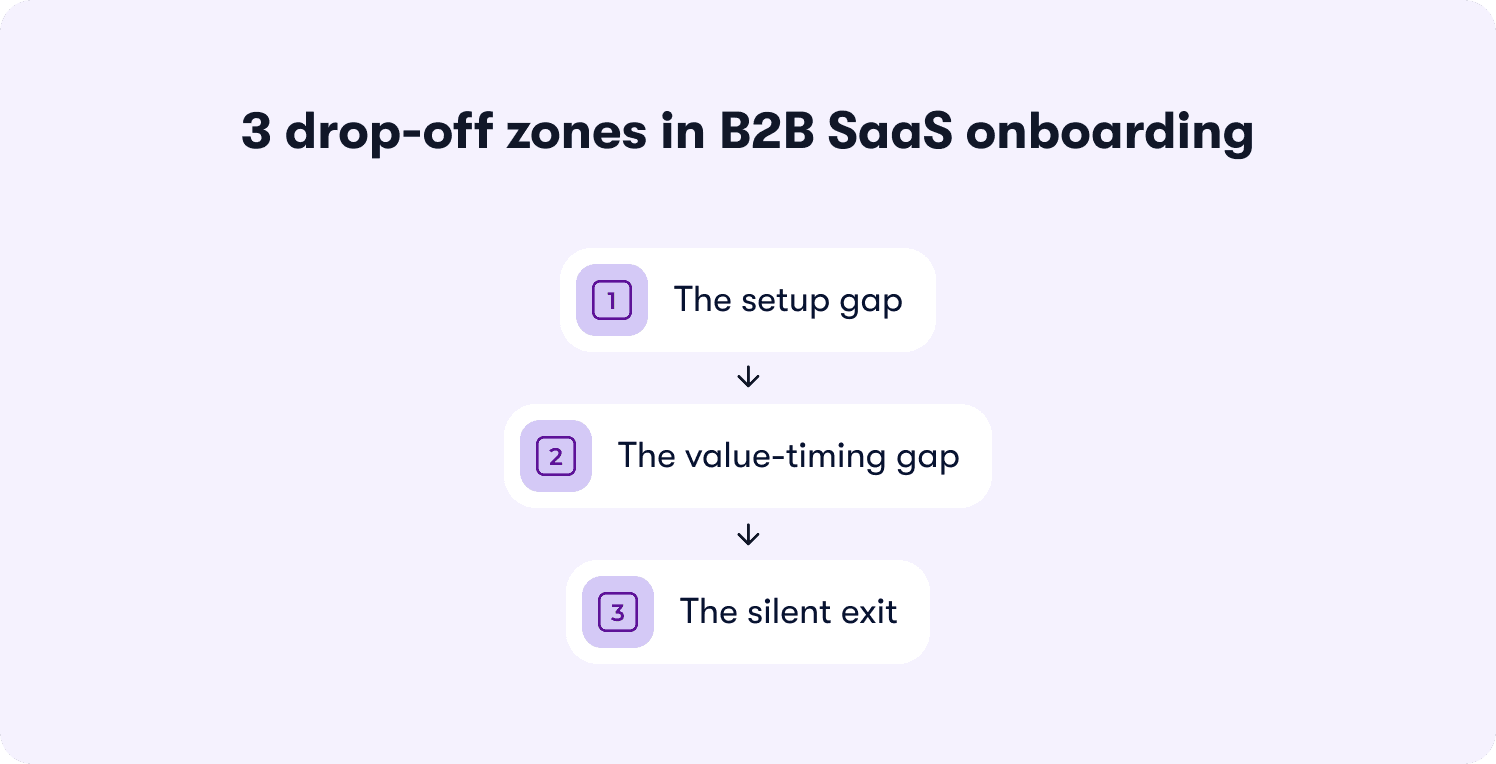
Three drop-off zones account for the majority of conversion loss in B2B SaaS onboarding
The setup gap
Users reach the product and immediately encounter a configuration requirement they did not anticipate: an integration that must be connected before the core feature is accessible, a workspace that requires populating before it shows value, or an admin permission that blocks the next step. No guidance fires at this moment because no flow was built for it. The user stalls. Most do not return.
The value-timing gap
The product's activation milestone requires more than one session to reach. For most B2B SaaS, the action that predicts payment involves data, a collaborator, a completed workflow, or a decision. Users who do not reach that milestone in their first meaningful session have a materially lower conversion probability than users who do. The gap is not about feature quality. It is about the distance between signup and the moment value becomes tangible.
The silent exit
Users complete the onboarding flow and then do not come back. The flow ended at the wrong place: it got users to the end of the tour, not to the action that would make them pay. There is no visible error. There is no flagged drop-off point. The cohort data simply shows a conversion rate that does not respond to further onboarding investment because the investment is being applied to the wrong moment.
Why these drop-off zones stay invisible
The reason most VPs are looking in the wrong place when conversion is flat is that these three zones do not appear in the metrics that typically get reported upward.
Standard VP dashboard metric | What it shows | What it misses |
Funnel conversion rate | Where users leave the acquisition funnel | Where inside the product they stopped before activation |
Tour completion rate | Users clicked through the flow | Whether they did the action the flow was designed to prompt |
DAU / WAU | Users returned to the product | Whether they reached the activation milestone that predicts payment |
Support ticket volume | Users who asked for help | The majority who encountered friction and left silently |
The setup gap, the value-timing gap, and the silent exit are all diagnosable with the right instrumentation. But they are invisible in a standard acquisition funnel view. Making the board-level case for onboarding investment requires reframing where the conversion data comes from, not just what it shows.
User friction at these three points is not a product quality problem. It is a guidance problem. The product works. Users cannot find the path to the value that makes it worth paying for. That distinction matters for how the investment is framed: fixing onboarding conversion does not require a product rebuild.
It requires deploying guidance at the exact moments and locations where users are currently dropping, and making that guidance adaptive enough to respond to each user's specific state rather than routing all users through the same predetermined sequence.
What the ILG-era intervention looks like at the VP level
The strategic case for fixing onboarding conversion does not start with flows or tours. It starts with a model question: what assumption is the current approach built on, and is that assumption still true?
Product-led growth was built on the assumption that a well-designed self-serve experience would guide users to value without active intervention. That assumption produced a decade of investment in onboarding design: better welcome modals, shorter checklists, more contextual tooltips. The design improved. The model beneath it did not change. Users were still routed through fixed sequences designed for a cohort, served the same guidance regardless of their individual state, and left without support the moment a flow ended.
Intelligence-Led Growth replaces that assumption. The product does not wait for users to find value. It actively guides each user toward the action that predicts payment, in real time, based on what that specific user has and has not done.
The commercial translation at VP level is direct.
PLG assumption | ILG reality | VP-level implication |
Funnels move users through defined stages | Journeys adapt to where each user actually is | Conversion is no longer capped by the weakest step in a fixed sequence |
Segments receive the same guidance | Individuals receive guidance based on their specific behavioral state | Drop-off from irrelevant guidance disappears as a conversion loss driver |
Reactive: drop-off is detected after users have left | Proactive: friction is detected and addressed while users are still in the product | Conversion intervention happens at the moment of risk, not after the fact |
Self-serve: users find value or they do not | AI-assisted: the product moves users toward value actively | The 64% of acquisition spend currently funding drop-off becomes a recoverable conversion pool |
The benchmark that frames the board conversation: traditional freemium converts at 3–5%, according to the ProductLed WARP framework. ILG-era agentic onboarding, where the product actively guides users to value rather than waiting for them to find it, approaches 25–30% trial-to-paid conversion. The gap between those two numbers is not explained by product quality, pricing, or ICP fit. It is explained by whether the product treats activation as something that happens passively or something it actively drives.
For a VP making the case for onboarding investment, this is the framing that survives board scrutiny. It is not a UX improvement argument. It is a CAC efficiency argument: the same acquisition spend produces materially different revenue outcomes depending on whether the activation layer between signup and payment is static or adaptive. Investing in the activation layer is how you increase revenue from the cohorts you are already acquiring, without increasing the budget that acquires them.
Behavioral friction detection as a conversion lever
The ILG model describes the strategic shift. The mechanism that delivers it is behavioral friction detection: identifying, in real time, the exact moment and location where each user is at risk of dropping before they convert, and deploying targeted guidance at that precise point.
This is categorically different from reviewing drop-off data in a dashboard and scheduling a sprint to update the onboarding flow. By the time that cycle completes, the users who dropped during the gap have already left.
Behavioral friction detection is not retrospective. It operates on the user currently in the product, at the moment they show a signal that they are about to exit without converting.
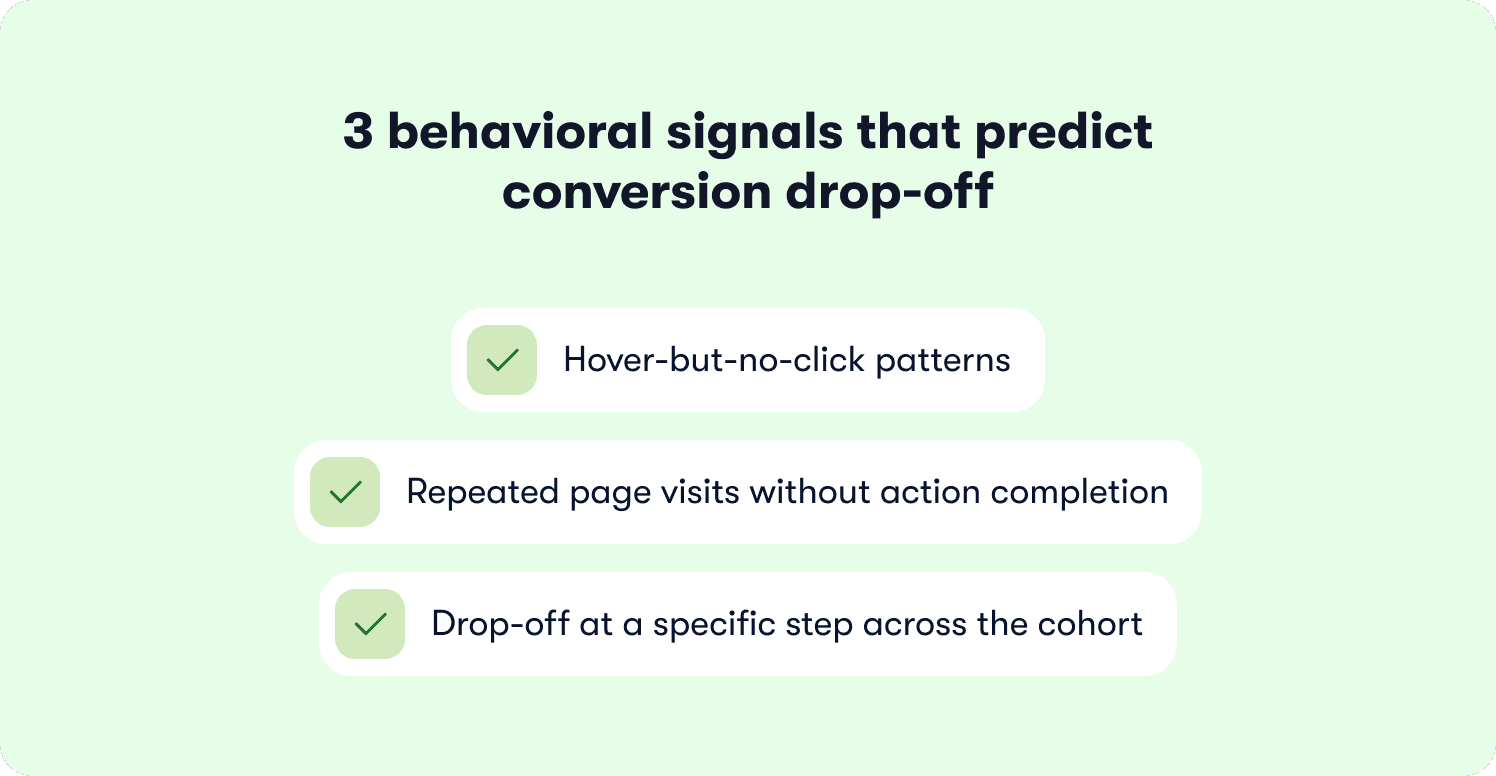
The three behavioral signals that predict conversion drop-off:
Hover-but-no-click patterns. A user who moves their cursor repeatedly over an element without completing the associated action is showing exactly where the gap is. They know the element is there. They are not confident about what will happen if they interact with it. This signal fires before the user exits. Guidance deployed at this moment, at this location, addresses the hesitation before it becomes a drop-off. Behavior-triggered messaging at this level of precision is not achievable with a static flow scheduled on a time delay.
Repeated page visits without action completion. A user who returns to the same product area across multiple sessions without completing the key action is telling you that motivation is not the issue. They keep coming back. The barrier is friction, confusion, or a missing piece of context that no existing flow is covering. This pattern is a high-signal indicator of a value-timing gap: the user wants to activate but cannot find the path.
Drop-off at a specific step across the cohort. When a material percentage of users in the same segment exit at the same point in the same flow, the issue is structural. Something about that step is producing consistent abandonment. Identifying it requires step-level behavioral data, not tour completion rate. Fixing it requires updating the guidance at that specific step, which, in a PLG-era setup, means a sprint. In an ILG-era setup, it means a PM making the change directly and publishing it the same day.
The VP-level implication of engineering dependency
Most of the conversion loss described above is not invisible to the teams responsible for onboarding. VPs know their activation rate is below target. PMs know which steps are producing drop-off. The constraint that keeps the conversion rate flat is not knowledge. It is the iteration speed.
Every onboarding fix gated behind an engineering sprint is a fix that ships weeks after the drop-off data was visible. Every behavioral trigger that requires a developer to instrument is a trigger that does not fire during the sprint queue. The conversion opportunity exists. The organizational constraint prevents it from being acted on in time to change the outcome for the users currently in the funnel.
FairMarkit resolved this by moving onboarding iteration out of the engineering queue. The result was a 25% activation improvement that correlated with a 34% revenue increase, per Jimo customer data. The product did not change. The guidance layer on top of it became adaptive, targeted, and updateable at the speed the conversion problem required.
The conversion lever available to a VP of Product is not building better flows. It is removing the constraint that prevents the flows that already exist from being updated, tested, and adapted at the speed that closes the gap between signup and payment. For the implementation detail on how action-based guidance design drives this outcome, the article on interactive onboarding strategies covers the mechanism in full. The VP decision is upstream of that: whether the team owns the iteration speed, or whether engineering does.
What a good SaaS onboarding conversion rate looks like and how to close the gap
Benchmarks matter to a VP in one context specifically: the board conversation. "Our activation rate is 36%" lands differently when the next sentence is "industry benchmarks suggest that is exactly average" versus "industry benchmarks suggest that 25–30% trial-to-paid conversion is achievable with the right activation model." The numbers do not speak for themselves. The framing around them determines whether the case for onboarding investment gets approved or deferred.
The benchmark table below is the version of this data that holds up in a board context. Every figure is qualified, sourced, and placed in a comparison that makes the gap visible without overstating what the data supports.
Benchmark | Figure | Source / qualifier |
Average SaaS activation rate | 36% (median 30%) | Industry benchmarks suggest, Lenny Rachitsky and Yuriy Timen, survey of 500+ products |
Traditional freemium trial-to-paid conversion | 3–5% | ProductLed WARP framework |
ILG-era agentic onboarding conversion | 25–30% | ProductLed WARP framework |
AI-powered tour completion vs. standard average | 44% vs. 27% | Jimo customer data, analysis of 1,025 product tours, early 2026 |
Activation improvement correlated with revenue impact | 25% activation lift / 34% revenue increase | FairMarkit, Jimo customer data |
What these numbers mean for the board conversation
The gap between 3–5% traditional freemium conversion and 25–30% ILG-era conversion is not a gap between bad and good onboarding design. It is a gap between two fundamentally different models for how the product relates to its users during the activation window. Presenting it as a design improvement argument undersells the investment required and the return available. Presenting it as a model shift argument is both more accurate and more defensible when a CFO asks what changed between last quarter and this one.
The FairMarkit figure is the one that closes the board conversation: a 25% activation improvement that correlated directly with a 34% revenue increase. The mechanism was not a product change. It was deploying targeted guidance at the moments where users were dropping before they converted. The acquisition budget did not change. The conversion rate on the existing cohort did.
The single metric a VP should track above all others
The north star metric for onboarding conversion is not tour completion rate and it is not signup volume. It is the percentage of trial users who reach the defined activation milestone within their first meaningful session. Everything else in this article is an input to that number. The board conversation is about whether that number is moving and what the investment required to move it looks like against the revenue it returns.
For the full measurement framework, including event instrumentation, funnel definitions, and how to connect activation data to retention cohorts, the detail is covered in the article on measuring user onboarding success. The constraint here is narrower: before adding measurement complexity, establish the one metric that represents the conversion gap, track it consistently, and use it as the anchor for every onboarding investment conversation.
The engineering dependency problem and why it keeps conversion flat
A VP who has read the previous four sections now has two things: a diagnosis of where the conversion gap is and a strategic case for the ILG model that closes it. The constraint that typically prevents both from being acted on is not budget or conviction. It is organizational architecture.
In most B2B SaaS companies, the team that owns conversion data is not the team that can act on it without a sprint. A PM identifies a drop-off at step three of the activation flow on a Monday. The fix requires updating the guidance at that step. That update goes into the sprint backlog, gets prioritized against feature work, and ships (if it makes the cut) two to three weeks later. During that window, every user who onboards hits the same drop-off point. The conversion loss compounds.
This is not a process failure. It is a structural consequence of owning onboarding guidance as engineering output rather than product output.
Structural condition | Consequence for conversion |
Onboarding flows are code artifacts owned by engineering | Every change requires a ticket, prioritization, and a deployment cycle |
Behavioral triggers are instrumented by developers | Precision targeting fires weeks after the insight that motivated it |
A/B testing guidance variants requires dev support | Iteration speed is capped by sprint velocity, not by insight quality |
Flow updates are scheduled, not responsive | Users dropping today hit friction that will not be addressed until next sprint |
The compounding cost of delayed iteration
The cost of this structure is not visible in a single sprint cycle. It becomes visible across quarters. A team that takes three weeks to act on a drop-off signal, running four sprint cycles per quarter, makes at most four onboarding changes in 90 days. A team with direct ownership of guidance iteration can make that many changes in a week when a meaningful signal appears. Over a quarter, the conversion difference between those two teams is not marginal.
The VP-level question is whether onboarding iteration speed is currently constrained by the engineering queue, and if so, whether the conversion cost of that constraint is larger than the cost of removing it. For most B2B SaaS teams shipping at speed, it is.
What removing the constraint enables
When product and growth teams own onboarding guidance directly, publishing flow updates, deploying behavioral triggers, and testing variants without engineering dependency. Three things change for conversion stand out:
Response time collapses. A drop-off signal identified on Monday becomes a fix live by Tuesday. The cohort that would have hit that friction point on Wednesday does not.
Iteration volume increases. More tests run per quarter. More variants are resolved. The signal-to-noise ratio in conversion data improves because the team is acting on signals rather than accumulating them.
Behavioral precision compounds. Triggers that fire at the exact moment a user shows a friction signal, rather than on a time delay built into a scheduled flow, catch users while they are still in the product and still recoverable as conversions.
Jimo: the onboarding conversion lever VPs can activate without engineering
Conversion that is stuck at the activation layer has a consistent profile. Acquisition is healthy. The product works. The team knows where users are dropping. The fix is gated behind a sprint queue that moves slower than the conversion problem compounds.
Jimo is built for exactly this organizational condition. Product and growth teams update guidance, configure behavioral triggers, test variants, and deploy targeted interventions without engineering dependency after initial setup.
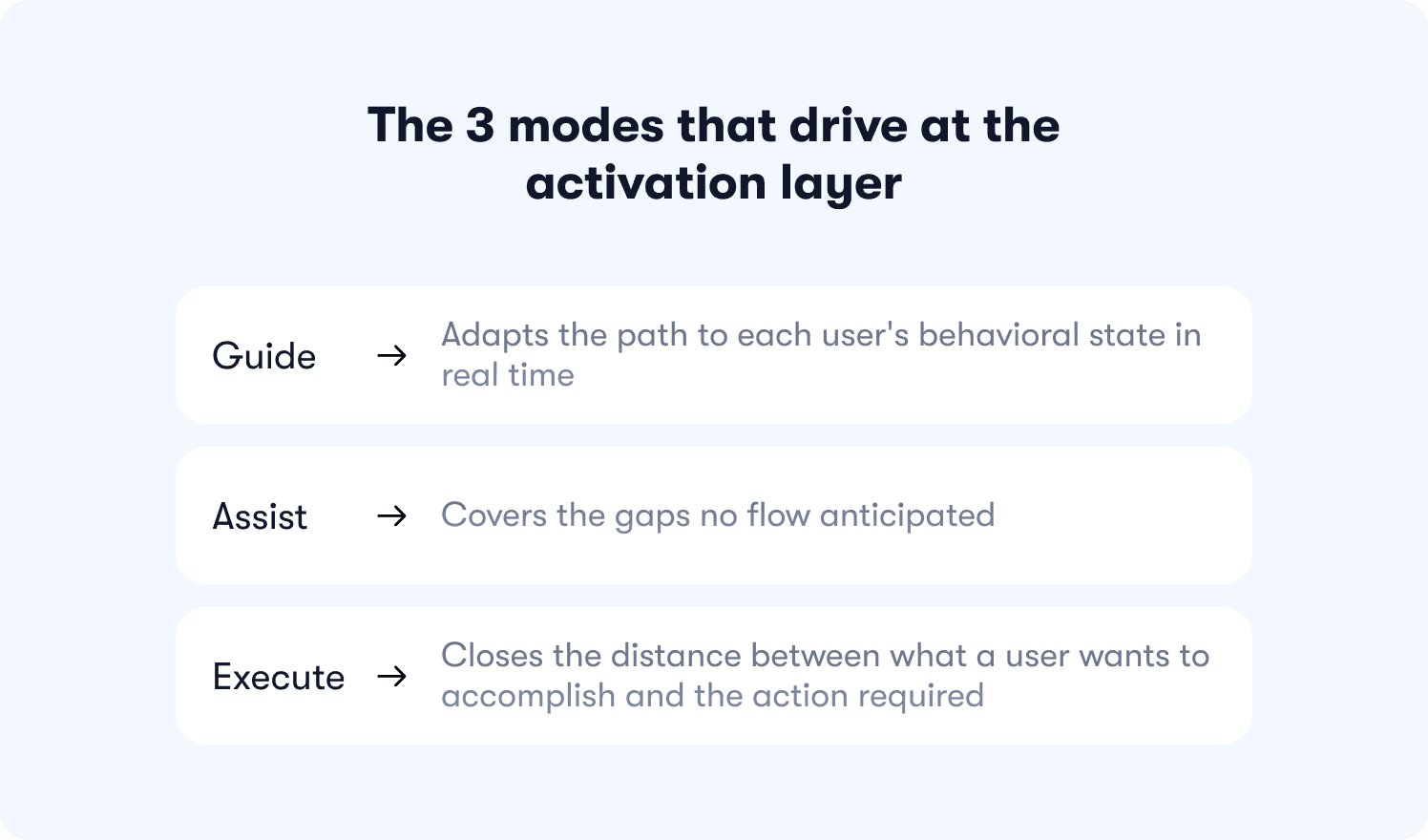
The three modes that drive this at the activation layer:
Guide adapts the path to each user's behavioral state in real time. Users who have already completed a step do not see it again. Users showing a friction signal at a specific moment receive guidance at that location, not at the next scheduled flow step.
Assist covers the gaps no flow anticipated. When a user encounters a question or an edge case that falls outside the defined activation path, in-product AI answers it in context without the user leaving the product and without a support ticket entering the queue.
Execute closes the distance between what a user wants to accomplish and the action required to accomplish it. For setup-heavy products where the value-timing gap is the primary conversion loss driver, Execute mode compresses the path to the activation milestone by taking configuration steps on behalf of the user.
Your product doesn't just sell itself; it activates itself. That shift from a product that is available to a product that guides, assists, and acts is what moves a 36% average activation rate toward the 25–30% trial-to-paid conversion that the ILG model demonstrates is achievable. Jimo deploys in days, not quarters. The engineers stay on the core product. The conversion lever is available now.
FAQs
What is a good SaaS onboarding conversion rate?
There is no single answer that applies across all SaaS products, but the data provides useful orientation. Industry benchmarks suggest the average activation rate sits at 36%, with a median of 30%. Traditional freemium trial-to-paid conversion typically lands between 3% and 5%. Products operating with adaptive, AI-assisted onboarding models approach 25–30% trial-to-paid conversion according to the ProductLed WARP framework. What "good" looks like for a specific product depends on its activation milestone, pricing model, and ICP complexity, but if trial-to-paid conversion is below 5% and signup volume is healthy, the gap is almost always in the activation layer, not the acquisition layer.
What is the difference between activation rate and trial-to-paid conversion rate?
Activation rate measures the percentage of new users who complete the defined action that predicts retention and payment: the moment they first experience real value. Trial-to-paid conversion rate measures the percentage of trial users who become paying customers. The two are closely related: activation rate is the leading indicator, trial-to-paid conversion is the lagging outcome. Improving trial-to-paid conversion without addressing activation rate is difficult because users who do not activate rarely convert. The activation rate is the lever; the conversion rate is the result.
Why does onboarding affect paid conversion so directly?
Users make the decision to pay based on whether they experienced value during the trial period. That experience is shaped almost entirely by what happens between signup and the activation milestone: whether they reached it, how quickly they reached it, and whether anything blocked them along the way. Onboarding is the mechanism that determines whether users find that path or abandon before finding it. Products where paid conversion is flat despite healthy acquisition almost always have an onboarding gap, not an acquisition gap.
What is the ILG approach to improving onboarding conversion?
Intelligence-Led Growth replaces the PLG assumption that a well-designed self-serve product will guide users to value without active intervention. In an ILG model, the product detects each user's behavioral state in real time, adapts the guidance path to what that specific user has and has not done, and deploys targeted interventions at the exact moment and location where friction is detected. The conversion outcome improves because irrelevant guidance is removed for users who do not need it, friction is addressed before users exit, and the path to the activation milestone is compressed for every user rather than optimized for an average cohort.
How quickly can onboarding conversion improvements be deployed?
The answer depends almost entirely on whether the team deploying them has engineering dependency or not. Teams gated behind sprint cycles typically make four to eight onboarding changes per quarter. Teams with direct ownership of the guidance layer can make that many changes in a week when a meaningful signal appears. Jimo deploys in days after initial setup. From that point, product and growth teams update flows, configure triggers, and publish changes without engineering involvement. The conversion improvement timeline is then constrained by insight quality, not organizational latency.
How do I make the business case for onboarding investment to the board?
The most defensible framing is CAC efficiency, not UX improvement. The argument: at a 36% average activation rate, 64 cents of every acquisition dollar is funding drop-off rather than revenue. Investing in the activation layer recovers conversion from the cohorts already acquired, without increasing the budget that acquires them. FairMarkit's 25% activation improvement correlating with a 34% revenue increase is the proof point that closes this conversation. The product did not change, the acquisition budget did not change, and revenue increased materially because the guidance layer between signup and payment became adaptive and targeted. The investment required to replicate that outcome is a deployment question, not a product rebuild question.
TL;DR
Flat trial-to-paid conversion is rarely a pricing problem or a positioning problem. It is almost always an activation problem. Industry benchmarks suggest the average SaaS activation rate sits at 36%, which means that on a typical cohort, 64 cents of every acquisition dollar is funding drop-off, not revenue. The standard response is to optimize the funnel above the product: adjust the ads, test the pricing page, revisit the ICP. None of those levers move the number that explains the gap.
This article makes the case that onboarding is the primary conversion lever available to a VP of Product in 2026, maps where the drop-off is actually occurring, and frames the Intelligence-Led Growth model as the strategic upgrade that changes the conversion outcome. It is not a guide to building onboarding flows. It is the board-ready argument for why onboarding investment is the highest-ROI move available when paid conversion is stuck.
Last quarter, signups grew. Paid conversion did not. Acquisition spend rose to match the higher volume. The board asked why revenue was not following.
The most common response to this scenario is to interrogate the wrong layer of the funnel. Pricing tests. Ad creative iteration. Positioning reviews. ICP refinement. These are all legitimate levers, and none of them address the place where most SaaS companies are actually losing paid conversion: the gap between signup and first value.
Jimo's analysis of more than 200 onboarding screens identified a pattern that appears across product categories and price points. Almost every product gets the first moment right. Users arrive, they see value promised, they complete the signup, and they land inside the product. Then the product abandons them. The guided path ends. The context disappears. The user is left with an interface and no clear route to the action that would make them pay. Jimo calls this the "Beautiful Entrance, Empty Room" problem: the acquisition motion works, and the activation motion does not.
The conversion loss is not happening because the wrong users are signing up. It is happening because the right users are arriving at a product that treats self-serve as sufficient. Product-led growth said the product sells itself. The data increasingly shows that it does not. It needs to actively guide users to the value that makes them convert, in real time, at the exact moment and location where they are at risk of dropping off.
That shift, from a product that is available to a product that adapts and guides, is the transition from PLG to Intelligence-Led Growth. For a VP of Product with a board conversation about conversion sitting on the calendar, it is also the most defensible argument for where to invest next.
Why flat conversion is an onboarding problem, not an acquisition problem
When trial-to-paid conversion stays flat quarter over quarter, the instinct is to interrogate acquisition. Traffic quality. ICP fit. Pricing page clarity. Channel mix. These are the levers that feel most controllable from a VP position, and they are also the levers that rarely explain a persistent conversion gap when signup volume is healthy.
The data points elsewhere. Industry benchmarks suggest the average SaaS activation rate sits at 36%, with a median of 30%, across a benchmarking study of more than 500 products. That figure is not a funnel metric above the product. It is a measure of what happens inside it: the percentage of users who reach the action that predicts payment and retention. The other 64% arrive, explore briefly, and leave without converting. They were not poor-fit users. They were users who did not find value quickly enough to stay.
The acquisition budget funded their arrival. The onboarding experience determined whether they converted.
Where VPs look when conversion is flat | Where the conversion loss is actually occurring |
Traffic quality and ICP fit | Inside the product, between signup and first value |
Pricing page and packaging | At the moment users encounter friction with no guidance |
Sales cycle and positioning | At the point users exhaust patience before reaching the activation milestone |
Channel mix and CAC efficiency | In the gap between the promise made in acquisition and the experience delivered in onboarding |
The product-led growth model built the case for self-serve as a conversion mechanism. The underlying assumption was that a well-designed product would guide users to value without intervention. That assumption holds when the product is genuinely simple, the activation milestone is obvious, and the time-to-value is measured in seconds.
For most B2B SaaS products, none of those conditions apply. The product is complex, the activation milestone requires configuration, and value takes multiple steps to reach.
PLG's answer was better onboarding design: cleaner flows, shorter checklists, more contextual tooltips. The design improved. The conversion numbers did not move proportionally, because the problem was never the design. It was the model.
A well-designed static flow is still a static flow. It plays the same sequence to every user regardless of where they are, what they have already done, and where they are at risk of dropping off. It cannot detect friction in real time. It cannot adapt. And when the product changes, it goes stale.
The gap between a 36% average activation rate and the 25–30% trial-to-paid conversion that Intelligence-Led Growth approaches achieve is not explained by better copy or cleaner UI. It is explained by the shift from a product that is available to a product that actively guides each user to the value that makes them pay, in real time, at the individual level. That is the conversion argument this article is making.
Not "improve your onboarding flows." But rather: change the model the flows are built on.
Where users actually drop and why most VPs are looking in the wrong place
The conversion gap has a location. It is not evenly distributed across the onboarding funnel. Across Jimo's analysis of more than 200 onboarding screens, a consistent pattern emerged: products invest heavily in the first experience and almost nothing in what comes immediately after. The signup flow is polished. The welcome screen is considered. The first guided step is clear. Then the path ends, and the user is left to navigate alone.
Jimo calls this the "Beautiful Entrance, Empty Room" pattern. The acquisition motion creates a compelling entrance. The onboarding motion puts users in a room with no furniture and no directions. The user looks around, decides there is nothing to do, and leaves. The conversion did not fail at acquisition. It failed at the moment the product stopped guiding.
Three drop-off zones account for the majority of conversion loss in B2B SaaS onboarding
The setup gap
Users reach the product and immediately encounter a configuration requirement they did not anticipate: an integration that must be connected before the core feature is accessible, a workspace that requires populating before it shows value, or an admin permission that blocks the next step. No guidance fires at this moment because no flow was built for it. The user stalls. Most do not return.
The value-timing gap
The product's activation milestone requires more than one session to reach. For most B2B SaaS, the action that predicts payment involves data, a collaborator, a completed workflow, or a decision. Users who do not reach that milestone in their first meaningful session have a materially lower conversion probability than users who do. The gap is not about feature quality. It is about the distance between signup and the moment value becomes tangible.
The silent exit
Users complete the onboarding flow and then do not come back. The flow ended at the wrong place: it got users to the end of the tour, not to the action that would make them pay. There is no visible error. There is no flagged drop-off point. The cohort data simply shows a conversion rate that does not respond to further onboarding investment because the investment is being applied to the wrong moment.
Why these drop-off zones stay invisible
The reason most VPs are looking in the wrong place when conversion is flat is that these three zones do not appear in the metrics that typically get reported upward.
Standard VP dashboard metric | What it shows | What it misses |
Funnel conversion rate | Where users leave the acquisition funnel | Where inside the product they stopped before activation |
Tour completion rate | Users clicked through the flow | Whether they did the action the flow was designed to prompt |
DAU / WAU | Users returned to the product | Whether they reached the activation milestone that predicts payment |
Support ticket volume | Users who asked for help | The majority who encountered friction and left silently |
The setup gap, the value-timing gap, and the silent exit are all diagnosable with the right instrumentation. But they are invisible in a standard acquisition funnel view. Making the board-level case for onboarding investment requires reframing where the conversion data comes from, not just what it shows.
User friction at these three points is not a product quality problem. It is a guidance problem. The product works. Users cannot find the path to the value that makes it worth paying for. That distinction matters for how the investment is framed: fixing onboarding conversion does not require a product rebuild.
It requires deploying guidance at the exact moments and locations where users are currently dropping, and making that guidance adaptive enough to respond to each user's specific state rather than routing all users through the same predetermined sequence.
What the ILG-era intervention looks like at the VP level
The strategic case for fixing onboarding conversion does not start with flows or tours. It starts with a model question: what assumption is the current approach built on, and is that assumption still true?
Product-led growth was built on the assumption that a well-designed self-serve experience would guide users to value without active intervention. That assumption produced a decade of investment in onboarding design: better welcome modals, shorter checklists, more contextual tooltips. The design improved. The model beneath it did not change. Users were still routed through fixed sequences designed for a cohort, served the same guidance regardless of their individual state, and left without support the moment a flow ended.
Intelligence-Led Growth replaces that assumption. The product does not wait for users to find value. It actively guides each user toward the action that predicts payment, in real time, based on what that specific user has and has not done.
The commercial translation at VP level is direct.
PLG assumption | ILG reality | VP-level implication |
Funnels move users through defined stages | Journeys adapt to where each user actually is | Conversion is no longer capped by the weakest step in a fixed sequence |
Segments receive the same guidance | Individuals receive guidance based on their specific behavioral state | Drop-off from irrelevant guidance disappears as a conversion loss driver |
Reactive: drop-off is detected after users have left | Proactive: friction is detected and addressed while users are still in the product | Conversion intervention happens at the moment of risk, not after the fact |
Self-serve: users find value or they do not | AI-assisted: the product moves users toward value actively | The 64% of acquisition spend currently funding drop-off becomes a recoverable conversion pool |
The benchmark that frames the board conversation: traditional freemium converts at 3–5%, according to the ProductLed WARP framework. ILG-era agentic onboarding, where the product actively guides users to value rather than waiting for them to find it, approaches 25–30% trial-to-paid conversion. The gap between those two numbers is not explained by product quality, pricing, or ICP fit. It is explained by whether the product treats activation as something that happens passively or something it actively drives.
For a VP making the case for onboarding investment, this is the framing that survives board scrutiny. It is not a UX improvement argument. It is a CAC efficiency argument: the same acquisition spend produces materially different revenue outcomes depending on whether the activation layer between signup and payment is static or adaptive. Investing in the activation layer is how you increase revenue from the cohorts you are already acquiring, without increasing the budget that acquires them.
Behavioral friction detection as a conversion lever
The ILG model describes the strategic shift. The mechanism that delivers it is behavioral friction detection: identifying, in real time, the exact moment and location where each user is at risk of dropping before they convert, and deploying targeted guidance at that precise point.
This is categorically different from reviewing drop-off data in a dashboard and scheduling a sprint to update the onboarding flow. By the time that cycle completes, the users who dropped during the gap have already left.
Behavioral friction detection is not retrospective. It operates on the user currently in the product, at the moment they show a signal that they are about to exit without converting.
The three behavioral signals that predict conversion drop-off:
Hover-but-no-click patterns. A user who moves their cursor repeatedly over an element without completing the associated action is showing exactly where the gap is. They know the element is there. They are not confident about what will happen if they interact with it. This signal fires before the user exits. Guidance deployed at this moment, at this location, addresses the hesitation before it becomes a drop-off. Behavior-triggered messaging at this level of precision is not achievable with a static flow scheduled on a time delay.
Repeated page visits without action completion. A user who returns to the same product area across multiple sessions without completing the key action is telling you that motivation is not the issue. They keep coming back. The barrier is friction, confusion, or a missing piece of context that no existing flow is covering. This pattern is a high-signal indicator of a value-timing gap: the user wants to activate but cannot find the path.
Drop-off at a specific step across the cohort. When a material percentage of users in the same segment exit at the same point in the same flow, the issue is structural. Something about that step is producing consistent abandonment. Identifying it requires step-level behavioral data, not tour completion rate. Fixing it requires updating the guidance at that specific step, which, in a PLG-era setup, means a sprint. In an ILG-era setup, it means a PM making the change directly and publishing it the same day.
The VP-level implication of engineering dependency
Most of the conversion loss described above is not invisible to the teams responsible for onboarding. VPs know their activation rate is below target. PMs know which steps are producing drop-off. The constraint that keeps the conversion rate flat is not knowledge. It is the iteration speed.
Every onboarding fix gated behind an engineering sprint is a fix that ships weeks after the drop-off data was visible. Every behavioral trigger that requires a developer to instrument is a trigger that does not fire during the sprint queue. The conversion opportunity exists. The organizational constraint prevents it from being acted on in time to change the outcome for the users currently in the funnel.
FairMarkit resolved this by moving onboarding iteration out of the engineering queue. The result was a 25% activation improvement that correlated with a 34% revenue increase, per Jimo customer data. The product did not change. The guidance layer on top of it became adaptive, targeted, and updateable at the speed the conversion problem required.
The conversion lever available to a VP of Product is not building better flows. It is removing the constraint that prevents the flows that already exist from being updated, tested, and adapted at the speed that closes the gap between signup and payment. For the implementation detail on how action-based guidance design drives this outcome, the article on interactive onboarding strategies covers the mechanism in full. The VP decision is upstream of that: whether the team owns the iteration speed, or whether engineering does.
What a good SaaS onboarding conversion rate looks like and how to close the gap
Benchmarks matter to a VP in one context specifically: the board conversation. "Our activation rate is 36%" lands differently when the next sentence is "industry benchmarks suggest that is exactly average" versus "industry benchmarks suggest that 25–30% trial-to-paid conversion is achievable with the right activation model." The numbers do not speak for themselves. The framing around them determines whether the case for onboarding investment gets approved or deferred.
The benchmark table below is the version of this data that holds up in a board context. Every figure is qualified, sourced, and placed in a comparison that makes the gap visible without overstating what the data supports.
Benchmark | Figure | Source / qualifier |
Average SaaS activation rate | 36% (median 30%) | Industry benchmarks suggest, Lenny Rachitsky and Yuriy Timen, survey of 500+ products |
Traditional freemium trial-to-paid conversion | 3–5% | ProductLed WARP framework |
ILG-era agentic onboarding conversion | 25–30% | ProductLed WARP framework |
AI-powered tour completion vs. standard average | 44% vs. 27% | Jimo customer data, analysis of 1,025 product tours, early 2026 |
Activation improvement correlated with revenue impact | 25% activation lift / 34% revenue increase | FairMarkit, Jimo customer data |
What these numbers mean for the board conversation
The gap between 3–5% traditional freemium conversion and 25–30% ILG-era conversion is not a gap between bad and good onboarding design. It is a gap between two fundamentally different models for how the product relates to its users during the activation window. Presenting it as a design improvement argument undersells the investment required and the return available. Presenting it as a model shift argument is both more accurate and more defensible when a CFO asks what changed between last quarter and this one.
The FairMarkit figure is the one that closes the board conversation: a 25% activation improvement that correlated directly with a 34% revenue increase. The mechanism was not a product change. It was deploying targeted guidance at the moments where users were dropping before they converted. The acquisition budget did not change. The conversion rate on the existing cohort did.
The single metric a VP should track above all others
The north star metric for onboarding conversion is not tour completion rate and it is not signup volume. It is the percentage of trial users who reach the defined activation milestone within their first meaningful session. Everything else in this article is an input to that number. The board conversation is about whether that number is moving and what the investment required to move it looks like against the revenue it returns.
For the full measurement framework, including event instrumentation, funnel definitions, and how to connect activation data to retention cohorts, the detail is covered in the article on measuring user onboarding success. The constraint here is narrower: before adding measurement complexity, establish the one metric that represents the conversion gap, track it consistently, and use it as the anchor for every onboarding investment conversation.
The engineering dependency problem and why it keeps conversion flat
A VP who has read the previous four sections now has two things: a diagnosis of where the conversion gap is and a strategic case for the ILG model that closes it. The constraint that typically prevents both from being acted on is not budget or conviction. It is organizational architecture.
In most B2B SaaS companies, the team that owns conversion data is not the team that can act on it without a sprint. A PM identifies a drop-off at step three of the activation flow on a Monday. The fix requires updating the guidance at that step. That update goes into the sprint backlog, gets prioritized against feature work, and ships (if it makes the cut) two to three weeks later. During that window, every user who onboards hits the same drop-off point. The conversion loss compounds.
This is not a process failure. It is a structural consequence of owning onboarding guidance as engineering output rather than product output.
Structural condition | Consequence for conversion |
Onboarding flows are code artifacts owned by engineering | Every change requires a ticket, prioritization, and a deployment cycle |
Behavioral triggers are instrumented by developers | Precision targeting fires weeks after the insight that motivated it |
A/B testing guidance variants requires dev support | Iteration speed is capped by sprint velocity, not by insight quality |
Flow updates are scheduled, not responsive | Users dropping today hit friction that will not be addressed until next sprint |
The compounding cost of delayed iteration
The cost of this structure is not visible in a single sprint cycle. It becomes visible across quarters. A team that takes three weeks to act on a drop-off signal, running four sprint cycles per quarter, makes at most four onboarding changes in 90 days. A team with direct ownership of guidance iteration can make that many changes in a week when a meaningful signal appears. Over a quarter, the conversion difference between those two teams is not marginal.
The VP-level question is whether onboarding iteration speed is currently constrained by the engineering queue, and if so, whether the conversion cost of that constraint is larger than the cost of removing it. For most B2B SaaS teams shipping at speed, it is.
What removing the constraint enables
When product and growth teams own onboarding guidance directly, publishing flow updates, deploying behavioral triggers, and testing variants without engineering dependency. Three things change for conversion stand out:
Response time collapses. A drop-off signal identified on Monday becomes a fix live by Tuesday. The cohort that would have hit that friction point on Wednesday does not.
Iteration volume increases. More tests run per quarter. More variants are resolved. The signal-to-noise ratio in conversion data improves because the team is acting on signals rather than accumulating them.
Behavioral precision compounds. Triggers that fire at the exact moment a user shows a friction signal, rather than on a time delay built into a scheduled flow, catch users while they are still in the product and still recoverable as conversions.
Jimo: the onboarding conversion lever VPs can activate without engineering
Conversion that is stuck at the activation layer has a consistent profile. Acquisition is healthy. The product works. The team knows where users are dropping. The fix is gated behind a sprint queue that moves slower than the conversion problem compounds.
Jimo is built for exactly this organizational condition. Product and growth teams update guidance, configure behavioral triggers, test variants, and deploy targeted interventions without engineering dependency after initial setup.
The three modes that drive this at the activation layer:
Guide adapts the path to each user's behavioral state in real time. Users who have already completed a step do not see it again. Users showing a friction signal at a specific moment receive guidance at that location, not at the next scheduled flow step.
Assist covers the gaps no flow anticipated. When a user encounters a question or an edge case that falls outside the defined activation path, in-product AI answers it in context without the user leaving the product and without a support ticket entering the queue.
Execute closes the distance between what a user wants to accomplish and the action required to accomplish it. For setup-heavy products where the value-timing gap is the primary conversion loss driver, Execute mode compresses the path to the activation milestone by taking configuration steps on behalf of the user.
Your product doesn't just sell itself; it activates itself. That shift from a product that is available to a product that guides, assists, and acts is what moves a 36% average activation rate toward the 25–30% trial-to-paid conversion that the ILG model demonstrates is achievable. Jimo deploys in days, not quarters. The engineers stay on the core product. The conversion lever is available now.
FAQs
What is a good SaaS onboarding conversion rate?
There is no single answer that applies across all SaaS products, but the data provides useful orientation. Industry benchmarks suggest the average activation rate sits at 36%, with a median of 30%. Traditional freemium trial-to-paid conversion typically lands between 3% and 5%. Products operating with adaptive, AI-assisted onboarding models approach 25–30% trial-to-paid conversion according to the ProductLed WARP framework. What "good" looks like for a specific product depends on its activation milestone, pricing model, and ICP complexity, but if trial-to-paid conversion is below 5% and signup volume is healthy, the gap is almost always in the activation layer, not the acquisition layer.
What is the difference between activation rate and trial-to-paid conversion rate?
Activation rate measures the percentage of new users who complete the defined action that predicts retention and payment: the moment they first experience real value. Trial-to-paid conversion rate measures the percentage of trial users who become paying customers. The two are closely related: activation rate is the leading indicator, trial-to-paid conversion is the lagging outcome. Improving trial-to-paid conversion without addressing activation rate is difficult because users who do not activate rarely convert. The activation rate is the lever; the conversion rate is the result.
Why does onboarding affect paid conversion so directly?
Users make the decision to pay based on whether they experienced value during the trial period. That experience is shaped almost entirely by what happens between signup and the activation milestone: whether they reached it, how quickly they reached it, and whether anything blocked them along the way. Onboarding is the mechanism that determines whether users find that path or abandon before finding it. Products where paid conversion is flat despite healthy acquisition almost always have an onboarding gap, not an acquisition gap.
What is the ILG approach to improving onboarding conversion?
Intelligence-Led Growth replaces the PLG assumption that a well-designed self-serve product will guide users to value without active intervention. In an ILG model, the product detects each user's behavioral state in real time, adapts the guidance path to what that specific user has and has not done, and deploys targeted interventions at the exact moment and location where friction is detected. The conversion outcome improves because irrelevant guidance is removed for users who do not need it, friction is addressed before users exit, and the path to the activation milestone is compressed for every user rather than optimized for an average cohort.
How quickly can onboarding conversion improvements be deployed?
The answer depends almost entirely on whether the team deploying them has engineering dependency or not. Teams gated behind sprint cycles typically make four to eight onboarding changes per quarter. Teams with direct ownership of the guidance layer can make that many changes in a week when a meaningful signal appears. Jimo deploys in days after initial setup. From that point, product and growth teams update flows, configure triggers, and publish changes without engineering involvement. The conversion improvement timeline is then constrained by insight quality, not organizational latency.
How do I make the business case for onboarding investment to the board?
The most defensible framing is CAC efficiency, not UX improvement. The argument: at a 36% average activation rate, 64 cents of every acquisition dollar is funding drop-off rather than revenue. Investing in the activation layer recovers conversion from the cohorts already acquired, without increasing the budget that acquires them. FairMarkit's 25% activation improvement correlating with a 34% revenue increase is the proof point that closes this conversation. The product did not change, the acquisition budget did not change, and revenue increased materially because the guidance layer between signup and payment became adaptive and targeted. The investment required to replicate that outcome is a deployment question, not a product rebuild question.

Level-up your onboarding in 30 mins
Discover how you can transform your product with experts from Jimo in 30 mins

Level-up your onboarding in 30 mins
Discover how you can transform your product with experts from Jimo in 30 mins
Level-up your onboarding in 30 mins
Discover how you can transform your product with experts from Jimo in 30 mins
Level-up your onboarding in 30 mins
Discover how you can transform your product with experts from Jimo in 30 mins
Keep Reading

Onboarding
8 Best No-Code Onboarding Tools for SaaS in 2026

Fahmi Dani
Product Designer @Jimo

Onboarding
Low-touch SaaS onboarding: how to scale without adding CS headcount

Raphaël Alexandre
CPO @Jimo

Onboarding
High-Touch Onboarding: When and How to Use It in 2026
Fahmi Dani
Product Designer @Jimo
Onboarding
8 Best No-Code Onboarding Tools for SaaS in 2026
Fahmi Dani
Product Designer @Jimo
Onboarding
Low-touch SaaS onboarding: how to scale without adding CS headcount
Raphaël Alexandre
CPO @Jimo
Onboarding
High-Touch Onboarding: When and How to Use It in 2026
Fahmi Dani
Product Designer @Jimo

Onboarding
How to Replace Repetitive Onboarding Questions with In-App Guidance

Thomas Moussafer
Co-Founder @Jimo