/
7 mins read

TL;DR
High-touch onboarding earns its cost for some accounts and wastes customer success manager (CSM) capacity on others, and most customer success teams still default to it based on account tier or annual contract value (ACV) rather than what the account actually needs. That default has a real cost: hours spent walking an enterprise account through setup it could have handled through self-serve guidance are hours not spent on high-value customers genuinely at risk of churn or genuinely ready to expand. This article gives a signal-based audit framework for scoring your current high-touch book, identifying which accounts are high-touch by habit rather than need, and reassigning them to a low-touch or hybrid onboarding path without losing the signals that tell CS when to step back in. Jimo helps customer success teams give low-touch accounts a self-serve onboarding experience while keeping the escalation signals that matter.
A customer success manager spending hours on a kickoff call and hands-on setup for an account that could have self-served through in-product guidance is capacity not spent on the enterprise account showing early churn signals, or the one ready to expand. Most onboarding books default to high-touch by tier or ACV. This article covers how to audit accounts by actual signal and reassign capacity accordingly.
What High-Touch Onboarding Actually Costs When It's Overapplied
High-touch onboarding isn't the problem; however, applying it as a default, regardless of whether an account actually needs it, is.
Every hour a CSM spends on hands-on guidance for an account that could have self-served through in-product instructions is an hour not spent on an enterprise account showing early churn signals, or one that's ready to expand and just needs someone to make the case.
That opportunity cost is easy to miss because it doesn't show up as a line item. It shows up as a customer success team that feels perpetually stretched: training sessions and kickoff calls booked out weeks in advance, while the accounts genuinely at risk get a calendar link and a "let's find time" instead of the active role they actually need.
The hours aren't missing. They're misallocated.
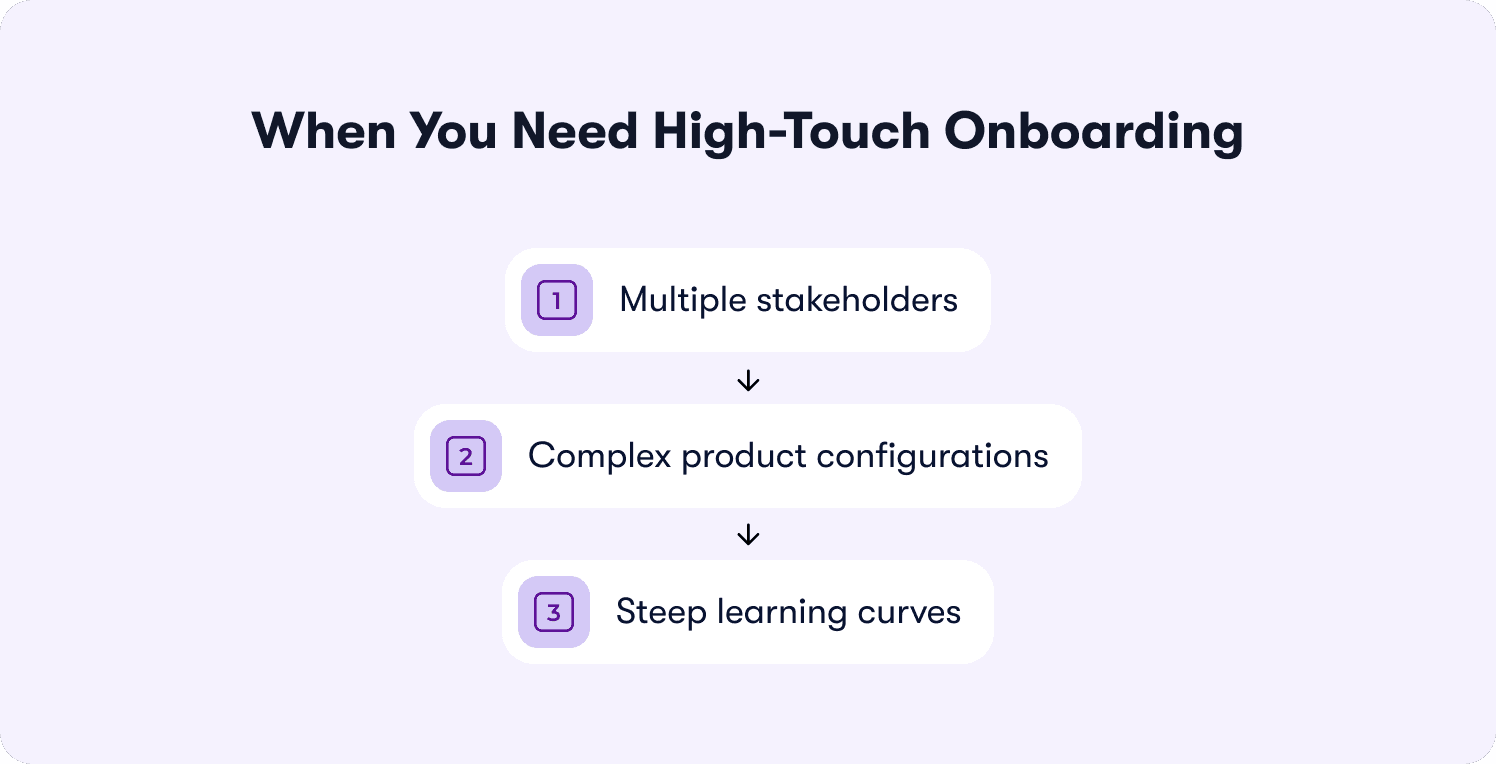
This isn't an argument against a hands-on approach for accounts that warrant it. Some customers genuinely need it, and the signals are usually one of these:
Multiple stakeholders coordinating an implementation across teams
Complex product configurations that go beyond default setup
Steep learning curves tied to the product itself, not the customer's familiarity with software in general
Those accounts deserve the white-glove experience it takes to set expectations correctly from day one. The problem isn't giving high-touch onboarding to the accounts above. It's giving it, by default, to every enterprise account regardless of whether any of those signals are present.
The next question is what should be driving that decision instead of the ones most CS teams currently use.
Why Tier and ACV Alone Are the Wrong Signals
Most CS teams draw the high-touch line at a tier or an ACV threshold: cross a certain contract value, get a dedicated CSM by default. It's an easy rule to operationalize, which is exactly why it's so common, and exactly why it produces so many mismatched assignments.
Contract value tells you what a customer is worth. It doesn't tell you what that customer's onboarding actually requires.
Consider two accounts side by side:
A large-ACV account buying a straightforward product with one admin and no integration needs, capable of a largely self-serve onboarding journey: video tutorials, a checklist, a CSM only a message away if something goes wrong.
A smaller account rolling out a complex integration across multiple teams, with several key people who all need to be on the same page before anything goes live, needing considerably more hands-on guidance than its contract size would suggest.
Tier-based rules get both of these wrong in opposite directions.
The signals that actually predict high-touch need sit closer to the customer's perspective than to the invoice:
How many internal resources the customer has available for implementation
How many teams and stakeholders are coordinating the rollout
Whether the setup demands technical instructions their team can't handle alone
None of that correlates cleanly with ACV, which is why tier-based rules keep over-serving customers who'd be fine with a tech-touch onboarding path, and under-serving the ones who actually need the additional resources a dedicated CSM provides.
This piece assumes your company has already decided to run a high-touch motion for at least some of its book. If that decision itself is still open, whether to run high-touch or low-touch as a model at all, our guide on SaaS onboarding strategy covers that broader choice.
The Four Signals That Actually Predict High-Touch Need
Four signals do a better job of predicting high-touch need than tier or ACV ever will. None of them show up on an invoice, and none of them require guessing, they're all things a CS team can actually observe about an account.
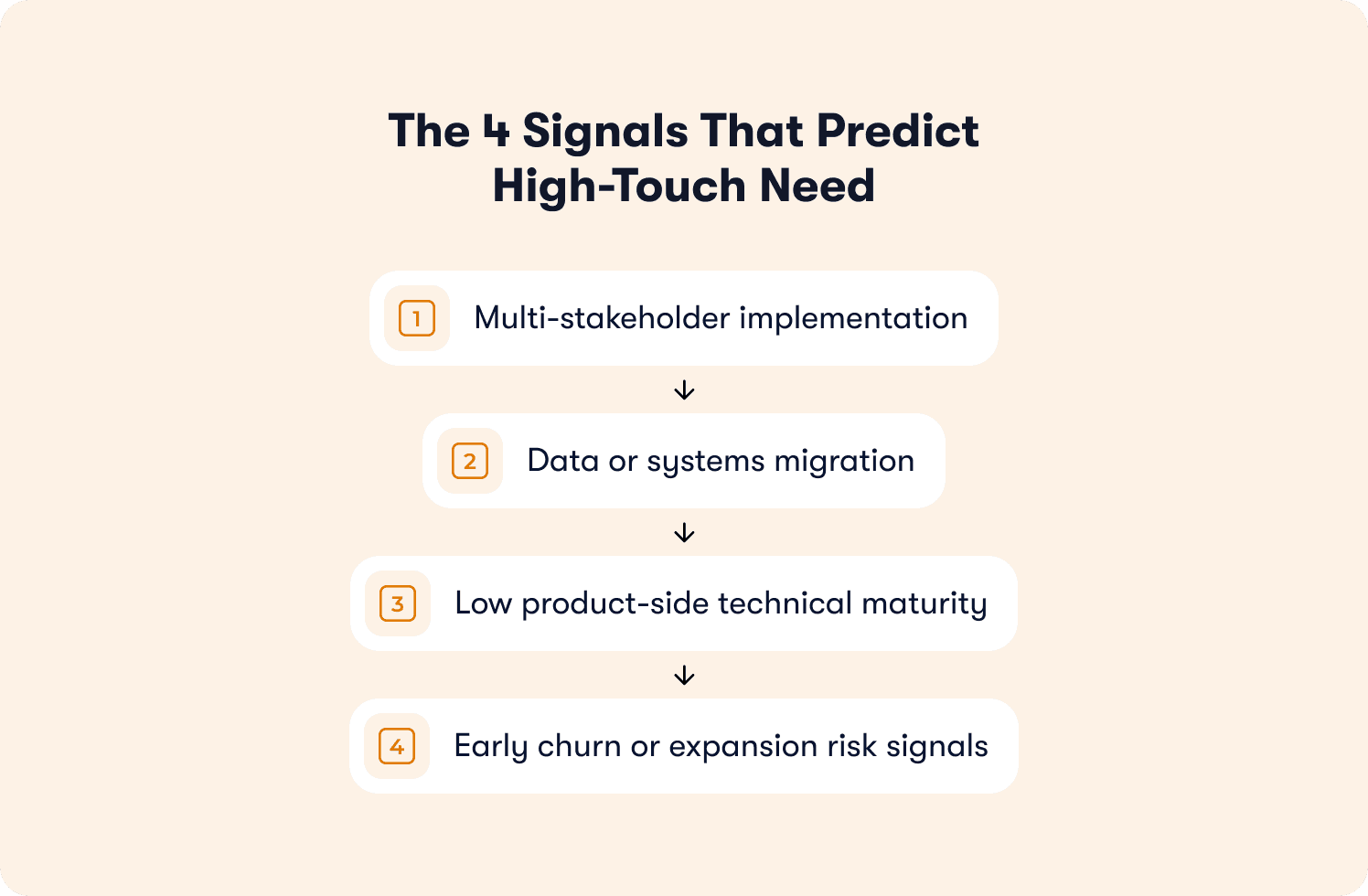
Multi-stakeholder implementation
Does activation require coordination across multiple teams on the customer's side, not just one admin clicking through setup alone? An account where finance, IT, and the end-user team all need to sign off before anything goes live needs someone keeping those groups on the same page. That coordination role is inherently a human one, no amount of in-product guidance replaces a person who can get three teams aligned on a rollout timeline.
Data or systems migration
Is there a technical lift beyond configuring the product itself, historical data being moved over, integrations with legacy systems, or a migration that touches infrastructure the customer's team didn't build? These are the accounts where a customer onboarding platform's self-serve tools hit a real ceiling. Technical instructions can only cover so much when the underlying migration itself is the hard part.
Low product-side technical maturity
Does the buying organization have someone who can self-serve setup, or does every configuration step require walking someone through it manually? A customer with a dedicated technical resource on staff can often handle a complex product with minimal hand-holding. A customer without one, regardless of contract size, may need a CSM even for setup steps that would otherwise be straightforward.
Early churn or expansion risk signals
Is this an account CS needs eyes on regardless of onboarding complexity? An account showing low engagement in week one, or one whose usage pattern suggests they're about to outgrow their current plan, warrants a human's attention independent of how complicated their setup was. These signals aren't about onboarding difficulty at all, they're about risk and opportunity that a CSM is best positioned to catch early.
Scored against these four signals, most current high-touch books split into two clear groups: accounts where the signals are genuinely present, and accounts that are high-touch purely by habit. The next section covers how to run that audit against your own book.
Auditing Your Current Book: Which Accounts Are High-Touch by Habit
Start with the current high-touch account list, the one built by tier or ACV threshold, and score each account against the four signals above. An account only stays classified as high-touch if at least one signal is genuinely present. Everything else becomes a reassignment candidate.
In practice, this audit looks like:
Pull the list. Every account currently receiving dedicated CSM attention, regardless of why.
Score each account against multi-stakeholder coordination, migration complexity, technical maturity, and churn/expansion risk, using what's actually known about the account, not assumptions based on its tier. An analytics segments view built around behavior and risk data makes this scoring step faster than pulling it together manually.
Flag the mismatches. Accounts that are high-touch by default, with none of the four signals present, go on the reassignment list.
Flag the reverse too. Any account that's currently low-touch but shows real risk or complexity signals belongs on a list of its own, since this audit cuts both ways.
A higher percentage of the book will likely land in the "high-touch by habit" group than most CS teams expect going in, particularly among enterprise accounts that were defaulted into a dedicated CSM relationship at signing and never revisited since. That's not a failure of the original decision. It's a sign the book hasn't been re-scored since the customer base grew past its original assumptions.
Building the Low-Touch or Hybrid Path for Reassigned Accounts
Reassigning an account off high-touch doesn't mean removing guidance. It means changing who delivers it.
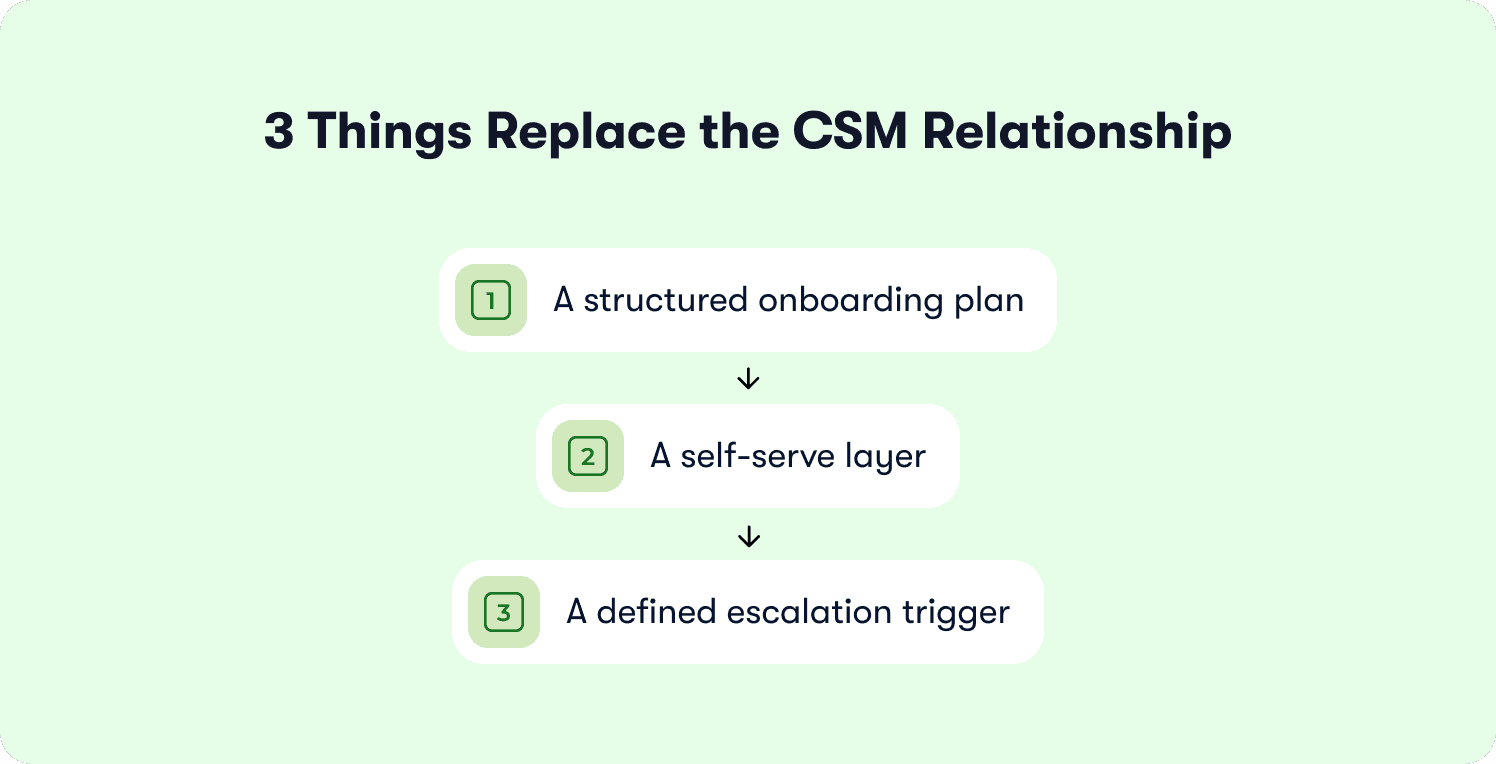
Three things replace the CSM relationship for a reassigned account:
A structured onboarding plan, built as a checklist, covering the exact setup steps a CSM used to walk through on a kickoff call
A self-serve layer, contextual hints placed at the point of confusion, for the smaller questions that used to fill a CSM's inbox: where's this setting, how do I invite a teammate, what does this feature do
A defined escalation trigger, a behavior-based signal rather than a calendar check-in, that routes the account back to a person the moment something goes wrong
The time savings show up in the second item most visibly. A CSM who used to spend an hour walking a new customer through configuration now spends none, because the product answered the question before the customer needed to ask a human at all.
The third item is the one teams get wrong most often. "Low-touch" doesn't mean "no visibility." A reassigned account still needs eyes on it, just not a person's eyes on a calendar. A stalled setup step, a drop in activity, a due date that passes with no action taken, any of these should trip a signal that pulls a CSM back in automatically.
That's the actual difference between low-touch and unsupported: the account still gets a hands-on response the moment it needs one. It just doesn't get one by default.
What Changes When You Right-Size Your Onboarding Model
Customer Alliance observed a 970% spike in feature adoption after shifting a share of their onboarding to self-serve, in-app guidance. That's the kind of lift available when accounts capable of self-serving actually get the guidance to do it, freeing customer success manager (CSM) time for the accounts that genuinely need a person's judgment.
The same logic applies to your own book. Every account correctly reassigned off high-touch onboarding is an account whose adoption can climb the way Customer Alliance's did, and every hour that reassignment frees up is an hour available for the enterprise accounts and expansion-ready accounts actually worth a CSM's time.
This is intelligence-led growth doing what it's meant to do: routing effort based on signal, not habit. The product handles the customers who can self-serve. The team handles the ones who can't, and the ones about to leave or about to grow, which is exactly where a CSM's time is worth the most.
The result wasn't just faster onboarding for accounts that no longer needed a person walking them through it. It was a CS team that stopped feeling permanently behind.
Give High-Touch Onboarding Back to the Accounts That Actually Need It
Not every customer needs a dedicated customer success manager walking them through setup. Some genuinely do, multi-stakeholder rollouts, technical migrations, accounts with real churn or expansion signals CS needs to watch closely. The rest are capable of a largely self-serve onboarding journey, if the product gives them the guidance to get there.
That's the shift this audit makes possible. Not fewer high-touch accounts as a target, but the right ones. A customer success team that's stopped spreading its hours evenly across a book that was never evenly distributed to begin with, and started spending them where a human's judgment is actually the scarce resource.
Your product doesn't just sell itself, it activates itself, handling the setup questions it already knows the answers to, so your customer success team can focus on the accounts that need a person, not a checklist.
See how Jimo helps customer success teams reassign onboarding capacity without losing the signals that matter. Book a demo to walk through how self-serve guidance and behavior-based escalation work together for accounts moving off high-touch.
FAQs
What's the difference between high-touch and low-touch onboarding?
High-touch onboarding pairs a customer with a dedicated CSM who guides setup directly, through kickoff calls, training sessions, and hands-on support. Low-touch onboarding relies on self-serve tools, checklists, hints, and resource centers, so the customer moves through onboarding largely on their own, with a CSM available if something goes wrong rather than driving the process by default.
How do I know if an account actually needs high-touch onboarding?
Score the account against real signals rather than tier or ACV: does the rollout involve multiple stakeholders across teams, is there a data or systems migration beyond standard configuration, does the customer lack the technical resources to self-serve setup, and are there early churn or expansion signals worth watching closely. An account with at least one of these signals present is a legitimate high-touch candidate. One with none of them is likely high-touch by habit.
Can you move an account from high-touch to low-touch without hurting retention?
Yes, provided the move includes a real escalation path, not just a removal of support. Replacing a CSM relationship with a checklist and hints while defining a behavior-based trigger that re-routes the account to a person when something stalls preserves the safety net. Retention risk comes from removing visibility, not from removing a human's default involvement.
Does company size or contract value determine whether an account needs high-touch onboarding?
Not reliably. Contract value reflects what a customer is worth, not what their onboarding actually requires. A large account buying a straightforward product may be entirely self-serve, while a smaller account managing a complex integration across multiple teams may need considerably more hands-on guidance. Signal-based scoring predicts onboarding needs more accurately than tier or ACV alone.
What does a hybrid onboarding model look like in practice?
A hybrid model gives every account a self-serve foundation, checklists, hints, a resource center, while reserving direct CSM time for the specific moments a signal indicates it's needed: a stalled setup step, a missed due date, a drop in product activity. The customer gets a mostly self-serve onboarding experience with a human available exactly when the situation calls for one, rather than on a fixed schedule.