/
13 mins read
TL;DR
Most B2B SaaS teams have an onboarding tactic stack, not an onboarding strategy. A strategy makes explicit choices about which model to use, how to deliver it, which channels to invest in, how much to automate, and what "working" means. This article is for Heads of Product who have already diagnosed where their current onboarding is breaking down and need a framework to decide what to build instead. It covers the five strategic choices every SaaS onboarding strategy has to make, three example archetypes showing how those choices combine in production, and the operating model that turns strategic decisions into outcomes the rest of the organization can execute against.
You have already accepted that onboarding affects revenue. You have already read the case for activation over completion. You have already looked at your funnel and seen where conversion is leaking. What you do not have is a coherent framework for what to do about it. Specifically, the strategic choices that will shape the next 12 to 18 months of investment, hiring, and tooling.
This article addresses those who are Head of Product and who have moved past diagnosis and are now choosing direction.
It covers what separates an onboarding strategy from a tactic stack, the five strategic choices every strategy has to make explicitly, three example archetypes showing how those choices combine in production B2B SaaS products, and how to translate strategic decisions into an operating model the rest of the organization can execute against.
If you are still at the diagnostic stage, trying to understand why your onboarding completes but conversion stays flat, start with Jimo's analysis of why most SaaS onboarding processes fail to drive paid conversion. This article picks up where that one ends: with the question of what framework to build instead.
What Separates an Onboarding Strategy from a Tactic Stack
A tactic stack is a collection of onboarding moves a team has accumulated over time. Welcome modals, tooltips, checklists, drip emails, feature announcements. Each was added because someone thought it would help. Most are not measured against each other. Many overlap. Some contradict.
A strategy is different. A strategy says:
This is what we are optimizing for (a specific outcome, measured a specific way)
This is the model we are using to get there (guided, self-guided, hybrid, adaptive)
This is how the model is delivered (in-product, email, sales-assisted, hybrid)
This is what we are explicitly not doing, and why the trade-off makes sense for our product
This is how we know it is working, and the threshold at which we would change direction
Most onboarding documents that call themselves strategies are missing at least three of those elements. They list activities. They do not name choices.
The diagnostic that tells you whether your current onboarding is a strategy or a tactic stack:
Signal | Indicates a tactic stack | Indicates a strategy |
When you add a new onboarding element, you can articulate why it belongs | "It seemed like a good idea" | "It supports the model we chose because…" |
When you remove an element, the system still makes sense | Nobody remembers why it was there | The element served a defined role in the strategy |
When activation drops, you have a hypothesis about which element is responsible | All metrics drop together | The answer is a choice with trade-offs |
The team can answer "what is our onboarding strategy" in one sentence | The answer is a list of features | The answer is a choice with trade-offs |
The rest of this article covers the five strategic choices that turn a tactic stack into a strategy.
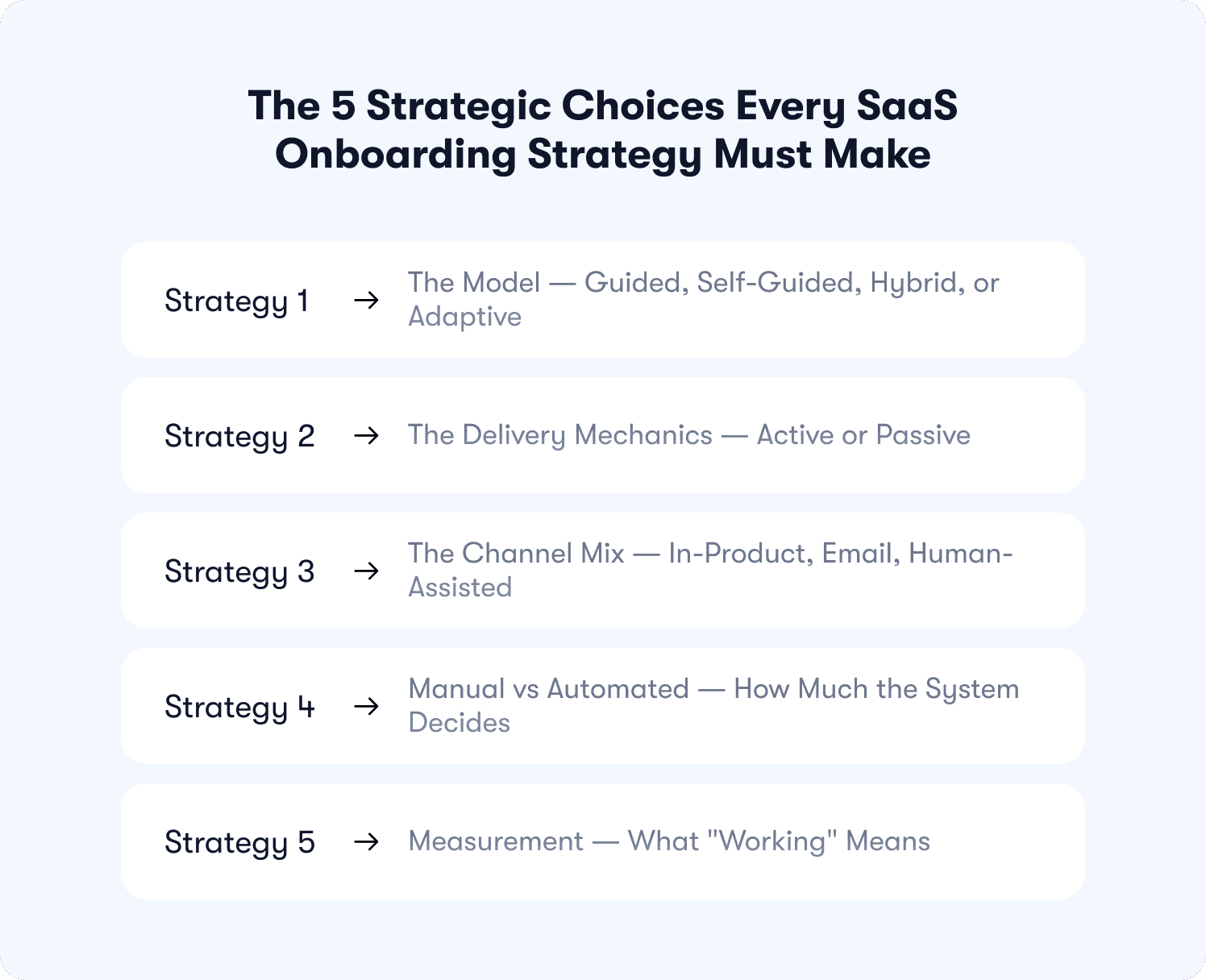
The Five Strategic Choices Every SaaS Onboarding Strategy Must Make
Strategic Choice 1: The Model — Guided, Self-Guided, Hybrid, or Adaptive
The first strategic decision is which onboarding model fits your product, users, and operational capacity.
The four options:
Guided: the product actively walks users through a defined sequence to activation
Self-guided: the product provides reference material and contextual hints; users determine their own path
Hybrid: different stages of the journey use different models
Adaptive (AI-driven): the product determines in real time which model each user needs
The choice depends on product complexity, user maturity, and team capacity to maintain the model. Highly familiar products with autonomous users typically lean self-guided. Complex products with non-obvious activation events lean guided. Most successful B2B SaaS products end up hybrid. Products with significant behavioral variance across users benefit most from adaptive.
The trade-off: guided onboarding compresses time-to-value but feels restrictive to advanced users. Self-guided respects user autonomy but loses users who needed direction. Hybrid avoids both failure modes but adds design complexity. Adaptive solves the complexity at the cost of requiring behavioral data infrastructure most products do not yet have.
What this choice means you are deliberately not doing: a pure guided strategy is a deliberate choice not to give users autonomy in the first session. A pure self-guided strategy is a deliberate choice not to compress time-to-value for users who need direction. Naming the trade-off explicitly is what makes this a strategic decision rather than a default.
The full framework for choosing between guided and self-guided is the subject of Jimo's guided onboarding decision framework, which works through five conditions where each model outperforms. For the adaptive option specifically, Jimo's AI-based personalization analysis covers when behavior-level personalization beats segment-level approaches.
Strategic Choice 2: The Delivery Mechanics — Active or Passive
Even within a chosen model, the second decision is whether your onboarding actively drives action or passively presents information.
Active delivery: users complete actions to progress (checklist items require the actual behavior, walkthroughs gate progress on real clicks)
Passive delivery: users acknowledge content to progress (tooltip-clicked, modal-dismissed, video-watched)
The distinction matters because passive onboarding produces completion rates that look good on a dashboard but do not correlate with retention. A user who clicked through a tour without performing the underlying action did not learn the product. They learned to dismiss tours.
The trade-off: active delivery has higher friction at each step. Users abandon it more often than passive flows. But the users who complete it are far more likely to retain. Active onboarding optimizes for activation. Passive optimizes for completion. The right choice depends on which metric your strategy is actually accountable for.
What this choice means you are deliberately not doing: active delivery means deliberately accepting higher in-flow abandonment as the cost of higher retention from the users who do complete. Teams that want both a high completion rate and high activation are choosing a metric goal that does not exist in practice.
The full case for action-based progression is made in Jimo's interactive onboarding strategies analysis, which covers the completion-vs-activation gap in detail.
Strategic Choice 3: The Channel Mix — In-Product, Email, Human-Assisted
The third decision is where onboarding happens. Most strategies default to in-product because it is the most scalable, but the right answer is rarely "only in-product."
In-product onboarding: the dominant channel for PLG SaaS. Checklists, walkthroughs, contextual hints, empty states.
Email onboarding: time-based or behavior-based. Useful for re-engagement. Less effective as the primary channel.
Human-assisted onboarding: sales engineer or CS-driven. Necessary for high-ACV deals. Expensive at scale.
The strategic question is not which channel to pick, but how to weight them and when each one carries the load. PLG with a $50/month plan cannot afford CS-driven onboarding. Enterprise deals at $50K ACV cannot rely on in-product alone. Most B2B SaaS products with mixed ACV ranges need a mixed strategy: in-product for self-serve cohorts, supplemented with behavioral email for re-engagement, with sales-assisted handoffs for enterprise tier.
This is where saas customer onboarding automation strategies become real strategic decisions rather than tactical defaults. Automation is the right strategic answer for self-serve cohorts. It is the wrong answer for high-touch enterprise deals where the human channel produces both activation and account expansion at the same time.
What this choice means you are deliberately not doing: committing to a channel mix means accepting that some cohorts will get less attention than others. A PLG-dominant strategy deliberately undeserves your top 5% of accounts by ACV. An enterprise-dominant strategy deliberately leaves self-serve activation on the table. Both are defensible. Both have to be named explicitly to count as strategy.
For teams whose strategy depends heavily on the human-assisted channel, the bridge between product behavioral signals and CS workflow automation is its own infrastructure problem. Jimo's analysis of how to improve the customer onboarding process covers the operationalization patterns specific to that territory.
Strategic Choice 4: Manual vs Automated — How Much the System Decides
The fourth strategic decision sits inside the channel mix: how much of onboarding does the system handle without human intervention, and how much requires manual setup, configuration, or content updates?
Three positions on the automation spectrum:
Position | What it looks like | Right for |
Fully manual | Every flow built and updated by hand. Rules configured for each segment. | Small teams with stable products and few user types |
Selectively automated | System handles routine triggers, behavioral re-engagement, segment routing. Team handles strategy and exceptions. | Most Series A–C SaaS teams |
Fully adaptive | System makes contextual decisions about what each user needs. Team defines goal states and guardrails. | Complex products with high behavioral variance |
The trade-off: full manual control gives the team complete visibility and predictability, but the maintenance cost scales linearly with product complexity. Full automation reduces maintenance but requires behavioral data, instrumentation, and tolerance for the system making decisions the team cannot always predict. Selectively automated is where most product teams should sit. The question is which decisions to delegate.
What this choice means you are deliberately not doing: committing to full automation means deliberately giving up the ability to predict every guidance moment a user will receive. Committing to full manual control means deliberately accepting that the team will spend a meaningful portion of its capacity on guidance maintenance rather than strategic improvement.
For the technical view of how adaptive onboarding actually operates the automated end of this spectrum, see Jimo's adaptive onboarding overview.
Strategic Choice 5: Measurement — What "Working" Means
The final strategic decision is the one most teams skip: what does "working" actually mean for our onboarding, and what would we have to see to change direction?
A strategy without a measurement frame is an opinion. The metric you choose to optimize against shapes every other choice in the system.
The four candidate primary metrics, with what each one biases the rest of the strategy toward:
Primary metric | Biases the strategy toward | When it's the right choice |
Trial-to-paid conversion rate | Speed to activation, aggressive funnel optimization | PLG products with short trial windows |
30-day retention | Quality of activation, deeper feature adoption | Subscription products with monthly churn |
Friction removal, channel optimization | Products competing on the 60-second value standard | |
Expansion revenue per activated user | Post-activation onboarding, feature depth, secondary value moments | Products with strong expansion motion |
Most onboarding strategies fail not because the team picked the wrong metric, but because they tried to optimize for all four simultaneously. That produces strategy paralysis: every decision has to balance four competing pressures, and no decision feels defensible. The discipline of picking one primary metric (and explicitly relegating the others to diagnostic status) is what turns a tactic stack into a strategy.
Progress tracking in SaaS onboarding strategies is the instrumentation that follows this choice, not a substitute for making it. The strategic question is what to track, framed by what you decided to optimize for.
What this choice means you are deliberately not doing: picking a primary metric means accepting that you will sometimes ship changes that improve your primary metric while slightly worsening one of the others. That trade-off has to be defensible before the strategy ships, not retroactively explained when the secondary metric dips.
For the system-level governance of this measurement work at scale, see our software onboarding best practices guide, which covers the measurement framework at the Product Ops level.
Strategy Chooses the Direction. Tactics Drive the Outcome.
If you’re redesigning onboarding in 2026, execution details matter: what users see first, which actions trigger guidance, when to intervene, and how to reduce time-to-value without overwhelming the user.
We compiled 19 proven activation tactics used by B2B SaaS teams across PLG, hybrid, and enterprise onboarding models.
📖 Download the free e-book → 19 SaaS Activation Tactics for Higher Activation and Retention
Three Examples of Strategic Onboarding in Practice
The strategic choices above only make sense when they combine. Here are three example archetypes showing how the five choices fit together for different product types. None of these are individual customer case studies.
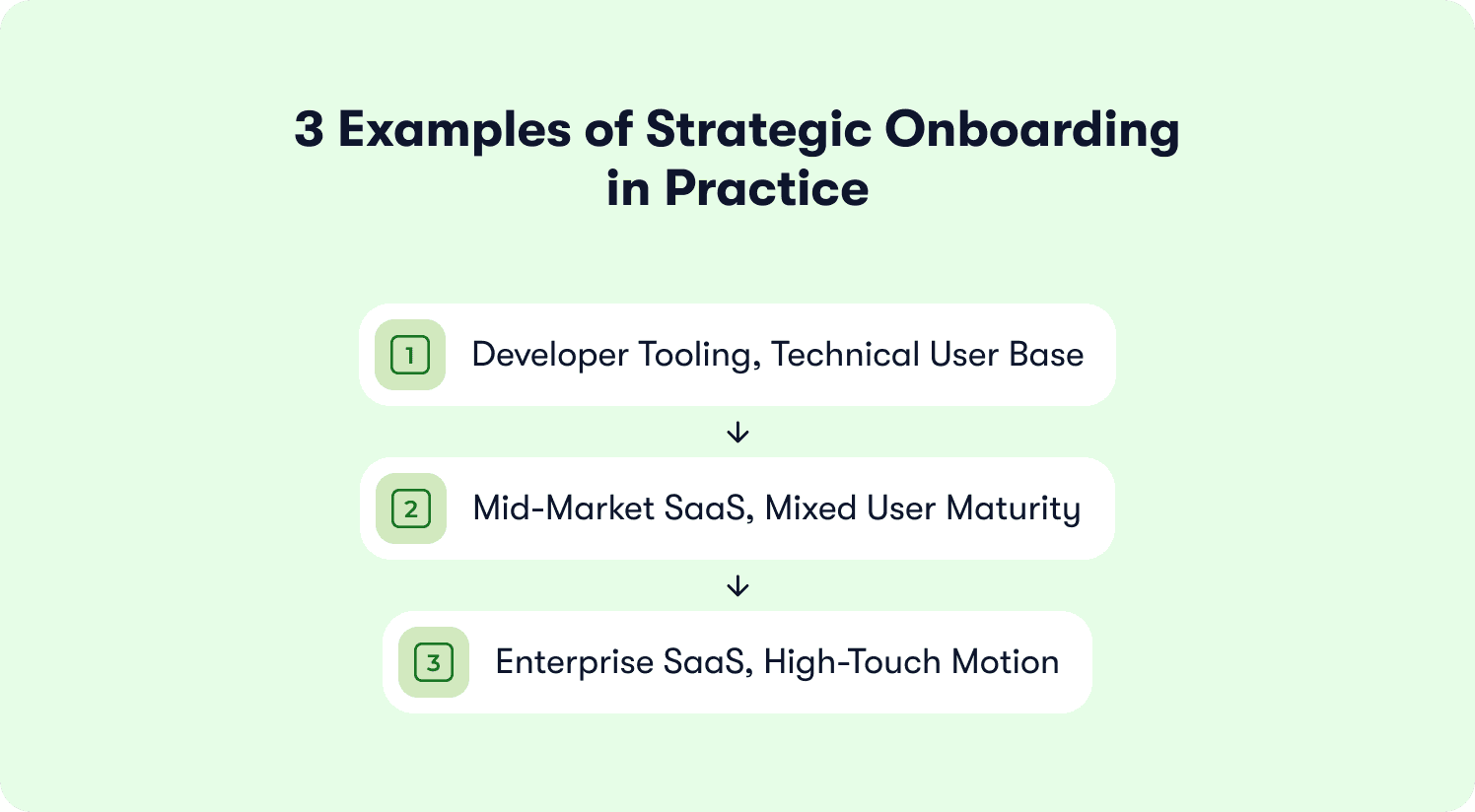
They are composite archetypes that illustrate how strategic coherence actually looks.
Example 1: Developer Tooling, Technical User Base
A developer infrastructure product serving engineers as the primary user. The team commits to:
Model: self-guided with two guided moments (initial repository connection and first deployment trigger)
Delivery: active progression at the two guided moments, passive reference content for everything else
Channel: in-product dominant, with documentation as the support layer; no scheduled email
Automation: selectively automated, with behavioral triggers for re-engagement
Measurement: time-to-value, target under 60 seconds to first deployment
What they deliberately did not do: build a 10-step welcome flow, send Day-3 nurture emails, or assign onboarding sequences by job title. The team's strategic bet is that technical users punish hand-holding more than they reward it. The 60-second time-to-value commitment makes that bet explicit. If the data ever shows that adding a guided tour increases activation, the strategy itself has to be revisited.
Example 2: Mid-Market SaaS, Mixed User Maturity
A workflow product serving both first-time admins setting up their first workspace and experienced operators moving from a competitor's tool. The team commits to:
Model: hybrid, with guided onboarding for the pre-activation stage and self-guided guidance afterward
Delivery: active for the guided stages, passive for post-activation reference content
Channel: in-product primary, with behavioral email for users who completed setup but did not return in seven days
Automation: selectively automated, with segment routing based on signup-form responses and post-signup behavior
Measurement: 30-day retention by activation cohort
What they deliberately did not do: route users by signup-form persona alone, or run drip campaigns on calendar dates. The team's strategic insight was that the signup-form data was less predictive of activation path than the first 90 seconds of in-product behavior. The strategy commits to letting behavior override signup intent when the two disagree.
Example 3: Enterprise SaaS, High-Touch Motion
A product serving both self-serve teams on a $50/month plan and enterprise accounts at $50K+ ACV. The team commits to:
Model: hybrid with significant human-assisted component for enterprise tier
Delivery: active progression for the self-serve segment, sales-engineer-led for enterprise
Channel: in-product plus CS-assisted, with a structured handoff at the moment the enterprise plan is purchased
Automation: fully manual for enterprise (every account onboarded by a named CS owner), selectively automated for self-serve
Measurement: expansion revenue per activated user
What they deliberately did not do: try to use the same onboarding flow for self-serve and enterprise users, or measure both segments against the same primary metric. The team's strategic recognition was that two different motions need two different operating models, and that the cost of running both in parallel is justified by the ACV difference.
How to Translate a Strategy Into an Operating Model
A strategy that does not translate into an operating model decays. The operating model has three components.
Decision rights. Who decides which onboarding elements ship, which get cut, and which get tested? In most B2B SaaS teams the answer is "everyone has an opinion and nobody owns the decision." Strategy work fixes this by naming the decision-maker for each choice. As Head of Product, you own the model choice. The PM owns flow design within the chosen model. Product Ops owns measurement and governance. Marketing owns the email channel. Sales owns the human-assisted handoff. If two functions believe they own the same decision, the strategy will produce conflicts that look like execution problems.
Iteration cadence. Onboarding strategies compound only if the team can iterate. Quarterly reviews are too slow. Weekly is the operational floor for teams running adaptive strategies. Monthly works for stable products with selectively automated strategies. The cadence has to be chosen with the same explicitness as the model. A monthly cadence committed to in writing produces compounding improvements. A "we will iterate when we have time" cadence produces a tactic stack that ages into a liability.
Engineering dependency. The single most important operating-model question is whether the product team can update onboarding without engineering involvement. If every change requires a sprint, the strategy will fall behind the product within two quarters.
How to Choose the Right Tooling for Your Strategy
The evaluation question is not which platform has the most features. It is which platform supports the model you actually chose and lets your team iterate the design without engineering becoming the bottleneck.
The criteria that determine fit:
Criterion | The Head of Product question |
Model flexibility | Does the tool support all four model options (guided, self-guided, hybrid, adaptive), or does it lock you into one? |
No-code authoring | Can your product team update flows without an engineering sprint? |
Behavioral data | Does the tool act on what users actually do, or only on signup-form attributes? |
Channel coverage | Can the tool drive in-product and behavioral email from the same logic layer, or do you need to maintain two parallel systems? |
Measurement | Does the tool measure activation outcomes by onboarding variant, or only flow completion? |
Operational cost | Does pricing scale predictably with usage, or do per-user overages surprise you mid-quarter? |
Jimo is a digital adoption platform built for web-based B2B SaaS teams who need to operate onboarding as a strategy rather than a tactic stack. The platform is designed to support all four models from a single implementation: guided product tours and in-product checklists for guided stages, contextual hints and a resource center for self-guided support, behavioral triggers via analytics segments for the hybrid model, and an AI copilot for the adaptive end of the spectrum.
That’s why teams trust Jimo and have built onboarding strategies that adapt to their specific channel mix and operational constraints.
See how Jimo supports all four onboarding models from a single implementation with a free demo.
FAQs
How is a SaaS onboarding strategy different from onboarding best practices?
Best practices are tactics: things you should generally do. A strategy is a set of explicit choices about which tactics fit your product, your users, and your operational capacity, and which tactics you are deliberately not using. Most B2B SaaS teams have read dozens of best practices articles. What they lack is a framework for choosing which practices to apply, in what order, with what trade-offs. That is what an onboarding strategy provides.
What are the most effective SaaS customer onboarding automation strategies?
Automation is most effective when applied selectively. Three patterns produce reliable results: behavioral triggers that fire onboarding content based on what the user actually did (not days since signup), automated segment routing that adapts to user behavior over time, and automated re-engagement that picks up exactly where the user stalled. Fully automated onboarding works only for products with mature behavioral data infrastructure. Most teams should target selective automation: automate the routine work, keep human judgment in the strategic decisions.
How do GTM strategies for SaaS user onboarding and session recording tools fit together?
Session recording surfaces qualitative signals (where users hesitate, what they click on, what they ignore) that quantitative metrics alone miss. The GTM connection is that these signals inform which channels and which moments need investment. Recording shows you that users in the enterprise tier are getting stuck on the workspace setup screen, which tells your strategy that the enterprise channel needs human-assisted onboarding at that step, not only an in-product tooltip. Session recording is diagnostic infrastructure, not a strategy on its own.
How does progress tracking in SaaS onboarding strategies work in practice?
Progress tracking is the instrumentation layer underneath whatever primary metric your strategy is optimizing for. The strategic question is not "should we track progress." Every strategy should. The strategic question is what to track. If your primary metric is trial-to-paid conversion, you track activation rate by entry path. If your primary metric is 30-day retention, you track retention by activation cohort. The progress tracking infrastructure follows the strategic choice, not the other way around.
What do secure onboarding strategies for SaaS applications look like?
Security in onboarding is mostly an enterprise-tier concern: SSO setup, role-based access controls, audit logging from the first session, compliance attestations during the signup flow. For self-serve PLG cohorts, security tends to be invisible during onboarding because the product handles it without the user needing to think about it. The strategic question is whether your onboarding model can serve both cases. Most B2B SaaS products with mixed segments need two onboarding paths: a lightweight one for self-serve and a security-first one for enterprise.
How long should we run a new onboarding strategy before evaluating whether it is working?
For pre-activation strategies, 30 days produces a meaningful cohort comparison. For post-activation or retention-focused strategies, 90 days. The discipline that matters more than the timeframe is committing to the primary metric before the strategy ships. Teams that change the primary metric mid-evaluation are not testing the strategy. They are searching for a number that justifies the choice they already made.