/
8 mins read
TL;DR
Guided onboarding and self-guided onboarding are not opposing philosophies. They are design patterns that work in different contexts, for different users, at different points in the journey to first value. This article covers the conditions where each model outperforms, why the most effective SaaS products combine both depending on the moment, how to design guided onboarding that doesn't feel restrictive, and how to measure whether the model you chose is actually moving activation. Written for product managers and heads of product at B2B SaaS companies who are choosing or revisiting their onboarding model and want a defensible framework rather than another opinion piece.
There are two camps in the SaaS onboarding discourse, and they can't both be right.
One says guided onboarding is essential: users get lost, you have to walk them through the product, hand-holding is the only path to conversion. The other says guided onboarding is condescending and outdated, that users want to explore on their own, that the most modern thing a product team can do is get out of the way.
Both camps are partially right. Neither is right enough to base a product decision on.
The reason the debate keeps happening is that guided and self-guided are not opposing philosophies. They are two patterns that work in different contexts, for different users, at different moments in the onboarding journey. The product team's job is not to pick a side. It is to decide which pattern fits which moment.
This article is the decision framework for that work. It covers what guided onboarding actually means and what people often confuse it for, when each model outperforms, why the best products combine both, what makes guided onboarding work as a model rather than feel like a tax on the user, and how to measure whether the choice you made is moving activation.
What Guided Onboarding Actually Means (and What People Often Confuse It For)
Guided onboarding is a deliberate design pattern.
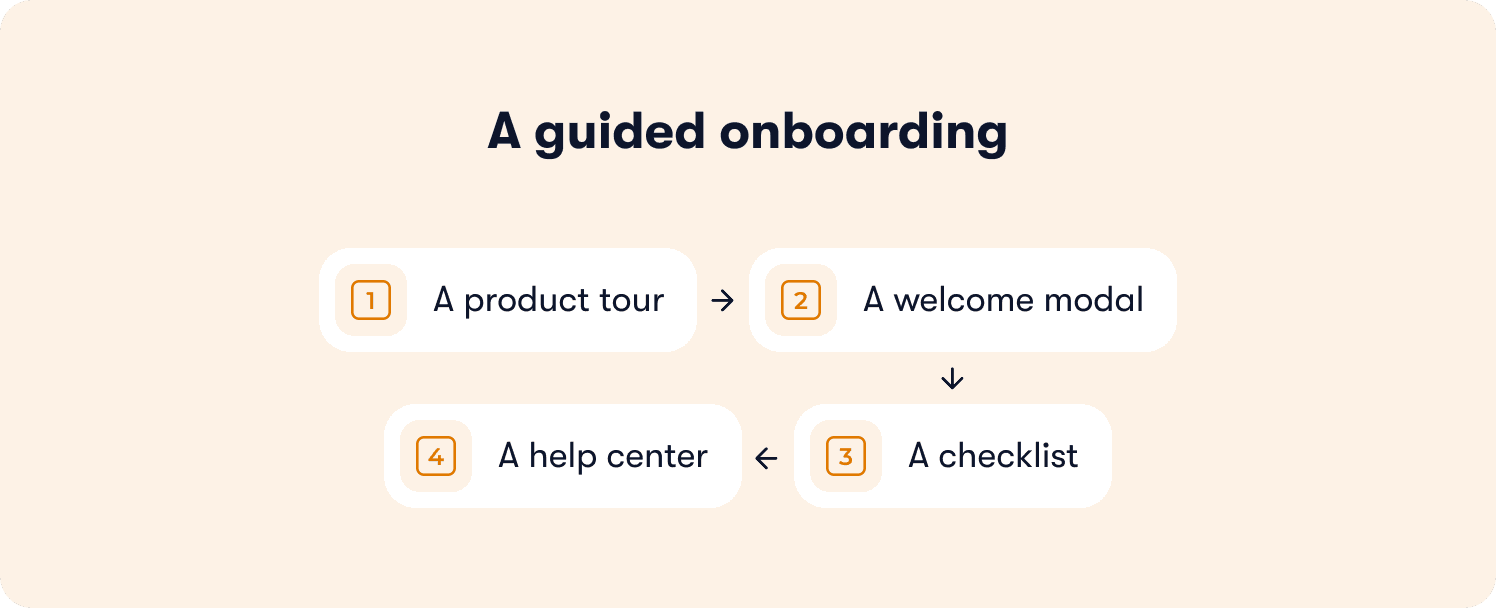
The product actively walks users through specific steps toward a defined activation moment, surfacing the next action and providing context at each one. It is not the same thing as several adjacent concepts:
A product tour. Tours can be guided or self-directed depending on whether the user is able to skip and explore.
A welcome modal. That is a starting point, not a model.
A checklist. That is a tool that can support guided onboarding, but having one does not mean your onboarding is guided.
A help center. That is reactive infrastructure for users who already know what they are looking for, not proactive direction.
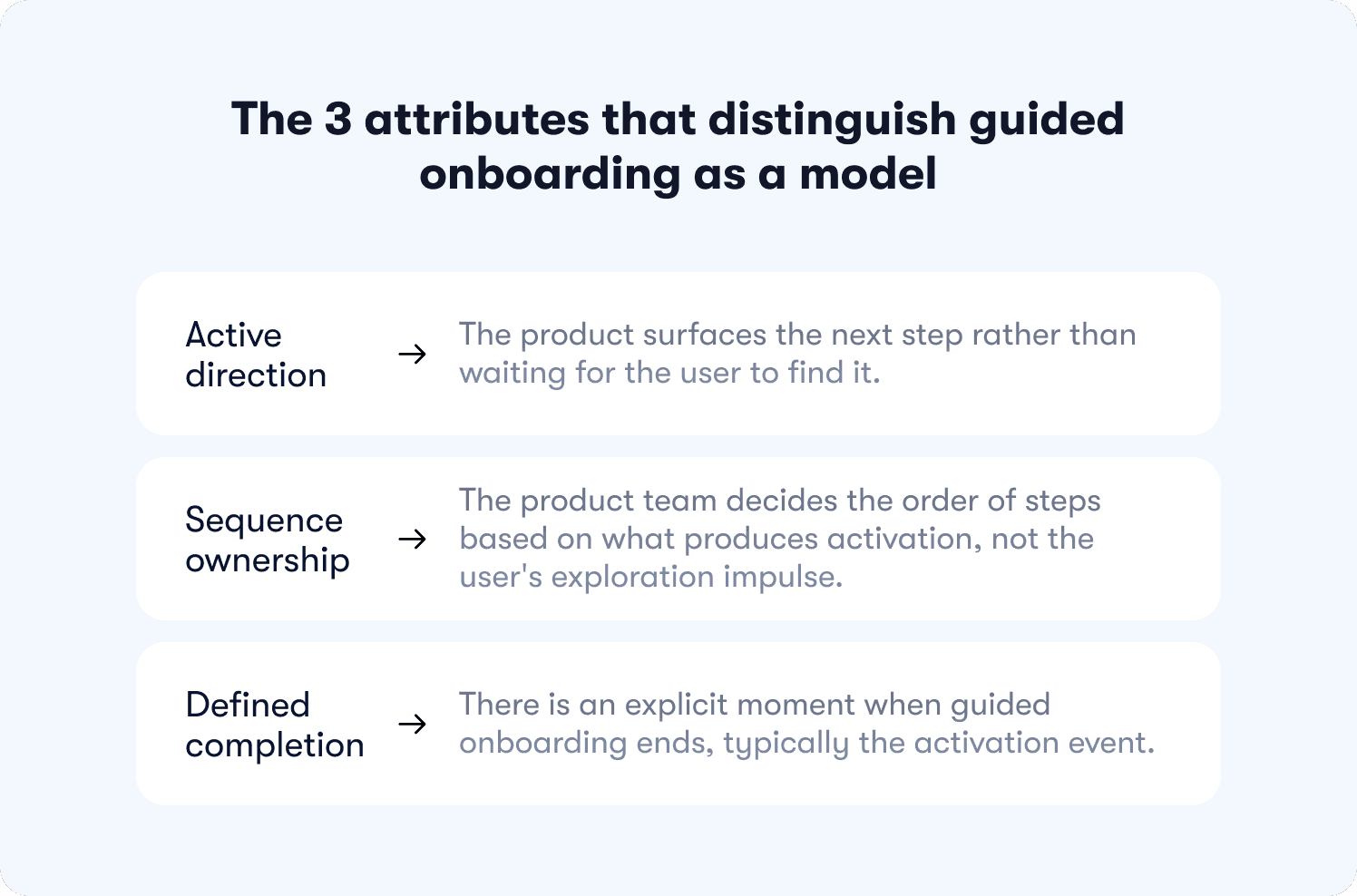
Three attributes distinguish guided onboarding as a model:
Attribute | What it means in practice |
Active direction | The product surfaces the next step rather than waiting for the user to find it. |
Sequence ownership | The product team decides the order of steps based on what produces activation, not the user's exploration impulse. |
Defined completion | There is an explicit moment when guided onboarding ends, typically the activation event. |
Self-guided onboarding is the inverse model. The user determines their own path through the product. The product provides reference material and contextual hints when asked, but it does not direct the sequence of actions.
Both models are legitimate. The question is which one fits the product, the user, and the moment.
The rest of this article is about how to answer that question.
When Guided Onboarding Outperforms Self-Guided
There are specific conditions under which guided onboarding is the right model. These are not opinions. They are situational rules tied to product characteristics and user behavior.
Condition | Why guided is the right model |
The product has a non-obvious activation event | If a new user cannot intuit what "success" looks like by exploring, leaving them to self-guide produces high drop-off. The product has to show them what to aim for. |
The first value moment requires multiple coordinated actions | If activation requires connecting an integration, importing data, and configuring a workflow in a specific order, self-guided exploration will not produce the right sequence. |
Users are time-poor and conversion-sensitive | When the user has 10 minutes to evaluate whether a product is worth their team's investment, guided onboarding compresses the path to value. Self-guided assumes they have patience they do not have. |
The product has a steep conceptual ramp | Some products require users to understand a model before they can use it (how the data flows, how the permission system works, how the core abstractions relate). Guided onboarding teaches that model. Self-guided assumes the user already has it. |
The user base is broad and heterogeneous | When users arrive with widely varying levels of context, guided onboarding establishes a common floor. Self-guided produces consistent outcomes only for users who arrived with consistent expectations. |
The pattern across all five conditions: guided onboarding wins when the product is too complex, too unfamiliar, or too time-sensitive for users to find their own way to value. The cost of guided onboarding (slower-feeling, more directive) is outweighed by the cost of users abandoning before activation.
The question that determines whether guided onboarding will actually convert under these conditions is not whether to use it. It is whether the guided flow itself is active or passive in design. Action-based progression beats linear, passive tours by significant margins, a differential Jimo's interactive onboarding strategies analysis covers in detail.
When Self-Guided Onboarding Outperforms Guided
The inverse is equally true. There are conditions under which self-guided is the right model and guided onboarding would actively damage conversion.
Condition | Why self-guided is the right model |
The product is built on a familiar pattern | When the product looks and works like tools users already know, hand-holding feels patronizing. They want to find their own way, and they can. |
The user base is technical and self-directed | Developers, analysts, and power users typically resent guided flows. Self-guided onboarding with strong reference material respects their autonomy and produces faster activation for them. |
The activation event is observable from the homepage | If a new user can see what to do next without being told (a clear empty state, an obvious primary CTA, an unambiguous workflow), guided onboarding adds friction rather than removing it. |
The product has high session length variance | When some users complete onboarding in five minutes and others in five days, a guided flow that assumes a single session feels broken. Self-guided lets users pick up where they left off without the product pretending the gap did not happen. |
The team cannot maintain guided flows at the pace of product changes | A guided flow that references features that no longer exist (or moved, or got renamed) is worse than no guided flow at all. If product velocity exceeds the team's capacity to maintain the guided layer, self-guided becomes the operationally responsible choice. |
The pattern across these conditions: self-guided wins when the product is familiar enough, the user is autonomous enough, or the team's operational capacity is constrained enough that active direction adds more friction than it removes.
The self-guided model has its own infrastructure requirements, and most teams underinvest in them. A self-guided product needs an in-product knowledge surface that surfaces the right answer at the right moment, not a generic help center that users have to leave the product to consult. Jimo's resource center and self-service documentation tools are designed for this work. The difference between self-guided that works and self-guided that fails is almost always whether the user can find what they need without leaving the product.
The Hybrid Reality: Why the Best SaaS Products Use Both
The most effective onboarding experiences are not one model or the other. They are hybrid systems that apply guided patterns at moments of high stakes and high complexity, and self-guided patterns at moments of low risk and high user agency. The combination produces better outcomes than either pure approach because it matches the model to the user's actual state at each moment.
The hybrid model breaks down by stage of the journey:
Stage | The right model | Why |
Signup to first value | Mostly guided | The user does not know what to do, the stakes for getting it wrong are high (abandonment), and the product team has a clear path to activation they can compress. |
First value to second session | Mostly self-guided | The user has experienced the product working. They have earned the right to explore. Reference material and contextual hints support them. Active direction would feel patronizing. |
Feature discovery and depth | Targeted contextual guidance | Activated users should not be put back into a guided flow for every new feature. Contextual nudges that surface the right feature at the right moment outperform either pure approach. |
Re-engagement after lapse | Behavioral, not time-based | Pick up where the user left off, with guidance that acknowledges what they have already accomplished. A generic "come back, we miss you" sequence ignores the specific context that caused the lapse. |
The deeper insight that makes the hybrid model work: pure guided onboarding fails when it does not know when to stop. Pure self-guided fails when it does not know when the user is stuck. The hybrid model is fundamentally about the product knowing which moment is which, and adapting accordingly.
That kind of adaptive responsiveness is harder to design than a single flow, but the conversion math favors it overwhelmingly. Industry benchmarks suggest products with adaptive guidance outperform pure guided or pure self-guided models on trial-to-paid conversion, often by substantial margins. The competitive standard the best SaaS products are now operating against is 60 seconds to first value. A 12-step guided tour cannot meet that bar. Neither can leaving the user to figure it out alone. Only guidance that gets the user to value as fast as possible, then steps aside, can.
The strategic case for treating adaptive guidance as a model in its own right is made more fully in Jimo's AI-based personalization framework, which argues that the conversion math favors adaptive over either pure approach. The technical infrastructure that enables this kind of adaptation, including context-aware guidance, behavioral triggers, and AI assistance for the cases no rule was written for, is covered in Jimo's adaptive onboarding overview.
Designing Guided Onboarding That Doesn't Feel Like a Tax on the User
For product teams that have decided guided (or hybrid with significant guided components) is the right model, the next question is how to design it well. Guided onboarding can convert beautifully or annoy aggressively, and the difference is design discipline.
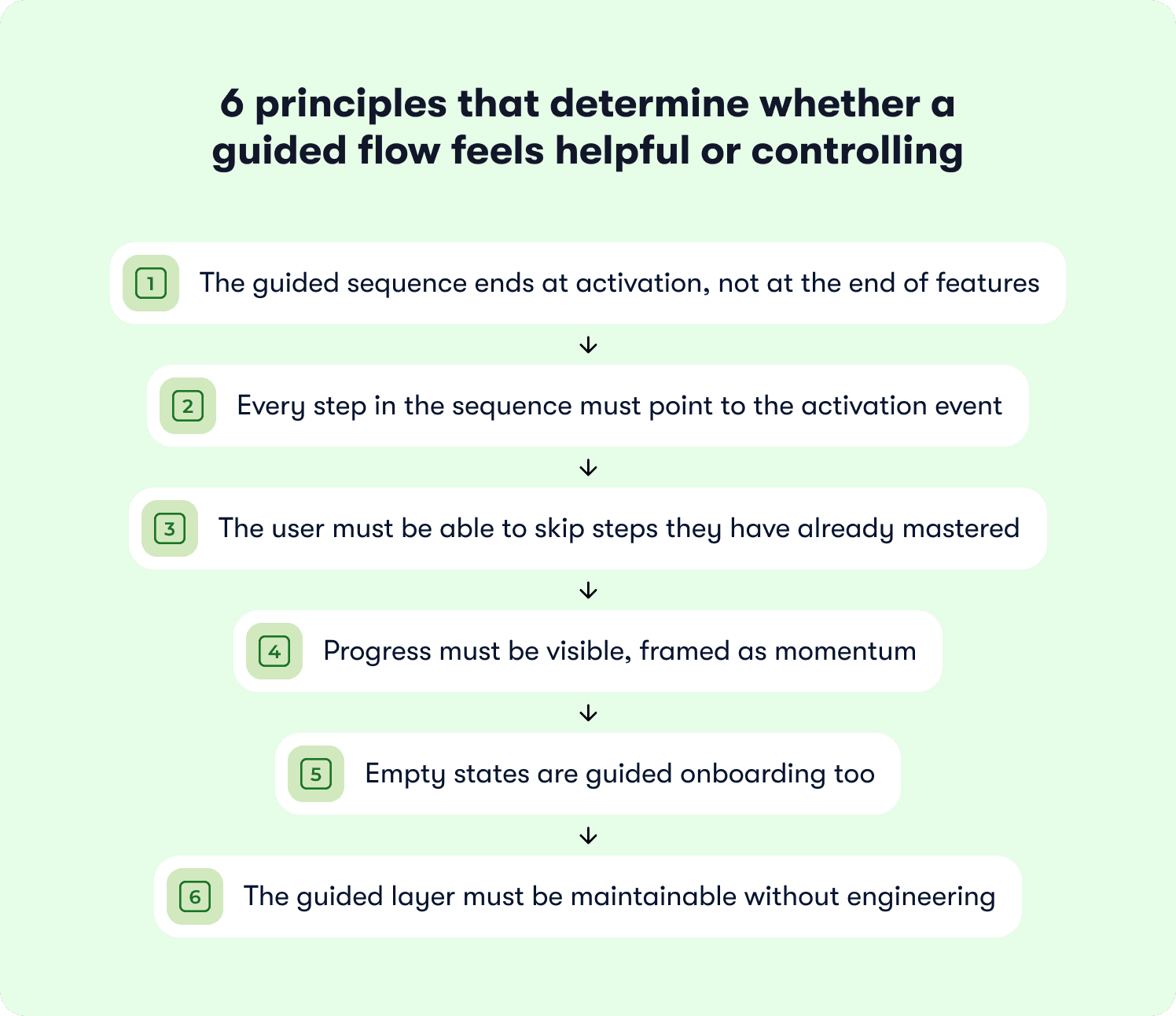
Six principles determine whether a guided flow feels helpful or controlling:
1. The guided sequence ends at activation, not at the end of features
Guided onboarding has a clear stopping point: the user reaches the defined activation event. Anything beyond that is feature adoption guidance, which belongs in a different system. Guided flows that never stop become the product's biggest UX liability, because users feel the experience is built around the product team's priorities rather than their own progress. Defining the activation event clearly enough that the guided flow knows when to end is the foundational decision the whole model depends on, and it is the first practice covered in Jimo's system-level guide to software onboarding.
2. Every step in the sequence must point to the activation event
If a step exists in the guided flow because a feature team wanted users to see their feature, not because the step moves users closer to activation, cut it. Guided onboarding is not a marketing surface for the product team's priorities. Each step should pass one test: does completing this step demonstrably increase the probability that the user reaches the activation event? If not, it does not belong in the flow.
3. The user must be able to skip steps they have already mastered
Power users, returning users, and users who already know the pattern should not be forced through a sequence designed for first-time users. Skipping is not a sign that guided onboarding failed. It is a sign that the user is more advanced than the average. The flow should respect that and reduce friction for those users rather than treating every signup as a blank slate.
4. Progress must be visible, framed as momentum
Users tolerate a longer guided sequence when they can see how far they have come. The framing matters more than the mechanism: "3 of 5 complete" reads as momentum worth protecting, while "2 steps remaining" reads as obligation to discharge. The two phrasings produce measurably different completion rates. Checklists are where most teams implement this framing, which is why a poorly designed checklist hurts conversion in ways a poorly designed tooltip does not. The checklist sets the user's expectation for the entire experience.
5. Empty states are guided onboarding too
A dashboard a user sees for the first time after activation is still onboarding. The guided flow may have ended, but the user is still new to that surface. Empty states designed as silent placeholders waste one of the highest-impact moments in the product, because they appear at exactly the moment a user is preparing to attempt something real and needs orientation.
6. The guided layer must be maintainable without engineering
If updating a tooltip requires a sprint cycle, the guided layer will always be one product release behind reality. By the time the change ships, the product has moved on. The teams that ship guided onboarding successfully treat the guided layer the way growth teams treat landing pages: continuous iteration, owned by the product or PMM team, deployed without a JIRA ticket. This iteration discipline is what separates a guided model that compounds in conversion improvement from one that decays, a distinction explored in Jimo's guide to building personalized onboarding flows.
How to Measure Whether Your Guided Onboarding Is Actually Working
The trap most teams fall into is measuring guided onboarding by completion rate. A guided flow can be "completed" by every user and still produce flat conversion if the steps were not tied to activation. Completion is a process metric. It is not an outcome metric.
What actually tells you the guided model is working:
Metric | What it tells you | Red flag |
Activation rate by onboarding cohort | Whether the guided flow is producing more activations than a no-flow or self-guided control. | Activation rate is similar with or without the guided flow. The flow is decorative. |
Time to activation event | Whether the guided sequence is compressing the path to value, as intended. | TTA increases when the guided flow is deployed. The flow is adding friction, not removing it. |
Skip rate by step | Which steps users are bypassing, and whether the skip correlates with activation. | High skip rate plus high activation means the steps are unnecessary. High skip rate plus low activation means the flow's logic is broken. |
30-day retention by activation cohort | Whether users who went through the guided flow retain better than users who did not. | No retention difference means the flow improved activation speed but not the quality of the activated user. |
The cohort comparison principle: run guided vs no-guided (or guided vs self-guided) variants on the same user base, controlled for entry path, and measure both activation rate and 30-day retention. If guided wins on both, the model is justified. If guided wins on activation but loses on retention, the flow is forcing users through an experience they are not ready for.
Running this kind of cohort comparison requires behavioral event tracking to be in place at the user level rather than only at the flow-completion level. Jimo's behavior metrics layer is what makes that comparison possible without setting up custom analytics infrastructure for every variant test.
📖 Not sure where your onboarding is leaking conversion? Jimo's 19 Tactics to Improve User Activation includes a self-assessment diagnostic that maps your drop-off pattern to the interventions with the highest impact. Get the free playbook
Choosing the Right Tool for Guided Onboarding
The evaluation question is not which platform has the most features. It is which platform supports the model you actually need (guided, self-guided, or hybrid) and lets your team iterate the design without engineering becoming the bottleneck.
The criteria that determine fit:
Criterion | The product team question |
Model flexibility | Does the tool support both guided and self-guided patterns, or does it lock you into one model? |
No-code authoring | Can you update guided sequences without engineering involvement? If not, the guided layer will fall behind the product. |
Adaptive logic | Can the tool detect when a user should be in guided mode versus self-guided mode, or does it apply the same model to every user regardless? |
Empty state coverage | Can you design empty states as onboarding surfaces with the same tool that builds the rest of the guided layer? |
Measurement | Does the tool measure activation outcomes by onboarding variant, or only flow completion? |
Cross-segment scaling | Can the tool serve different guided sequences to different user segments from a single implementation? |
Jimo is a digital adoption platform built for web-based B2B SaaS teams who need to operate guided onboarding as a design system rather than a one-time configuration. It supports the patterns the hybrid model requires: guided product tours and in-product checklists for the guided stages, contextual hints for the lighter-touch guidance in between, and an AI copilot that determines which pattern fits each user's behavioral state. Pricing is fixed within each MAU tier, with no per-user overage charges and no unexpected costs when signups spike within your band.
Teams at AB Tasty, Zenchef, and Lemlist have built guided onboarding on Jimo that adapts to user behavior rather than forcing every user through the same flow. The full tools suite and integration list cover the implementation surface.
If you are earlier in the evaluation and want a broader category view, Jimo's personalized onboarding software analysis compares platforms by the criteria above. Teams evaluating walkthrough tools specifically as the entry point into guided onboarding will find a more focused comparison in Jimo's walkthrough software guide.
See how Jimo adapts between guided and self-guided modes based on user behavior. Book a demo
FAQs
Is guided onboarding the same as a product tour?
Not quite. A product tour is a tool that can be used in either a guided or self-guided model. Guided onboarding is the broader pattern: the product actively directs the sequence toward an activation moment using whatever tools support that direction (checklists, tooltips, walkthroughs, tours, empty states). A product tour the user can skip and explore freely is closer to self-guided. A product tour that locks the user into the next step until they complete the current one is guided. The label matters less than the design intent behind it.
How do I know if my product is a candidate for guided onboarding?
Four diagnostic questions:
Can a brand-new user complete the activation event without instruction, by exploring on their own? If yes, lean self-guided. If no, lean guided.
Does the activation event require multiple coordinated actions in a specific order? If yes, lean guided.
Is your user base technical and self-directed (developers, analysts, power users)? If yes, lean self-guided with strong reference material.
Is your product activating users in under 60 seconds for most cohorts? If yes, you probably do not need much guided content at all. Focus on the empty state and the activation step.
Can guided onboarding work for technical users like developers?
Yes, but the design rules change. Developers tolerate guided onboarding when it respects their time. The flow needs to be skippable, focused on the activation event only, with reference documentation immediately accessible. Developers reject guided onboarding when it forces them through a fixed sequence designed for non-technical users. The same principle applies to other autonomous user types. Give them the path and let them deviate.
How long should guided onboarding take?
As short as it can be while still producing the activation event reliably. Industry benchmarks suggest the best PLG products activate users in under 60 seconds. Most B2B SaaS products with meaningful complexity activate in two to five minutes through a well-designed guided flow. If your guided onboarding takes longer than 10 minutes, the question is whether you are guiding too much or whether the activation event is too far from the signup moment.
What is the difference between guided onboarding and customer onboarding?
Guided onboarding refers to the in-product experience that walks individual users through their first interactions with the product. Customer onboarding typically refers to a broader process that includes contracts, kickoff calls, and implementation work, usually managed by a customer success team. For product-led SaaS, guided onboarding is the primary lever. Customer onboarding becomes relevant primarily for enterprise deals where there is a human in the loop alongside the product experience.
Should I replace my existing self-guided onboarding with a guided model?
Probably not all at once. The right starting point is to audit which stages of your current onboarding are producing the most drop-off:
If drop-off is concentrated in the signup-to-first-value stage, add guided patterns there while leaving the rest of the experience self-guided.
If drop-off is happening after activation (low feature adoption, no expansion behavior), the answer is contextual guidance for activated users, not a guided onboarding flow at the start.
If drop-off is uniform across stages, the issue is probably the activation event definition itself, not the model.
Match the model to the moment. Pure replacement is rarely the right move.