TL;DR
Most customer product surveys ask the same question regardless of where a customer actually sits in their relationship with your product, so a brand-new customer and a three-year renewal get the identical questionnaire and neither answer is particularly useful. This article maps survey design to customer lifecycle stage instead of a fixed calendar, covers how to gather customer feedback without a formal survey instrument at all, and shows what changes when responses route into customer success (CS) action instead of a quarterly report. Jimo triggers surveys by lifecycle stage and routes the responses straight into CS workflows.
Your surveys go out on schedule. Response rates are mediocre, and the answers that do come back are too generic to act on: "satisfied," a 7 out of 10, nothing your team can actually do something with. This article covers why that happens, a lifecycle-stage framework for fixing it, and what to do when a formal survey isn't the right instrument for the feedback you need at all.
Why Most Customer Product Surveys Produce Weak Signal
Most customer satisfaction surveys ask the same question on the same schedule, regardless of where the customer actually is in their relationship with your product. A customer two weeks past onboarding and a customer eighteen months into a renewal cycle get the identical questionnaire, the same general customer satisfaction survey questions, the same net promoter score (NPS) check, sent on the same quarterly cadence.
Neither answer tells you much. The new customer doesn't have enough context yet to give detailed feedback beyond "still figuring it out." The long-tenured customer has opinions about a dozen different things, some resolved, some not, and a single overall satisfaction score collapses all of it into a number that doesn't point your support team or your product managers toward anything specific.
This is the actual mechanism behind weak signal: a survey asking the wrong question at the wrong lifecycle stage produces an answer that's technically honest feedback but practically useless. It's not that customers are being vague on purpose. It's that the question itself was too broad for where they are, so the most specific answer available to them is a number and maybe a sentence.
A few patterns show up consistently once you start looking at survey performance this way:
Response rates drop when the ask doesn't match the moment. A customer being surveyed about "overall satisfaction" three weeks after signing up hasn't formed a real opinion yet, and low-effort surveys sent at the wrong time train customers to skip the next one too.
Follow-up answers get shorter and less specific over time, not because customers stop caring, but because a survey with no obvious connection to their actual current experience starts to feel like noise.
The most valuable feedback tends to come from customers who weren't asked a general question at all, they were asked something tied to a decision they were actually in the middle of making.
The fix isn't a better survey template. It's matching the question to the stage the customer is actually in.
How to Map Your Survey Program to the Customer Lifecycle
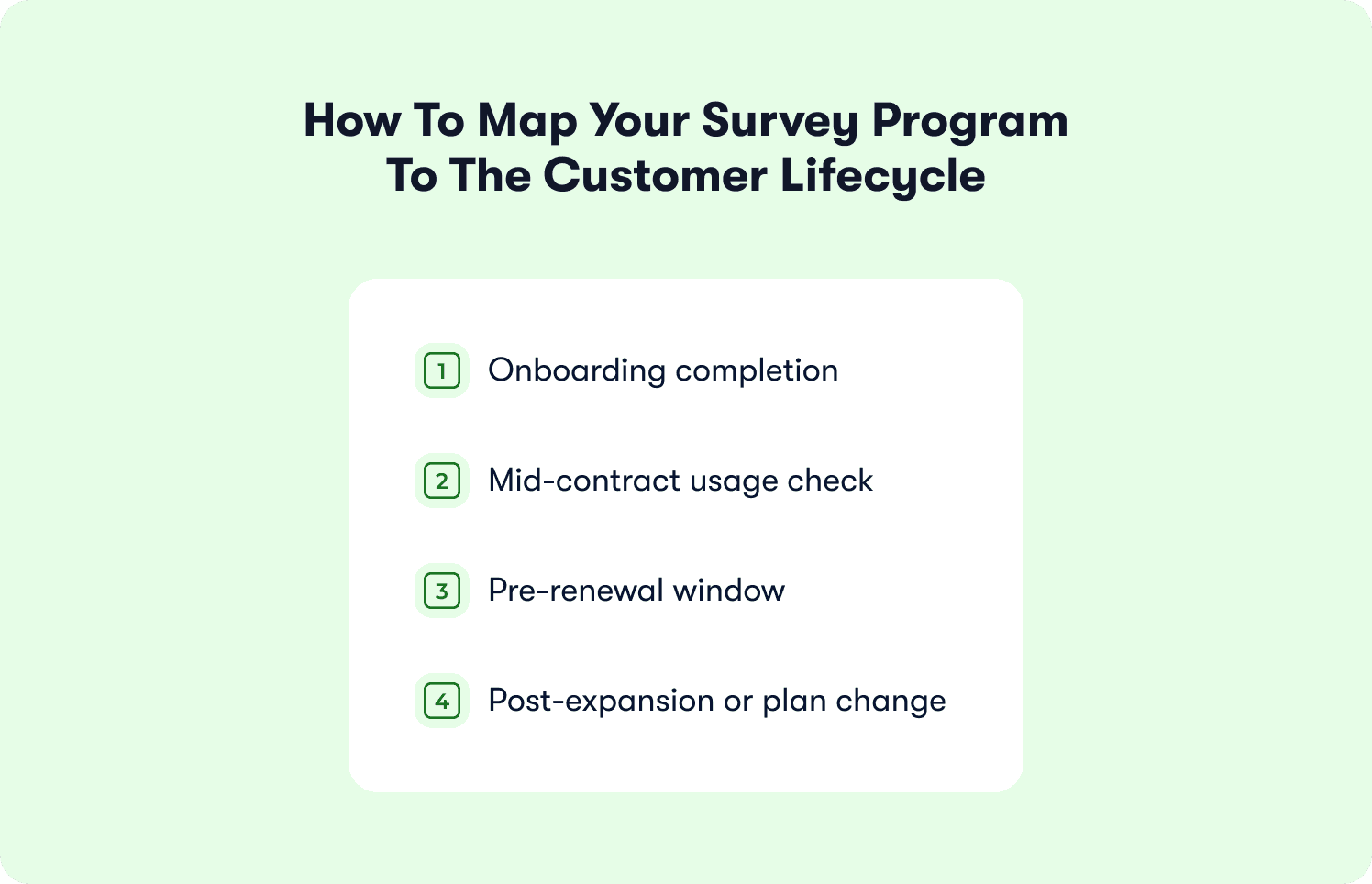
Instead of a fixed survey calendar, anchor your program to four customer lifecycle stages: onboarding completion, mid-contract usage check, the pre-renewal window, and post-expansion or plan change. Each stage calls for a genuinely different question, feeding a genuinely different CS action.
Lifecycle stage | What to ask | What it feeds |
Onboarding completion | Did setup match expectations; where did friction show up | Onboarding process fixes, early health score |
Mid-contract usage check | Is the product delivering the value the customer expected | Health score updates, proactive outreach triggers |
Pre-renewal window | Value realization and risk signals, not general satisfaction | Renewal conversation prep, churn risk flags |
Post-expansion or plan change | Whether the new use case is actually landing | Expansion success validation, upsell signal |
Onboarding completion
Right after onboarding, a customer has enough experience to describe what setup felt like, but not enough to speak meaningfully about long-term value. The right question at this stage is narrow: did the onboarding process match what they expected, and where specifically did friction show up. Hold off on anything asking about overall product quality or long-term satisfaction. It's too early for that answer to mean anything, and asking it anyway just produces a vague "too soon to say" response that doesn't help anyone.
Mid-contract usage check
Somewhere in the middle of the contract, the useful question shifts from "how did setup go" to "is this delivering what you expected." This is where you can meaningfully ask about specific aspects of the product, whether key features are getting used, whether the use case they signed up for is actually the one playing out day to day. A generic satisfaction survey at this stage misses the point entirely; what you actually want is a read on value realization, which is a different question with a different structure.
Pre-renewal window
A survey sent before renewal should be built around renewal risk, not general satisfaction. This is the moment to ask direct questions about whether the customer sees themselves renewing, what would change their answer, and where the product has fallen short of their expectations over the contract period. A generic "how satisfied are you" question here wastes the one moment in the relationship where a customer is most likely to give you a genuinely honest, unfiltered answer about risk.
Post-expansion or plan change
After a customer expands or changes plans, the right question checks whether the new use case is actually landing, not whether they're satisfied overall. A customer who just moved to a higher tier or added seats has a specific new job the product needs to do for them. Asking a broad satisfaction question here misses the chance to catch early friction in the exact area where an expansion is most likely to quietly underperform.
How to Get Customer Feedback for a B2B Product Without a Survey
Not every useful signal comes from a survey instrument, and teams that survey too often usually already have better feedback sitting somewhere else in their existing stack. Three sources consistently provide direct feedback without adding another questionnaire to a customer's inbox:
Signal source | What it reveals | Where to look |
Usage data | Feature adoption patterns, drop-off points, which key features go unused | Behavior metrics, product analytics |
Support ticket themes | Recurring friction points customers describe in their own words | Customer support channels, ticket tagging |
QBR and renewal-call notes | Context and nuance a survey response could never capture | CS team notes from quarterly business reviews (QBRs) |
Usage data
Feature adoption patterns and drop-off points tell you where customers are struggling without asking them to self-report it. A customer who never touches a key feature is telling you something a satisfaction survey never would; the gap between what they signed up for and what they actually use is itself a form of feedback, and it's more reliable than a self-reported number because it reflects actual customer behavior rather than what someone remembers to mention.
Support ticket themes
Your support team is sitting on a constant stream of unprompted, specific feedback. Customers describe friction in their own words when something goes wrong, often more precisely than they would on a structured questionnaire. Reviewing recurring themes across support tickets, the same confusion showing up from multiple accounts, is a legitimate research method, not a workaround, and it surfaces actionable data that a quarterly survey would only catch months later.
QBR and renewal-call notes
Conversations your CS team already has, quarterly business reviews, renewal calls, expansion discussions, contain nuance no survey question could capture. A customer explaining why a feature didn't work for their specific workflow gives you far more than a Likert scale questions response ever could. The insight is already being generated in these calls; the fix is capturing and routing it somewhere useful instead of letting it live in one CSM's notes.
None of these replace a survey entirely, they answer different questions than a structured instrument does, but for a CS team that's over-surveying and getting diminishing returns, these three sources are usually sitting right there in the existing stack, generating meaningful feedback that never gets systematically reviewed.
How to Write Questions That Fit the Lifecycle Stage They're Asked At
The core discipline here is matching question specificity to the stage the customer is in. A pre-renewal survey should ask about value realization and renewal risk. A mid-contract check should ask about specific aspects of usage. Neither should default to a general "how satisfied are you overall" question, because that question is specific to no stage at all, which is exactly why it produces such thin answers.
This isn't a full question-writing guide, matching a question to a stage is a design principle, not a template. For the actual question bank, including product survey questions examples, customer loyalty questions, and a sample customer product survey questionnaire built stage by stage, see our guide on product satisfaction survey questions.
Format questions correctly for the answer you actually need. Multiple choice questions and Likert scale questions (strongly agree to strongly disagree) work well for tracking a metric over time, like a customer effort score. Open-ended questions asking a customer to answer in their own words work better when you're trying to catch something a scale can't, the specific reason behind a low score, or a detail about how customers perceive a particular workflow. Using a scale question where you need an open-ended answer, or vice versa, is a common reason surveys collect data that looks complete but doesn't actually inform anything.
For the deeper mechanics of format selection and timing, in-app versus email, when to trigger a net promoter score versus a customer satisfaction survey versus a customer effort score, see our guide on in-app survey best practices. And if net promoter score is the specific format you're building around, our guide on the best NPS questions to ask covers that format in more depth than this piece does.
What Changes When Surveys Match Lifecycle Stage
Zenchef reported cutting onboarding time in half using in-app guidance, a result of catching and resolving friction closer to the moment it actually occurs, rather than waiting for it to surface later. The same principle applies to feedback: a survey that reaches a customer at the right lifecycle moment catches an issue while it's still fixable, instead of surfacing it in a quarterly report after the moment to act on it has passed.
That's the real shift a lifecycle-matched survey program produces. It's not just better response rates, though those tend to improve too, once customers start seeing questions that actually reflect where they are. It's that the feedback loop closes faster: a customer struggling mid-onboarding gets caught during onboarding, not three months later in a satisfaction survey that arrives too late to fix anything for that customer specifically.
Routing responses into CS action, rather than a report that gets reviewed once a quarter, is what makes the timing shift actually matter. A pre-renewal survey flagging risk is only useful if it reaches a CSM before the renewal conversation, not after. A mid-contract check showing low feature adoption is only useful if it triggers proactive outreach, not if it sits in a dashboard until someone happens to look. This is intelligence-led growth applied to feedback specifically: surveys that respond to where a customer actually is, generating a signal that reaches the person who can act on it while it's still useful.
Ask the Right Question for Where the Customer Actually Is
A survey asking the wrong question at the wrong stage isn't collecting weak feedback because customers don't have opinions. It's collecting weak feedback because the question didn't match the moment they were in.
For a Head of Customer Success managing a survey program that's producing more noise than signal, the fix isn't a better question bank or a higher-effort incentive to boost response rates. It's rebuilding the trigger logic around customer lifecycle stage instead of a calendar, so every survey a customer receives actually reflects where they are.
Your product doesn't just sell itself, it activates itself, and the same logic applies to how you listen to customers: surveys that show up at the right moment collect valuable insights. Surveys that show up on a fixed schedule collect noise.
See how Jimo triggers surveys by lifecycle stage and routes every response straight into CS action. Book a demo to see it working against your own customer base.
FAQs
How often should a B2B SaaS company survey its customers?
There's no universal cadence that works across every account. Frequency should follow lifecycle stage rather than a fixed calendar: a customer moving through onboarding, a mid-contract usage check, a pre-renewal window, and a post-expansion moment each warrant a survey tied to that specific point in the relationship, rather than a quarterly blast sent to every customer regardless of where they are.
What makes a customer product survey questionnaire effective at different lifecycle stages?
Effectiveness comes from matching question specificity to what the customer can actually speak to at that stage. A brand-new customer can describe onboarding friction but not long-term value. A pre-renewal customer can speak directly to renewal risk. A questionnaire that asks the same general satisfaction question at every stage produces shallow answers because it's not specific to what that customer actually knows yet.
Can you get useful product feedback from a B2B customer without sending a survey?
Yes. Usage data reveals feature adoption patterns and drop-off points without requiring a customer to self-report anything. Support ticket themes surface recurring friction in customers' own words. Notes from QBR and renewal calls capture nuance a structured survey question never could. All three are legitimate, often underused feedback channels sitting in most CS teams' existing stack.
What should a customer survey for a new product look like versus one for an existing customer?
A survey for a new product or a newly onboarded customer should stay narrow: what matched expectations, where friction showed up, nothing requiring long-term context they don't have yet. A survey for an existing customer further into the relationship can ask more specific questions about value realization, feature usage, and renewal risk, since they have the experience to answer with real specificity.
How do you improve low response rates on customer product surveys?
Low response rates usually trace back to timing and relevance rather than survey length or incentive. Customers respond less when a survey doesn't obviously connect to their current experience with the product. Triggering surveys by lifecycle stage, so the question a customer receives actually reflects the moment they're in, tends to improve response rates more reliably than shortening the survey or adding an incentive to a poorly timed question.