TL;DR
This article gives you 40+ product satisfaction survey questions organized by what you’re trying to learn, a ready-to-send product satisfaction survey template, and a framework for turning survey responses into real in-product changes. You’ll find questions across seven categories plus a full sample questionnaire you can deploy today.
Knowing your customer satisfaction (CSAT) score doesn’t tell you what to fix. The score tells you where you stand, but the questions behind it rarely point to a specific feature, workflow, or moment you can act on.
Here we’ve come up with 40+ product satisfaction survey questions, a copy-paste-ready survey template, and a way to close the loop so every answer triggers something inside your product.
What a product satisfaction survey actually measures (and how it’s different)
A product satisfaction survey goes broader and deeper than a single-metric score. A CSAT survey captures how someone felt about one specific interaction. A net promoter score (NPS) survey captures customer loyalty and the likelihood of future recommendation.
But a product satisfaction survey asks how someone feels about the product as a whole, across features, usability, support, value, and onboarding. The mechanics of when and where you deliver it follow their own in-app survey best practices.
A user can love your core feature but hate your support experience, and a single score won't tell you which is pulling the average up or down. Customer sentiment shifts across the customer journey, shaped by dozens of customer interactions with your interface, your features, and your team.
The way customers perceive your product is more nuanced than any single metric can capture. But that breadth has a boundary. Customer satisfaction surveys work best when they stay scoped to satisfaction, not when they try to measure loyalty and effort in the same questionnaire. Customer surveys that mix NPS, CSAT, and Customer Effort Score (CES) end up measuring none of them well. The question bank below covers many dimensions of satisfaction, so you can pair it with a dedicated NPS or CES effort without overlap.
What makes a product satisfaction survey question actually work
A good satisfaction survey question earns its place by being specific enough to act on, clean enough to trust, and scoped enough to answer. Four principles make that happen.
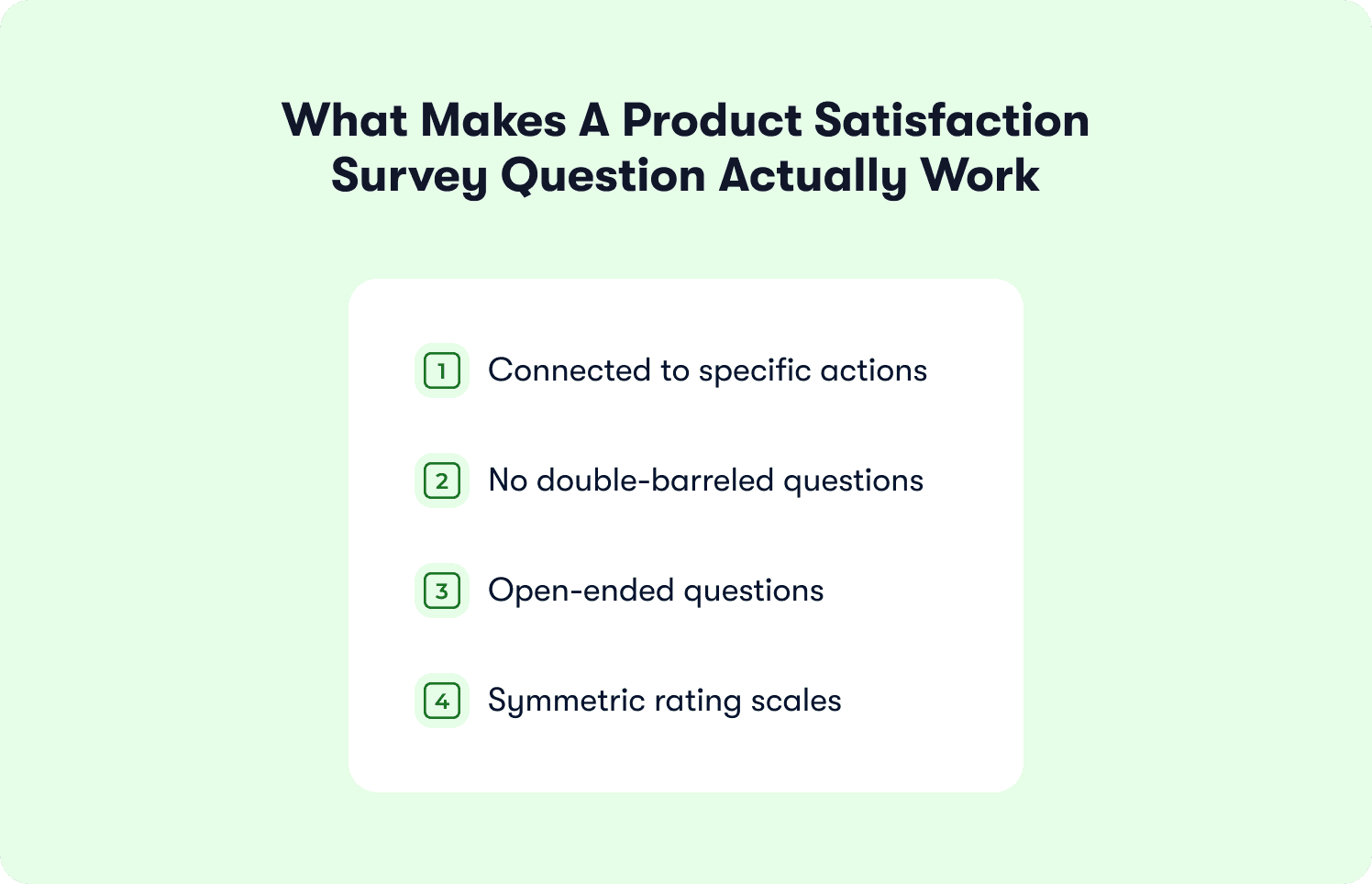
Connect to a specific action
“How satisfied are you with the dashboard?” tells you something if you’re willing to redesign the dashboard based on what comes back. “How satisfied are you with [product]?” tells you less, because the answer doesn’t point to any single thing you can fix. If you can’t articulate what you’d change after reading the response, the question isn’t worth asking.
Avoid double-barreled questions
“How satisfied are you with the speed and design of [feature]?” forces respondents to blend two separate judgments into one answer, and you can’t tell which one drove the score. Split it into two questions instead. When customers respond to a double-barreled question, their answer is a compromise, not a signal.
Keep open-ended questions scoped to a specific part of the product
“What could we improve?” is too broad for most respondents to answer usefully, and the qualitative data you get back tends to be vague. “What is one specific thing about [feature name] you’d change if you could?” gives people a concrete starting point, and the answers you get will be specific enough to act on. When respondents answer in their own words, scoped questions produce meaningful feedback instead of generic complaints.
Use symmetric rating scales
A scale that runs from “somewhat dissatisfied” to “extremely satisfied” pushes respondents toward positive answers by removing the negative end. Likert scale questions with balanced positive and negative options give you accurate feedback because they let the answer go wherever it actually goes. The same principle applies to multiple choice design and multiple choice questions, Make sure every option is distinct and covers the full range of possible responses.
40+ product satisfaction survey questions, organized by what you’re trying to learn
The product satisfaction survey questions below don’t focus on question type, but rather by what you’re trying to learn. Each category has a short intro and a bank of copy-paste-ready questions.
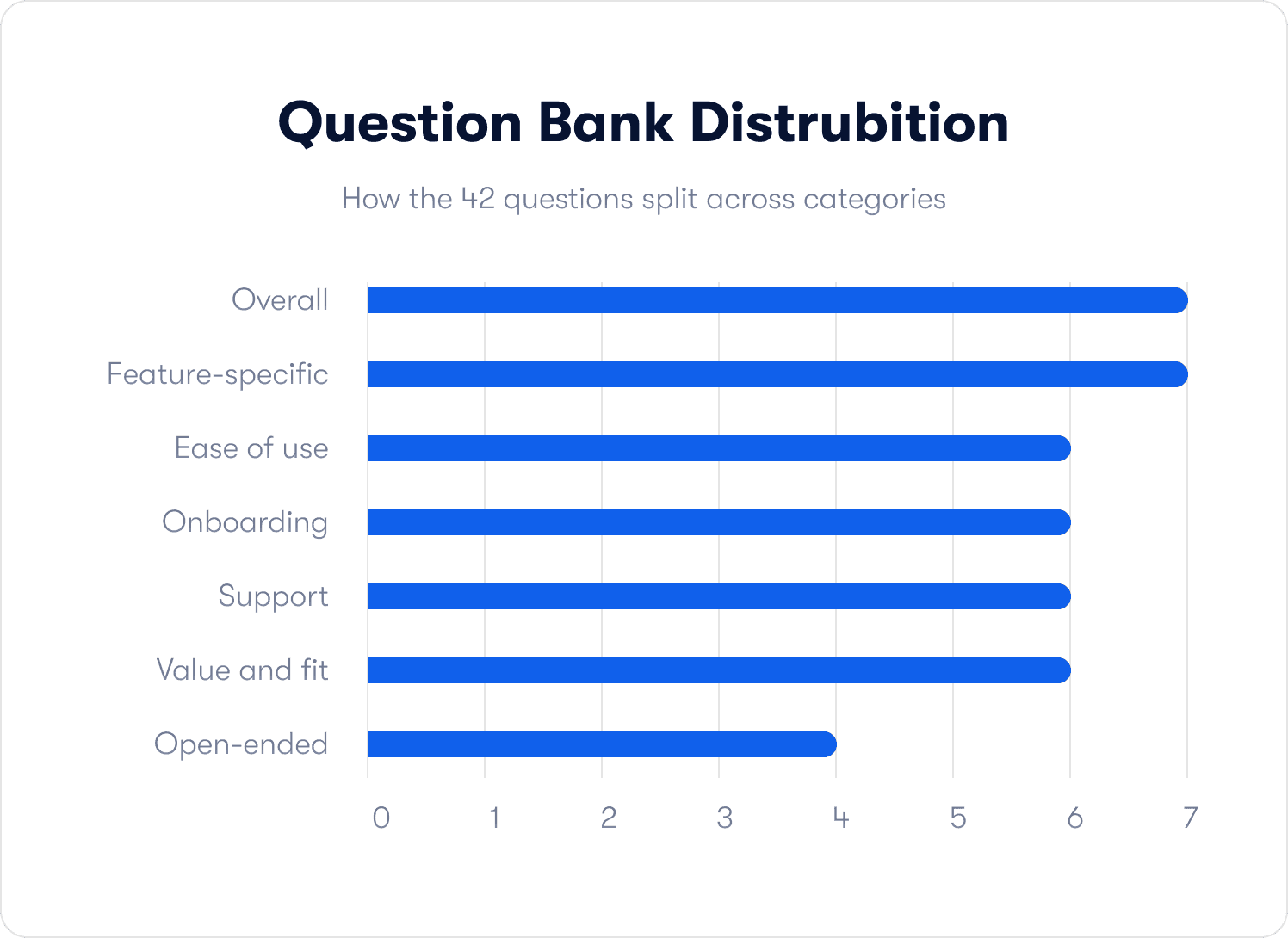
These product customer satisfaction survey questions work across customer segments, so you can target them at power users, new users, or any group in between. Pull the ones that match your situation, or use the full customer satisfaction survey questions sample questionnaire in the next section.
Overall product satisfaction
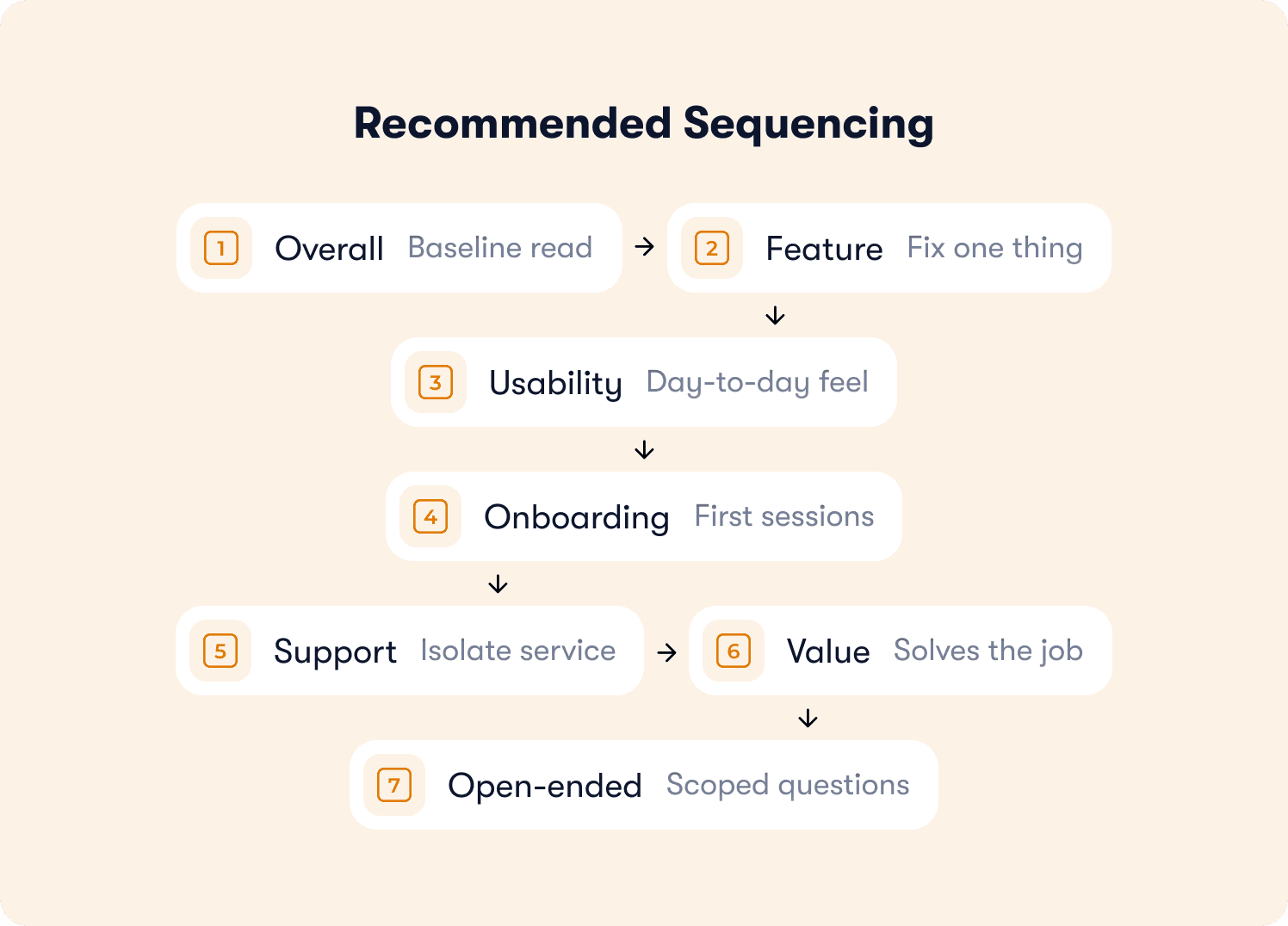
These questions give you a baseline read on how existing customers feel about the product as a whole. Use them as the opening of your satisfaction survey, then drill down with the category-specific questions below. They’re the broadest survey questions in the bank, and they set up the more specific ones that follow.
How satisfied are you with [product] overall?
How would you rate your experience with [product] over the past 30 days?
How well does [product] meet your customer expectations?
How has your satisfaction with [product] changed since you started using it?
How does [product] compare to what you expected when you signed up?
How would you rate the overall satisfaction you get from using [product]?
How consistently does [product] deliver the experience you expect?
Feature-specific satisfaction
These questions map feedback to a single feature or workflow, so you can pinpoint what’s working and what isn’t. Replace [feature name] with the specific feature you’re evaluating. This is where you gain insights into whether individual features are delivering value or creating friction.
How satisfied are you with the [feature name] feature?
How well does [feature name] perform the task you need it for?
How often do you encounter issues when using [feature name]?
How would you rate the reliability of [feature name]?
Does [feature name] do everything you need it to, or is something missing?
How satisfied are you with the performance of [feature name]?
How well does [feature name] integrate with the rest of [product]?
Ease of use and usability
These questions measure ongoing usability, not the effort of a single task. For task-specific effort, use a dedicated CES question instead. These questions help you understand customer preferences around how the product feels to use day after day, not how much effort a single task takes. The goal is to learn what customer preferences are so you can shape the product around them.
How easy is it to navigate [product]’s interface?
How intuitive do you find the layout of [product]?
How quickly can you complete your main task in [product]?
How often do you need to look up help documentation while using [product]?
How easy is it to find the feature you need within [product]?
How would you rate the learning curve for new users of [product]?
Onboarding and setup satisfaction
These questions measure how existing customers experienced the onboarding process. For a broader framework on creating customer satisfaction surveys that cover the full onboarding journey, pair these with our SaaS onboarding checklist or app onboarding best practices.
How satisfied were you with the setup process for [product]?
How clearly were the first steps explained when you started using [product]?
How long did it take to feel confident using [product] on your own?
Did the onboarding process cover everything you needed to get started?
How satisfied are you with the guidance available during your first few sessions?
What part of getting started with [product] felt most difficult?
Customer support satisfaction
These isolate the support experience from the product experience. A good satisfaction survey measures both separately, so you can tell whether a low score reflects the product or the service delivery around it. These questions help your customer service team resolve issues faster by showing where support is helping and where it’s falling short.
They also work well as standalone customer service surveys when you need to evaluate a recent customer service experience on its own. Your customer service team can use these responses to spot patterns in support tickets and improve response quality.
How satisfied are you with the support you’ve received from our customer support team?
How quickly was your most recent support issue resolved?
How well did our support team understand your problem?
How easy was it to reach a customer service representative when you needed help?
Did the support you received fully resolve your issue?
How would you rate the customer support channels available to you?
Value and fit
These questions measure whether the product meets the need it was bought for. They focus on outcomes and service quality rather than pricing or features. The goal is to understand whether the product is retaining customers by delivering real value, whether service meets expectations, and whether there’s a disconnect between what was promised and what users experience. Enhancing satisfaction starts with knowing where that disconnect lies.
How well does [product] solve the problem you bought it for?
How often does [product] save you time compared to your previous approach?
How well does [product] fit into your existing workflow?
What is the main value you get from [product] in your daily workflow?
Does [product] do anything you didn’t expect it to when you first signed up?
How well does [product] adapt to your needs as they change?
Open-ended and improvement-focused
Each question below is scoped to a specific part of the product rather than a generic “what could we improve?” prompt. Scoping produces qualitative feedback you can actually act on, and it gives customers a chance to share detailed feedback in their own words.
What is one specific thing about [feature name] you’d change if you could? (Scoped to a feature so answers point to something you can fix.)
What part of [product] confused you most when you first started using it? (Scoped to the onboarding experience so you can improve first-run guidance.)
If [product] could do one thing it doesn’t do today, what would you want it to be? (Scoped to a missing capability so you can prioritize the roadmap.)
What’s the one task you still prefer doing outside of [product], and why? (Scoped to a workflow gap so you can understand where the product falls short.)
Product satisfaction survey template and questionnaire you can use today
This section gives you a complete product satisfaction survey template formatted as a ready-to-send questionnaire. It pulls 10 questions from the bank above, sequenced logically. It starts with overall satisfaction first, then feature-specific and usability questions, then support and value, then open-ended questions last. You can use this design as an email survey, a standalone link, or an in-product survey.
Product satisfaction survey sample questionnaire
This product satisfaction survey sample is meant to be short enough to finish in under three minutes. You can trim it to 5 or 6 questions for in-product delivery, or extend it with category-specific questions for a deeper standalone survey. The customer satisfaction survey templates above give you the building blocks.
Q1. How satisfied are you with [product] overall?
(Scale: Extremely dissatisfied / Dissatisfied / Neutral / Satisfied / Extremely satisfied)
Q2. How has your satisfaction with [product] changed since you started using it?
(Scale: Much worse / Somewhat worse / About the same / Somewhat better / Much better)
Q3. How satisfied are you with the [feature name] feature?
(Scale: Extremely dissatisfied / Dissatisfied / Neutral / Satisfied / Extremely satisfied)
Q4. How easy is it to navigate [product]’s interface?
(Scale: Extremely difficult / Difficult / Neutral / Easy / Extremely easy)
Q5. How satisfied were you with the setup process for [product]?
(Scale: Extremely dissatisfied / Dissatisfied / Neutral / Satisfied / Extremely satisfied)
Q6. How satisfied are you with the support you’ve received from our team?
(Scale: Extremely dissatisfied / Dissatisfied / Neutral / Satisfied / Extremely satisfied / Not applicable)
Q7. How well does [product] solve the problem you bought it for?
(Scale: Extremely poorly / Poorly / Neutral / Well / Extremely well)
Q8. What is one specific thing about [feature name] you’d change if you could?
(Open-ended)
Q9. What part of [product] confused you most when you first started using it?
(Open-ended)
Q10. If [product] could do one thing it doesn’t do today, what would you want it to be?
(Open-ended)
Adjust the feature names, scale length, and delivery method to fit your context, and you have a working customer service survey template you can ship today. These satisfaction survey templates are designed to be adapted, not used verbatim, so tweak the wording to match your product’s voice. And you can always swap a question with another from the bank above.
Turning product satisfaction answers into real product changes
Collecting answers is the easy part. The feedback collected from a well-designed survey tells you where satisfaction is high and where it’s low, but a score on its own doesn’t change anything.
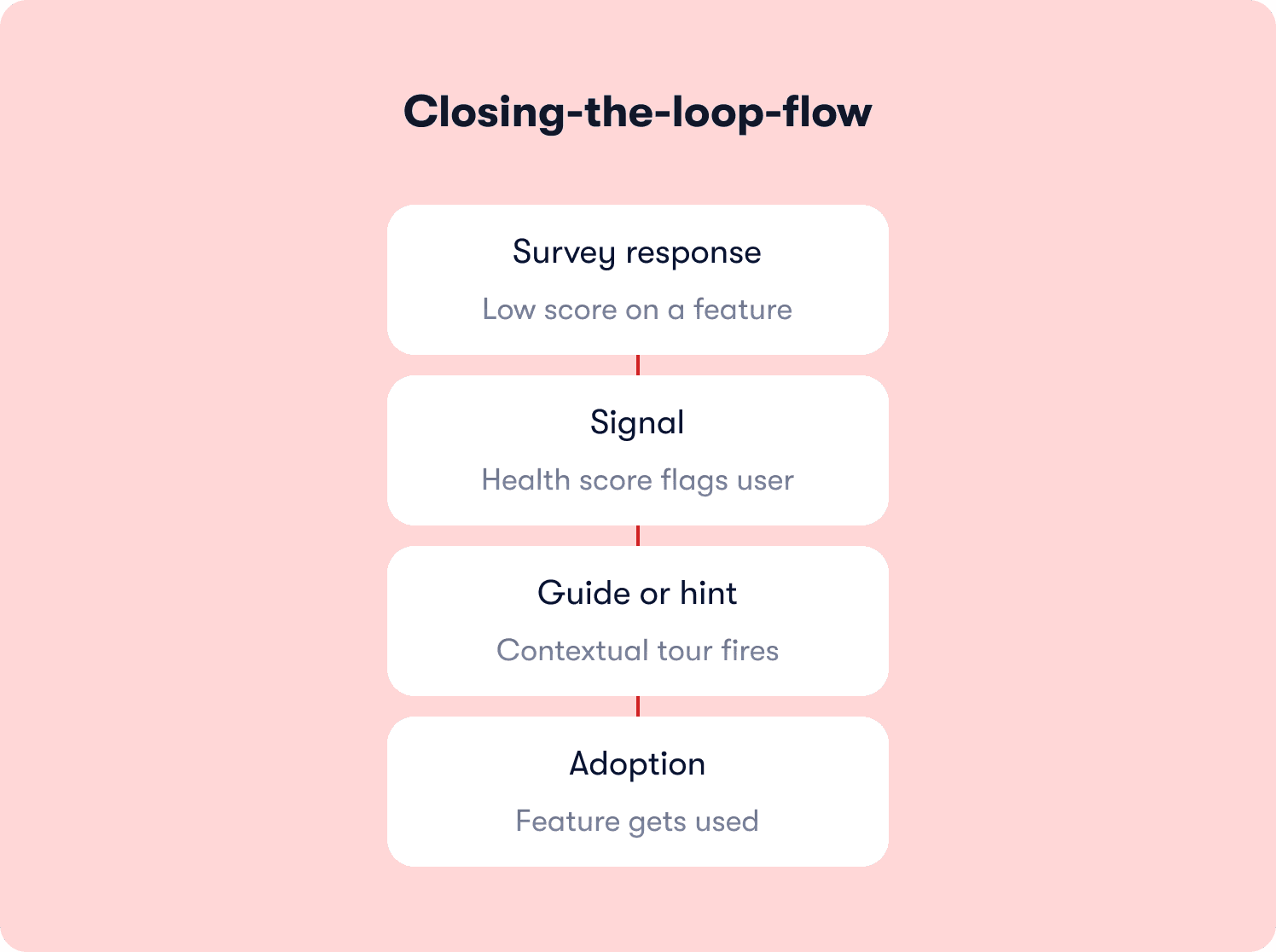
Most customer satisfaction surveys stop there. Teams export the customer satisfaction survey data, build a chart for the next quarterly review, and move on. The customer satisfaction feedback sits in a report and the insights never reach the user who provided them. Unhappy customers stay unhappy because no one followed up. Satisfied customers don’t get nudged toward deeper engagement. The customer satisfaction data measured something, but nothing changed.
The value is in closing the loop inside the product. A low score on a specific feature should trigger a guide or Hint that helps that user get more out of that feature. The survey data becomes a trigger, not a dashboard, and over time those triggers help you identify trends in satisfaction before they show up in churn numbers.
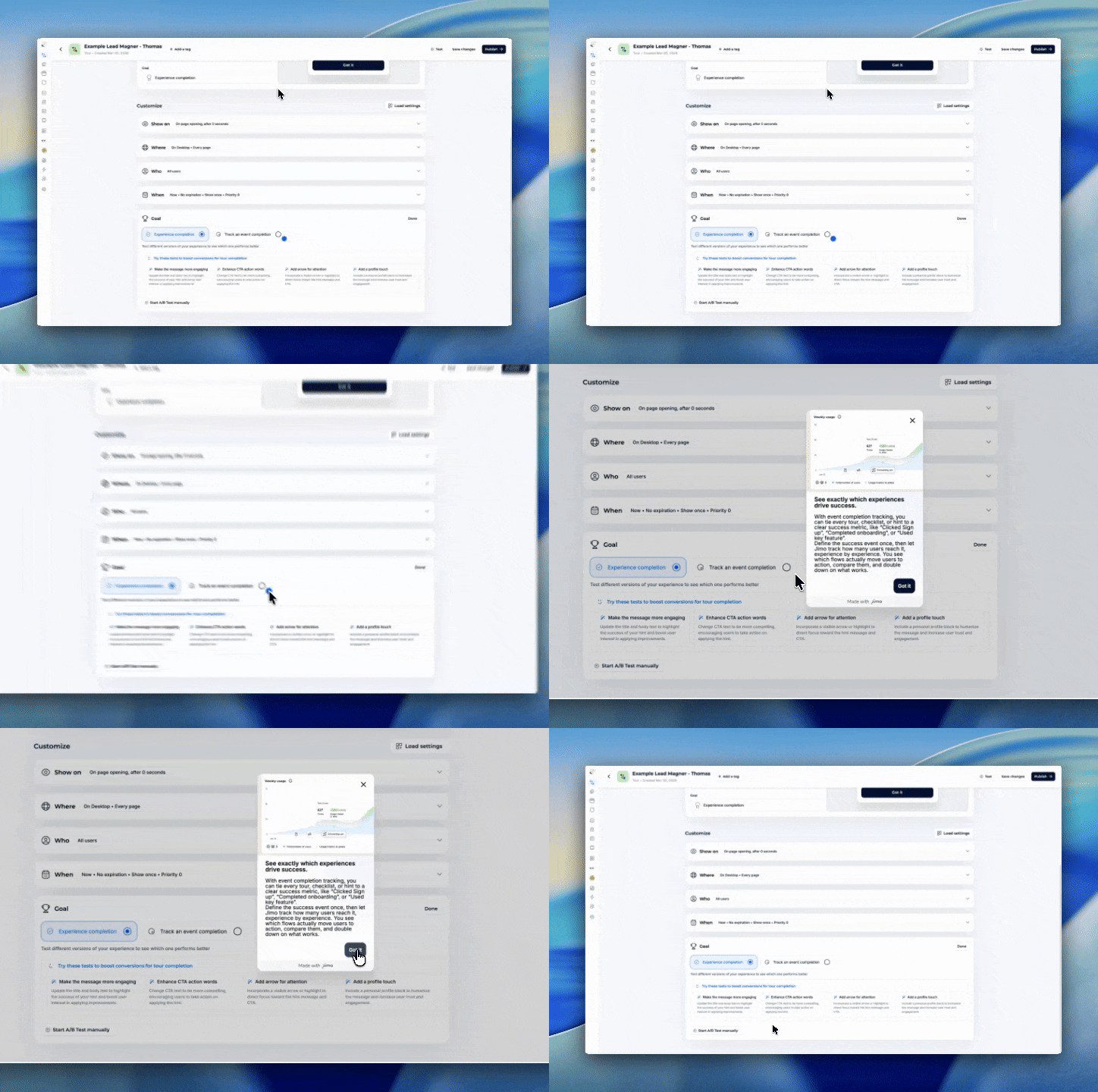
Customer Alliance did exactly this when they implemented Jimo. Their in-product surveys collected 120 responses in two weeks versus 20 from email, a 6x improvement in feedback collection. Separately, they used health score data to trigger contextual tours promoting their AI reply feature, which drove a 970% spike in adoption among customers with low engagement scores. The surveys gave them the feedback. The health score data drove the in-product action.
Jimo Surveys gives you the survey side with conditional logic that customizes the flow based on each response, and the user surveys tool handles the targeting and triggers so you reach the right users at the right moment. When customers feel that their customer feedback led to a visible change, customer relationships strengthen, customer engagement rises, and brand reputation follows. You gather feedback you can act on immediately.
Raising customer awareness of new features through targeted follow-up is part of that loop, and the valuable feedback users give you becomes the input for the next round of guidance. AB Tasty used the same approach to cut user onboarding time from three months to two weeks.
Ask better questions, then act on the answers
A long questionnaire or sophisticated scoring model isn’t going to guarantee you more value. Asking questions scoped enough to act on, then routing every response to a specific in-product follow-up is what will.
If you’re a B2B SaaS product team that wants survey responses to change something in-product, not only populate a report, book a demo to see how Jimo survey answers connect to in-product follow-up. You can build a survey, connect it to guidance, and close the loop in a single workflow.
FAQs
What makes a good product satisfaction survey question?
A good product satisfaction survey question is tied to a specific action you’d take based on the answer. It’s scoped to a single feature or experience, avoids double-barreled phrasing, and uses a symmetric rating scale so respondents can answer honestly in either direction.
How is a product satisfaction survey different from a CSAT survey?
A CSAT survey measures satisfaction with a single interaction or moment, while a product satisfaction survey measures how someone feels about the product as a whole across features, usability, support, and value. CSAT is narrow and moment-specific, while a product satisfaction survey is broad and multi-dimensional.
What should a product satisfaction survey questionnaire include?
A product satisfaction survey questionnaire should include an overall satisfaction question, feature-specific questions, usability questions, onboarding satisfaction, support satisfaction, value and fit questions, and at least one scoped open-ended question. The template above shows a logical sequence that starts broad and narrows to specifics.
How many questions should a product satisfaction survey have?
A product satisfaction survey should have 5–10 questions for most use cases. Fewer questions improve response rates, especially in-product. If you need more depth, use a standalone survey or follow-up email rather than stacking questions into a single in-product prompt.
Where in the customer journey should I measure customer satisfaction?
You should measure customer satisfaction at the moments that matter most in the customer journey, not at a fixed interval. A survey sent after onboarding captures a different signal than one sent after a support interaction or at a 90-day renewal check-in. Mapping surveys to specific stages of the customer experience gives you actionable data at each point, rather than a single number that blends everything together.