TL;DR
A customer engagement survey tracks whether a customer's relationship with your product is getting stronger or weaker over time. But a number on its own is a lagging signal. It tells you the relationship shifted, not what's driving the shift. The customer engagement survey questions that actually help are the ones designed to catch disengagement early, framed around specific account-risk patterns, and paired with behavioral data that shows what changed in the product. Jimo puts engagement data next to real product usage so CS teams can stop reacting to score drops and start diagnosing what's behind them.
A customer engagement survey is supposed to be your early warning system. Too often it’s the opposite. The score moves one direction, the renewals move another, and by the time the split is visible, the account is already in trouble.
The survey itself isn’t what went wrong. It’s that a score was never going to tell you which workflow stalled, which feature went quiet, or which user stopped logging in. That takes a different kind of question and a different kind of data behind it.
What is a customer engagement survey?
A customer engagement survey measures whether a customer’s relationship with the product is strengthening or eroding. For a Director of Customer Success, it’s the kind of signal that needs to arrive before it becomes a churn statistic. It asks about:
Customer interactions with the product
Customer sentiment toward the relationship
Whether the customer experience still justifies the renewal
Who on the team is actually logging in, and whether that's narrowed
Whether the customer’s expectations have shifted since the last survey
A customer engagement survey is not a general customer satisfaction check, a customer service survey template bolted onto a quarterly review, or an NPS or CSAT score.
Customer satisfaction surveys and customer service surveys capture a moment.
NPS measures likelihood to recommend.
CSAT measures satisfaction with a specific interaction.
Customer engagement surveys capture a trajectory. It focuses on relationship health over time, which is why it belongs in the CS tech stack rather than the customer support team's toolkit. For a deeper comparison of when to use each format, see our in-app survey best practices guide.
Why an engagement score alone doesn’t explain anything
People usually stop using a product long before they stop paying for it. By the time a customer engagement score drops, the decision to churn has often been weeks in the making. The score confirms the relationship shifted. But it doesn’t tell you what specifically went wrong.
Across multiple SaaS engagements, NPS and CSAT failed to flag over 70% of accounts that later churned. The survey takers weren’t decision-makers or they answered during short-term satisfaction spikes that masked the underlying decay.
At face value, satisfaction scores don’t tell you much. One company watched its customer satisfaction score climb from 51 to 59 over three years while its churn rate rose from 10% to 14% over the same period. The score improved, so why didn’t retention?
When a customer engagement survey measures overall satisfaction in isolation, it can tell you the relationship feels fine while the account is quietly disengaging. Satisfied customers and unhappy customers can give you the same score for entirely different reasons.
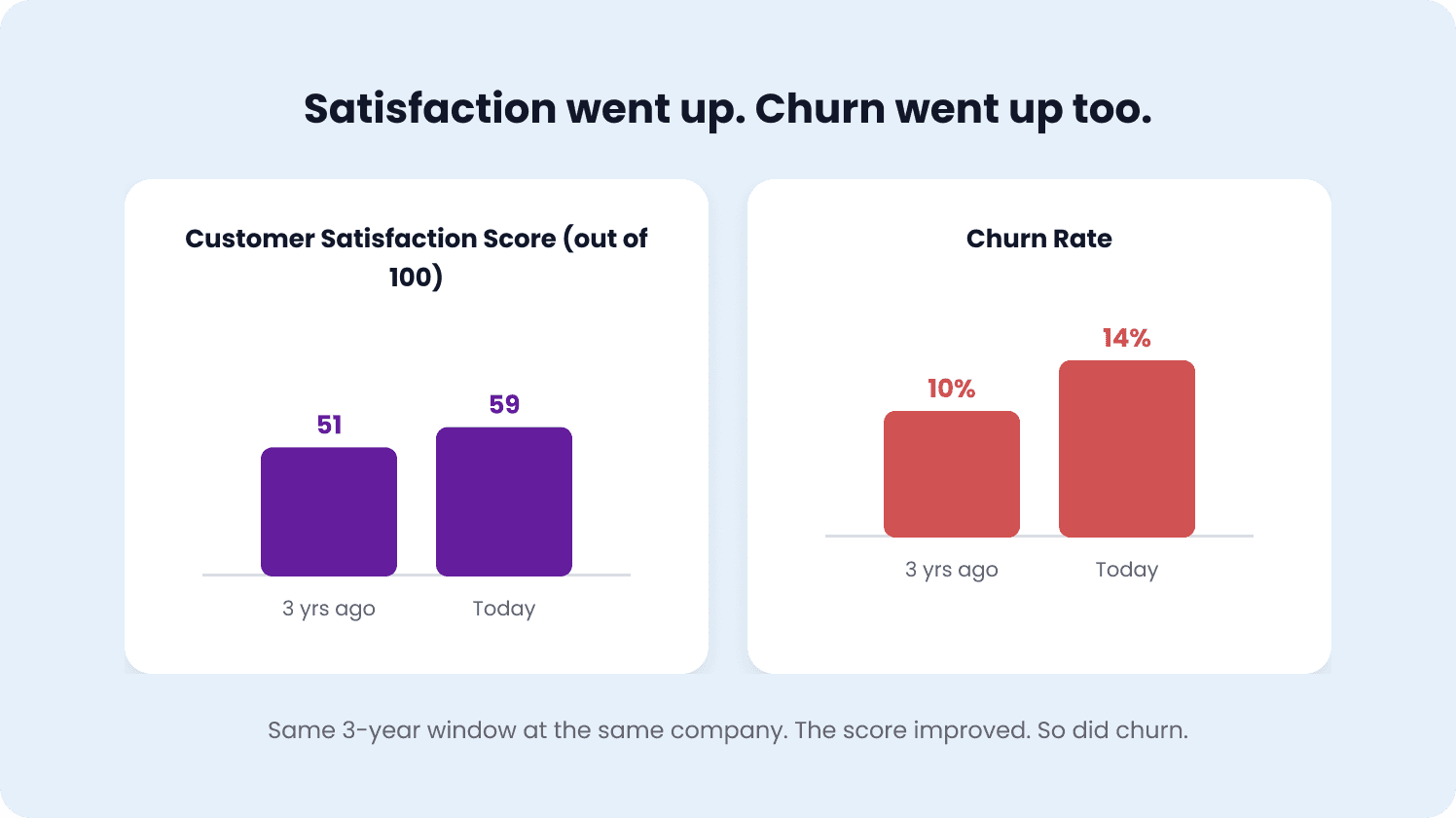
A high score lets you stay complacent. A low score sends you into a scramble.
The score-drop scramble
When a customer engagement score drops, the response is usually panic followed by scrambling. An account manager schedules a call and pulls usage reports. But the survey was designed to measure customer sentiment, not to diagnose cause. The team can gather feedback but can't act on it because the customer feedback isn’t specific enough. What looked like valuable feedback was just a score with no cause attached. The low score creates stress without creating a path to fix it.
Writing customer engagement survey questions that surface risk before it’s visible
Most guidance on survey questions tells you to keep them short, use rating scales, and avoid leading language. This is all true, but the harder job is writing customer engagement survey questions that catch leading indicators of disengagement before they surface as a churn statistic. The CS Director doesn’t need another generic “How satisfied are you?” prompt.
Response rates and why delivery matters
Response rates matter here. The median SaaS customer survey response rate sits at just 7.74%, below the cross-industry median of 9.98%. When participation is that thin, two things have to work together. You need quality questions and the right delivery channel.
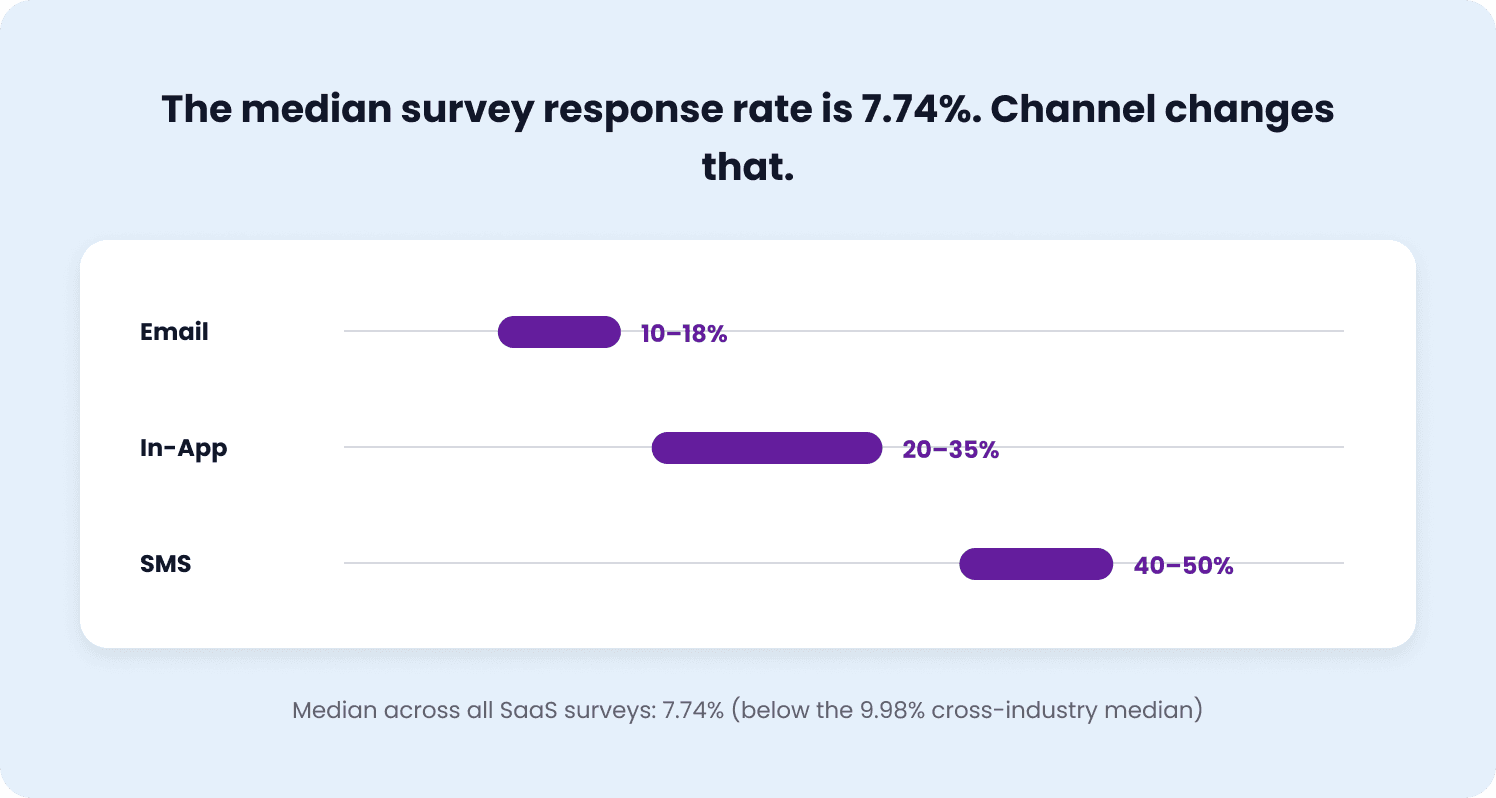
Email-linked surveys, the most common method, are also the worst-performing, with response rates of 10-18%. In-app surveys perform significantly better at 20-35%, and SMS surveys lead all channels at 40-50%. To maximize participation, choose communication channels that reach users in context. A question that measures overall customer satisfaction but doesn't surface a specific risk signal wastes the response you got, regardless of how you delivered it.
Quality answer comes from quality questions
How customers respond tells you as much as what they say. Thoughtful responses with detailed feedback are worth more than a high score with no context. Qualitative feedback in the customer’s own words often reveals the root cause that a number can’t. That’s why follow up questions matter. A low score followed by an open-ended prompt can uncover the specific aspect of the product that broke down.
Good engagement survey questions do three things:
They target a specific behavioral signal, not a general feeling.
They’re narrow enough that the answer tells you where to look, not just whether to worry.
They’re designed so that a low score points to an action, not a follow-up meeting to figure out what the score means.
When you design a survey thoughtfully, you give respondents the ability to respond with just as much care.
Design for diagnosis, not sentiment
The difference between a sentiment check and a diagnostic question is specificity. “How would you rate your overall satisfaction with the product?” is a sentiment check. It tells you how the customer feels. It doesn’t tell you what to fix. “Which workflows have your team stopped using in the past 30 days?” is a diagnostic. The answer points directly to a behavioral signal you can investigate.
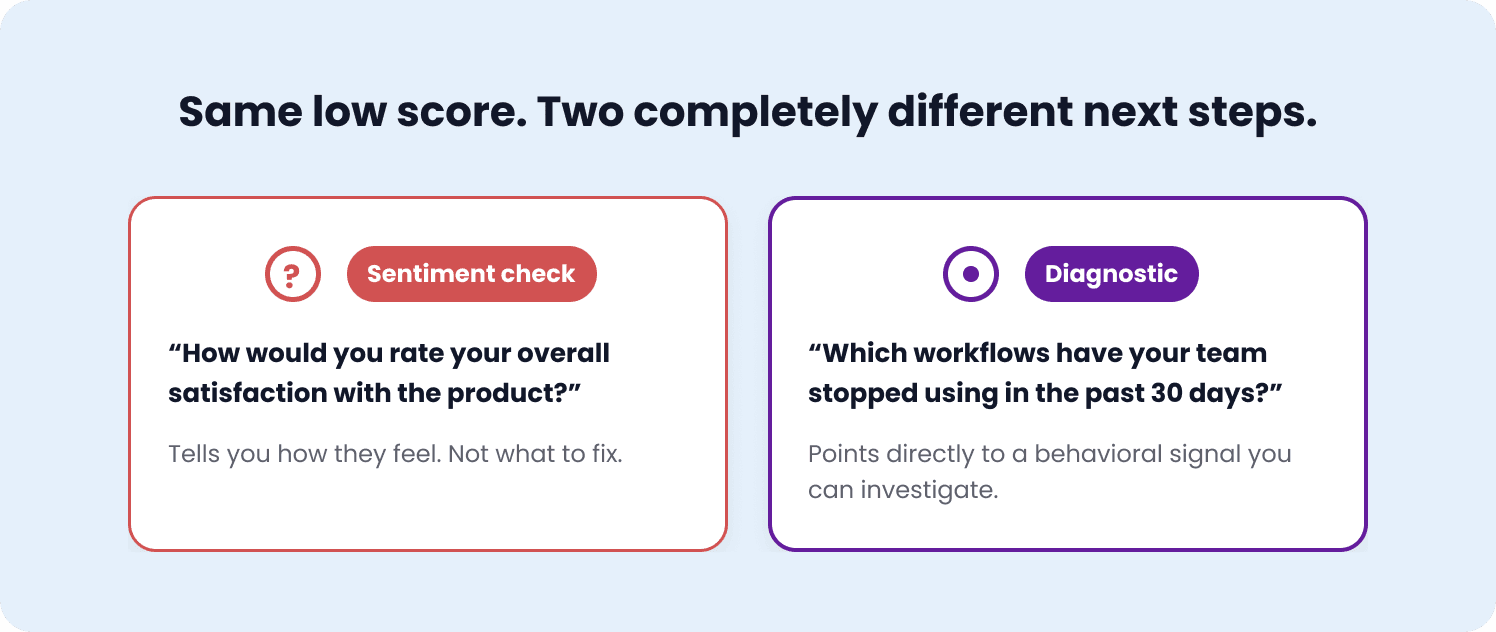
This is where customer engagement survey questions earn their place. Instead of asking about customer feelings in the abstract, ask about the specific workflows, features, and habits that signal engagement or disengagement. The goal is actionable insights, not valuable insights that sound good when presented in a slide deck but don’t change what the CS team does next week. Honest feedback about a stalled workflow is more useful than a polite nine out of 10.
Customer engagement survey examples for catching account risk early
The right customer engagement survey examples are designed around the specific signals that precede churn. Each set below targets a disengagement pattern a CS Director would recognize from a renewal that went sideways.
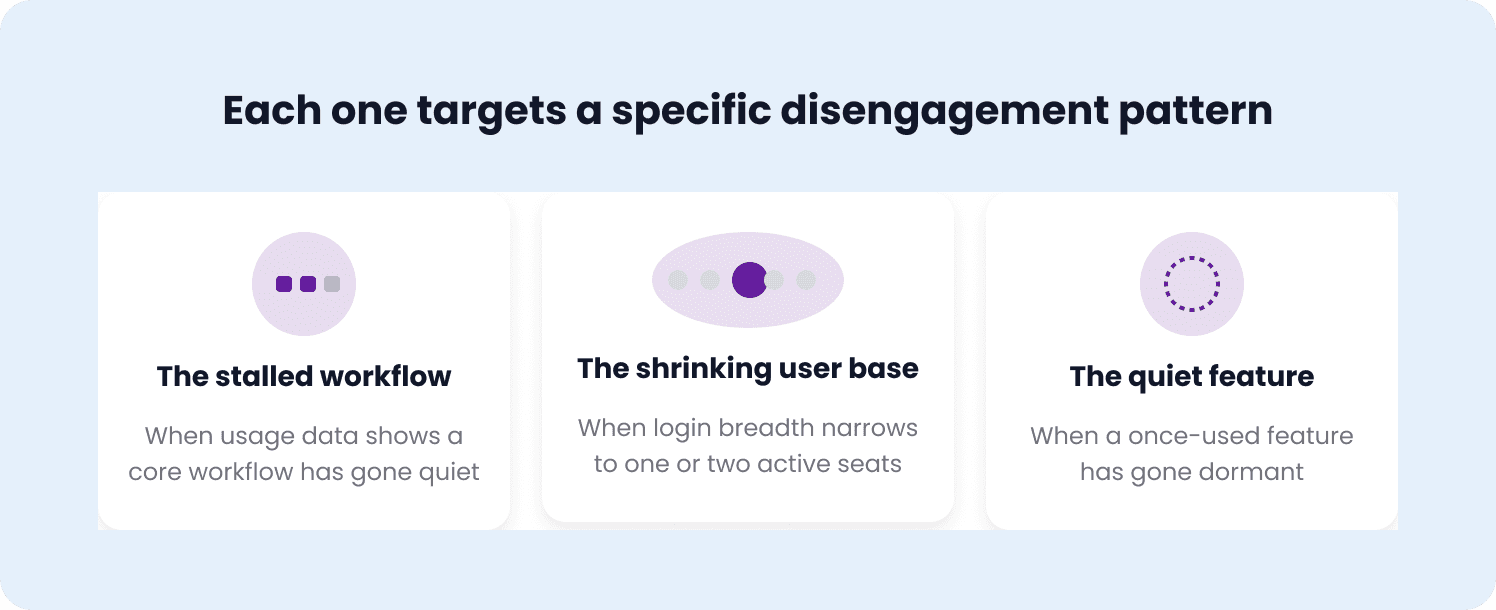
Use these as a customer engagement survey questionnaire template, not a rigid script. Adapt the questions to your product’s workflows and customer expectations.
Example 1: The stalled workflow
When to send: Mid-contract, when usage data shows a core workflow has gone quiet.
“Which workflows have your team used less in the past 30 days?”
“What changed in your process that made [workflow] less necessary?”
“Is there a different tool handling this step now?”
What it catches: A workflow that stopped getting clicks is one of the earliest behavioral signals of disengagement. These questions surface whether the customer found a workaround, replaced the step, or simply stopped needing it. The answer tells you whether to retrain, rebuild, or accept the shift.
Example 2: The shrinking user base
When to send: When login breadth narrows and only one or two seats remain active.
“Who on your team has logged in this week?”
“Has the person who originally championed this product changed roles?”
“What would make the product more relevant to the rest of your team?”
What it catches: A single stakeholder remaining active is a leading churn signal. When the champion leaves or the team stops logging in, the renewal is at risk. These questions surface whether the account has narrowed to one user, whether that user is still the decision-maker, and what it would take to re-engage the broader team.
Example 3: The quiet feature
When to send: When adoption data shows a once-used feature has gone dormant.
“Which features have you stopped using that you used to rely on?”
“Was the feature too hard to use, or did it stop solving your problem?”
“What would bring you back to using it?”
What it catches: Feature abandonment often precedes full disengagement. These questions distinguish between a feature that was too difficult and one that lost relevance. The answer points to a product fix, a training opportunity, or a conversation about whether the product or service still fits the customer's needs.
Pairing survey data with behavioral data to close the gap
A customer engagement survey captures what behavioral data can’t: intent, sentiment, and relationship signals.
Behavioral data captures what the survey can't: which workflow stalled, which feature went quiet, which user stopped logging in.
Together, they turn a customer engagement score into a diagnosis. A low score paired with a 40% drop in login frequency tells you the disengagement is real and behavioral, not just a bad survey week. A low score paired with steady usage tells you the issue is relational or sentiment-based, not product-driven. A steady score paired with declining usage tells you the customer hasn't noticed the decay yet, but the account is still at risk.
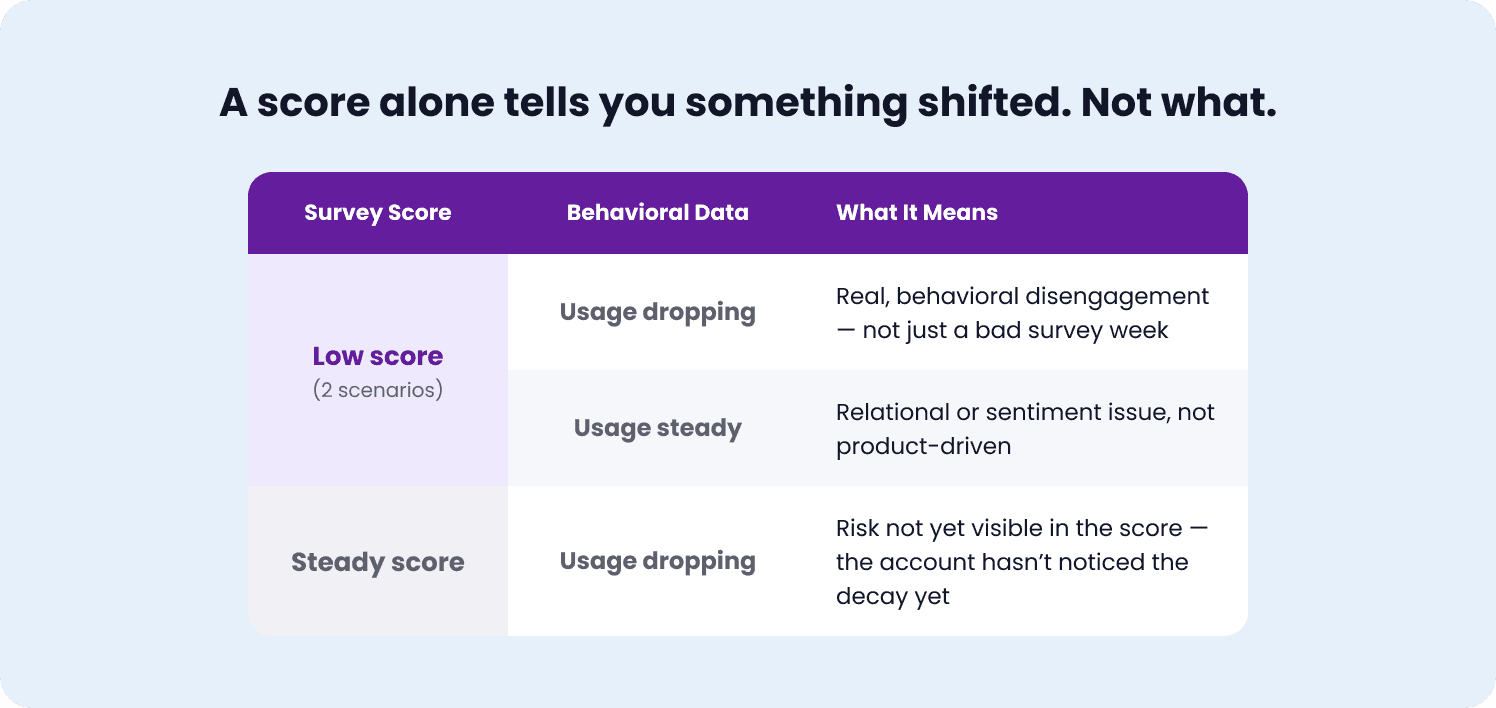
This is where Jimo fits. Jimo contextualizes engagement data against real product usage so CS teams can see the friction points behind the score. Behavior metrics show which workflows and features are trending down. Actionable reports connect those trends to survey responses so the diagnosis is specific. The result is a customer engagement survey that tells you what to do.
Catch disengagement before it becomes a renewal conversation
A Director of Customer Success doesn’t need another survey that confirms what happened. They need a customer engagement survey that surfaces what’s about to happen, paired with behavioral data that confirms the signal and points to the fix. The score-drop scramble happens when a survey measures customer sentiment but wasn’t designed to diagnose cause. The way out is questions that target specific behavioral signals, examples framed around account risk, and a workflow that pairs survey feedback with usage data.
That’s the difference between watching a score drop and catching the disengagement that caused it. Enhancing satisfaction is a nice outcome, but the real goal is protecting customer relationships and measuring customer loyalty. When you encourage participation through contextual, in-product surveys and pair the results with behavioral data, you get key insights that turn into continuous improvement instead of reactive scrambles.
The responses range from confirmations that the account is healthy to early warnings you’d never see in marketing messages or usage data alone. Over time, that protects brand loyalty and brand reputation in ways that tracking market trends after the fact never will.
Book a demo to see how Jimo surfaces the friction behind every engagement score.
FAQs
What is a customer engagement survey, and why does CS need one?
A customer engagement survey measures the customer’s experience with the product and overall relationship throughout their customer journey. CS teams need it because churn starts long before cancellation, and a well-designed survey can help teams understand customer preferences, identify trends, and intervene before retention dips.
What makes a customer engagement survey question good at catching risk early, not just measuring sentiment?
A good customer engagement survey question targets a specific behavioral signal, like a stalled workflow or a shrinking user base, rather than asking about overall satisfaction in the abstract. It’s narrow enough that the answer points to an action, not a follow-up meeting to interpret the score. The goal is actionable feedback and meaningful feedback that tells you where to look, not just whether to worry.
How is a customer engagement survey different from NPS or CSAT?
A customer engagement survey measures the health of the customer relationship with the product, while NPS measures likelihood to recommend and CSAT measures satisfaction with a specific interaction. Customer service surveys and customer satisfaction survey questions focus on service quality and whether service meets expectations at a moment in time.
What should a CS team do when a customer engagement score drops?
First, pull behavioral data to see which workflows, features, or users changed before the score dropped. The survey data tells you the relationship shifted, but usage data tells you what shifted. Then design a targeted intervention based on the specific signal, whether that’s retraining on a stalled workflow, re-engaging a quiet team, or addressing a relational issue. Don’t scramble to interpret the score in a vacuum, and don’t let customer support or a customer service representative own the response. The CS team needs the full picture.
Can customer satisfaction scores tell you what's driving churn across the customer journey?
Customer satisfaction scores tell you how a customer feels at a moment in time, but they don’t show where the customer journey broke down. To identify trends across accounts, you need customer surveys designed to surface specific disengagement signals, not just a satisfaction rating. Accurate feedback comes from pairing those survey responses with behavioral data that shows what actually changed in the product.