TL;DR
A product feedback survey doesn't fail because the questions were bad. It fails because the response lands in a survey tool while a support ticket about the same issue sits in a help desk, a comment from a sales call lives in a CRM note, and a review-site complaint never makes it into either. Nobody owns reconciling the four. This article covers how to design product feedback survey questions that produce answerable, ownable signal, and where AI-assisted unification fits into closing the gap that scattered channels create.
A product feedback survey goes out. Responses come back. They join a pile of support tickets, sales-call notes, and review-site comments, different formats of user feedback that never get connected into one place. The survey's insight gets buried in the noise instead of acted on. This article covers how to design surveys that hold up against that problem, and how to close the ownership gap that causes it in the first place.
Why Scattered Feedback Undermines Even a Well-Designed Survey
A survey can ask exactly the right question and still produce nothing useful if the answer arrives disconnected from everything else customers are already saying.
The same signal, split across four places
Most product teams aren't short on feedback. They're short on a place to see it together.
Support tickets capture what's broken right now, in the customer's own words, filed under whatever category the support team uses, not the product roadmap.
Sales calls surface what almost stopped a deal, often the sharpest, most specific feedback a company gets, and it usually lives in a CRM note nobody outside sales reads.
Review sites capture what a customer will say publicly but might soften privately, useful precisely because it's unfiltered, and easy to miss if nobody's monitoring it against product decisions.
Product feedback surveys capture what customers say when asked directly, structured and easy to analyze in isolation, but incomplete without the other three.
Scattered feedback still has a pattern, it's just invisible
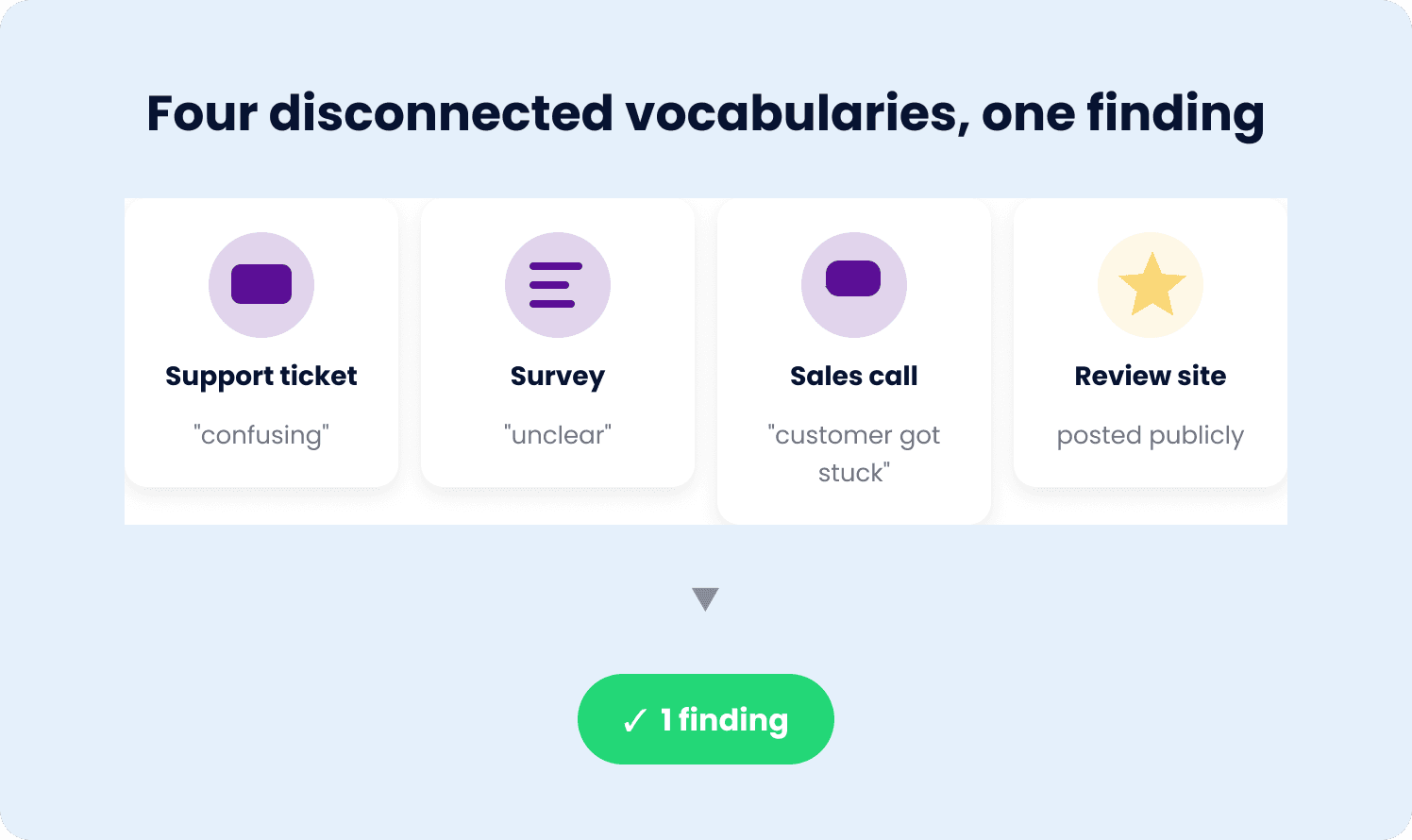
Feedback arriving through four separate channels usually points at the same handful of user friction points, repeated in different words by different people in different tools. A support ticket about a confusing setting, a sales call where a prospect got stuck on the same setting, and a survey response calling that setting "unclear" are three versions of one finding. Nobody sees it as one finding, because nobody's looking at all three at once.
This is the real cost of scattered feedback: the signal is already there, split into pieces small enough that no single piece looks urgent enough to act on.
A well-designed survey doesn't fix this on its own
A better question in the survey helps the survey's own responses. It does nothing for the ticket, the CRM note, or the review sitting in three other systems. Fixing survey design without addressing where the response goes afterward solves the smaller problem while leaving the real one untouched.
Designing Product Feedback Survey Questions That Produce Ownable Signal
Once a survey response has somewhere to go, the next question is whether it's specific enough to be worth routing anywhere at all.
What makes a question ownable
An ownable question produces an answer a specific person or team can act on without needing to ask a follow-up first.
Vague question: "How satisfied are you with [feature]?" Produces a number. Nobody knows what to do with a 6 out of 10.
Ownable question: "What's the last thing that stopped you from finishing a task in [feature]?" Produces a specific obstacle, something a PM can hand directly to the person who owns that part of the product.
This distinction matters more here than in other survey types. Unlike a CSAT check that measures sentiment after a single interaction, a product feedback survey question needs to isolate what specifically drove that sentiment, not just confirm it existed.
A few examples worth adapting, not copying directly
"What were you trying to do the last time [feature] didn't work the way you expected?" Surfaces a specific moment, not a general impression.
"If you could change one thing about [workflow] before your next session, what would it be?" Forces prioritization instead of an open-ended wish list.
"What almost made you stop using [feature] the first time you tried it?" Catches friction close to the moment it happened, before memory of it fades.
These are illustrative, not exhaustive. For a full bank of tested question formats across satisfaction, effort, and feature-specific feedback, see our guide on product satisfaction survey questions.
Write for the person who'll read the answer, not the person answering
A question that's easy to answer isn't automatically useful. The real test is whether the response tells the person who owns this area of the product exactly what to look into next. If it doesn't, the question needs another pass before it goes out, regardless of how well it reads.
Where an AI Agent Fits Into Unifying Scattered Product Feedback
Reconciling feedback across four channels by hand doesn't scale past a handful of responses a week. This is where an AI agent becomes useful: as the layer that catches the pattern a person reading one channel at a time would miss.
What AI-assisted unification actually does
The mechanism is pattern-matching across formats.
Clustering similar language across channels. A support ticket saying "confusing," a survey response saying "unclear," and a sales note saying "customer got stuck," describing the same underlying issue in three different vocabularies, get grouped as one finding instead of three unconnected mentions.
Surfacing frequency across mentions. A single complaint is an anecdote. The same complaint appearing eleven times across three channels in one week is a signal, and that distinction is invisible until something is actually counting across all three at once.
Routing by relevance, regardless of which tool the feedback arrived through. Feedback about a specific feature should reach the person who owns that feature.
Where this genuinely helps, and where it doesn't replace judgment
An AI agent narrows a pile of scattered feedback down to a shortlist of patterns worth a person's attention. Deciding what to build stays a human call. A cluster of eleven similar complaints still needs a PM to weigh it against roadmap priorities, technical feasibility, and which customers raised it, judgment an agent isn't positioned to replace.
The realistic value is time: the difference between a PM manually cross-referencing four tools every week and a PM reviewing a shortlist that's already been assembled from all four.
Tools built specifically for this kind of cross-channel triage are becoming a standard part of the feedback stack for teams outgrowing manual reconciliation.
From Survey Response to Roadmap Decision
Unifying feedback solves the visibility problem. It doesn't automatically solve the next one: proving that a roadmap decision made because of that feedback actually mattered.
The gap between "we heard this" and "we acted on this"
A cluster of feedback pointing at the same friction point is a strong case for prioritizing a fix. It's a weaker case, on its own, for showing afterward that fixing it moved anything that matters, retention, adoption, expansion. Those are two different questions, and conflating them is a common reason feedback-driven roadmap decisions are hard to defend later.
What Changes When Feedback Has One Owner
Feedback stops being scattered the moment there's one place it all lands, and one person or team accountable for what happens to it next.
Ownership fixes what unification alone can't
Bringing four channels into one view solves visibility. It doesn't automatically solve accountability: without an owner, unified feedback can sit unactioned in one place instead of four.
A named owner interprets what the pattern actually means for a specific account, weighing plan tier, tenure, and churn risk, the judgment unification alone can't supply.
A single owner closes the loop. Customers who raised the same issue in a ticket, a survey, and a sales call should hear about the fix once, from someone who knows they raised it, not experience three separate silences from three separate teams.
What this looks like in practice
Unified feedback becomes another input into customer health scoring, giving CS visibility into friction patterns that used to live only in a survey dashboard nobody outside that team ever opened. A pattern of friction feedback from a specific account becomes an early read on that account's trajectory, not just a product-roadmap data point.
This is what changes when feedback has one owner: the same signal that used to justify a roadmap decision in isolation now also feeds the broader picture of how customers are actually doing.
Give Product Feedback One Home
What happens to a response after it arrives determines whether a product feedback survey was worth running.
Scattered across a survey tool, a help desk, a CRM, and a review site, even well-designed feedback stays invisible as a pattern until someone reconciles it into one view. Reconciled without a named owner, it becomes visible and still goes unactioned. Both pieces have to be in place, one home for the signal, one person accountable for what happens next, before a product feedback survey actually earns the time it takes customers to answer it.
For the deeper methodology on tying a fix back to a measurable outcome once feedback is unified, see our guide on how to track feedback impact in product development.