The Best NPS Questions to Ask and What to Do with the Answers
The Best NPS Questions to Ask and What to Do with the Answers
The Best NPS Questions to Ask and What to Do with the Answers
/
8 mins read

TL;DR
NPS surveys work best when the questions are built to generate signals, not just scores. This guide covers the core loyalty question, the follow-up questions that reveal why users feel the way they do, how to interpret your score against industry benchmarks, and when to send surveys for maximum response quality. It also covers what separates teams that collect NPS data from teams that act on it and how closing the loop inside your product, rather than through a follow-up email, is what actually moves activation and retention.
Most teams treat NPS as a report card. Run the survey, tally the scores, add them to the monthly deck.
Not that that’s wrong. It's just incomplete. A score tells you where you stand, but it never tells your product what to do about it.
The teams getting the most out of NPS aren't just measuring loyalty. They're using every response as a signal: who needs a walkthrough right now, who's ready for an upsell conversation, who's three days from churning without realizing it. The survey is the input. What happens inside the product afterward is where the value is.
This guide covers the questions that generate those kinds of signals and how to act on them before the moment passes.
What is the Net Promoter Score (NPS)?
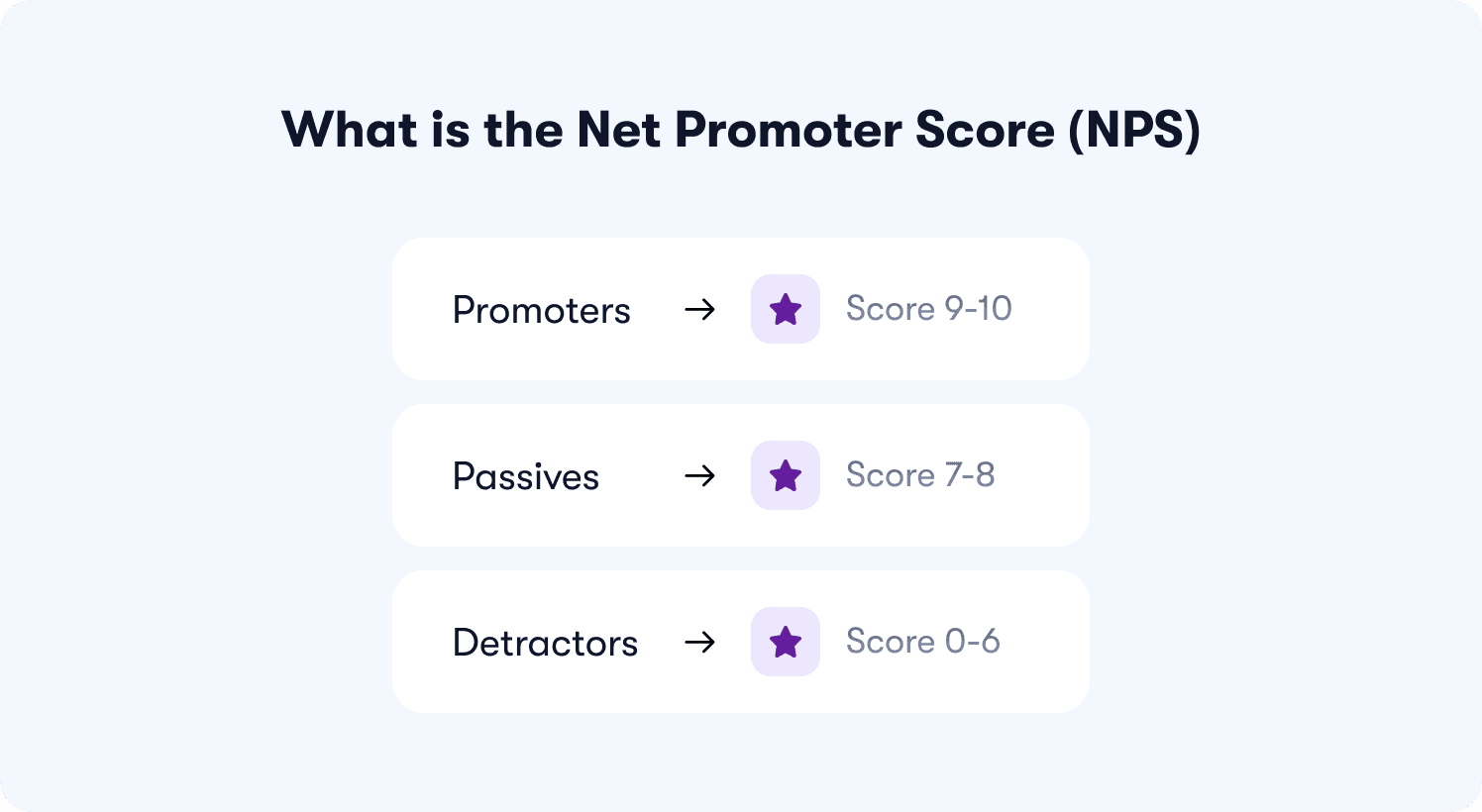
The Net Promoter Score (NPS) is one of the most widely adopted customer feedback metrics in SaaS, and one of the most consistently underused. The concept is simple: ask customers how likely they are to recommend your product on a scale of 0 to 10, sort responses into promoters (9–10), passives (7–8), and detractors (0–6), and subtract the percentage of detractors from the percentage of promoters. Your score lands somewhere between -100 and +100.
According to the Harvard Business Review, two-thirds of Fortune 1000 companies run NPS surveys. Far fewer do anything meaningful with the results.
That gap is the real problem. Most teams treat NPS as a reporting exercise: run the survey quarterly, share the score in the monthly deck, flag the detractors for a CS follow-up call. The score moves a point or two in either direction, and the cycle repeats. What never changes is the product experience that generated the score in the first place.
The teams getting the most value from NPS have a different relationship with the data. They treat every response as a signal about a specific moment in the user journey where friction lives, which features aren't landing, who is three days from churning without knowing it. They use that signal to change what happens inside the product, not just what happens in the next QBR slide. That's the difference between measuring loyalty and building it.
But getting there starts with asking the right questions and at the right time.
The Best NPS Survey Questions to Ask
Most NPS surveys stop at the rating question. That's the equivalent of asking someone how their meal was and walking away before they answer. The score tells you the temperature. The questions that follow tell you why and what to do about it.
The best NPS question sets are built around a simple principle: every question should move you closer to a specific action, either in your product, your onboarding, or your support experience. If you can't articulate what you'd do with the answer, the question probably isn't earning its place in the survey.
Here are the categories that matter most, and why.
Core loyalty assessment
Start with the standard rating question, then immediately probe the most recent interaction:
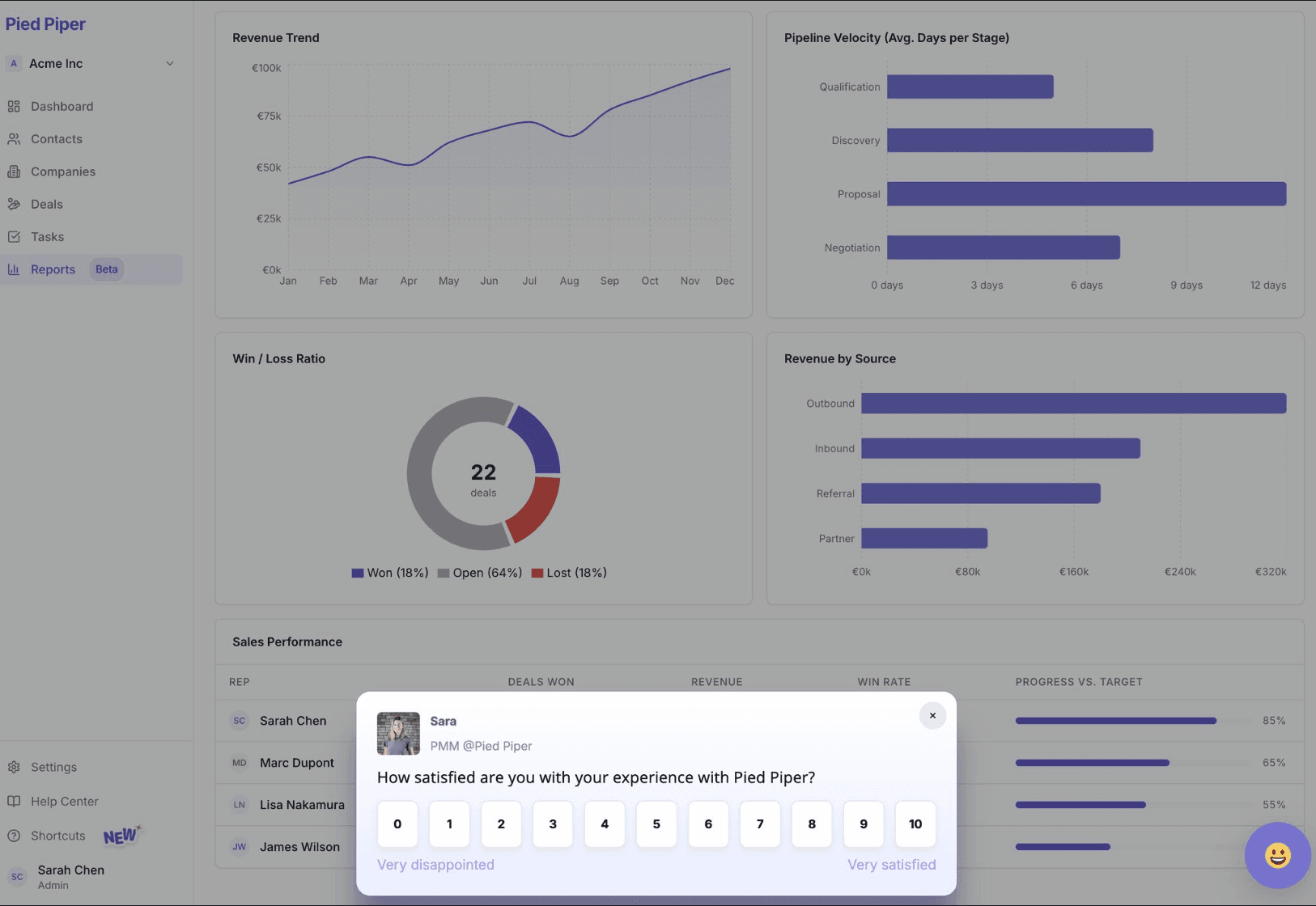
"On a scale of 0 to 10, how likely are you to recommend our product to a friend or colleague?"
"Based on your most recent experience with our product, how likely are you to recommend us?"
The second question is one most teams skip, and it's often more useful than the first. Aggregate NPS scores smooth over a lot of friction. A user who gave you a 9 six months ago but just had a frustrating experience with a new feature is still counted as a promoter until they aren't. Asking about the most recent interaction surfaces that kind of drift before it shows up in your overall score.
Understanding what drives the NPS score
Once you have the number, these questions explain it:
"Could you explain the main reason for your score?" This is the single most valuable follow-up in any NPS survey. Keep it open-ended. The moment you add suggested answers, you start shaping responses toward what you expect rather than what users actually experience.
"What feature or aspect of our product do you value most?" This tells you what's worth protecting. A surprising number of teams discover through this question that the feature users love most is not the one the product team has been investing in.
"What about your onboarding or setup experience influenced your score?" Separating onboarding friction from ongoing product friction is critical. A detractor who struggled to get started is a different problem than a detractor who got to value and then hit a wall. Treating them the same way wastes resources and misses the actual fix.
How to identify what needs to change
This is where most NPS programs generate their most actionable data, and where most teams ask the weakest questions:
"What would make you more likely to recommend us?" Simple, direct, and underused. Most teams are afraid of this question because the answers can be uncomfortable. That discomfort is the point.
"What are the main reasons you might not recommend our product, and what could we do to address them?" The dual structure matters. Asking for the problem and implicitly inviting a solution generates far more specific responses than a generic "what went wrong?" Users who feel like their answer might lead somewhere give better answers.
The insight most teams miss here: detractor responses are most valuable not as a churn signal but as a product brief. A detractor who says "I can never find the reporting feature when I need it" is telling you exactly what your in-product guidance should be doing.
Digging into specific experiences
"Which features do you find most valuable, and how could they be improved?" This question sits at the intersection of retention and roadmap. Users who articulate what they love and how it could be better are doing product discovery work for you.
"How well does our product meet your needs today, and what's missing?" The word "today" matters. User needs evolve, and the gap between what someone needed when they signed up and what they need six months in is often where churn hides. This question makes that gap visible.
"What additional capabilities would make this product indispensable for you?" Forward-looking, and particularly useful when tracked across multiple NPS cycles. Patterns in this answer often surface product opportunities before they show up anywhere else.
Turning promoters into an asset
Most NPS programs over-index on detractors and treat promoters as a vanity metric. That's a missed opportunity on two fronts.
"Would you be willing to share a specific experience with our product that stood out?" Promoters who answer this question generate some of the most credible, specific social proof available; far more useful than a generic five-star review.
"Would you be open to a brief follow-up conversation about your experience?" High-scoring users who agree to this are among the best qualitative research participants you have access to. They're engaged, they're articulate about what works, and they're invested in the product getting better.
When to Ask NPS Questions (and Why Timing Changes Everything)
The question you ask matters. When you ask it matters just as much.
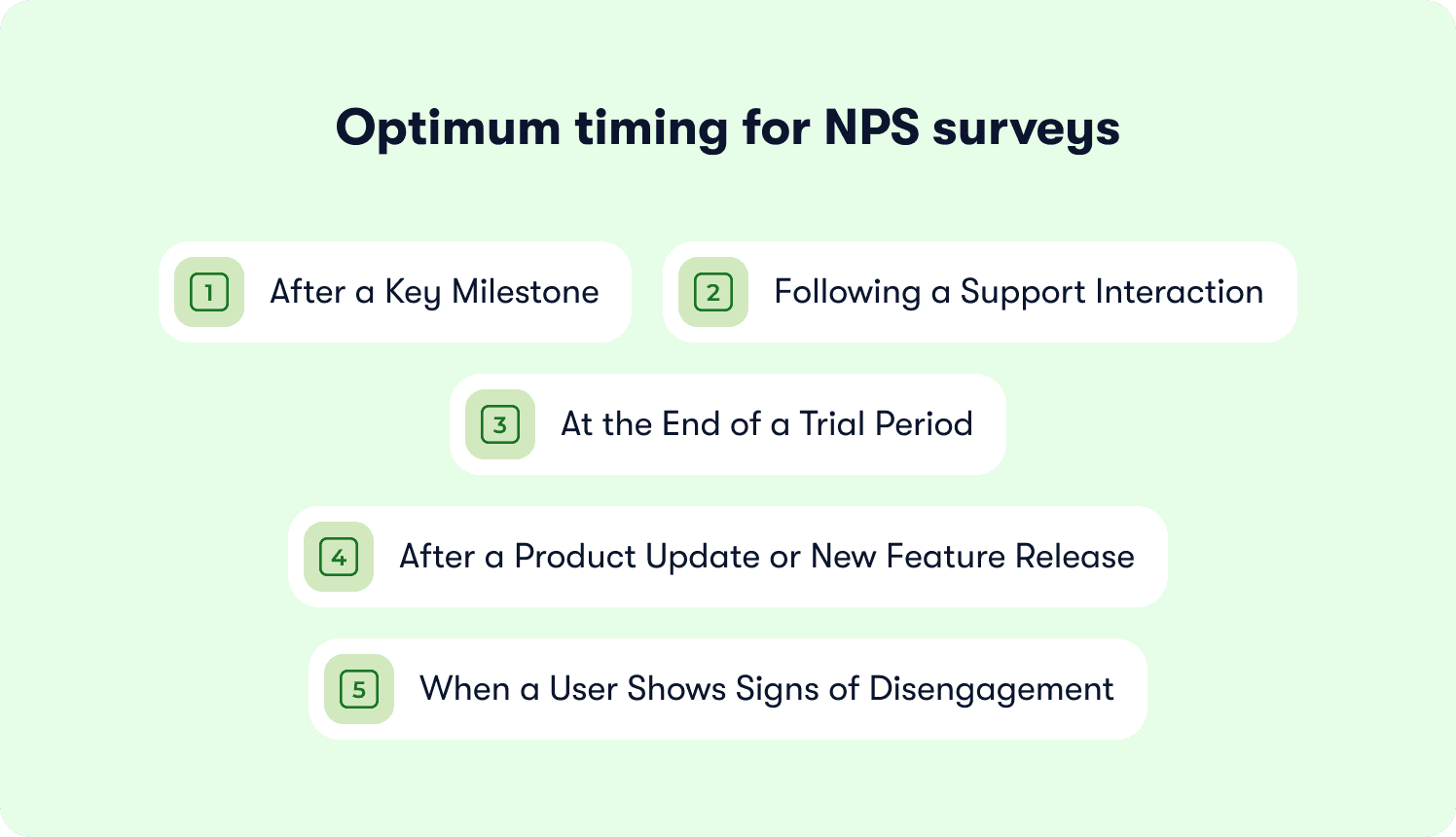
Most teams default to interval-based NPS: send the survey every 90 days, capture whoever responds, average out the scores. It's operationally simple and strategically weak. You're asking users to recall an experience that may have happened weeks ago, at a moment that has nothing to do with where they are in their journey right now. The responses you get reflect memory, not experience.
The shift that changes NPS from a reporting tool into an action system is moving from time-based triggers to behavior-based triggers. Ask at the moment the experience is fresh, and relevant.
After a Key Milestone
A user who just completed onboarding, published their first project, or hit a meaningful output inside your product is at peak engagement. That's the moment their sentiment most accurately reflects the product experience. It's also the moment a high score is most likely. A promoter at the activation milestone is a different asset than a promoter who's been using the product passively for six months.
Following a Support Interaction
Post-support NPS is one of the most underused survey triggers in SaaS. If a user just had an issue resolved, their response tells you whether your support experience is building loyalty or just containing damage. A detractor who gave you an 8 before a support ticket and a 5 after is telling you something specific about where the experience broke down.
At the End of a Trial Period
Trial users who haven't converted are one of the highest-value segments you can survey. Their NPS response, combined with behavioral data from the trial, tells you whether they didn't convert because of the product, the pricing, the onboarding, or something else entirely. Most teams find out too late, if at all.
After a Product Update or New Feature Release
Releasing a major update without following up with an NPS survey is leaving signal on the table. Users who interact with a new feature in the first two weeks have the sharpest, most specific feedback you'll get. Wait 90 days and that precision is gone.
When a User Shows Signs of Disengagement
This is the timing insight most PLG-era tools miss entirely. By the time a disengaged user responds to a quarterly survey, the decision to churn is often already made. Triggering an NPS survey when engagement drops (fewer logins, features going unused, sessions getting shorter) catches users at the moment their dissatisfaction is actionable, and not historical.
In an ILG model, this is where NPS becomes genuinely powerful. Rather than waiting for users to raise their hand, your product identifies the signal and responds to it: a contextual survey surfaces at the right moment, the response feeds back into the product layer, and the next experience that user has is already shaped by what they told you. The loop closes inside the product, not in a follow-up email three days later.
How to Interpret Your NPS Score
Getting your NPS score back is the easy part. Knowing what to do with it is where most teams stall.
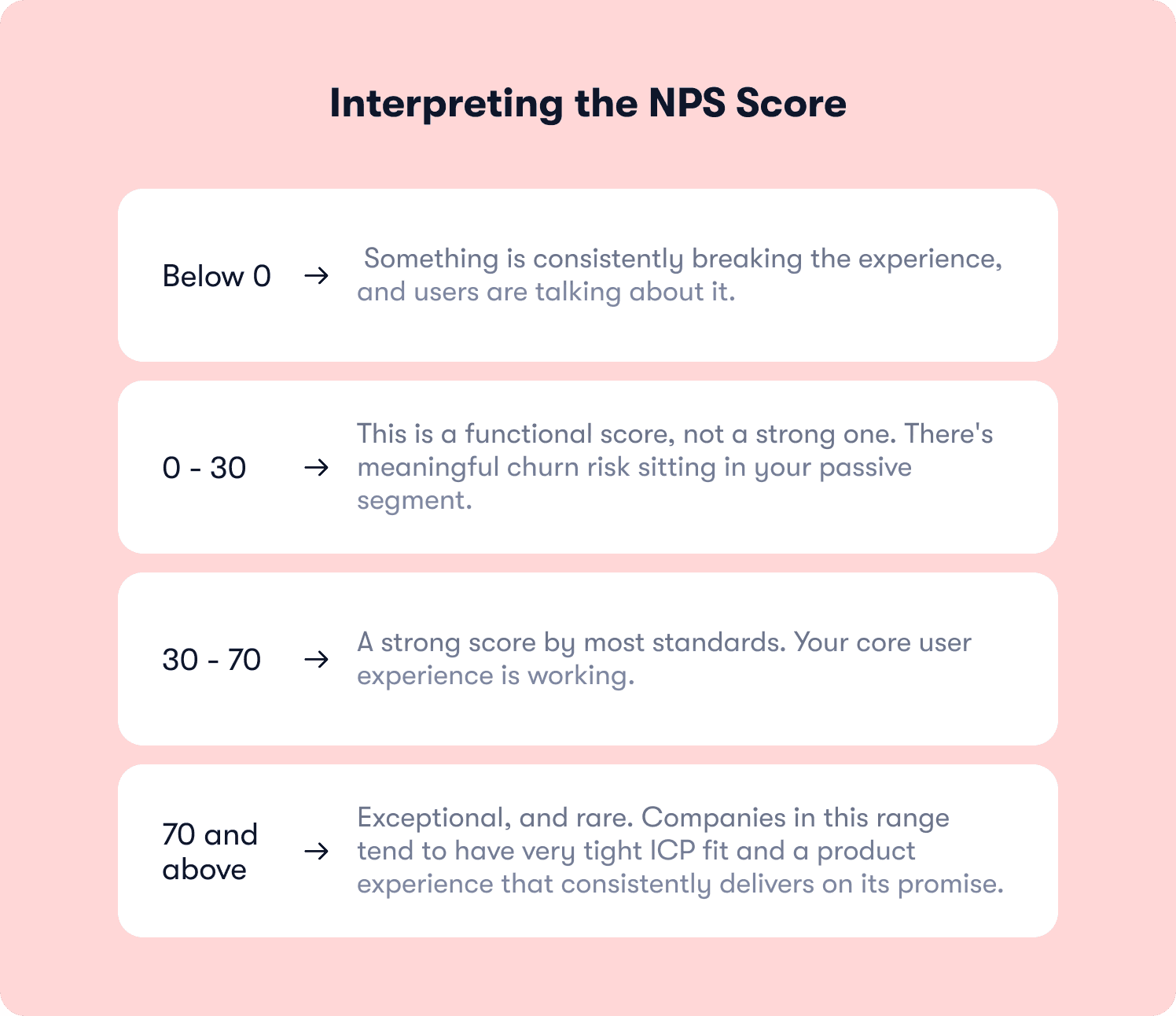
Your score sits on a scale from -100 to +100, calculated by subtracting the percentage of detractors from the percentage of promoters. Passives don't factor into the calculation, but they matter strategically — they're the segment most likely to move in either direction based on their next meaningful product experience.
Here's a general framework for reading your score:
Below 0: More detractors than promoters. Something is consistently breaking the experience, and users are talking about it.
0 to 30: More promoters than detractors, but the gap is narrow. This is a functional score, not a strong one. There's meaningful churn risk sitting in your passive segment.
30 to 70: A strong score by most standards. Your core user experience is working. The focus here shifts to converting passives and identifying what's driving your promoters so you can systematize it.
70 and above: Exceptional, and rare. Companies in this range tend to have very tight ICP fit and a product experience that consistently delivers on its promise. Maintaining it requires the same rigor that built it.
What Your NPS Score Means Depends on Your Industry
Reading your NPS score in isolation is one of the most common mistakes SaaS teams make. A score of 35 might signal a struggling product in one category and a market-leading one in another. Context is everything.
Industry benchmarks may seem to suggest the following ranges:
Industry | Score (avg.) | Particularities |
SaaS / Software | 30 to 40 | The category is competitive and users have high expectations, which naturally pressures scores downward. |
Financial Services | 35 to 55 | Trust is the primary driver, which means detractor responses in this category disproportionately reflect security or reliability concerns. |
E-commerce / Retail | 40 to 70 | Higher variance than SaaS, largely because the experience is more transactional and easier to get right consistently. |
Healthcare | 20 to 40 | Complexity and compliance constraints make high NPS scores genuinely difficult to achieve. |
Telecommunications | -5 to 20 | One of the lowest-scoring categories consistently, driven by switching friction rather than loyalty. |
For B2B SaaS specifically, the more useful benchmark is often your own score over time rather than a category average. A product that moves from 18 to 34 over three quarters is doing something right, regardless of where the category average sits. What matters is direction, velocity, and whether you can explain the movement.
The Number That Matters More Than Your Score
Your aggregate NPS score is a lagging indicator. By the time it moves, the experience that caused the movement is already weeks old. The metric that gives you more lead time is your detractor rate in isolation, specifically, whether it's growing as a share of total responses.
A stable aggregate score with a rising detractor count means your promoters are carrying a problem that's getting worse. That's a different situation than a stable score driven by genuine loyalty across the board, and it requires a different response.
How to Use NPS Data to Improve Customer Experience
Collecting NPS responses is straightforward. The gap between teams that improve because of NPS and teams that just report it comes down to one thing: whether the data changes what happens next, for a specific user, in a specific part of the product.
Here is how to work each segment.
The Detractor Playbook
Detractors are the segment most teams respond to reactively: a CS email, a follow-up call, a discount offer. Those interventions can work, but they treat the symptom rather than the cause. The more useful question is: what in the product experience generated this score, and can it be fixed before the next user hits the same wall?
Start by tagging detractor responses by theme. Onboarding friction, missing features, performance issues, and pricing concerns each require a different response. Routing all detractor feedback into a single "follow up with CS" queue loses that distinction and makes it impossible to spot patterns.
For detractors who cite onboarding or feature confusion specifically, the highest-leverage intervention isn't a phone call. It's fixing the in-product experience that left them confused in the first place. A user who says "I could never figure out how to set up the reporting dashboard" is giving you a product brief. The response should be a better onboarding experience for that feature, one that's there the next time any user needs it, not just the one who complained.
The Passive Playbook
Passives are the most undervalued segment in most NPS programs. They're satisfied enough to stay but not invested enough to advocate — which means they're one bad experience away from becoming detractors and one great experience away from becoming promoters.
The goal with passives is not to push them toward a higher score. It's to identify the specific gap between where they are and where promoters are, and close it.
The most effective passive intervention is feature exposure. Industry benchmarks suggest that a significant share of passive users have never discovered the features that promoters cite as the reason for their score. A targeted in-product experience which surfaces the right capability at the right moment converts more passives than any follow-up email campaign, because it addresses the actual gap rather than the symptom.
Ask passives directly: "What would make you more likely to recommend us?" The responses cluster around a small number of themes faster than most teams expect. Those themes are your activation roadmap.
The Promoter Playbook
Most teams treat promoters as a validation metric and move on. That leaves significant value on the table.
Promoters are your highest-quality source of three things: referrals, case study material, and product insight. They know what's working well enough to recommend it. That knowledge is more specific and more credible than anything a market research exercise will generate.
Engage them deliberately. Ask what they'd tell a colleague about your product. Ask what they wish had been clearer when they started. Ask what they're hoping you'll build next. Promoters who feel genuinely consulted tend to deepen their engagement with the product, and their responses often surface the clearest picture of what your product does at its best, which is exactly the experience you want to replicate for every new user.
Closing the NPS Loop In-Product
Collecting NPS data and acting on it are two different capabilities. Most teams have the first. Very few have built the second in any systematic way.
The traditional response cycle looks like this: survey goes out, responses come in, detractors get flagged, CS team follows up, findings get added to the next product review. That cycle takes weeks. By the time a detractor hears back from anyone, they've already formed a conclusion about your product, and in most cases, acted on it.
The shift that changes NPS from a feedback program into a retention tool is closing the loop inside the product, not outside it.
When a user scores low on a specific workflow, the most effective intervention isn't an email. The response meets the user where they are, at the moment they need it, without requiring them to re-engage with a support thread they've already mentally closed.
This is the core logic of Intelligence-Led Growth (ILG): rather than treating user feedback as an input to a quarterly planning cycle, you treat it as a real-time signal that changes what the product does next. NPS responses stop being data points in a spreadsheet and start being instructions for your product experience layer.
The practical difference is significant. A detractor who receives a follow-up email three days after submitting a low score is being asked to re-engage with a frustration they've moved past. A detractor whose next product session is noticeably smoother because what they described was already addressed: experiences something closer to being heard. That distinction drives retention in a way that no follow-up campaign reliably does.
For passive users, the same logic applies. A passive who said they'd never discovered the reporting feature shouldn't receive a newsletter about it. They should see a contextual walkthrough the next time they're in a workflow where that feature would help. The moment of relevance is what converts passives, not the volume of communication.
💡 Jimo's Surveys and NPS feature is built around this principle. Surveys trigger based on user behavior rather than time intervals, and responses feed directly into Jimo's in-product guidance layer so the loop closes automatically, inside the product, without requiring a CS team to manually triage every response. That's what makes NPS a growth tool rather than a reporting tool.
NPS as a Tool for Continuous Improvement
A single NPS survey is a snapshot. Run consistently over time, NPS becomes something more useful: a leading indicator of whether your product decisions are actually landing.
Most teams treat NPS as a periodic check-in rather than a measurement system. The difference matters. A check-in tells you where you are. A measurement system tells you whether what you're doing is working and gives you enough lead time to course correct before the damage shows up in churn.
Track Movement, Not Just Score
The most important NPS data point is rarely your current score. It's the direction and velocity of change over the last two or three measurement periods. A score that's moved from 22 to 31 to 40 over three quarters tells a cleaner story than a static 45; it tells you the product is improving in ways users can feel, which is a different and more durable signal than a high score that hasn't moved in a year.
When your score drops, the first question isn't "how do we recover it?" It's "what changed?" A score decline that coincides with a major product update is telling you something specific about that update. A decline that coincides with nothing obvious is often a sign that a slow-building friction point has finally reached critical mass in enough users to move the aggregate. The open-ended responses from that period are where you find out which.
Measure the Impact of Product Decisions
One of the most underused applications of NPS is as a before-and-after measurement tool for specific product changes. When you improve an onboarding flow, redesign a core feature, or change your pricing structure, the NPS scores from users who experienced the change measured against a baseline from users who didn't, give you one of the clearest signals available about whether the change actually improved the experience.
This requires segmenting your NPS data by cohort rather than averaging across your entire user base. Aggregate scores hide the impact of specific decisions. Cohort-level data surfaces it.
Watch the Passive-to-Detractor Ratio
As noted in the interpretation section, a stable aggregate score can mask a deteriorating experience if promoters are compensating for a growing detractor segment. The ratio worth watching most closely is passive-to-detractor movement. When passives start converting to detractors at a higher rate than they're converting to promoters, you have a problem that the aggregate score isn't showing, but will, within one or two measurement cycles.
Catching that shift early is the difference between a targeted intervention and a recovery effort. The data to catch it is already in your NPS program. Most teams just aren't looking at it at the right level of granularity.
Close the Loop on Improvements
When you make a product change in direct response to NPS feedback, tell the users who gave you that feedback. This is among the most consistently underleveraged practices in SaaS. Users who see that their input changed something become significantly more likely to respond to future surveys, more likely to upgrade their score when re-surveyed, and more likely to become active advocates for the product.
It also changes the nature of the NPS program itself. When users believe their responses lead somewhere, response quality improves. They give more specific answers, they engage with follow-up questions more thoroughly, and they're more willing to have a deeper conversation. The survey stops feeling like a form and starts feeling like a channel, which is exactly what it should be.
The Score Is Now the Easy Part
Every SaaS team running NPS has the same data available to them. Promoters, passives, detractors, a number between -100 and +100. The difference between teams that grow because of that data and teams that just report it has nothing to do with the questions they ask or how often they survey.
It comes down to what happens after the response is submitted.
The companies setting the pace right now have stopped treating NPS as a feedback program and started treating it as a product input. A user who signals friction at a specific moment doesn't hear back three days later. They encounter a different experience the next time they hit that moment. The signal becomes the fix.
Most teams are one decision away from that. The data is already there. The question is whether it changes anything.
If you're ready to make it, see how Jimo Surveys works here.
FAQs
What is a good NPS score for a SaaS company?
Industry benchmarks suggest that a score between 30 and 40 is average for SaaS products, though context matters more than the number itself. A score of 35 in a highly competitive category with complex user needs tells a different story than a 35 in a simpler, more transactional product. The more useful benchmark is your own score over time, direction and velocity of change matter more than where you sit on any given quarter.
How many questions should an NPS survey have?
Enough to generate actionable signal, not so many that completion rates drop. The core rating question plus two to three open-ended follow-ups is the right range for most SaaS products. The follow-up questions should vary based on the score and detractors and promoters have different things to tell you, and a one-size-fits-all question set misses that distinction.
How often should you run NPS surveys?
The honest answer is: less often on a fixed schedule, more often based on behavior. Quarterly interval surveys are operationally convenient but strategically weak. They capture sentiment at an arbitrary moment rather than at the moments that matter. Triggering surveys after key milestones, support interactions, feature releases, or signs of disengagement generates far more useful data than any fixed cadence.
What is the difference between NPS and CSAT?
NPS measures loyalty and the likelihood of recommendation. It is a forward-looking metric that reflects the overall relationship a user has with your product. CSAT (Customer Satisfaction Score) measures satisfaction with a specific interaction or experience at a point in time. Both have their place, but they answer different questions. NPS tells you where you stand. CSAT tells you how a specific moment landed. For SaaS teams tracking product-level sentiment over time, NPS is the more durable and strategically useful of the two.
What is the difference between transactional and relational NPS?
Relational NPS measures overall customer loyalty at a fixed point in time. It gives you a broad read on how your customer base feels about your product or service as a whole. Transactional NPS is triggered by a specific interaction: a support call, a feature release, a billing event. It measures customer sentiment in the immediate aftermath of that moment rather than overall loyalty. Both serve different purposes within a well-structured NPS program. The most effective NPS survey structures use both: relational surveys to track the baseline, transactional surveys to diagnose the moments that move it. For SaaS teams, transactional NPS triggered after a support team interaction or onboarding milestone tends to generate the most specific and actionable feedback, because the experience is fresh and the user can pinpoint exactly what shaped their NPS response.
How do you improve your NPS response rate?
Response rate is one of the most underleveraged variables in an NPS program. A survey sent to your entire customer base at a generic interval will always underperform one that reaches the right customer segment at the right moment. The single biggest driver of NPS response rate is timing, whether that's after a support interaction, a key milestone, or a product update, and response rates improve significantly. Beyond timing, keep the NPS survey structure lean: the core NPS question plus two focused follow-up questions outperforms a longer survey template on completion rate every time. For open-ended questions specifically, framing matters by asking users to share the primary reason for their score generates richer qualitative feedback than asking broadly what they think.
TL;DR
NPS surveys work best when the questions are built to generate signals, not just scores. This guide covers the core loyalty question, the follow-up questions that reveal why users feel the way they do, how to interpret your score against industry benchmarks, and when to send surveys for maximum response quality. It also covers what separates teams that collect NPS data from teams that act on it and how closing the loop inside your product, rather than through a follow-up email, is what actually moves activation and retention.
Most teams treat NPS as a report card. Run the survey, tally the scores, add them to the monthly deck.
Not that that’s wrong. It's just incomplete. A score tells you where you stand, but it never tells your product what to do about it.
The teams getting the most out of NPS aren't just measuring loyalty. They're using every response as a signal: who needs a walkthrough right now, who's ready for an upsell conversation, who's three days from churning without realizing it. The survey is the input. What happens inside the product afterward is where the value is.
This guide covers the questions that generate those kinds of signals and how to act on them before the moment passes.
What is the Net Promoter Score (NPS)?
The Net Promoter Score (NPS) is one of the most widely adopted customer feedback metrics in SaaS, and one of the most consistently underused. The concept is simple: ask customers how likely they are to recommend your product on a scale of 0 to 10, sort responses into promoters (9–10), passives (7–8), and detractors (0–6), and subtract the percentage of detractors from the percentage of promoters. Your score lands somewhere between -100 and +100.
According to the Harvard Business Review, two-thirds of Fortune 1000 companies run NPS surveys. Far fewer do anything meaningful with the results.
That gap is the real problem. Most teams treat NPS as a reporting exercise: run the survey quarterly, share the score in the monthly deck, flag the detractors for a CS follow-up call. The score moves a point or two in either direction, and the cycle repeats. What never changes is the product experience that generated the score in the first place.
The teams getting the most value from NPS have a different relationship with the data. They treat every response as a signal about a specific moment in the user journey where friction lives, which features aren't landing, who is three days from churning without knowing it. They use that signal to change what happens inside the product, not just what happens in the next QBR slide. That's the difference between measuring loyalty and building it.
But getting there starts with asking the right questions and at the right time.
The Best NPS Survey Questions to Ask
Most NPS surveys stop at the rating question. That's the equivalent of asking someone how their meal was and walking away before they answer. The score tells you the temperature. The questions that follow tell you why and what to do about it.
The best NPS question sets are built around a simple principle: every question should move you closer to a specific action, either in your product, your onboarding, or your support experience. If you can't articulate what you'd do with the answer, the question probably isn't earning its place in the survey.
Here are the categories that matter most, and why.
Core loyalty assessment
Start with the standard rating question, then immediately probe the most recent interaction:
"On a scale of 0 to 10, how likely are you to recommend our product to a friend or colleague?"
"Based on your most recent experience with our product, how likely are you to recommend us?"
The second question is one most teams skip, and it's often more useful than the first. Aggregate NPS scores smooth over a lot of friction. A user who gave you a 9 six months ago but just had a frustrating experience with a new feature is still counted as a promoter until they aren't. Asking about the most recent interaction surfaces that kind of drift before it shows up in your overall score.
Understanding what drives the NPS score
Once you have the number, these questions explain it:
"Could you explain the main reason for your score?" This is the single most valuable follow-up in any NPS survey. Keep it open-ended. The moment you add suggested answers, you start shaping responses toward what you expect rather than what users actually experience.
"What feature or aspect of our product do you value most?" This tells you what's worth protecting. A surprising number of teams discover through this question that the feature users love most is not the one the product team has been investing in.
"What about your onboarding or setup experience influenced your score?" Separating onboarding friction from ongoing product friction is critical. A detractor who struggled to get started is a different problem than a detractor who got to value and then hit a wall. Treating them the same way wastes resources and misses the actual fix.
How to identify what needs to change
This is where most NPS programs generate their most actionable data, and where most teams ask the weakest questions:
"What would make you more likely to recommend us?" Simple, direct, and underused. Most teams are afraid of this question because the answers can be uncomfortable. That discomfort is the point.
"What are the main reasons you might not recommend our product, and what could we do to address them?" The dual structure matters. Asking for the problem and implicitly inviting a solution generates far more specific responses than a generic "what went wrong?" Users who feel like their answer might lead somewhere give better answers.
The insight most teams miss here: detractor responses are most valuable not as a churn signal but as a product brief. A detractor who says "I can never find the reporting feature when I need it" is telling you exactly what your in-product guidance should be doing.
Digging into specific experiences
"Which features do you find most valuable, and how could they be improved?" This question sits at the intersection of retention and roadmap. Users who articulate what they love and how it could be better are doing product discovery work for you.
"How well does our product meet your needs today, and what's missing?" The word "today" matters. User needs evolve, and the gap between what someone needed when they signed up and what they need six months in is often where churn hides. This question makes that gap visible.
"What additional capabilities would make this product indispensable for you?" Forward-looking, and particularly useful when tracked across multiple NPS cycles. Patterns in this answer often surface product opportunities before they show up anywhere else.
Turning promoters into an asset
Most NPS programs over-index on detractors and treat promoters as a vanity metric. That's a missed opportunity on two fronts.
"Would you be willing to share a specific experience with our product that stood out?" Promoters who answer this question generate some of the most credible, specific social proof available; far more useful than a generic five-star review.
"Would you be open to a brief follow-up conversation about your experience?" High-scoring users who agree to this are among the best qualitative research participants you have access to. They're engaged, they're articulate about what works, and they're invested in the product getting better.
When to Ask NPS Questions (and Why Timing Changes Everything)
The question you ask matters. When you ask it matters just as much.
Most teams default to interval-based NPS: send the survey every 90 days, capture whoever responds, average out the scores. It's operationally simple and strategically weak. You're asking users to recall an experience that may have happened weeks ago, at a moment that has nothing to do with where they are in their journey right now. The responses you get reflect memory, not experience.
The shift that changes NPS from a reporting tool into an action system is moving from time-based triggers to behavior-based triggers. Ask at the moment the experience is fresh, and relevant.
After a Key Milestone
A user who just completed onboarding, published their first project, or hit a meaningful output inside your product is at peak engagement. That's the moment their sentiment most accurately reflects the product experience. It's also the moment a high score is most likely. A promoter at the activation milestone is a different asset than a promoter who's been using the product passively for six months.
Following a Support Interaction
Post-support NPS is one of the most underused survey triggers in SaaS. If a user just had an issue resolved, their response tells you whether your support experience is building loyalty or just containing damage. A detractor who gave you an 8 before a support ticket and a 5 after is telling you something specific about where the experience broke down.
At the End of a Trial Period
Trial users who haven't converted are one of the highest-value segments you can survey. Their NPS response, combined with behavioral data from the trial, tells you whether they didn't convert because of the product, the pricing, the onboarding, or something else entirely. Most teams find out too late, if at all.
After a Product Update or New Feature Release
Releasing a major update without following up with an NPS survey is leaving signal on the table. Users who interact with a new feature in the first two weeks have the sharpest, most specific feedback you'll get. Wait 90 days and that precision is gone.
When a User Shows Signs of Disengagement
This is the timing insight most PLG-era tools miss entirely. By the time a disengaged user responds to a quarterly survey, the decision to churn is often already made. Triggering an NPS survey when engagement drops (fewer logins, features going unused, sessions getting shorter) catches users at the moment their dissatisfaction is actionable, and not historical.
In an ILG model, this is where NPS becomes genuinely powerful. Rather than waiting for users to raise their hand, your product identifies the signal and responds to it: a contextual survey surfaces at the right moment, the response feeds back into the product layer, and the next experience that user has is already shaped by what they told you. The loop closes inside the product, not in a follow-up email three days later.
How to Interpret Your NPS Score
Getting your NPS score back is the easy part. Knowing what to do with it is where most teams stall.
Your score sits on a scale from -100 to +100, calculated by subtracting the percentage of detractors from the percentage of promoters. Passives don't factor into the calculation, but they matter strategically — they're the segment most likely to move in either direction based on their next meaningful product experience.
Here's a general framework for reading your score:
Below 0: More detractors than promoters. Something is consistently breaking the experience, and users are talking about it.
0 to 30: More promoters than detractors, but the gap is narrow. This is a functional score, not a strong one. There's meaningful churn risk sitting in your passive segment.
30 to 70: A strong score by most standards. Your core user experience is working. The focus here shifts to converting passives and identifying what's driving your promoters so you can systematize it.
70 and above: Exceptional, and rare. Companies in this range tend to have very tight ICP fit and a product experience that consistently delivers on its promise. Maintaining it requires the same rigor that built it.
What Your NPS Score Means Depends on Your Industry
Reading your NPS score in isolation is one of the most common mistakes SaaS teams make. A score of 35 might signal a struggling product in one category and a market-leading one in another. Context is everything.
Industry benchmarks may seem to suggest the following ranges:
Industry | Score (avg.) | Particularities |
SaaS / Software | 30 to 40 | The category is competitive and users have high expectations, which naturally pressures scores downward. |
Financial Services | 35 to 55 | Trust is the primary driver, which means detractor responses in this category disproportionately reflect security or reliability concerns. |
E-commerce / Retail | 40 to 70 | Higher variance than SaaS, largely because the experience is more transactional and easier to get right consistently. |
Healthcare | 20 to 40 | Complexity and compliance constraints make high NPS scores genuinely difficult to achieve. |
Telecommunications | -5 to 20 | One of the lowest-scoring categories consistently, driven by switching friction rather than loyalty. |
For B2B SaaS specifically, the more useful benchmark is often your own score over time rather than a category average. A product that moves from 18 to 34 over three quarters is doing something right, regardless of where the category average sits. What matters is direction, velocity, and whether you can explain the movement.
The Number That Matters More Than Your Score
Your aggregate NPS score is a lagging indicator. By the time it moves, the experience that caused the movement is already weeks old. The metric that gives you more lead time is your detractor rate in isolation, specifically, whether it's growing as a share of total responses.
A stable aggregate score with a rising detractor count means your promoters are carrying a problem that's getting worse. That's a different situation than a stable score driven by genuine loyalty across the board, and it requires a different response.
How to Use NPS Data to Improve Customer Experience
Collecting NPS responses is straightforward. The gap between teams that improve because of NPS and teams that just report it comes down to one thing: whether the data changes what happens next, for a specific user, in a specific part of the product.
Here is how to work each segment.
The Detractor Playbook
Detractors are the segment most teams respond to reactively: a CS email, a follow-up call, a discount offer. Those interventions can work, but they treat the symptom rather than the cause. The more useful question is: what in the product experience generated this score, and can it be fixed before the next user hits the same wall?
Start by tagging detractor responses by theme. Onboarding friction, missing features, performance issues, and pricing concerns each require a different response. Routing all detractor feedback into a single "follow up with CS" queue loses that distinction and makes it impossible to spot patterns.
For detractors who cite onboarding or feature confusion specifically, the highest-leverage intervention isn't a phone call. It's fixing the in-product experience that left them confused in the first place. A user who says "I could never figure out how to set up the reporting dashboard" is giving you a product brief. The response should be a better onboarding experience for that feature, one that's there the next time any user needs it, not just the one who complained.
The Passive Playbook
Passives are the most undervalued segment in most NPS programs. They're satisfied enough to stay but not invested enough to advocate — which means they're one bad experience away from becoming detractors and one great experience away from becoming promoters.
The goal with passives is not to push them toward a higher score. It's to identify the specific gap between where they are and where promoters are, and close it.
The most effective passive intervention is feature exposure. Industry benchmarks suggest that a significant share of passive users have never discovered the features that promoters cite as the reason for their score. A targeted in-product experience which surfaces the right capability at the right moment converts more passives than any follow-up email campaign, because it addresses the actual gap rather than the symptom.
Ask passives directly: "What would make you more likely to recommend us?" The responses cluster around a small number of themes faster than most teams expect. Those themes are your activation roadmap.
The Promoter Playbook
Most teams treat promoters as a validation metric and move on. That leaves significant value on the table.
Promoters are your highest-quality source of three things: referrals, case study material, and product insight. They know what's working well enough to recommend it. That knowledge is more specific and more credible than anything a market research exercise will generate.
Engage them deliberately. Ask what they'd tell a colleague about your product. Ask what they wish had been clearer when they started. Ask what they're hoping you'll build next. Promoters who feel genuinely consulted tend to deepen their engagement with the product, and their responses often surface the clearest picture of what your product does at its best, which is exactly the experience you want to replicate for every new user.
Closing the NPS Loop In-Product
Collecting NPS data and acting on it are two different capabilities. Most teams have the first. Very few have built the second in any systematic way.
The traditional response cycle looks like this: survey goes out, responses come in, detractors get flagged, CS team follows up, findings get added to the next product review. That cycle takes weeks. By the time a detractor hears back from anyone, they've already formed a conclusion about your product, and in most cases, acted on it.
The shift that changes NPS from a feedback program into a retention tool is closing the loop inside the product, not outside it.
When a user scores low on a specific workflow, the most effective intervention isn't an email. The response meets the user where they are, at the moment they need it, without requiring them to re-engage with a support thread they've already mentally closed.
This is the core logic of Intelligence-Led Growth (ILG): rather than treating user feedback as an input to a quarterly planning cycle, you treat it as a real-time signal that changes what the product does next. NPS responses stop being data points in a spreadsheet and start being instructions for your product experience layer.
The practical difference is significant. A detractor who receives a follow-up email three days after submitting a low score is being asked to re-engage with a frustration they've moved past. A detractor whose next product session is noticeably smoother because what they described was already addressed: experiences something closer to being heard. That distinction drives retention in a way that no follow-up campaign reliably does.
For passive users, the same logic applies. A passive who said they'd never discovered the reporting feature shouldn't receive a newsletter about it. They should see a contextual walkthrough the next time they're in a workflow where that feature would help. The moment of relevance is what converts passives, not the volume of communication.
💡 Jimo's Surveys and NPS feature is built around this principle. Surveys trigger based on user behavior rather than time intervals, and responses feed directly into Jimo's in-product guidance layer so the loop closes automatically, inside the product, without requiring a CS team to manually triage every response. That's what makes NPS a growth tool rather than a reporting tool.
NPS as a Tool for Continuous Improvement
A single NPS survey is a snapshot. Run consistently over time, NPS becomes something more useful: a leading indicator of whether your product decisions are actually landing.
Most teams treat NPS as a periodic check-in rather than a measurement system. The difference matters. A check-in tells you where you are. A measurement system tells you whether what you're doing is working and gives you enough lead time to course correct before the damage shows up in churn.
Track Movement, Not Just Score
The most important NPS data point is rarely your current score. It's the direction and velocity of change over the last two or three measurement periods. A score that's moved from 22 to 31 to 40 over three quarters tells a cleaner story than a static 45; it tells you the product is improving in ways users can feel, which is a different and more durable signal than a high score that hasn't moved in a year.
When your score drops, the first question isn't "how do we recover it?" It's "what changed?" A score decline that coincides with a major product update is telling you something specific about that update. A decline that coincides with nothing obvious is often a sign that a slow-building friction point has finally reached critical mass in enough users to move the aggregate. The open-ended responses from that period are where you find out which.
Measure the Impact of Product Decisions
One of the most underused applications of NPS is as a before-and-after measurement tool for specific product changes. When you improve an onboarding flow, redesign a core feature, or change your pricing structure, the NPS scores from users who experienced the change measured against a baseline from users who didn't, give you one of the clearest signals available about whether the change actually improved the experience.
This requires segmenting your NPS data by cohort rather than averaging across your entire user base. Aggregate scores hide the impact of specific decisions. Cohort-level data surfaces it.
Watch the Passive-to-Detractor Ratio
As noted in the interpretation section, a stable aggregate score can mask a deteriorating experience if promoters are compensating for a growing detractor segment. The ratio worth watching most closely is passive-to-detractor movement. When passives start converting to detractors at a higher rate than they're converting to promoters, you have a problem that the aggregate score isn't showing, but will, within one or two measurement cycles.
Catching that shift early is the difference between a targeted intervention and a recovery effort. The data to catch it is already in your NPS program. Most teams just aren't looking at it at the right level of granularity.
Close the Loop on Improvements
When you make a product change in direct response to NPS feedback, tell the users who gave you that feedback. This is among the most consistently underleveraged practices in SaaS. Users who see that their input changed something become significantly more likely to respond to future surveys, more likely to upgrade their score when re-surveyed, and more likely to become active advocates for the product.
It also changes the nature of the NPS program itself. When users believe their responses lead somewhere, response quality improves. They give more specific answers, they engage with follow-up questions more thoroughly, and they're more willing to have a deeper conversation. The survey stops feeling like a form and starts feeling like a channel, which is exactly what it should be.
The Score Is Now the Easy Part
Every SaaS team running NPS has the same data available to them. Promoters, passives, detractors, a number between -100 and +100. The difference between teams that grow because of that data and teams that just report it has nothing to do with the questions they ask or how often they survey.
It comes down to what happens after the response is submitted.
The companies setting the pace right now have stopped treating NPS as a feedback program and started treating it as a product input. A user who signals friction at a specific moment doesn't hear back three days later. They encounter a different experience the next time they hit that moment. The signal becomes the fix.
Most teams are one decision away from that. The data is already there. The question is whether it changes anything.
If you're ready to make it, see how Jimo Surveys works here.
FAQs
What is a good NPS score for a SaaS company?
Industry benchmarks suggest that a score between 30 and 40 is average for SaaS products, though context matters more than the number itself. A score of 35 in a highly competitive category with complex user needs tells a different story than a 35 in a simpler, more transactional product. The more useful benchmark is your own score over time, direction and velocity of change matter more than where you sit on any given quarter.
How many questions should an NPS survey have?
Enough to generate actionable signal, not so many that completion rates drop. The core rating question plus two to three open-ended follow-ups is the right range for most SaaS products. The follow-up questions should vary based on the score and detractors and promoters have different things to tell you, and a one-size-fits-all question set misses that distinction.
How often should you run NPS surveys?
The honest answer is: less often on a fixed schedule, more often based on behavior. Quarterly interval surveys are operationally convenient but strategically weak. They capture sentiment at an arbitrary moment rather than at the moments that matter. Triggering surveys after key milestones, support interactions, feature releases, or signs of disengagement generates far more useful data than any fixed cadence.
What is the difference between NPS and CSAT?
NPS measures loyalty and the likelihood of recommendation. It is a forward-looking metric that reflects the overall relationship a user has with your product. CSAT (Customer Satisfaction Score) measures satisfaction with a specific interaction or experience at a point in time. Both have their place, but they answer different questions. NPS tells you where you stand. CSAT tells you how a specific moment landed. For SaaS teams tracking product-level sentiment over time, NPS is the more durable and strategically useful of the two.
What is the difference between transactional and relational NPS?
Relational NPS measures overall customer loyalty at a fixed point in time. It gives you a broad read on how your customer base feels about your product or service as a whole. Transactional NPS is triggered by a specific interaction: a support call, a feature release, a billing event. It measures customer sentiment in the immediate aftermath of that moment rather than overall loyalty. Both serve different purposes within a well-structured NPS program. The most effective NPS survey structures use both: relational surveys to track the baseline, transactional surveys to diagnose the moments that move it. For SaaS teams, transactional NPS triggered after a support team interaction or onboarding milestone tends to generate the most specific and actionable feedback, because the experience is fresh and the user can pinpoint exactly what shaped their NPS response.
How do you improve your NPS response rate?
Response rate is one of the most underleveraged variables in an NPS program. A survey sent to your entire customer base at a generic interval will always underperform one that reaches the right customer segment at the right moment. The single biggest driver of NPS response rate is timing, whether that's after a support interaction, a key milestone, or a product update, and response rates improve significantly. Beyond timing, keep the NPS survey structure lean: the core NPS question plus two focused follow-up questions outperforms a longer survey template on completion rate every time. For open-ended questions specifically, framing matters by asking users to share the primary reason for their score generates richer qualitative feedback than asking broadly what they think.

Level-up your onboarding in 30 mins
Discover how you can transform your product with experts from Jimo in 30 mins

Level-up your onboarding in 30 mins
Discover how you can transform your product with experts from Jimo in 30 mins
Level-up your onboarding in 30 mins
Discover how you can transform your product with experts from Jimo in 30 mins
Level-up your onboarding in 30 mins
Discover how you can transform your product with experts from Jimo in 30 mins
Keep Reading

Product Discovery
How to Measure Product-Market Fit in SaaS in 2026

Thomas Moussafer
Co-Founder @Jimo

Product Discovery
The Feature Launch Checklist PMs Actually Use in 2026

Raphaël Alexandre
CPO @Jimo

Product Discovery
In-app surveys: best practices and examples for 2026

Fahmi Dani
Product Designer @Jimo
Product Discovery
How to Measure Product-Market Fit in SaaS in 2026
Thomas Moussafer
Co-Founder @Jimo
Product Discovery
The Feature Launch Checklist PMs Actually Use in 2026
Raphaël Alexandre
CPO @Jimo
Product Discovery
In-app surveys: best practices and examples for 2026
Fahmi Dani
Product Designer @Jimo

Product Discovery
How to track feedback impact in product development in 2026
Fahmi Dani
Product Designer @Jimo