/
8 mins read
TL;DR
Interactive demo software is one of the most contested categories in the B2B SaaS go-to-market stack. Product marketers, sales engineers, and growth teams all buy from the same shelf, but each is solving a fundamentally different problem. The tool that is right for one team can be wrong for another.
This guide evaluates the 10 best interactive product demo software platforms across the four criteria that determine pipeline impact: capture method, personalization depth, analytics, and how demo engagement flows into your sales stack. Find your buyer profile, match it to a tool, and use the detailed entries to validate fit before you commit.
The moment that starts the evaluation
Most interactive demo software buying decisions start the same way. Someone on the marketing or sales team watches a competitor embed a slick, clickable product experience on their website, forwards it to their manager with a one-line message ("we need this"), and the evaluation begins. Three weeks and five vendor demos later, the team has picked a tool, published their first interactive demo, and moved on.
That evaluation is worth getting right. The gap between a tool that generates pipeline intelligence and one that produces polished but analytically silent demos is the gap between a demo program that compounds and one that stays isolated. This guide is built to close that gap.
What is interactive demo software?
Interactive demo tools create simulated, clickable product experiences that let prospects explore your product before they commit. They serve four core use cases.
Website self-serve exploration: visitors click through a demo on your site without scheduling a call.
Outbound sales sequences: custom demos land in email and LinkedIn touchpoints to start the conversation before the first call.
Live sales calls: reps demo freely in a controlled environment without touching production data.
Events and conferences: a compelling product experience that runs without a live setup or internet dependency.
When executed correctly, interactive demos shorten sales cycles, reduce reliance on scarce sales engineering time, and give buying committees the space to evaluate on their own terms.
If your question is what happens after a prospect signs up and lands in your actual product, that is a different category. Product walkthrough software and interactive product tour cover that territory. This guide focuses on the pre-conversion layer.
How to evaluate interactive demo software
Three teams buy interactive demo software, and they are not optimizing for the same things.
Product marketing managers need speed and embedability. If a PM cannot publish without an engineering ticket, the tool cannot keep pace with campaign cadence. Weight no-code capture, clean embedding options, and step-level analytics.
Sales engineers and presales teams need fidelity and personalization at scale. Weight live-environment or HTML-clone capture, prospect-level data injection, and governance features that let reps self-serve without SE involvement on every deal.
Growth teams need demos that feed the pipeline. Weight analytics depth and CRM integration above everything else. A demo that generates no downstream signal is a closed loop.
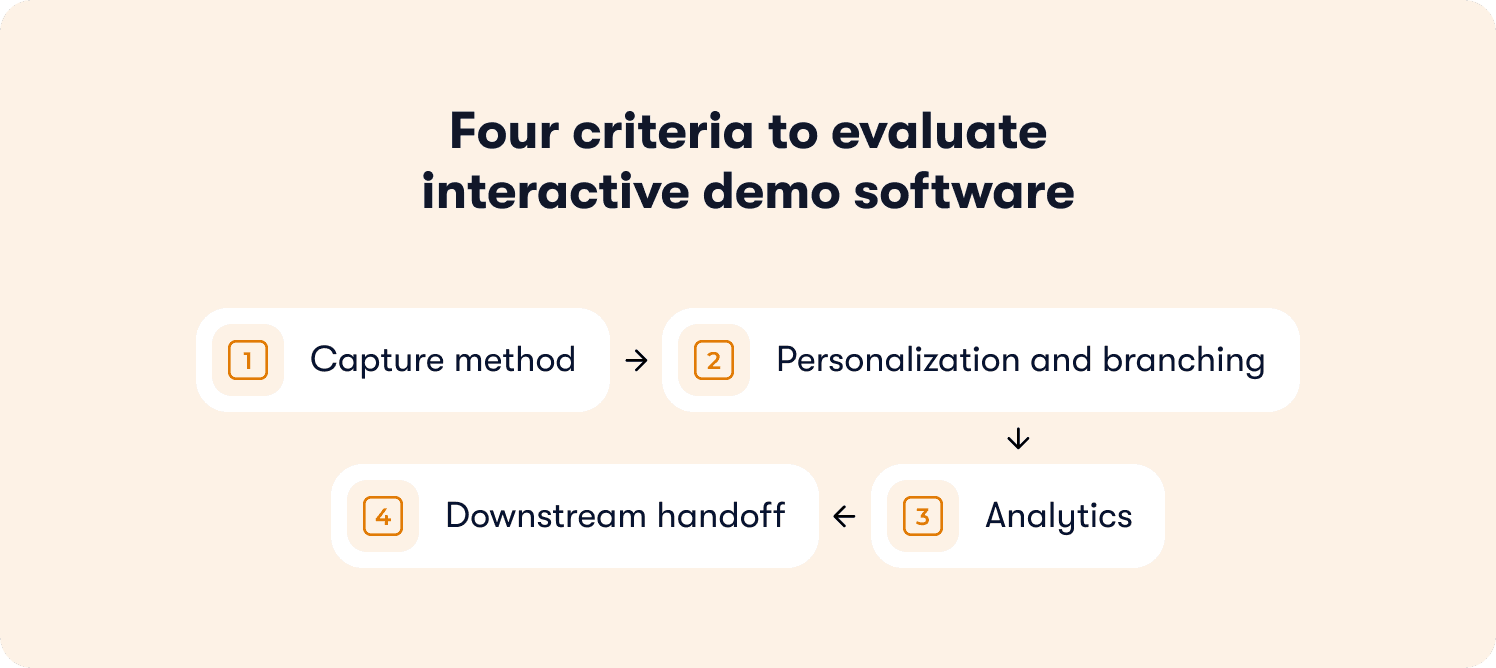
Four criteria apply regardless of buyer profile. Use the qualifiers below to shortlist fast:
Capture method. Screen capture for speed and simplicity. HTML clone if your UI changes frequently and demo durability matters. Live clone for enterprise presales where fidelity is non-negotiable.
Personalization and branching. Linear sequences work for website demos. If you are running multi-stakeholder enterprise deals or segmenting by persona, you need conditional branching and prospect-level data injection.
Analytics. Completion rates are the floor. If your sales team does not receive engagement signals before the discovery call (which features a prospect explored, how long they spent, whether they returned), you are leaving pipeline intelligence on the table.
Downstream handoff. Does demo engagement sync to your CRM, trigger a sequence, or inform attribution? For lean teams covering a high volume of deals, this is the multiplier that determines whether demo investment compounds or stays isolated.
Interactive demo software comparison: 10 tools at a glance
Tool | Category | Best for | Capture method | Analytics |
Storylane | Pre-sales demo | Sales team creation | HTML clone | Medium |
Arcade | Pre-sales demo | Marketing content | Screen capture | Light |
Consensus | Sales enablement | Buying committee | Screen capture | Medium |
Guideflow | Pre-sales demo/demo analytics | Buyer intent signals | Screen capture | Deep |
Navattic | Pre-sales demo | No-code website demos | Screen capture | Medium |
Reprise | Pre-sales demo | Enterprise presales | Live clone | Medium |
Demoboost | Sales enablement | Sales-led teams | Screen capture | Medium |
Supademo | Pre-sales demo | Lightweight async | Screenshot | Light |
GetSmartcue | Sales enablement | Demo scripting | Screen capture | Light |
Demodazzle | Pre-sales demo | Video-first demos | Video hybrid | Light |
The 10 best interactive demo software tools in 2026
1. Storylane - Best interactive demo software for sales and GTM teams needing speed and breadth
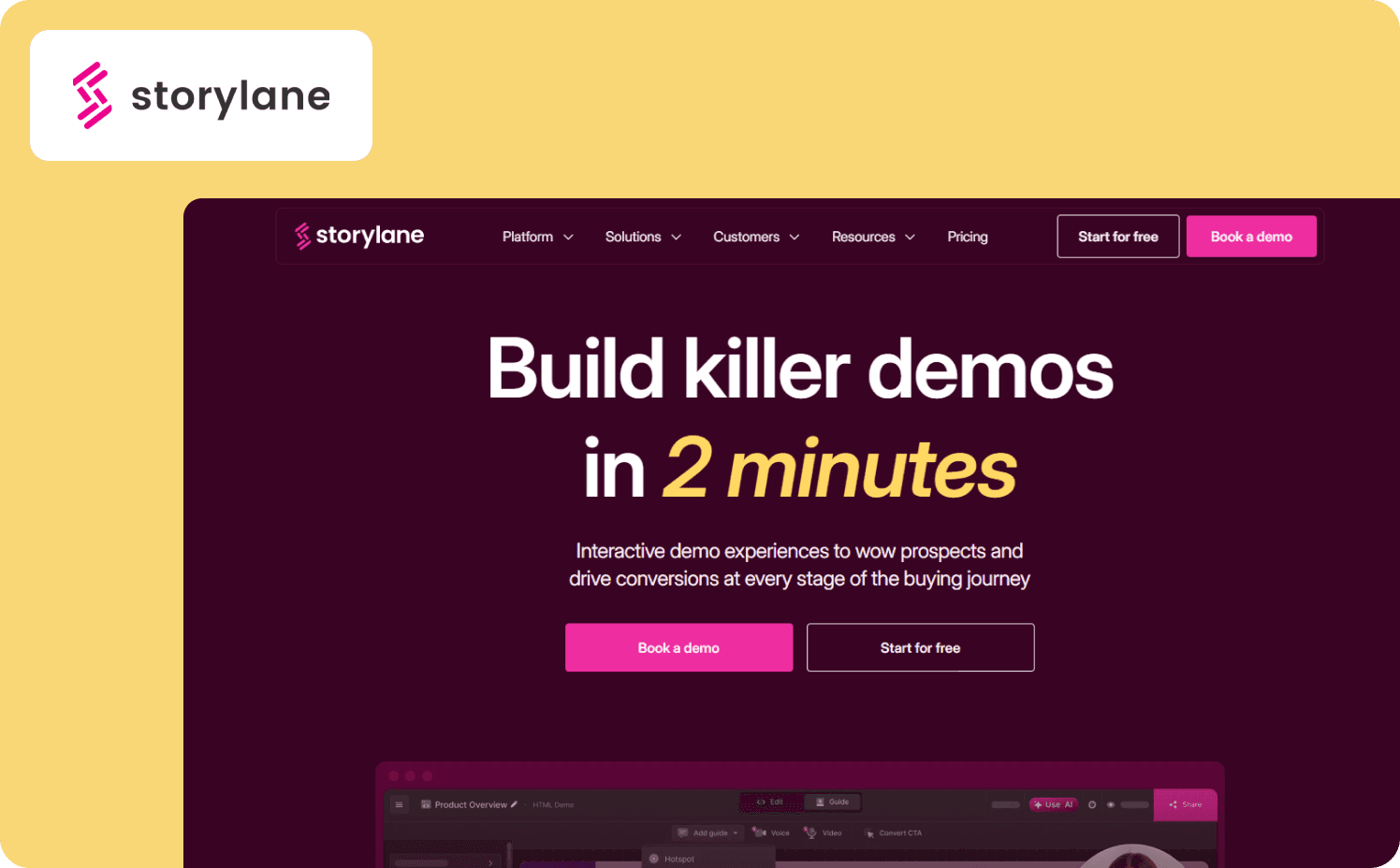
Sales and solution engineering teams at mid-market SaaS companies where deal volume makes per-deal demo rebuilding unsustainable. Storylane has transparent pricing with a flexible monthly billing option and no long-term contracts, which makes it the natural starting point for teams that want to validate ROI before locking into an annual commitment.
Strengths:
The only platform that supports screenshot, video, and HTML recording in a single product. Teams match the format to the use case rather than being locked into one approach.
Lily AI creates personalized demos in a single click, generates life-like presenter demos with video avatars and voiceovers, and translates demos into over 25 languages.
Demo Hub addresses multiple buyer personas and use cases in one place with galleries and playlists, so marketing can run a website library and sales can share curated sequences from the same platform.
Native apps for Gmail, HubSpot, Salesforce, and desktop (Mac), plus RepX, an AI sales agent that qualifies inbound leads and books meetings.
Limitations:
HTML demos require the Growth plan at $500/month annually. The breadth of features can make onboarding complex for smaller teams who only need one use case.
Pricing:
Free plan (one published demo). Starter from $40/month for screenshot and video demos. Growth from $500/month for HTML capture, five seats included. Enterprise custom.
2. Arcade - Best interactive demo software for design-led marketing teams
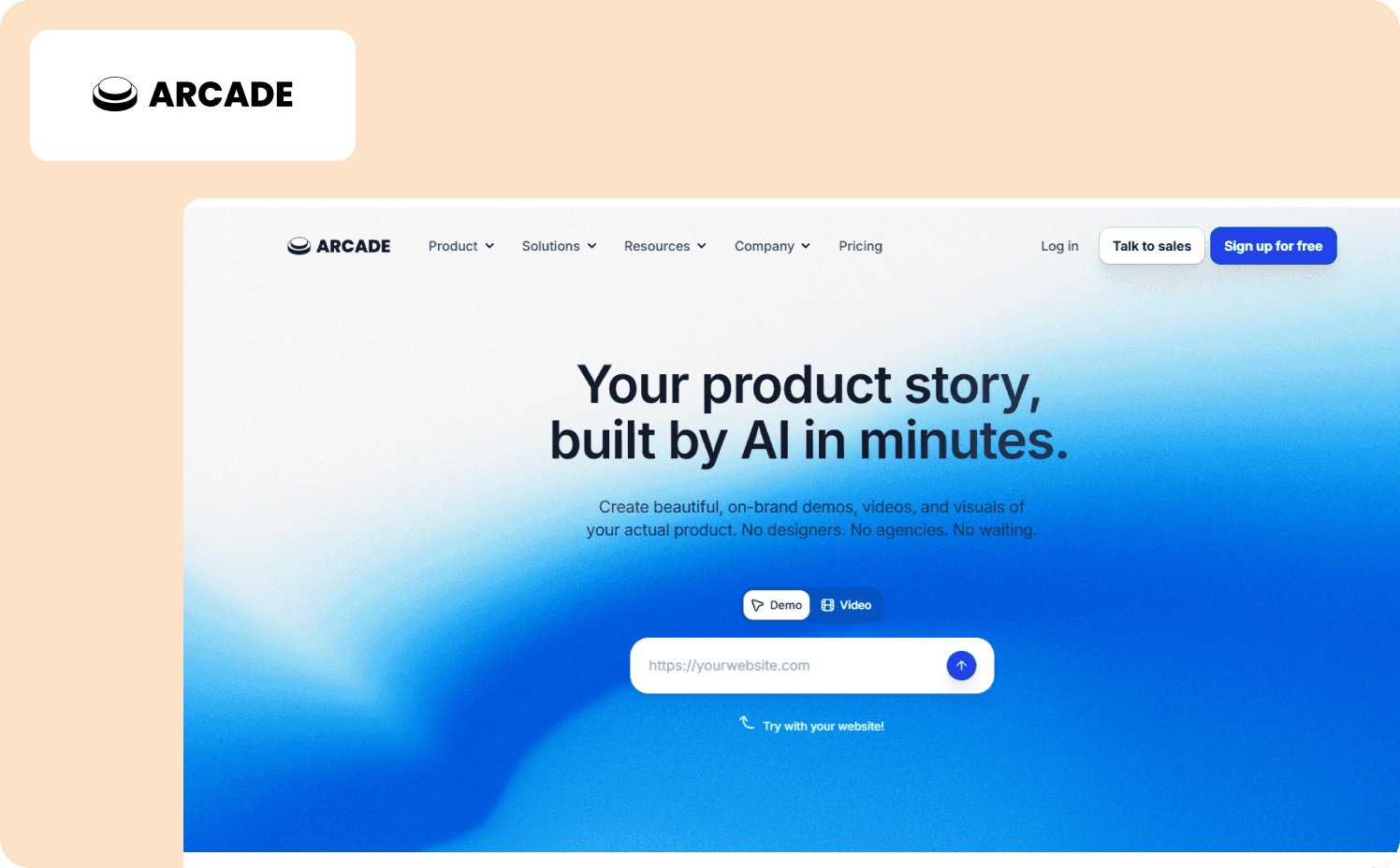
Design-led marketing teams at PLG SaaS companies where the demo is a brand asset as much as a sales tool. When your product walkthrough looks as polished as your brand, prospects actually finish it. Arcade understood this earlier than anyone else in the category. If visual polish and fast publication are the primary requirements, and you are not yet at the scale where deep CRM integration or HTML fidelity are bottlenecks, Arcade is the most frictionless entry point.
Strengths:
The screen recording workflow produces a polished demo in 10 to 15 minutes. AI features include Avery for voiceover, copy suggestions, automatic translations, and auto-chapters.
The most capable free plan in the category: three published demos, 200 AI credits, AI voiceover, Chrome extension, desktop app, and Figma plugin with no time limit.
Output formats include interactive demos, GIFs, and MP4 videos, making the same capture reusable across website, social, and async sales contexts.
Limitations:
When you need analytics that tie demo engagement to pipeline, personalization that adapts content to a buyer's industry, or formats beyond demos and GIFs, Arcade starts to feel limited. The Growth plan moved to $297.50/month flat (five included seats) in 2026, which raised the floor for small teams.
Pricing:
Free plan (three demos, no time limit). Pro at $32/user/month (annual). Growth at $42/month flat for five seats. HTML capture is Growth tier and above. Enterprise custom.
3. Consensus - Best interactive demo software for buying committee enablement
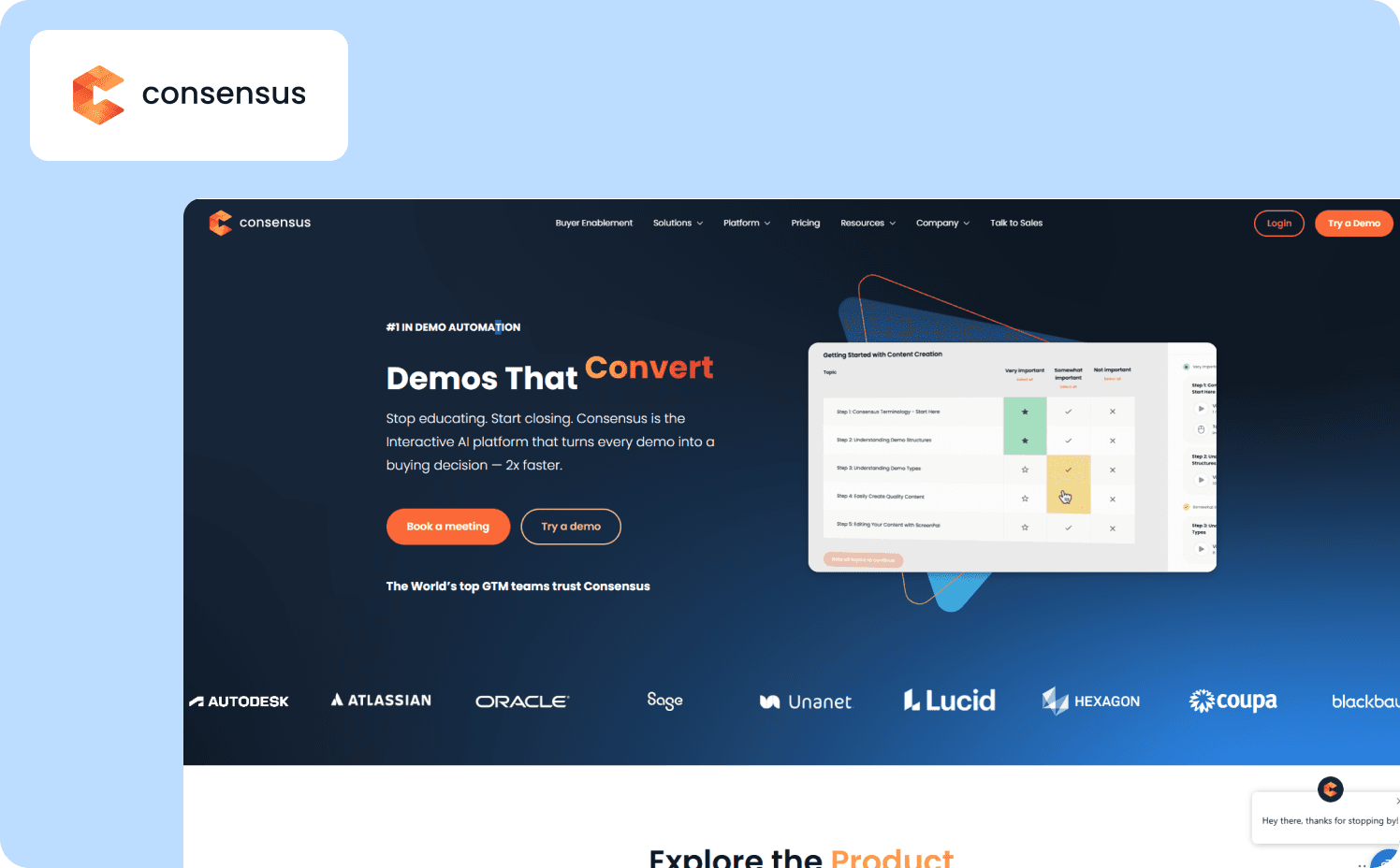
B2B sales teams in mid-market to enterprise deals where the economic buyer is rarely on the first call and the champion needs to sell internally on your behalf. Consensus enables interactive, self-guided demos without engineering support. If your sales motion is multi-threaded (procurement, IT, legal, and end users all involved) and your champion needs something they can share that tracks without requiring a rep on every touchpoint, Consensus is built for that situation.
Strengths:
Buying committee analytics surface which stakeholders engaged with which content, for how long, and in what sequence. No traditional demo tool produces this visibility because it has no insight into what happens after a champion shares a link.
Guided tours, sandbox environments, overlays, digital sales rooms, and demo menus that allow prospects to navigate independently. Covers the full range of async buyer engagement formats from a single platform.
Automated follow-up triggered by engagement events means deals keep moving without requiring reps to manually track every stakeholder touchpoint.
Limitations:
Auto-renewal terms require a 90-day advance notice to cancel. The platform is a sales enablement and buyer engagement layer rather than a demo creation tool. Teams evaluating it for visual production quality will find it less refined than Navattic or Arcade.
Pricing:
Starter from (5 users) from $600/month. Pro plan from $1,250/month. Enterprise custom.
4. Guideflow - Best for teams that treat demo engagement as pipeline intelligence
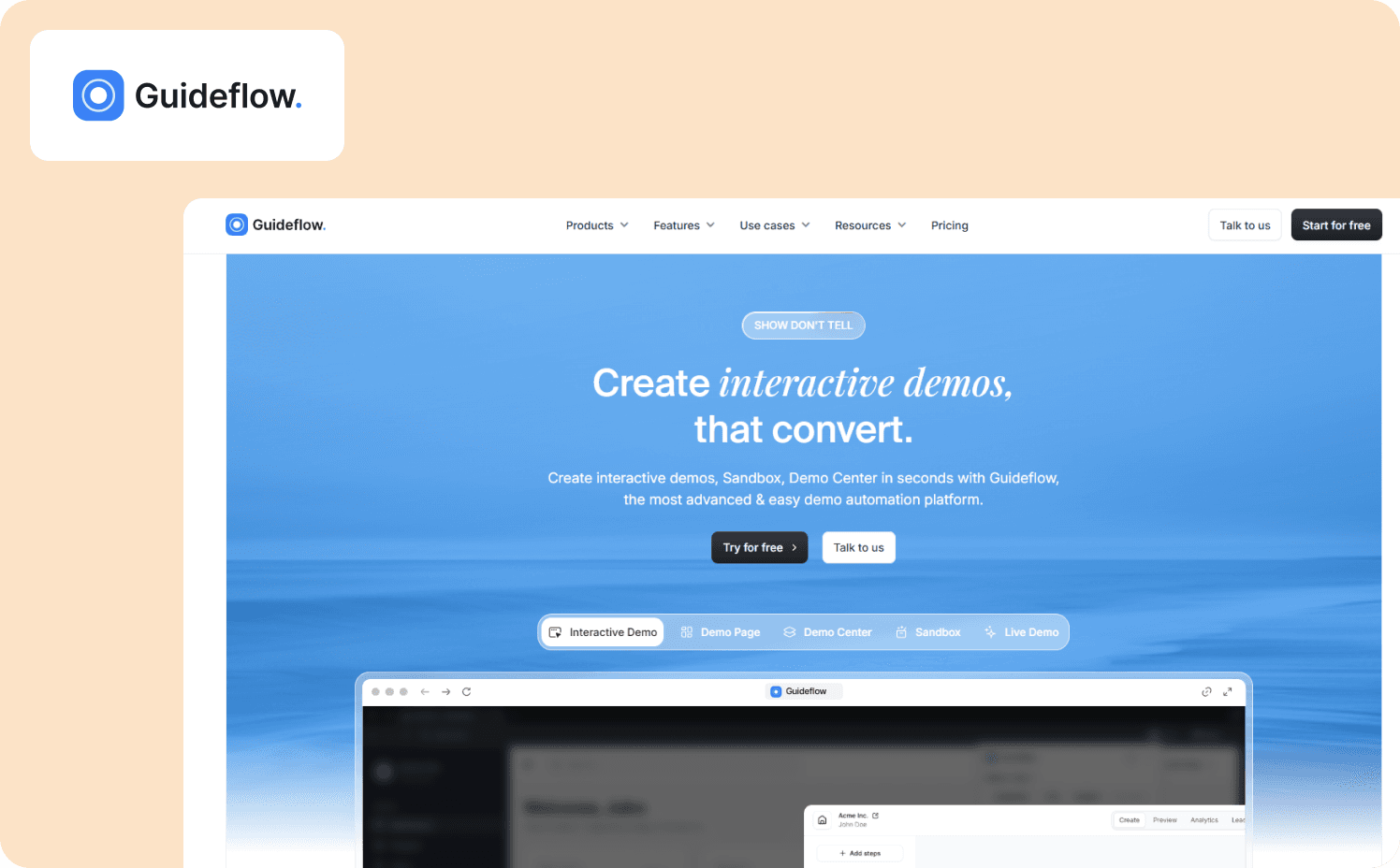
Sales and marketing teams at data-driven SaaS companies where the question after every demo is not "did they watch it?" but "what did they care about, and what does that tell us about how to close the deal?" Guideflow caters to marketing, presales, and enterprise sales workflows, with a strong focus on turning demo engagement into actionable pipeline signals.
Strengths:
Demo engagement analytics go beyond completion rates: step-level time spent, drop-off points, and repeat view data per prospect give sales teams a detailed picture of buyer interest before the first live conversation.
Strong integration layer connecting demo data to HubSpot, Salesforce, Segment, and analytics platforms, making demo engagement a persistent pipeline signal rather than an isolated interaction.
Supports interactive guides and product tours alongside pre-sales demos, giving teams a single platform that spans the sales motion and early post-conversion experience.
Limitations:
More analytics-forward than creation-forward. Teams whose primary need is fast, visually polished demo production will find the creation workflow less optimized than Navattic or Storylane.
Pricing:
Free plan available. Solo plan from $35/month. Growth plan from $499/month. Enterprise from $2,999/month.
5. Reprise - Best interactive demo software for enterprise presales teams
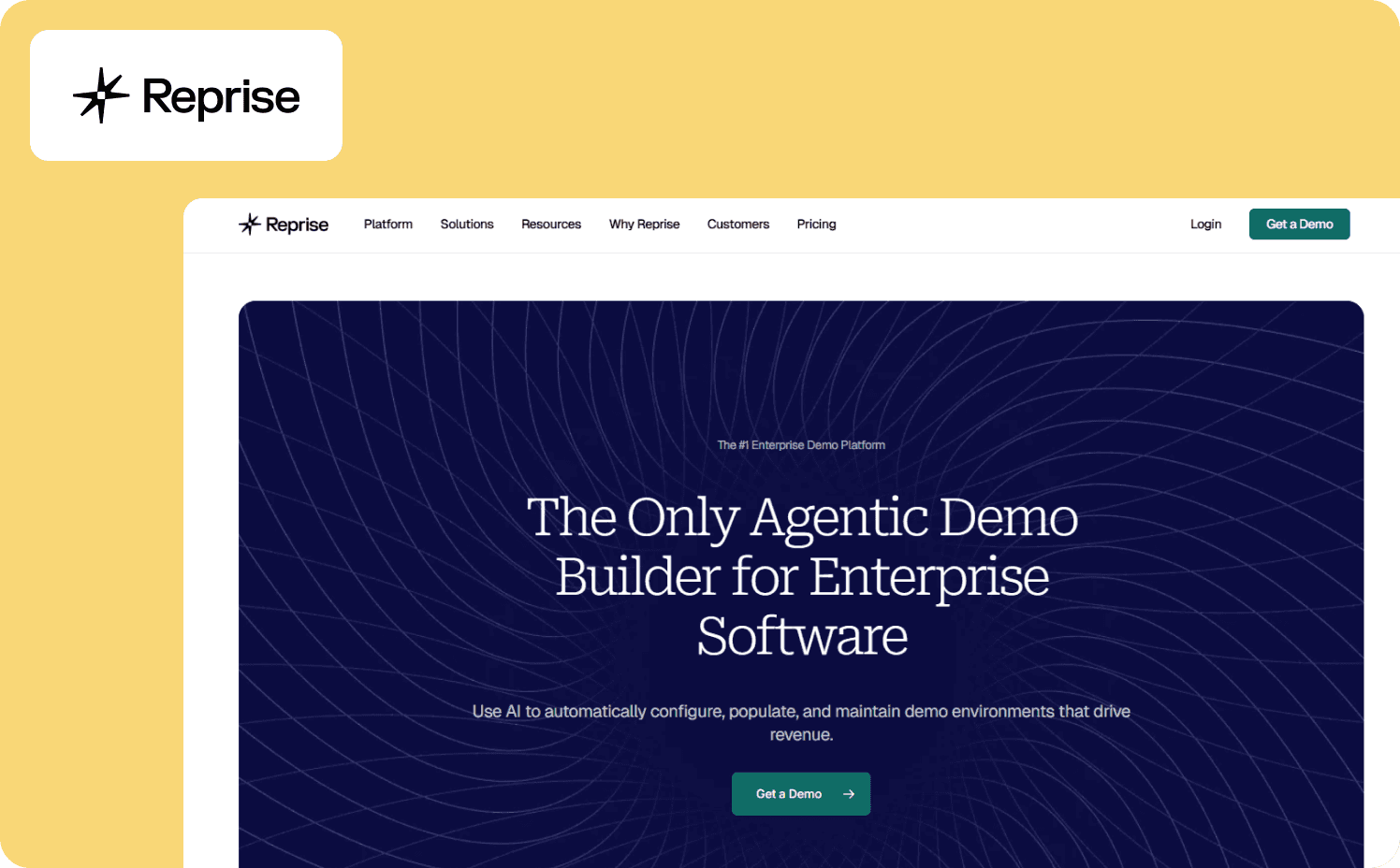
Enterprise sales organizations (typically 200+ employees) with dedicated presales or solutions engineering functions where demo quality is a competitive differentiator in formal evaluations. Reprise supports SOC 2 Type 2 and ISO/IEC 27001:2022 security standards, with customizable role-based access controls. If your deals involve procurement security checklists or compliance requirements, Reprise is the only tool in this list built to those standards.
Strengths:
Reprise Reveal lets you inject customer data into demos with a Chrome Extension, with fast no-code edits to images, text, and logos in bulk. The same SE can produce a customized demo environment for two different industries in one morning.
Three demo formats: walkthroughs, live demo overlays, and sandboxes. Covers the full presales motion from early-stage discovery through to live proof-of-concept environments.
Built for storytelling across complex environments and use cases, with the ability to consolidate multiple tours into a single narrative for internal communications and sales support.
Limitations:
Slower to reach ROI than lighter tools, and some features require specialized technical knowledge. Pricing starts around $30,000 to $50,000+ per year on enterprise contracts, with annual commitments and a 90-day cancellation notice. Not suited to companies under 200 employees.
Pricing:
Enterprise only. Annual platform fee plus flexible per-user licenses. No public pricing.
6. Navattic - Best no-code interactive demo software for product marketing teams
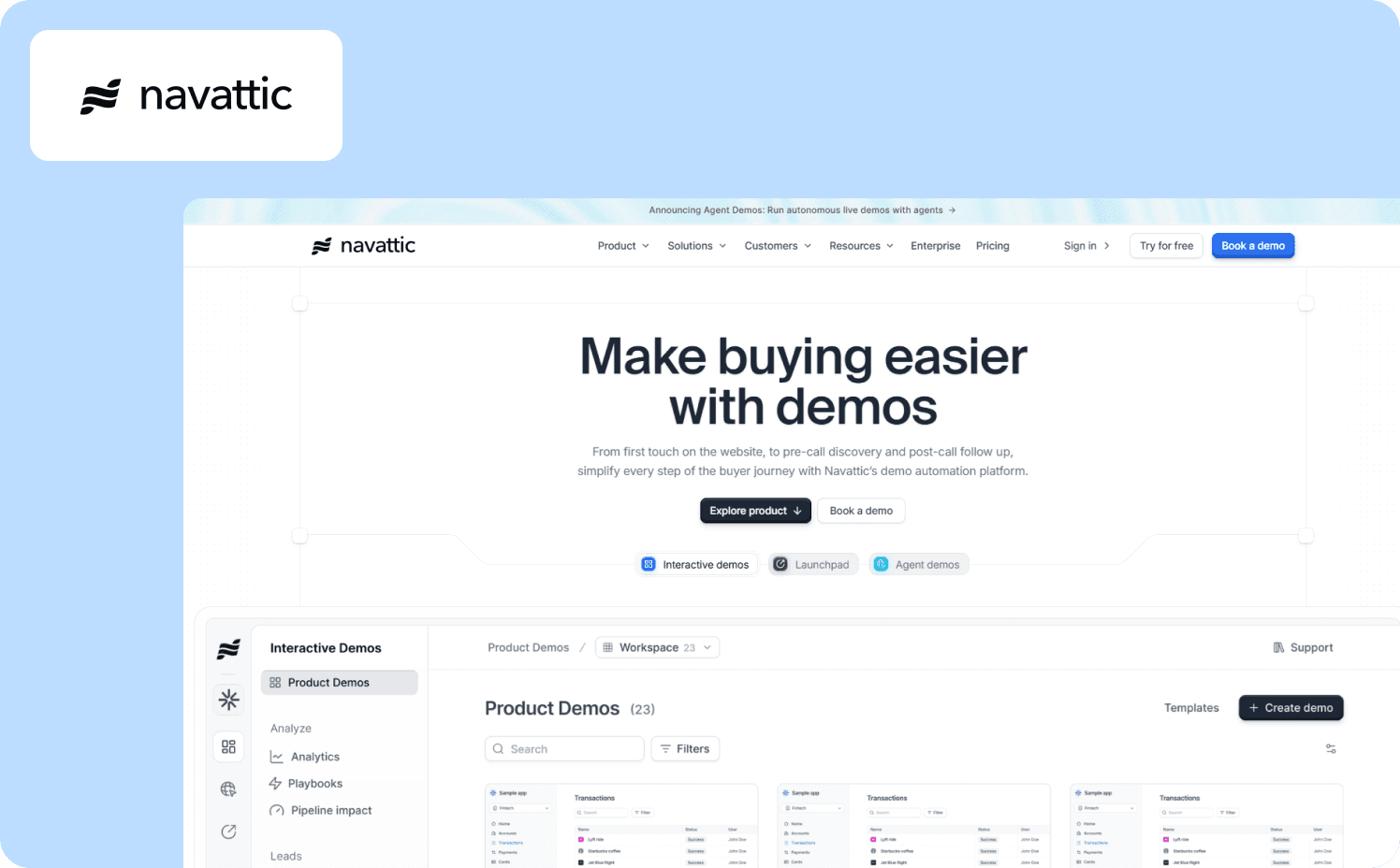
Product marketing managers at Series A through C SaaS companies running ABM, PLG, or demand gen motions who need a self-serve product experience live on the website without waiting on engineering. Navattic averages about two weeks from purchase to live implementation, with strong customer support ratings. If your team needs to get a demo live fast, iterate by campaign, and track which companies are engaging without a data team interpreting the output, Navattic is built for that workflow.
Strengths:
Demo intent data shows exactly how prospects engage and can trigger email or Slack alerts for high-intent demo views. Syncs engagement data to Salesforce, HubSpot, Marketo, Segment, Amplitude, and Google Analytics.
Launchpad is demo automation purpose-built for sales teams to share demos earlier in the sales cycle and free up presales time. SEs can understand prospect interests before a live call.
Branching and checklist logic allows custom demo flows that activate self-serve users or upsell current accounts.
AI Copilot writes demo copy, anchors tooltips, and crafts a demo story, reducing time from capture to publishable demo.
Limitations:
No monthly billing. Navattic offers quarterly (minimum three months) or annual commitments, meaning the minimum spend at the Base tier is $1,500. CRM integrations are Base tier and above. Sandbox demos are locked behind the Growth tier.
Pricing:
Base plan from $500/month (five seats, quarterly minimum). Growth at $1,000/month. Free Starter plan gives one HTML demo and one seat. Enterprise plan available.
7. Demoboost - Best for sales-led teams that need demo consistency without a dedicated SE team
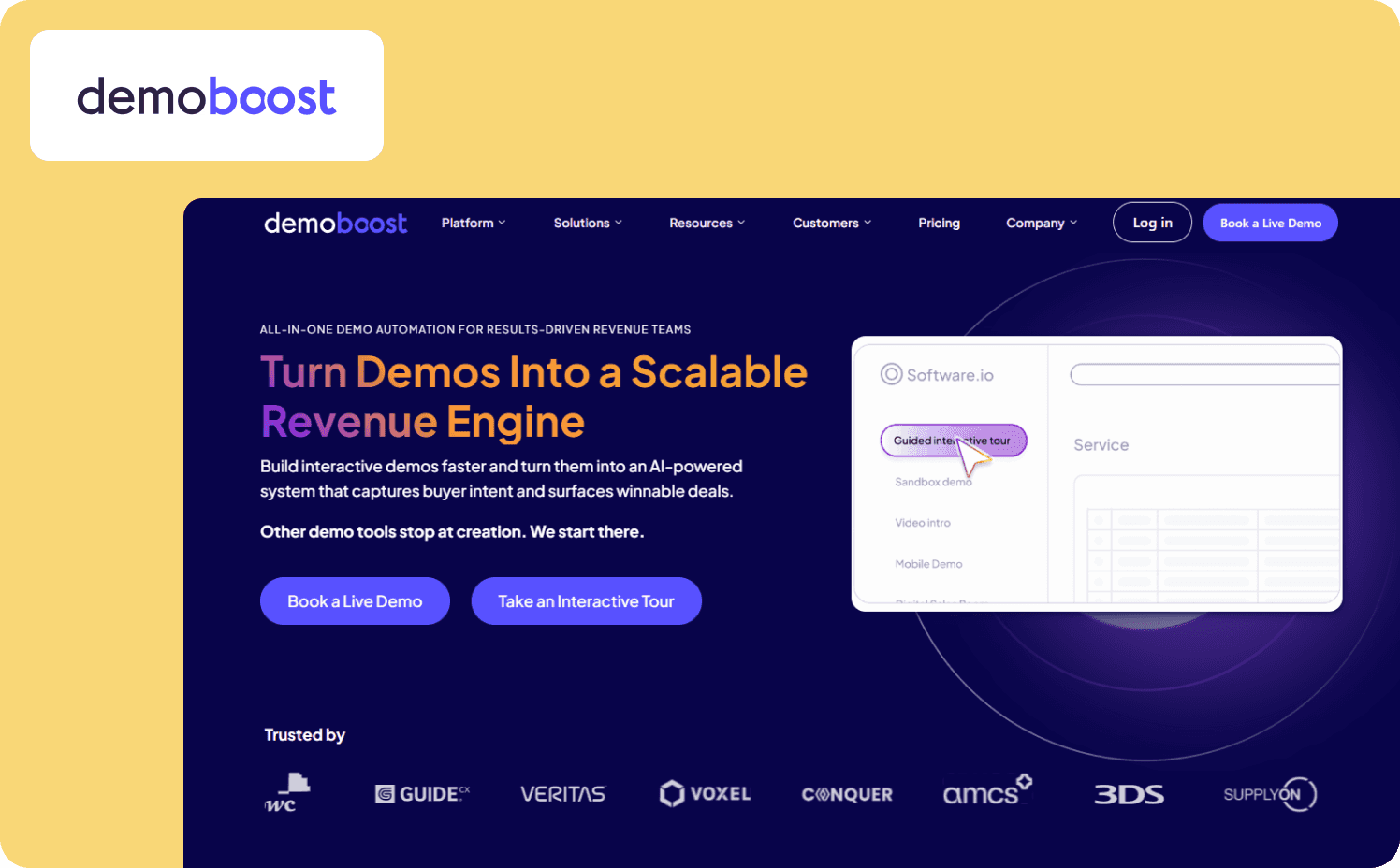
Sales-led SaaS companies at the growth stage (typically 20 to 150 employees) where the founding SE can no longer personally support every demo across a growing rep team. Demoboost enables live and on-demand interactive demos that are editable, trackable, and integrated with CRM systems. If demo quality variance across reps is a recognized revenue problem and the budget requires a tool covering both live and async formats from one platform, Demoboost sits in the right position.
Strengths:
Speaker notes and built-in scripts with recommended talking points help both new and experienced sellers navigate discussions with confidence, reducing variance from reps improvising different emphasis across calls.
Supports overlaying video on top of HTML-based demos, internal feedback collection, and A/B testing of demo variants.
Guided tours, sandbox environments, overlays, and digital sales rooms all in one platform, reducing tool sprawl for teams managing multiple demo formats.
Limitations:
HTML-based, which means it is less useful for embedding in documents, smaller screens, or mobile viewing. No free trial.
Pricing:
Startup plan from $375/month. For Custom (enterprise), contact Demoboost directly for a quote based on number of users.
8. Supademo - Best no-code demo software for small teams and early-stage companies
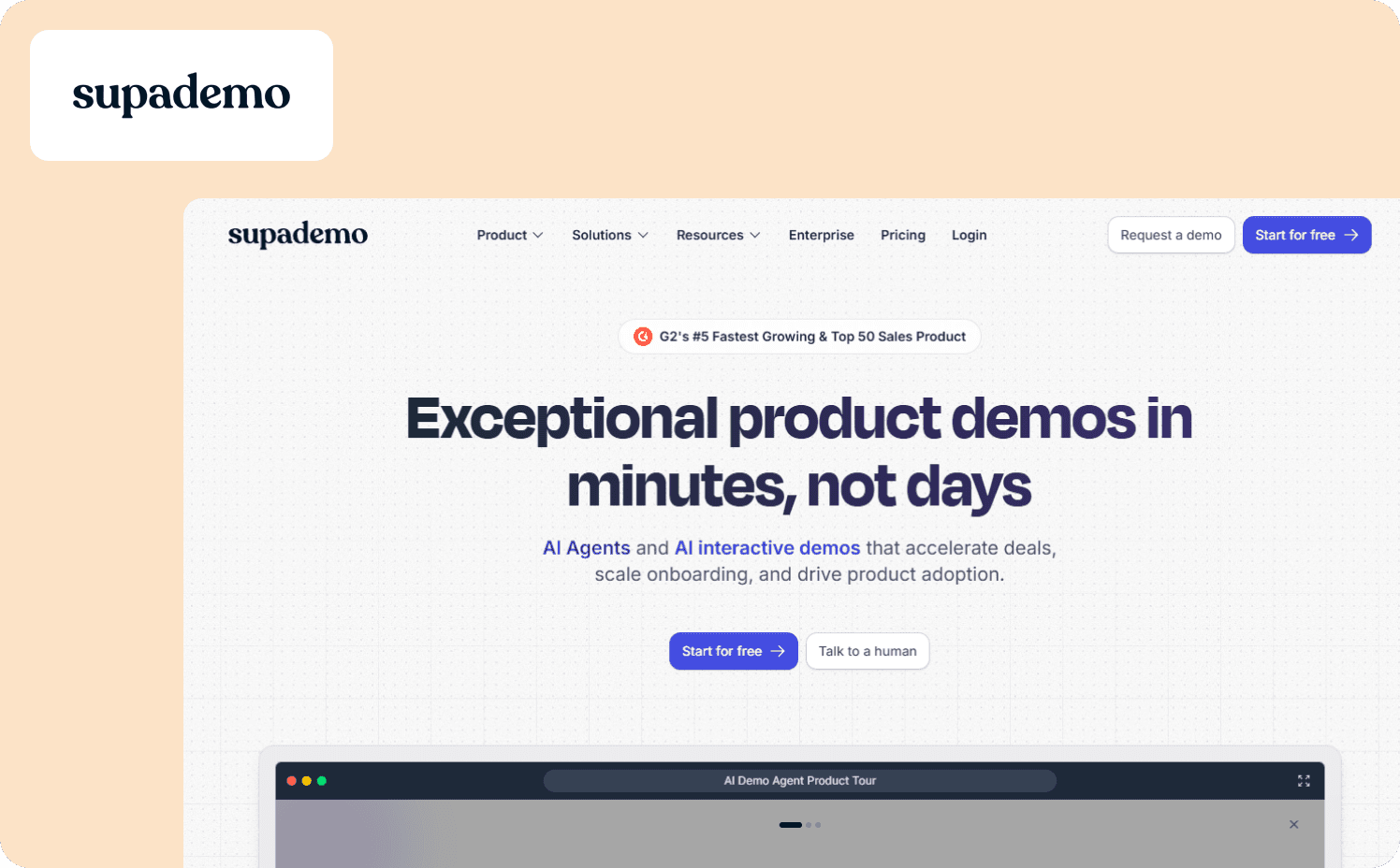
Early-stage SaaS companies (pre-Series A through early Series A) where a founder, single growth hire, or small marketing team needs to produce shareable product demos for async sales, investor decks, and website conversion without design or engineering resources. Rated number one for easiest setup on G2, averaging 3.5 minutes from recording to publishing. If every tool decision is also a budget decision, Supademo's free tier and accessible pricing make it the lowest-friction entry point in the category.
Strengths:
Supports HTML cloning, screenshot capture, video recording, and sandbox environments for free-exploration demos. More format flexibility than its pricing tier suggests.
AI enhancements add synthetic voiceovers, annotations, and translations. A solo marketer can produce a narrated, multi-language demo without a large production budget.
Free plan (one creator, five demos). Scale from $38/month annual per creator, the most accessible paid entry point in the category.
Limitations:
HTML demos start at the $350/month Growth tier for five creators. Analytics are present but less granular than Storylane or Navattic. Optimized for product-led and marketing-led pipeline; sales-led teams needing deal intelligence or deep CRM integration will outgrow it.
Pricing:
Free (five demos, one creator). Scale from $38/month per creator (annual). Growth from $350/month for five creators. Enterprise custom.
9. Smartcue - Best for scaling sales teams where demo narrative consistency is the constraint
Sales teams that have grown past the point where a single SE or founding AE can personally coach every rep's demo delivery (typically 10 to 50 quota-carrying reps) and where deal quality variance is traceable to how differently reps tell the product story. Smartcue is AI-native and built for price-conscious mid-market teams where the per-seat cost of Navattic or Storylane is not justified, but demo narrative consistency is a recognized revenue problem.
Strengths:
Guided talk tracks and speaker notes embedded alongside the demo mean every rep follows the same narrative structure in real time, reducing variance across calls.
At roughly $99/seat/year, Smartcue is six to 19 times cheaper than Supademo Pro or Scale, making it viable for teams where the consistency problem is real but the budget for a full demo automation platform is not.
Enterprise customers including Personify Health, Creditsafe, and OneDigital run on Smartcue at the self-serve price tier.
Limitations:
Works best as a scripting and consistency layer on top of demos created in another tool, rather than as a standalone demo builder.
Pricing:
Approximately $99/seat/year on annual essential plan. Custom enterprise pricing.
10. Demodazzle - Best for teams using AI avatars and 3D presentations to differentiate demos
Sales and presales teams, particularly in SaaS, edtech, and enterprise software, where the standard click-through demo format is table stakes and teams want to differentiate through a higher-production, AI-driven presentation format. If the primary constraint is buyer attention in cold outreach and early nurture contexts, Demodazzle's format creates differentiation at the awareness stage.
Strengths:
AI-powered personalization allows tailored demonstrations for each prospect without rebuilding the demo per deal.
Covers use cases beyond pure pre-sales: learning and development teams creating interactive training modules, SaaS founders building investor presentations.
Design-once, share-anytime format reduces the per-demo production cost for teams running high-volume outbound.
Limitations:
Less suited for teams needing deep product interactivity or late-stage evaluation demos where a buyer wants to explore the product on their own terms. The AI avatar format performs best as a top-of-funnel engagement mechanism, not a close-stage proof-of-capability tool.
Pricing:
Works on a token-based pricing with business plan from $50 (for 300 tokens, $0.17/token)
Which interactive demo software is right for your situation?
Choosing a tool from a list of ten is not the hard part. The hard part is knowing which problem you are actually solving, because the right answer for a product marketer running ABM campaigns is different from the right answer for an SE team managing enterprise proof-of-concepts. The table below maps common team situations to the tool best built for them.
If you are... | The right fit |
A product marketer running ABM campaigns with no engineering support | Navattic |
An early-stage founder or a team of one who needs something live this week | Supademo or Arcade |
A sales team where every rep tells a different story and deal quality varies | GetSmartcue |
A RevOps or sales team that wants to know what prospects care about before the discovery call | Guideflow |
Running multi-stakeholder enterprise deals where the economic buyer is never on your calls | Consensus |
An enterprise presales team with compliance requirements and live demo complexity | Reprise |
A GTM team where marketing, sales, and presales all need demo access without separate tools | Storylane |
A sales-led team that needs polished demos but cannot justify a dedicated SE hire yet | Demoboost |
Interactive demo software has matured quickly. What started as a niche tool for product marketers embedding tours on landing pages now spans pre-sales sandbox environments, AI-assisted personalization, buying committee analytics, and multi-format demo hubs.
Every tool in this list is built for the moment before conversion. They are exceptional at generating desire, shortening sales cycles, and getting a prospect to yes. What they cannot do is follow that prospect into your product and make sure the experience that convinced them to sign up is the same experience they have on day one.
What happens after the demo converts?
The nine-word version of the problem: a prospect loved the demo, signed up, and then churned.
Demo software closes the pre-conversion gap. But trial-to-paid conversion and activation rates are separate problems. Getting a prospect to yes is one discipline; getting a new user to the moment where your product delivers on what the demo promised is another. If your activation rate has not moved despite a high-performing demo program, the issue is not your demo tool. It is what happens after the signup button.
Jimo is a digital adoption platform built for B2B SaaS product teams (Series A through B, 50 to 500 employees, PLG or hybrid GTM). It is not a demo creation tool. It is the activation layer that takes over the moment a prospect becomes a user and lands in your actual product.
Strengths:
Action-based product tours: Tours auto-progress when users perform real product behaviors (element clicks, page navigations, form submissions) rather than requiring "Next" button clicks. Steps connect to actual user intent rather than a predetermined sequence.
Native integration with Arcade and Storylane: Teams already using Arcade or Storylane for pre-sales demos can embed those interactive demos inside Jimo experiences, so the visual language a prospect saw before signing up continues into their first product session.
Success Tracker: Connects in-app guidance to revenue-driving activation events. The closed loop between observing user behavior and deploying contextual guidance that moves activation metrics.
AI Builder: Generates complete onboarding flows from a recorded user session in minutes. 90% of teams ship new guidance flows without developer involvement.
Verified results: AB Tasty reached 2,000 users in week one with 6x faster launch time.
Limitations:
Web-based SaaS only. Not designed for native mobile apps (iOS/Android). Built for product teams managing post-conversion activation, not sales teams building pre-sales demos. If you need a demo creation tool, entries 1 through 10 cover that category. For onboarding checklists that map to activation milestones, see the user onboarding checklist guide.
Pricing:
Starter: $249/mo (2,500 to 10,000 MAUs). Growth: $479/mo (2,500 to 100,000 MAUs). Enterprise: Custom.
Jimo calls this discipline Intelligence-Led Growth (ILG). If the tools above solve the problem you came here with, you are in good hands. If you recognize the gap (the churned trial, the activation rate that stalled, the demo that converted but the product that did not), book a demo with Jimo and see what comes after the demo.
FAQs
What is the best interactive demo software for SaaS companies?
It depends on where your team sits in the GTM motion. For product marketing managers who need a self-serve website demo without engineering support, Navattic leads, particularly for ABM-focused teams that need intent data flowing into Salesforce or HubSpot. For sales and GTM teams that need format flexibility across screenshot, video, and HTML, Storylane's transparent pricing and multi-format support make it the most versatile option at mid-market scale. For design-led teams where the demo is a brand asset, Arcade's visual defaults and fast publication workflow are the strongest fit. For enterprise presales with compliance requirements, Reprise is the only platform built to that security standard. For demo engagement analytics that generate buyer intent signals before the discovery call, Guideflow is the most analytics-forward option.
What is the best interactive demo software for sales engineers and presales teams?
It depends on deal complexity and company size. Reprise leads for enterprise presales teams at 200+ employee organizations that need live, customized demo environments and SOC 2 compliance, but plan for a $30,000 to $50,000+ annual investment. Consensus is the strongest option for multi-threaded deals where buying committee stakeholders need to engage asynchronously. Storylane is the most accessible option for presales teams at growth-stage companies who need AI-assisted personalization at a price point that does not require an enterprise budget. For teams where demo narrative consistency across reps is the constraint, GetSmartcue's embedded talk tracks solve a problem the other tools leave untouched.
What is the best no-code software for creating interactive demos?
Navattic and Supademo are the two strongest no-code options, but they serve different buyer profiles. Navattic fits marketing teams at Series A through C companies running ABM or PLG motions who need HTML-quality demos, intent data, and CRM integration, at a minimum $500/month quarterly commitment. Supademo fits early-stage teams or individuals who need to be published in minutes without a sales conversation. The free plan covers five demos with no time limit. Arcade sits between them: the most visually polished no-code output in the category, a generous free tier, and a straightforward creation workflow, though HTML capture requires the Growth plan at $297.50/month flat.
What is the difference between interactive demo software and product onboarding software?
Interactive demo software creates simulated product experiences for prospects before they sign up. The demos run in a captured or cloned version of your product (not the live product) and are designed to generate pipeline by helping buyers understand what they would be purchasing.
Product onboarding and digital adoption platforms like Jimo guide real users through your actual product after they convert, connecting each step to the activation events that determine whether a new user becomes a retained, paying customer. The two categories are complementary, not interchangeable. For a deeper treatment of the onboarding side, see product walkthrough software.