TL;DR
Signups look healthy, but the product empties out day to day, and that gap between acquisition and daily use is where most SaaS growth actually stalls. This guide covers what drives daily and monthly active users up for web-based SaaS products specifically, not mobile apps: the real causes behind declining engagement, six to eight tactics that turn occasional logins into habits, and how to grow return visits without triggering notification fatigue. The DAU/MAU ratio runs through all of it as the number that tells you whether any of this is working. By the end, you'll have a practical framework for building the kind of daily engagement that compounds into retention and expansion.
This guide is for web-based SaaS products, not mobile apps. If you're chasing App Store rankings or fighting install-to-open drop-off, the tactics here won't map cleanly to that world.
For everyone else: your signup numbers look fine. Trial activations are steady, maybe even growing. But open your analytics dashboard and a different story shows up. Users log in once, poke around, and don't come back the next day. Or the next week.
That's not an acquisition problem. It's a daily active users problem, and it's a lot more common than most product teams want to admit. A product can have a healthy top of funnel and a quietly shrinking base of people who actually use it on any given day.
This matters because daily and monthly active users aren't vanity numbers. They're the clearest signal of whether a product has become part of someone's routine or just another tool they signed up for and forgot. A declining DAU/MAU ratio shows up in retention numbers eventually. Catching it early, in the daily behavior itself, gives a team time to fix the problem before it becomes a churn statistic.
The rest of this guide covers what actually drives that daily return behavior, the tactics that build it deliberately, and how to grow engagement without wearing users out in the process.
What counts as an active user (and why the definition matters)
"Active" means something different depending on who's counting. A social platform might count anyone who opens the app. A SaaS product needs a tighter bar, or the number stops meaning anything.
The right definition ties to a specific, value-generating action, not just a login. A project management tool might define active as "created or updated a task." A CRM might define it as "logged an activity or moved a deal stage." Login-only definitions inflate the number and hide the real engagement problem underneath it.
Metric | Time window | Best for |
Daily active users (DAU) | 24 hours | High-frequency products: messaging, collaboration, dashboards checked daily |
Weekly active users (WAU) | 7 days | Workflow tools where a weekly check-in is the natural cadence |
Monthly active users (MAU) | 30 days | Products used in longer cycles: reporting, billing, less frequent workflows |
Before chasing any of these numbers up, define what counts as an action worth measuring. A team tracking the wrong active-user definition can spend months optimizing a number that has nothing to do with whether the product is actually sticking.
Why daily active users decline (the real causes, not the symptoms)
A shrinking DAU number is a symptom. The causes usually fall into a handful of patterns, and most teams jump straight to tactics without diagnosing which one they're actually dealing with.
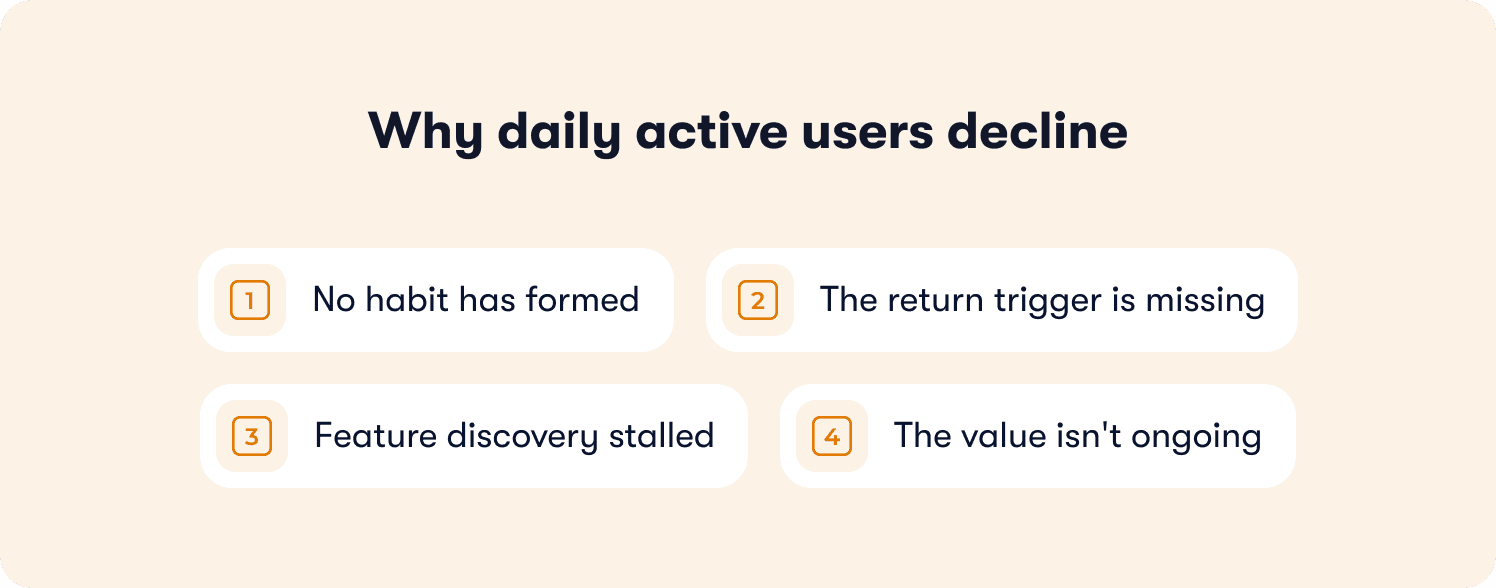
No habit has formed. Users got value once, during onboarding, but nothing in the product experience gives them a reason to come back today specifically.
The return trigger is missing. There's no prompt, no notification, no natural cue that brings a user back when they'd otherwise forget the product exists.
Feature discovery stalled. Users are stuck using one narrow slice of the product. Once that slice stops being relevant that week, they have no reason to open the app.
The value isn't ongoing. Some products deliver most of their value in a single setup session. If the product doesn't have an ongoing reason to be opened, no amount of triggers will manufacture one.
This is a different failure point than a broken first-session activation flow. A user can activate successfully, reach their first value moment, and still drift away weeks later because nothing pulled them back. That drift shows up clearly on a product adoption curve: a strong early spike in usage that flattens out instead of settling into a steady return pattern.
Diagnosing which of these four patterns is driving the decline matters before picking a tactic. A re-engagement email won't fix a product with no ongoing value. A feature nudge won't fix a missing return trigger. The tactics in the next section map to specific causes, not a one-size-fits-all fix.
6 tactics to increase daily and monthly active users
Each tactic below maps to one of the four decline patterns from the previous section. Match the tactic to the cause you're actually seeing in your own data, rather than running all of them at once.
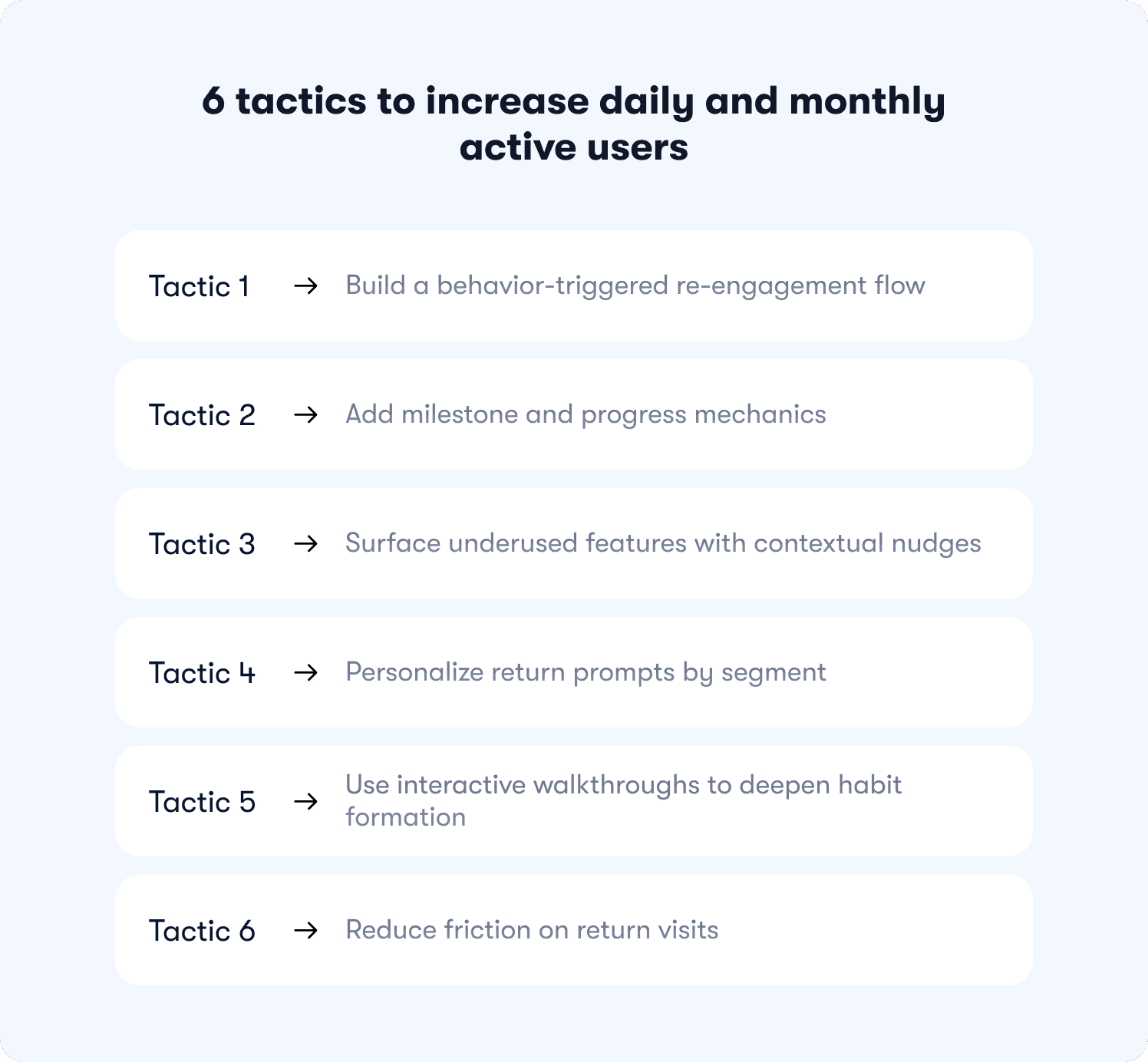
Build a behavior-triggered re-engagement flow
A user who hasn't logged in for five days doesn't need a generic "we miss you" email. They need a nudge tied to something specific: an unread report, a task nobody picked up, a teammate who moved forward without them.
Behavior-triggered messaging built around actual account activity, not just elapsed time, consistently outperforms static win-back campaigns because the message carries a reason to come back today, not just a reminder that the product exists.
Add milestone and progress mechanics
Visible progress toward a goal is one of the more reliable ways to bring a user back tomorrow, not just today. A completion bar, a streak counter, or a simple "you're 2 steps from finishing this workflow" prompt gives users a reason to return that has nothing to do with a notification.
This works especially well layered into onboarding itself, where early habit formation gets set. For a deeper look at building these mechanics into the first-use experience, see gamifying user onboarding.
Surface underused features with contextual nudges
Users who only touch one narrow slice of a product have a shallow reason to open it. A contextual nudge that surfaces a relevant, unused feature at the right moment can widen that surface area and give users more reasons to return through the week.
This tactic focuses on depth of use, not frequency, which is where it overlaps with feature discovery work more broadly. If a team's real problem is that users aren't adopting enough of the product rather than returning often enough, how to increase product adoption covers that territory in more depth.
Personalize return prompts by segment
A sales rep and a finance lead using the same product have different reasons to log in daily. A single generic re-engagement message ignores that, and it shows in low response rates.
User segmentation based on role, usage pattern, or lifecycle stage lets a team tailor the specific hook in each return prompt, rather than sending the same message to everyone and hoping it lands for a fraction of them.
Use interactive walkthroughs to deepen habit formation
A one-time tour during onboarding rarely builds a lasting habit on its own. Interactive walkthroughs that reappear contextually, tied to a feature a user hasn't tried yet, do more to build the return behavior that turns a one-time activation into a daily pattern.
See interactive onboarding strategies for the mechanics behind action-based tours that drive this kind of ongoing engagement, not just a first-session completion rate.
Reduce friction on return visits
Every extra click between opening the product and reaching something useful is a small tax on the habit a team is trying to build. A dashboard that loads to the last-used view, a saved filter, or a quick-access shortcut to yesterday's work all lower the bar for a user to return tomorrow.
This tactic doesn't require new messaging or triggers. It just removes the small frictions that make returning feel like more effort than it's worth.
How to increase active users without overwhelming them
More triggers isn't automatically better. Past a certain point, additional messaging stops driving return visits and starts training users to ignore or mute the product entirely.
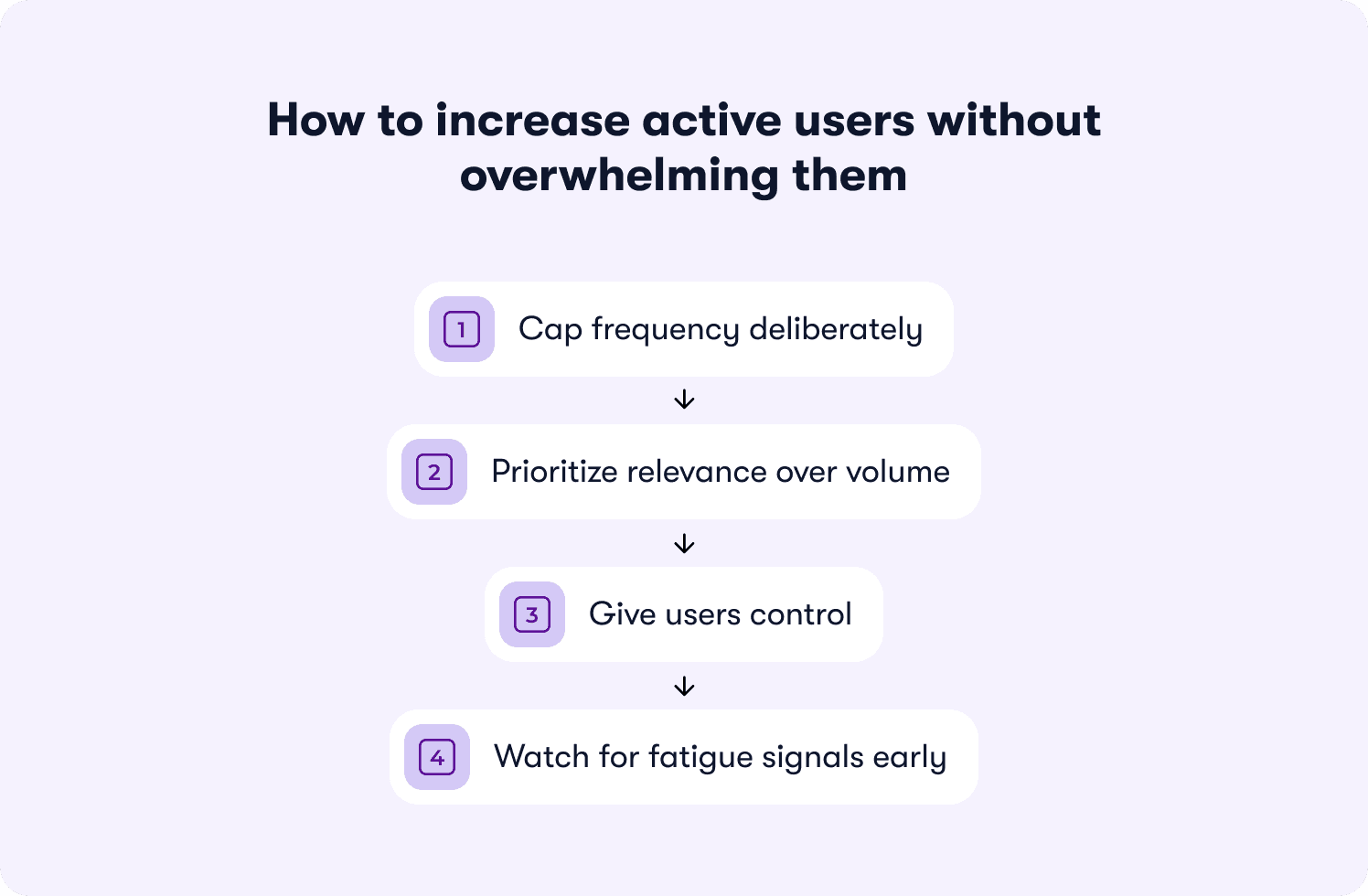
Cap frequency deliberately. A user shouldn't receive more than one or two proactive nudges in a given week unless they've explicitly opted into a higher-touch experience.
Prioritize relevance over volume. One well-targeted message tied to real account activity outperforms five generic ones, and it's far less likely to get muted.
Give users control. Letting users adjust notification frequency or opt out of specific message types reduces churn risk from fatigue while still keeping the door open for the users who do want more contact.
Watch for fatigue signals early. A rising unsubscribe or mute rate is a clearer warning sign than a flat DAU number, and it shows up faster.
The goal isn't maximum contact. It's contact that a user is glad to receive, because it's tied to something they actually care about. A product that respects that line tends to hold onto its CSAT scores even while ramping up engagement tactics, which is the balance worth aiming for.
Turning daily engagement into durable growth
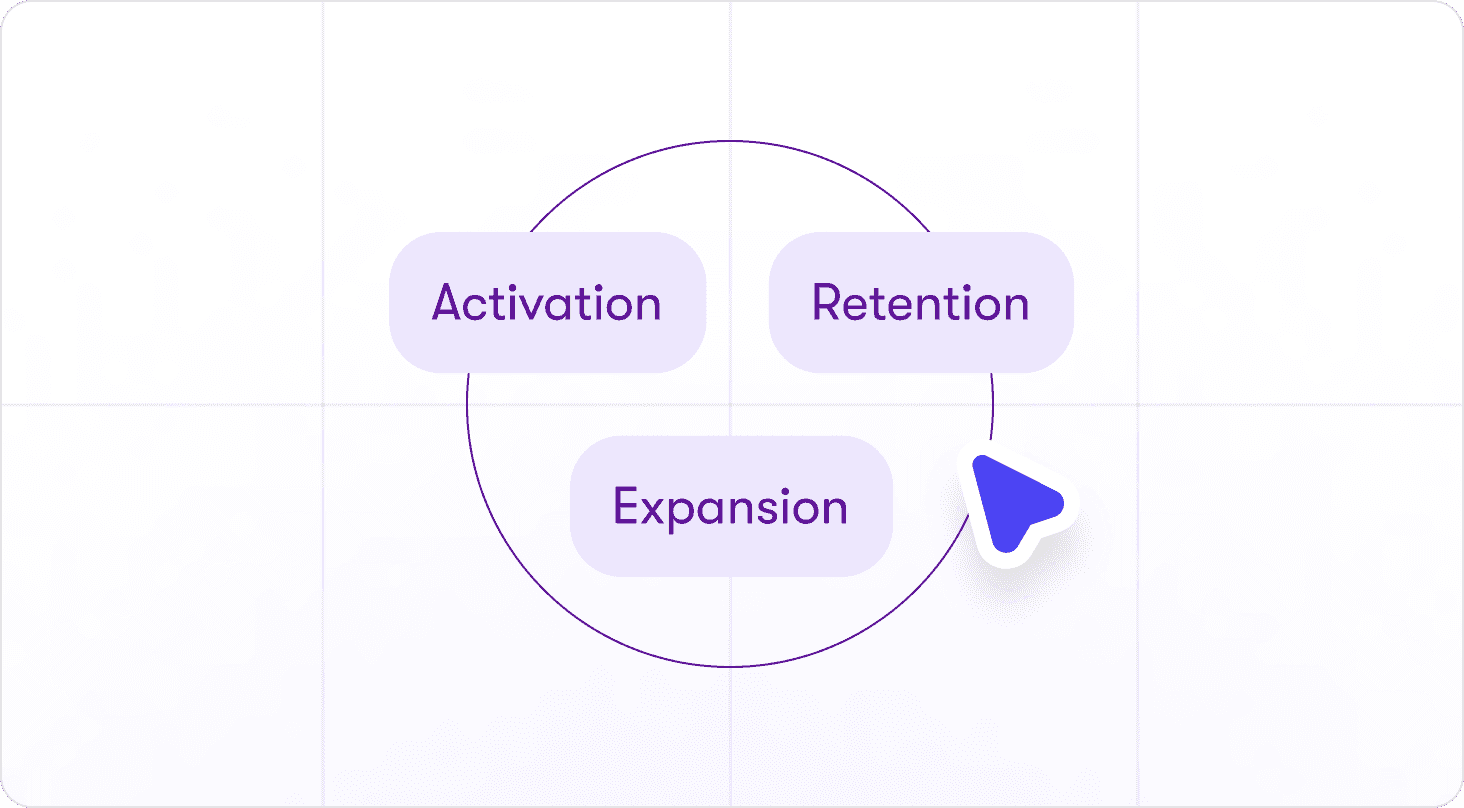
The tactics in this guide share one thing in common: they address a specific cause of decline, not just the symptom of a shrinking number. Behavior-triggered re-engagement fixes a missing return trigger. Milestone mechanics fix a stalled habit. Contextual nudges fix shallow feature use. Matching the tactic to the actual cause is what separates a DAU number that recovers from one that keeps drifting no matter how much gets thrown at it.
None of this works as a one-time push. Daily active users grow when a product earns a place in someone's routine, which means the tactics above need to run continuously, get measured, and get adjusted as usage patterns shift.
That's also where these tactics tie back to something bigger than a single metric. A rising DAU/MAU ratio is one input into a broader customer health score, alongside feature depth and account-level engagement. Tracking daily activity in isolation tells a team whether users are showing up. Tracking it as part of a fuller health picture tells them whether that activity is actually building toward retention and expansion, not just a better-looking chart this month.
Start with the diagnosis, not the tactic list. Figure out which of the four decline patterns is actually driving the number down, run the one or two tactics that address it, and measure the DAU/MAU ratio before adding anything else. Jimo's in-app guidance and behavioral targeting can run several of these tactics, from contextual nudges to milestone tracking, without engineering time, which makes it easier to test what actually moves the number before committing to a full rebuild of the engagement strategy.
FAQs
What's a good DAU/MAU ratio for a SaaS product?
There's no single healthy number across all SaaS categories. A daily collaboration tool should aim higher than a monthly reporting tool, since the ratio should reflect how often a product's core use case genuinely calls for it, not an arbitrary industry-wide target.
Does this apply to mobile apps too, or just web products?
This guide is written for web-based SaaS products specifically. Mobile app engagement involves different mechanics, like push notifications, app-store visibility, and install-to-open behavior, that fall outside what's covered here.
How is increasing daily active users different from increasing user activation?
Activation is about getting a new user to their first value moment. Increasing daily active users is about getting users, including ones who already activated successfully, to keep returning afterward. A product can have strong activation and still see daily engagement decline weeks later.
How often should re-engagement messages go out without annoying users?
One or two proactive, behavior-triggered messages per week is a reasonable ceiling for most products, with frequency reduced further for any user showing signs of message fatigue, like rising mute or unsubscribe rates.