/
6 mins read

TL;DR
Product teams leave Appcues when static tours fail to adapt to user behavior, analytics can't answer whether onboarding drove paid conversions, and custom pricing makes it impossible to model costs at scale. The five strongest alternatives are Jimo (behavior-driven onboarding with cohort-level activation measurement), Userpilot (consolidated analytics and onboarding in one platform), Chameleon (CSS-level customization for design-focused teams), UserGuiding (budget-accessible linear tours with monthly billing), and Product Fruits (fastest path to a complete onboarding toolkit with AI assistance).
Onboarding flows are live. Completion rates look healthy. But trial-to-paid conversion stays flat. This is where most product teams evaluating Appcues alternatives actually are. Not at the beginning of the onboarding journey, but stuck in the middle of it. Tours ship. Users click through. And then nothing changes in the metrics that matter to leadership.
Appcues is a capable platform. For teams that need simple, linear onboarding experiences live fast, it works. The problems show up when teams need more, like experiences that adapt to what users have actually done, not just which page they're on. Analytics that connect onboarding completions to activation rate and trial-to-paid conversion. Pricing that doesn't require a sales conversation to model at scale.
This article evaluates five alternatives using a framework built around those three constraints. Each tool is mapped to the specific problem it solves best, so the comparison is useful whether you're hitting Appcues' behavioral limits, its analytics gap, or its pricing opacity.
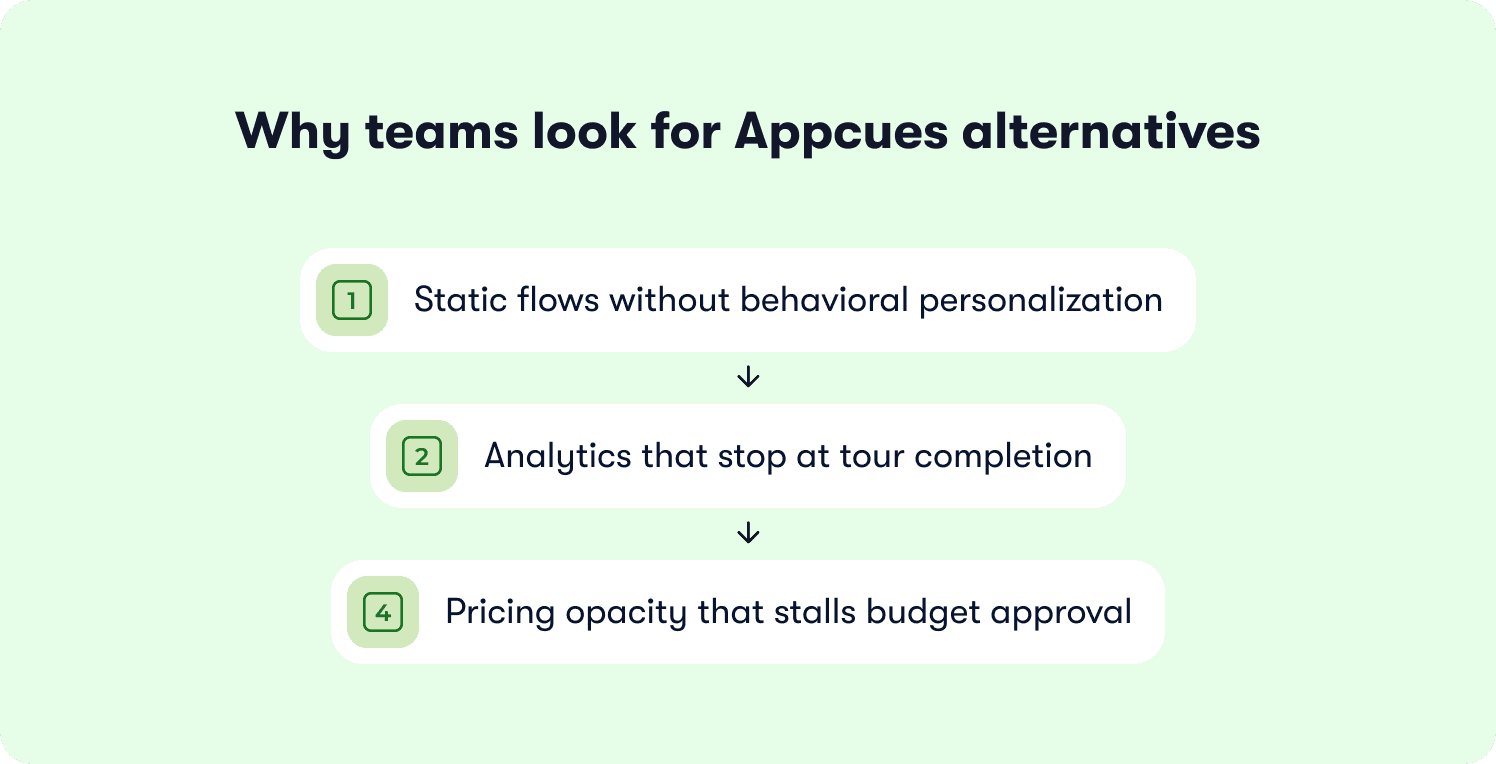
Why teams look for Appcues alternatives
Appcues delivers what it promises: fast deployment of beautiful product tours, workflow orchestration connecting in-app messages with email campaigns and push notifications, and an intuitive builder that non-technical users can operate. Native A/B testing lets growth teams run flow variations without other tools. These are real strengths.
The issue isn't that Appcues is inadequate. It's that product-led teams grow into constraints the platform wasn't designed to solve.
Static flows without behavioral personalization
Appcues onboarding tours are built around page sequences, not user actions. If a user has already connected an integration, they still see the tour prompting them to connect one. Segmentation requires manual reconfiguration for each cohort, and behavioral triggers don't automatically adjust onboarding flows based on real-time user behavior.
The platform struggles with dynamic, non-linear journeys. Across 1,025 product tours analyzed by Jimo in early 2026, the average static tour completion rate was 27%, with a median of just 15%. AI-powered interactive tours that gate progress on actual user actions achieve 44% completion, nearly double. The gap between passive “click next” sequences and behavior-driven flows is measurable.
Analytics that stop at tour completion
Appcues tracks how many users clicked through onboarding flows. It doesn't tell you whether those users activated faster or converted to paid at a higher rate. Connecting flow completions to trial-to-paid conversion requires stitching Appcues data with your CRM or product analytics platform manually. Product managers end up building attribution models in spreadsheets instead of reading a dashboard.
One G2 reviewer at a mid-market company describes exactly this workaround: “The analytics and reporting part might require some further improvements. Currently, we are pushing the user insights to Google Analytics to have a more structured overview of user behavior.”
That's the gap in practice. The platform tracks what happens inside Appcues. Understanding what happens to those users afterward requires other tools.
Pricing opacity that stalls budget approval
Appcues has moved to fully custom pricing across all tiers, meaning there are no published rates to model costs against without booking a sales call. The Start plan caps at 3,000 monthly active users (MAUs), 10 published experiences, and 12 months of reporting history. The Grow plan raises those limits but still caps at 25 published experiences and 24 months of reporting history.
For fast-growing SaaS teams, the combination of custom pricing, hard caps on published experiences, and limited reporting history creates budget friction at exactly the moment the platform should be proving its value. Teams that need to scale onboarding flows across multiple user segments hit the experience caps before they hit the MAU limits, and losing access to historical data at the 12-month mark makes it harder to run the year-over-year activation comparisons that justify continued investment to finance.
How to evaluate Appcues alternatives
Use three evaluation criteria to assess any Appcues alternative. Each criterion ties directly to a role and a measurable revenue outcome.
Activation mechanics. Can product managers iterate onboarding flows without filing engineering tickets? More importantly, can you measure whether those interventions improved activation rate, not just tour completion? The platforms that solve this natively let you answer: “Did users who completed this flow activate faster and convert to paid at higher rates?” without exporting data to external analytics tools. This criterion separates onboarding software that prove ROI from those that measure engagement.
Behavioral personalization depth. Does the platform adapt flows based on what users have actually done, or does segmentation require manual reconfiguration for each cohort? Event-driven triggers that respond to real user actions eliminate the work of rebuilding flows for every new segment and ensure users see guidance that matches where they actually are in their journey.
TCO and pricing transparency. What does scaling from 2,000 to 10,000 monthly active users truly cost, and can you model it without a sales call? Transparent pricing lets finance build a business case. Custom quotes for every growth plan create procurement friction at exactly the moment you need budget approval most.
Criterion | What to look for | Revenue outcome |
Activation mechanics | PMs iterate without engineering + native activation-to-revenue measurement | Trial-to-paid conversion lift you can prove to leadership |
Behavioral personalization | Event-driven triggers that adapt flows based on real user actions, not just segment rules | Faster time-to-value for each user cohort without manual reconfiguration |
TCO transparency | Published pricing with scalable model — no custom quotes required to model growth | Finance can model scaling costs without procurement surprises |
Each tool comparison in this article returns to these three dimensions rather than listing generic features.
5 Appcues alternatives worth evaluating

Appcues has a real ceiling. The tools below are where teams land when they hit it. Some solve one problem well while others solve all three.
1. Jimo — Best for activation-focused teams who need to prove ROI to leadership
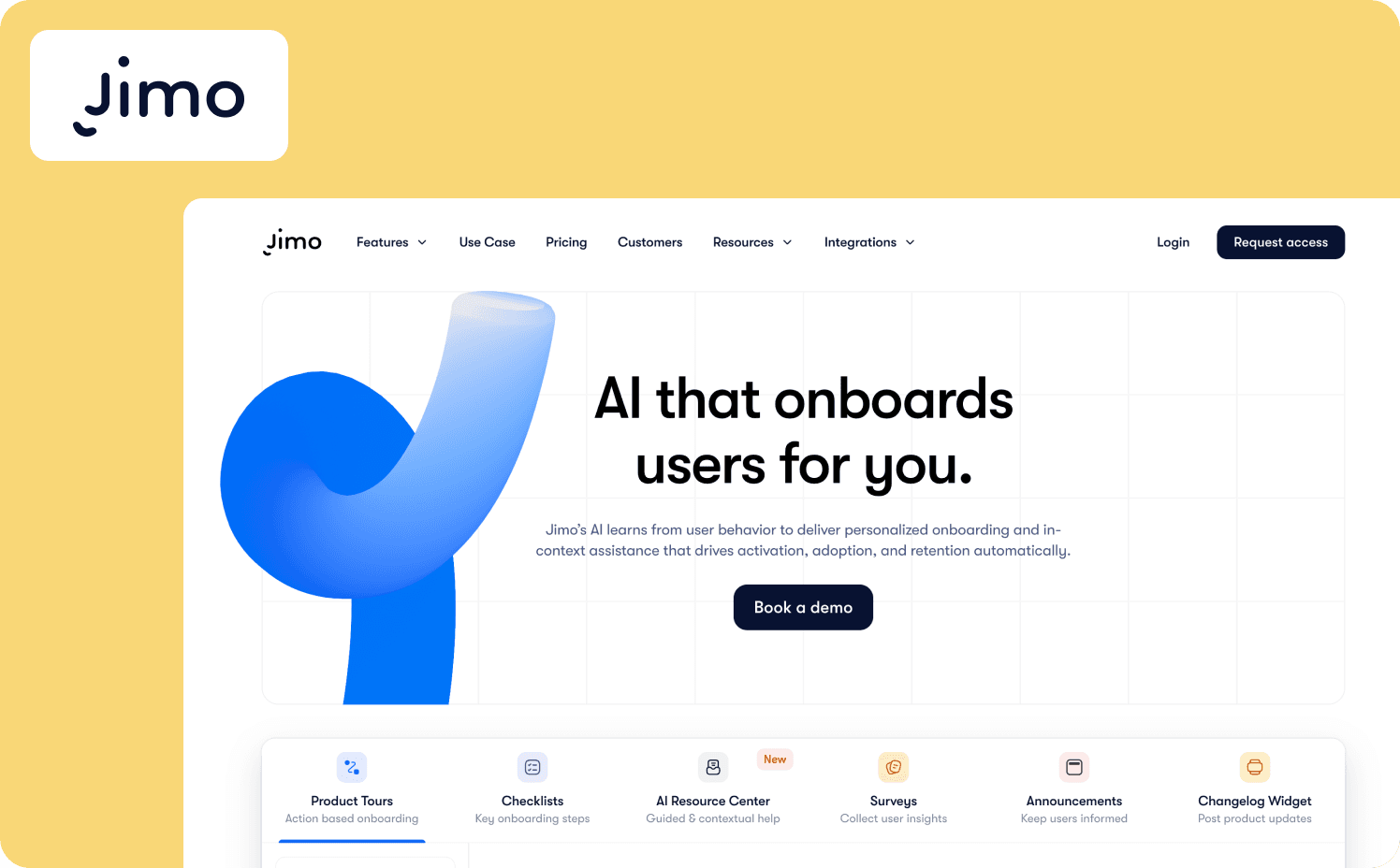
Jimo is an AI-powered digital adoption platform built for product teams who treat activation rate as a revenue metric. It directly addresses all three reasons teams leave Appcues: static flows that don't adapt to user behavior, analytics that stop at tour completion, and engineering dependency for behavioral triggers.
Jimo generates complete AI-powered onboarding tours from a single recorded flow, cutting creation time by 90%, so product teams can iterate without filing engineering tickets. The Figma-like editor lets non-technical teams build and publish on-brand experiences without CSS or technical expertise.
Tours progress only when users complete real product actions. The Resource Center combines multiple tools like tours, checklists, AI-powered answers, and docs into one in-app widget. It adapts by segment and journey stage, with native integrations to Segment, HubSpot, and Salesforce.
Finally, the Success Tracker closes the ROI gap Appcues leaves open. There’s no data exports or spreadsheet models. Customer Alliance drove a 970% spike in feature adoption while AB Tasty reduced launch time from three months to two weeks.
Key differentiators: Appcues uses page-based triggers and requires manual reconfiguration for each cohort. Jimo adapts automatically based on what users have actually done. Appcues analytics stop at flow completion while Jimo's Success Tracker proves cohort-level causation between onboarding and paid conversion. This isn't an incremental improvement on Appcues' experience-first model. It's a fundamentally different approach built for proving activation ROI to leadership.
When to consider Jimo over Appcues:
You need tours that adapt to real user behavior, not predetermined page sequences, without manual reconfiguration for each cohort.
You need to prove to finance that onboarding changes drove trial-to-paid conversion lift, without manual attribution models or data exports.
Your product team needs to iterate onboarding experiments weekly without filing engineering tickets.
Where it falls short: Jimo is built for modern SaaS web applications. It doesn’t support native iOS/Android mobile apps, where Appcues has stronger coverage. It's not suited for enterprises requiring cross-application guidance, audit trails, or employee onboarding.
Starter: $249/mo (2,500–10,000 MAUs)
Growth: $479/mo (2,500–100,000 MAUs)
Enterprise: Custom
2. Userpilot — Best for feature adoption focus beyond initial onboarding
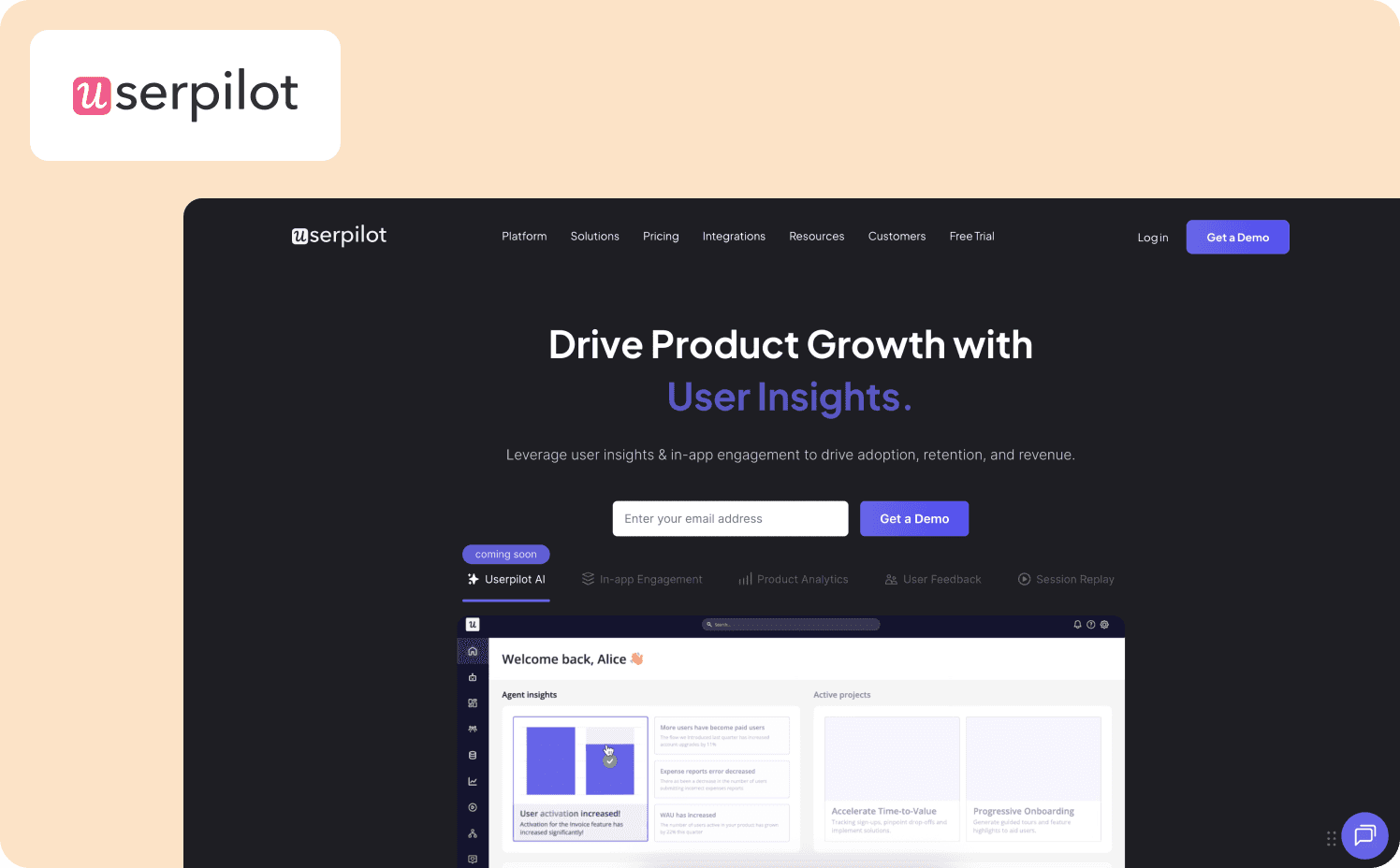
Userpilot is an all-in-one product growth platform that combines onboarding, product analytics, and user feedback in a single suite. Where Appcues focuses on initial onboarding tours, Userpilot's strength is what happens after, driving feature adoption once users complete their first activation milestone.
The platform combines funnels, trends, paths, retention, and cohort analytics with in-app guidance, creating a closed loop from insight to intervention without switching tools. Retroactive event auto-capture tracks historical user behavior without prior instrumentation, and the Visual Labeler lets product managers define trackable events by clicking any UI element, without engineering tickets. Behavior-triggered flows and branching paths adapt to what users have actually done, solving Appcues' static flow limitation.
Key differentiators: If you're leaving Appcues because analytics stop at tour completion, Userpilot provides the funnels, cohorts, and retention analysis Appcues doesn't attempt. For teams that need one platform across the entire product adoption lifecycle, that consolidation is the core argument.
When to consider Userpilot over Appcues:
You need built-in product analytics alongside onboarding flows, without paying separately for Mixpanel or Amplitude.
Your primary bottleneck is feature adoption after initial onboarding, not first-run experiences.
You want retroactive event tracking and a no-code Visual Labeler to define events without engineering dependency.
Where it falls short: Userpilot's steep learning curve and interface stability issues create the same operational friction Appcues was supposed to eliminate. Users also report flows breaking, causing users to consider Userpilot alternatives. If you're leaving Appcues because of pricing opacity or implementation complexity, Userpilot doesn't solve those problems.
Pricing:
Starter: $299/mo (1–2,000 MAUs)
Growth: Custom (5,000–100,000 MAUs)
Enterprise: Custom (from 10,000 MAUs)
3. Chameleon — Best for teams needing custom code flexibility beyond Appcues' templates
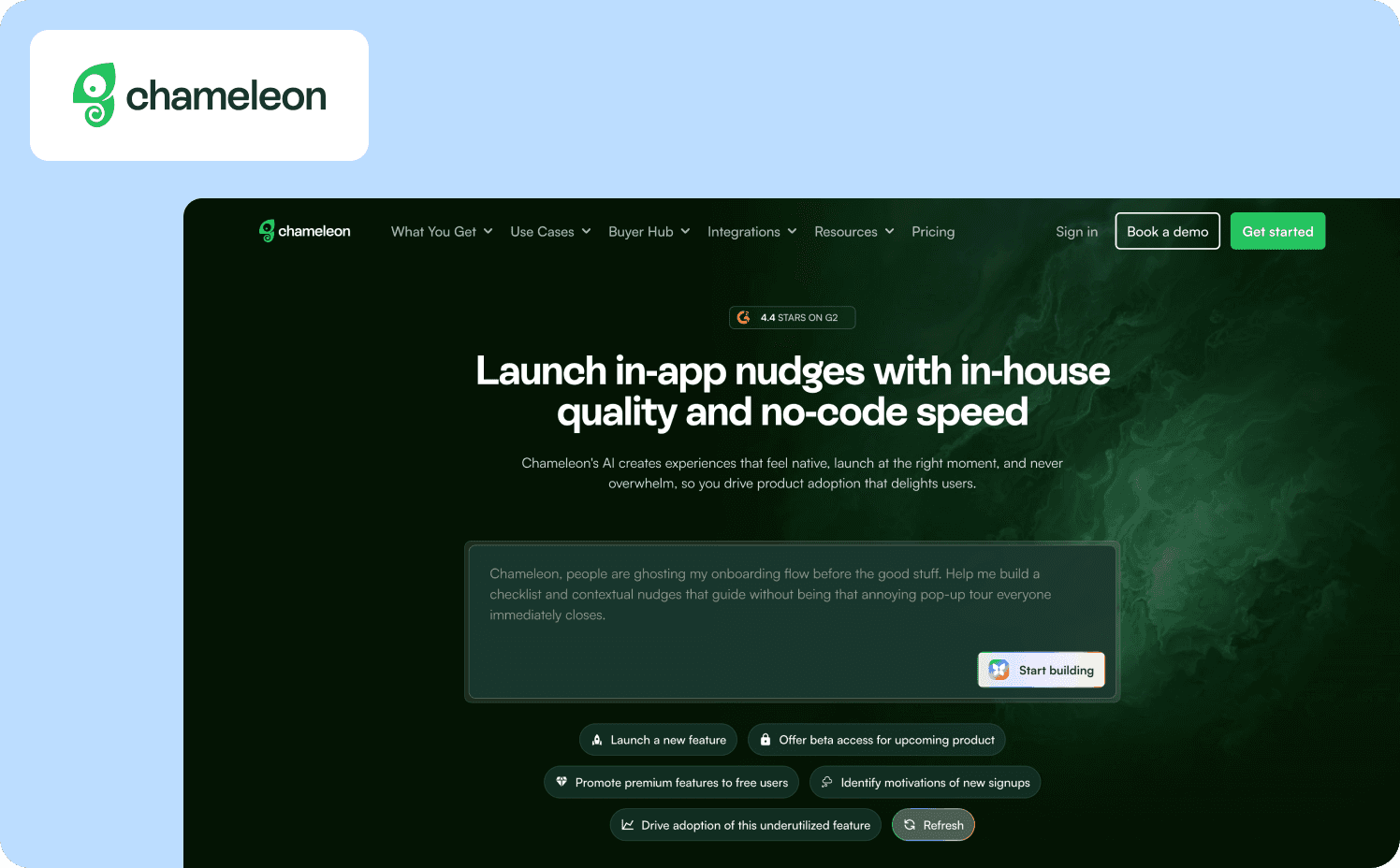
Chameleon is a customization-first digital adoption platform for product teams who need technical flexibility Appcues' template builder can't deliver. CSS-level control, account-wide design rules, and reusable themes let teams create brand-consistent experiences once with developer involvement and deploy them across multiple flows without rebuilding.
Embedded Cards blend into your UI and feel native rather than sitting on top of it. The Copilot AI agent builds production-ready campaigns through conversational prompts. Two-way analytics integrations with Mixpanel, Amplitude, Heap, and FullStory consolidate data without manual exports. Where Appcues forces a choice between fast templates or brittle custom CSS, Chameleon provides the middle ground: powerful customization that maintains design consistency without rebuilding from scratch for each flow.
Key differentiators: Chameleon gives technical teams the custom event tracking, webhook support, and API-first architecture that Appcues deliberately avoids to stay accessible. If you're leaving Appcues because you need pixel-perfect brand alignment or programmatic control, Chameleon delivers that depth.
When to consider Chameleon over Appcues:
You have front-end developers who can maintain custom CSS, and need full control over brand matching that Appcues' templates can't achieve.
Your product uses complex UI interactions requiring custom event tracking and webhook integrations where Appcues' page-based approach becomes a limitation.
You need two-way analytics integrations with Mixpanel, Amplitude, or Heap to unify data flows that Appcues handles through one-way exports only.
Where it falls short: Deep customization requires CSS knowledge. There's also no native mobile SDK for iOS or Android. The Startup tier starts at $279/month for 1,000 MAUs and the Growth tier runs $15,000/year. If you're switching from Appcues because of cost, Chameleon amplifies that problem rather than solving it.
Pricing:
Free: Unlimited product-connected interactive demos
Startup: From $279/mo (1,000–2,000 MAUs)
Growth: From $15,000/year (1,000 MAUs)
Enterprise: Custom
4. UserGuiding — Best for budget-conscious teams wanting Appcues simplicity at lower cost
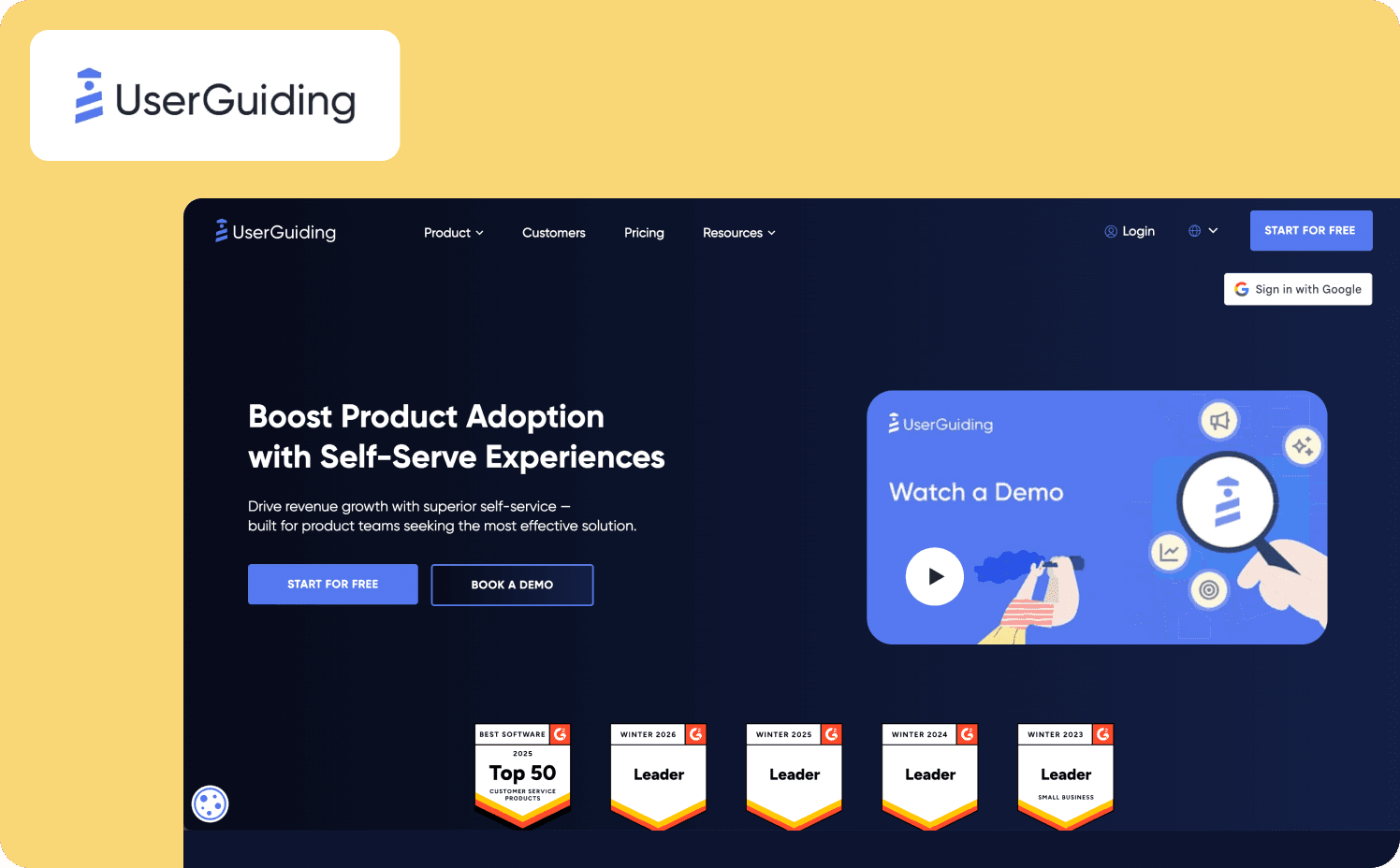
UserGuiding is a no-code user onboarding tool that delivers core product tour functionality at a price point most early-stage startups can actually afford. The no-code editor is intuitive, setup is fast, and pre-built templates get basic onboarding flows live without a steep learning curve.
The platform offers monthly billing alongside annual plans, eliminating the annual lock-in that Appcues requires, and provides transparent pricing with a clear tier structure. For teams needing basic onboarding flows without complex logic, UserGuiding delivers fast time-to-value and intuitive setup for linear tours.
Key differentiators: If pricing is the binding constraint and your use case is simple linear tours without behavioral triggers or deep analytics, UserGuiding is a budget-friendly option that covers the basics at a much cheaper entry point than Appcues. The monthly billing option lets teams test onboarding platforms without long-term commitment.
When to consider UserGuiding over Appcues:
Budget is the primary constraint and you need basic product tours and onboarding checklists from an affordable alternative.
Your use case is straightforward linear flows without complex branching logic or behavioral adaptation.
You want monthly billing flexibility and transparent pricing that scales predictably without annual lock-in.
Where it falls short: UserGuiding’s analytics track only elements created within the platform, with no cohort analysis or funnel tracking. The editor can feel clunky when managing multiple walkthroughs, and end-user experiences tend to feel generic compared to premium alternatives. Teams considering Appcues competitors because flows don't adapt to guide users will find UserGuiding moves further in the wrong direction.
Pricing:
Free plan
Starter: From $249/mo (2,000–10,000 MAUs)
Growth: From $499/mo (5,000–10,000 MAUs)
Enterprise: Custom
5. Product Fruits — Best for speed to deployment with AI-assisted full toolkit
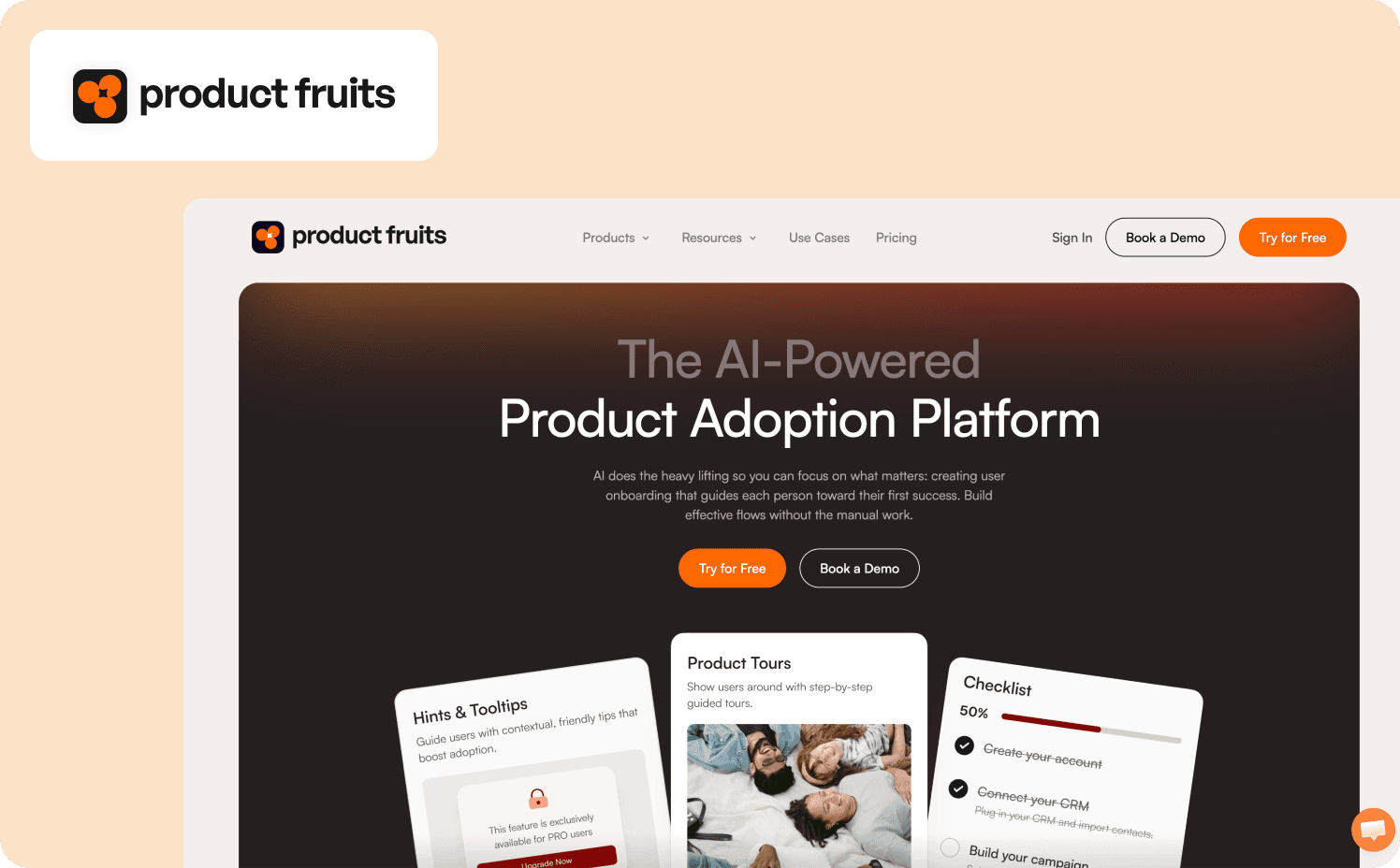
Product Fruits is an all-in-one onboarding platform that gets teams from zero to a live, complete toolkit faster than anything else in this comparison. Like Appcues, though, flows are linear and don't adapt to what users actually do. Elvin AI generates tours, copy, and targeting automatically from annotations, with most teams completing full setup in under an hour.
Tours, checklists, NPS surveys, announcements, and a knowledge base are all included, eliminating tool sprawl for teams that need consolidated feedback collection alongside onboarding.
Key differentiators: If setup complexity and time-to-first-tour is the bottleneck, Product Fruits solves that specific problem faster than any alternative here. The all-in-one consolidation of tours, feedback, and a knowledge base also addresses tool sprawl that Appcues creates by focusing primarily on tours and multi-channel flows.
When to consider Product Fruits over Appcues:
Speed to deployment is the primary constraint and you need a complete onboarding toolkit live in hours, not days.
You want to consolidate user feedback collection with onboarding tours without paying for separate NPS or in-app survey tools.
Budget and monthly billing flexibility matter, and you need transparent pricing without annual commitments.
Where it falls short: Like Appcues, Product Fruits has linear tours only, with no action-based progression, no sophisticated behavioral triggering. If you're leaving Appcues because flows don't adapt to user behavior or analytics stop at completion, Product Fruits doesn't solve those problems. It trades behavioral sophistication for deployment speed and tool consolidation.
Pricing:
Starter: From $149/mo (1,500–20,000 MAUs)
Pro: From $249/mo (1,500–20,000 MAUs)
Business: From $499/mo (1,500–20,000 MAUs)
Which Appcues alternative fits your team's bottleneck
Match your specific Appcues limitation to the platform that solves it most directly.
If your bottleneck is... | Best fit | Why |
Proving onboarding ROI to leadership | Jimo | Success Tracker attributes onboarding changes to activation rate and trial-to-paid conversion at cohort level, not just tour completion |
Design control | Chameleon | CSS-level customization, reusable themes, and API-first architecture for teams with front-end resources |
Flows that don't adapt | Jimo | Action-based progression and AI personalization adapt tours to what users have actually done, not just which page they're on |
Needing both onboarding and analytics | Userpilot | Native analytics, A/B testing, and NPS alongside onboarding flows, all in one platform |
Budget | UserGuiding or Jimo | UserGuiding ($249/mo for 2,000 MAUs) and Product Fruits ($249/mo) are the lowest entry points Jimo at $249/mo for 2,500 MAUs adds behavioral measurement and activation analytics |
Speed | Jimo or Product Fruits | Product Fruits gets the entire toolkit live in under an hour Jimo builds complete, activation-based tours from a single recorded flow in seconds |
The evaluation framework from earlier (activation mechanics, behavioral personalization depth, TCO transparency) separates good shortlists from feature-checklist exercises. Choose the platform that solves your primary constraint, not the one with the longest feature list.
If your onboarding flows ship but trial-to-paid conversion stays flat, the problem isn't the tours. It's that you can't see what's working. See how Jimo connects onboarding to revenue by booking a demo.
FAQ
What are the best alternatives to Appcues for user onboarding?
The top alternatives depend on what's driving the switch. Jimo is the strongest fit for product-led teams who need to drive adoption through behavior-driven onboarding and prove activation ROI to leadership. Userpilot suits larger teams needing consolidated analytics. Chameleon suits design-focused teams with technical resources, and UserGuiding and Product Fruits are the most accessible options for small teams with budget or speed constraints.
What are the main limitations of Appcues?
Appcues focuses on linear, page-based product tours that don't adapt to what users have actually done, which limits its effectiveness for teams trying to drive adoption beyond simple first-run experiences. Analytics stop at tour completion, so connecting onboarding to trial-to-paid conversion requires pushing data to external tools. Pricing is fully custom across all tiers, making it difficult to model costs without a sales conversation.
Which Appcues alternative is best for product-led growth teams?
Jimo is purpose-built for PLG teams who need onboarding that adapts to real user behavior and proves activation ROI to leadership. The Success Tracker provides cohort-level attribution connecting onboarding completions to paid conversions, without manual data exports.
Is there a cheaper alternative to Appcues?
Yes. UserGuiding starts at $249/month for 2,000 MAUs and Product Fruits starts at $149/month, making both strong budget-friendly options for small teams needing basic linear tours with monthly billing flexibility. Jimo Starter at $249/month for 2,500 MAUs is the most accessible option for teams that also need behavioral triggers and activation measurement for new users.
Can I use Appcues for mobile app onboarding?
Appcues has native iOS and Android support, which is one of its genuine strengths over most alternatives in this comparison. Most alternatives here, including Jimo, Userpilot, Chameleon, UserGuiding, and Product Fruits, are primarily built for web applications rather than native mobile apps. If native mobile app onboarding is a core requirement, Appcues remains one of the stronger options in the category, though teams also needing session replays or deep analytics will still need additional tools alongside it.