/
9 mins read
TL;DR
Most user onboarding software still operates on a static Product-Led Growth model built around linear tours, broad user segments, and disconnected tooling. This article argues that the category is shifting toward Intelligence-Led Growth, where onboarding platforms adapt to individual user behavior in real time and connect guidance directly to activation outcomes. Instead of evaluating tools by feature lists alone, the comparison focuses on stack consolidation: which platforms replace separate tour builders, analytics tools, survey platforms, help centers, and AI assistants under one shared data model. The article examines how fragmented onboarding stacks create operational blind spots that prevent Product Ops teams from proving onboarding ROI or connecting guidance to retention and revenue. It then compares eight leading user onboarding software platforms based on action-based onboarding logic, analytics depth, adaptability, no-code ownership, and their ability to close the loop between onboarding activity and measurable activation. Readers will also learn which tools fit specific operational scenarios, from enterprise analytics needs to AI-native onboarding and budget-conscious deployment.
The user onboarding playbook has remained unchanged for a decade. Teams still rely on tooltips, checklists, and linear product tours. Meanwhile, the SaaS products with the strongest activation rates aren't running better tours. They've replaced the tour entirely with a product that understands what each user needs and responds to it in real time.
Most user onboarding tools remain trapped in this old model. Teams show new users around, hope they figure it out, measure tour completions, and wonder why trial-to-paid conversion remains flat. The fundamental approach is flawed. Static onboarding processes follow a rigid script. Analyze user behavior and you’ll see it follows curiosity, deadlines, confusion, and intent. Users navigate products based on their immediate needs.
The era of Product-Led Growth relies on rigid funnels, broad user segments, and generic self-serve motions. This model is giving way to Intelligence-Led Growth (ILG). ILG demands that the product understands each user individually and adapts in real time. The personalized onboarding experience must serve one specific person in the exact moment they need help. Finding the best user onboarding software in 2026 requires identifying platforms built for the future of activation.
What is onboarding SaaS software, and why is the category splitting?
User onboarding software covers AI-powered platforms that guide users through product workflows, collect behavioral data, and measure activation. They’re deployed inside a live web-based SaaS application, without engineering dependency. This article covers in-product activation tools only.
Look elsewhere if you need the following tools.
Employee onboarding platforms: Tools like Docebo train internal staff on company policies. They don’t guide your customers inside your own product.
Client onboarding portals: These handle document collection and project management for new agency or service accounts. They operate entirely outside your application.
Interactive demo builders: These create simulated sandbox environments for marketing websites. They don’t provide guidance for live users inside a functioning product.
If you’re a Product Ops Manager at a B2B SaaS company who needs to consolidate in-product onboarding, engagement, surveys, and analytics under one platform, read on.
Why most onboarding SaaS tools are evaluated on the wrong criteria
After analyzing 200+ onboarding flows, Jimo found a clear pattern. Almost every SaaS product nails the first “aha” moment. A polished welcome screen, a clean three-step checklist, a product tour that shows the key features. Then the user completes it, and the product has nothing left to say. Sign-up generation gets confused with activation. The entrance looks great, but the room is empty.
To fix this, teams must shift their evaluative frame from segments to individuals. Tools that treat everyone in “Segment” the exact same way produce generic customer onboarding that fails at scale.
Here’s the criteria that now matter.
How many tools does it replace? Genuine consolidation means one data model across tours, surveys, analytics, help center, and AI. An integration for the missing piece reproduces the ownership problem at a smaller scale.
Action-based or linear tour logic? Tours that advance on real task completion drive behavior change and customer satisfaction. Client onboarding software that advances on “Next” clicks inflate completion metrics. Jimo's own data shows AI-powered tours achieve 44% completion versus 27% for standard tours.
Does it adapt to individual users or fire at segments? Segments work for analytics. They’re poor instruments for guidance. Real users navigate products based on curiosity, confusion, and intent. Customer onboarding software that adapts to what this specific user is doing right now predicts activation. A platform firing a pre-written sequence at a cohort fails to do so.
Can a Product Ops Manager own it without engineering? True no-code means no developer tickets for event tracking, flow building, or publishing. If any step requires a sprint, the ownership problem is merely relocated.
Does the analytics layer close the loop? Completion rate is an output. Activation rate is an outcome. The platform must connect guidance to what users did next. It must track more than just click-throughs.
The 8 best user onboarding tools for B2B SaaS in 2026
We evaluated the best customer onboarding platforms based on their ability to drive measurable activation, customer engagement, and consolidate your tech stack. The following breakdown highlights how each tool approaches user guidance and behavioral adaptation.
1. Jimo — Best for AI-driven activation and intelligence-led growth
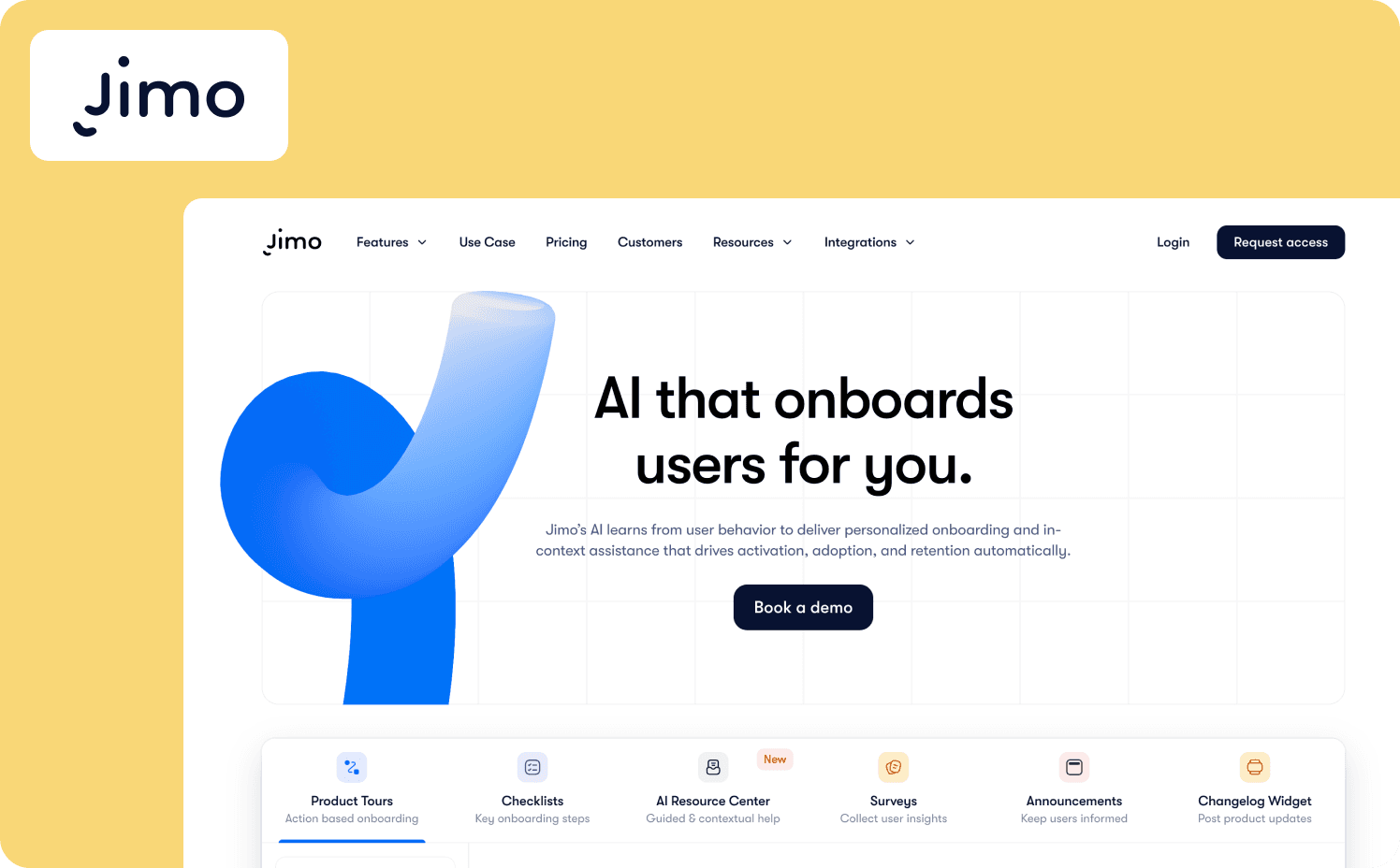
Jimo is an AI-native product experience platform built for modern SaaS teams to drive measurable activation. It replaces static walkthroughs with intelligent guidance that adapts to how users actually behave, not just which page they land on.
What it consolidates:
✅ Analytics platform
✅ Survey tool
✅ Help center
✅ AI assistant
Strengths: Jimo is entirely action-based. Tours advance on real task completion rather than passive “Next” clicks. AI tour generation builds the full tour structure from a single recorded flow, which delivers a 90% reduction in build time. This speed allows companies like AB Tasty to achieve a 6x faster launch, completing a 90-minute build that reached 2,000 users in week one.
Jimo also has an AI Copilot that operates on a Guide, Assist, and Execute framework, bringing Intelligence-Led Growth (ILG) directly into the product. Adaptive walkthroughs respond to individual behavior, in-context answers from your knowledge base, and natural language task execution on the user's behalf. The Success Tracker then connects every guidance interaction to activation and retention signals, so product ops teams can see which flows drive adoption and which ones precede churn.
Limitations: Jimo is built for web-based SaaS applications. It’s not designed for employee training on third-party software, and it doesn’t support native mobile apps.
Starter: $249/mo (2,500–10,000 MAUs)
Growth: $479/mo (2,500–100,000 MAUs)
Enterprise: Custom
2. Pendo — Best for enterprise product analytics
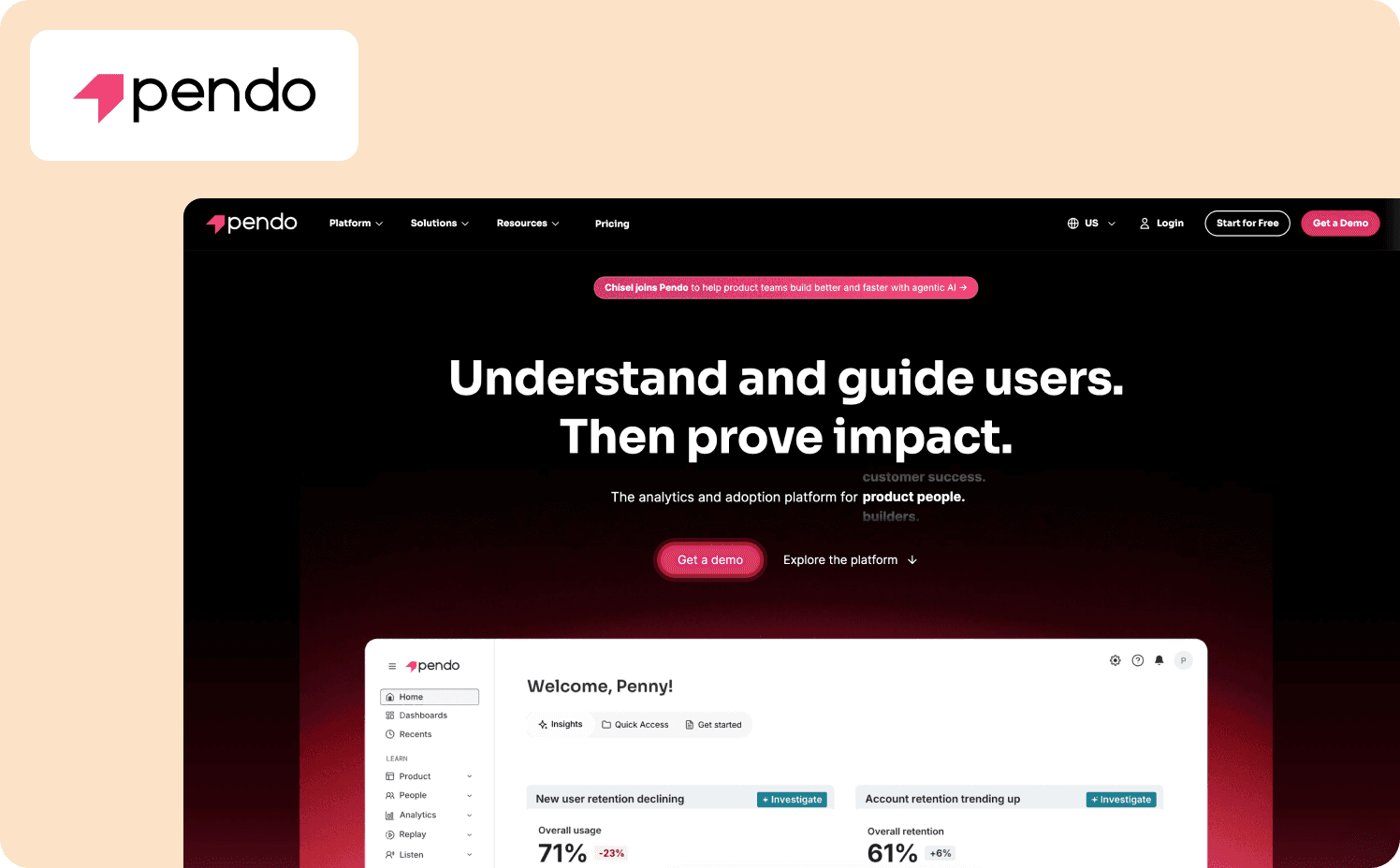
Pendo is a product experience platform built for large organizations that need deep behavioral data. Its core strength is analytics. Pendo has retroactive event tracking, retention analysis, funnel tracking, and a Product Engagement Score that measures overall product health across adoption, stickiness, and growth.
What it consolidates:
✅ Tour builder
✅ Analytics platform
✅ Survey tool
✅ Help center
✅ AI assistant
Strengths: Pendo measures product milestones rather than just tour completion. It integrates with complex enterprise stacks, offers cross-channel journey building, and gives customer success managers the behavioral depth to understand where users stall across the full customer journey.
For organizations that need quantitative usage data and qualitative feedback in one platform, Pendo offers more analytics breadth than most tools in this category.
Limitations: Pendo is a PLG-era platform built for analysis, but not for adaptation. Its builder is rigid, and in-app guidance relies on linear tours. Conditional branching requires Guides Pro, an add-on tier not included in base plans, and poll-based branching logic requires manual markdown syntax configuration. Pricing is also entirely opaque beyond a free tier for 500 MAUs.
Pricing:
Free: For 500 MAU
Base: Custom (custom MAUs)
Core: Custom (custom MAUs)
Ultimate: Custom (custom MAUs)
3. Appcues — Best for non-technical teams building simple tours
Appcues is a no-code customer onboarding solution whose core differentiator is multi-channel orchestration. It coordinates in-app messages, behavioral emails, and push notifications across up to 75 workflow nodes without engineering involvement. For product and marketing teams running cross-channel campaigns from a single platform, that's a meaningful consolidation.
What it consolidates:
✅ Tour builder
⚠️ Analytics platform
✅ Survey tool
✅ Help center
✅ AI assistant
Strengths: Appcues is fast to deploy. Non-technical teams can launch visually polished onboarding flows without developer dependency, and its drag-and-drop builder with pre-built templates accelerates initial setup. Native A/B testing lets teams run flow-variation experiments without pushing data to external tools.
It also offers native iOS and Android SDK support, one of the few tools in this list that covers both web and mobile app onboarding.
Limitations: Appcues is a static DAP built around page sequences, not user actions. Behavioral triggers don't automatically adjust flows based on what users have actually done, which leads to lower completion rates as users grow past first-run experiences. Deep customization also requires CSS, which defeats the no-code purpose.
Pricing:
Start: Custom pricing (up to 3,000 MAUs)
Grow: Custom pricing (up to 50,000 MAUs)
Enterprise: Custom pricing (custom MAUs)
4. Userpilot — Best for post-onboarding product growth
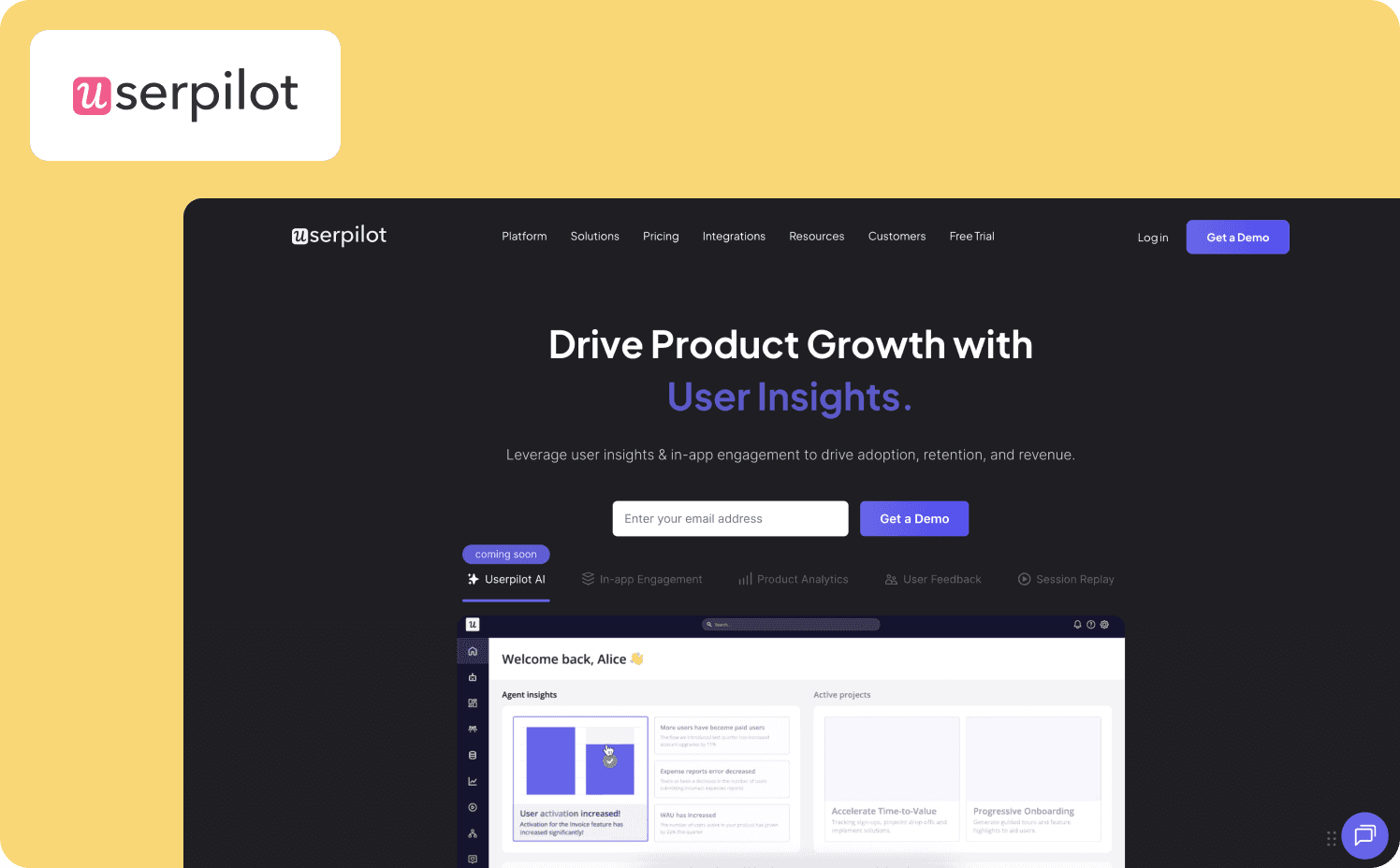
Userpilot consolidates the tools mid-market SaaS teams typically buy separately, like onboarding flows, product analytics, NPS surveys, session replay, and resource centers, into a single platform. Its focus is on activation and retention, optimized for teams asking “What's blocking users from reaching first value?” rather than teams needing deep retrospective behavioral modeling.
What it consolidates:
✅ Tour builder
✅ Analytics platform
✅ Survey tool
✅ Help center
✅ AI assistant
Strengths: Userpilot offers action-based triggering and built-in funnels, cohorts, and retention analysis. This lets product teams ask activation questions without switching tools. The unified analytics-to-guidance workflow is its core advantage. You can identify a friction point and deploy a fix in the same platform.
Contextual nudges, localization, and solid segmentation make it a workable all-in-one option for teams that want to eliminate tool sprawl at a mid-market price point.
Limitations: Userpilot is a static DAP, and the structural limitation shows at any shipping cadence above monthly. Users report flows breaking silently after product updates. The platform is also web-only on base plans, making it unsuitable for mobile-first products.
Pricing:
Starter: $299/mo (up to 2,000 MAUs)
Growth: Custom pricing (starts from 5,000 MAUs)
Enterprise: Custom pricing (custom MAUs)
5. Chameleon — Best for deep customization and design control
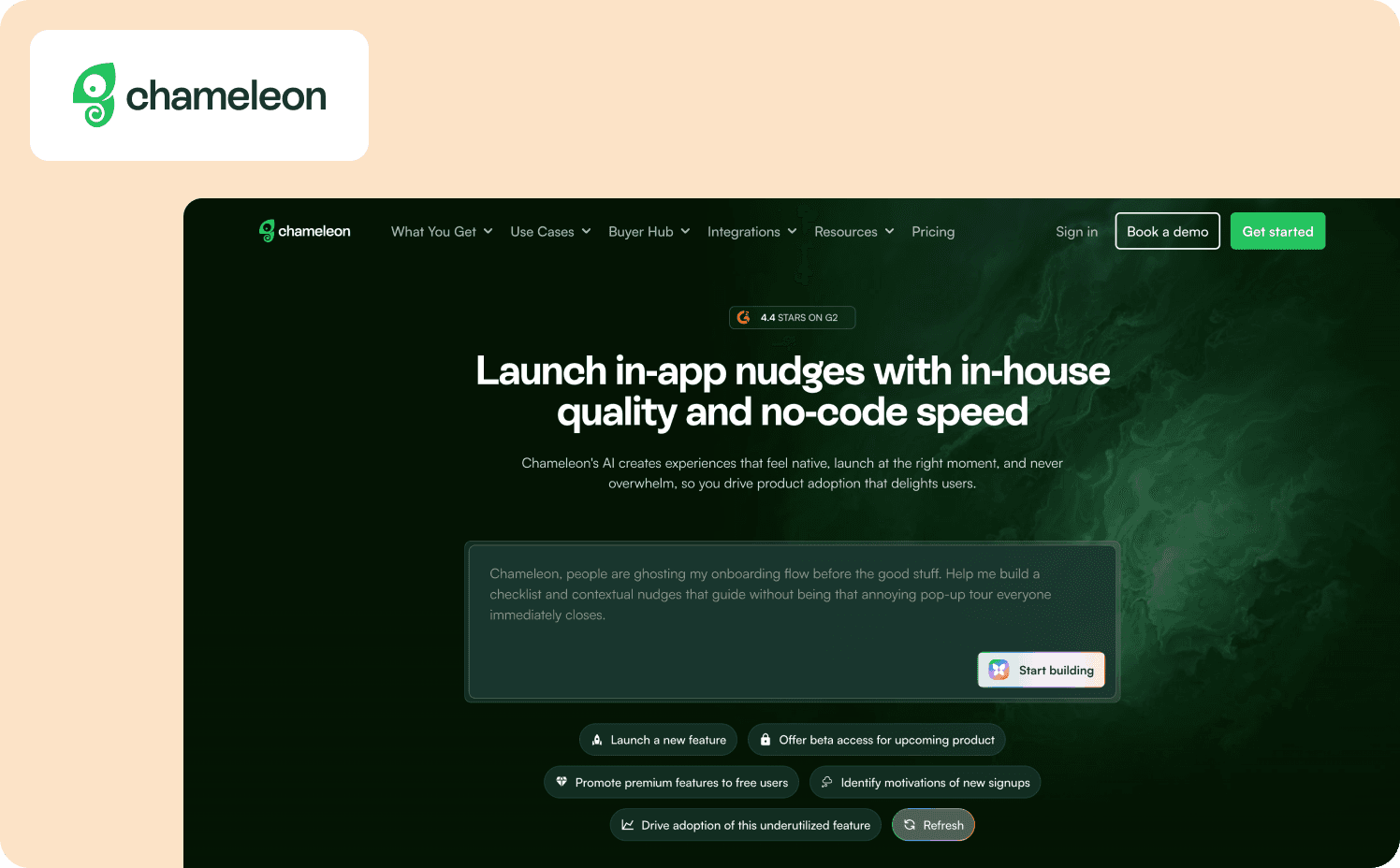
Chameleon is a product adoption platform for design-conscious teams who need in-app guidance that feels native rather than overlaid. CSS-level control, account-wide design rules, and reusable themes let designers create brand-consistent experiences once and apply them across flows.
What it consolidates:
✅ Tour builder
⚠️ Analytics platform
✅ Survey tool
✅ Help center
✅ AI assistant
Strengths: Chameleon gives technical PMs and design-heavy teams the CSS-level control that template builders can't reach. Its AI agent builds production-ready campaigns through conversational prompts and can automatically generate A/B test variants, where most tools require manual creation.
Limitations: Chameleon is a static DAP built for the teams that originally had front-end resources. When that profile shifts, the friction starts fast. Achieving the native-experience value requires CSS knowledge, and for teams without it, the no-code promise breaks down quickly. The editor also has a steep learning curve, and complex tours frequently break when UI elements change, with no built-in alerting to flag it.
Pricing:
Startup: From $279/mo (1,000 MAUs)
Growth: From $15,000/year (1,000 MAUs)
Enterprise: Custom (custom MAUs)
6. Userflow — Best for fast, no-code flow building
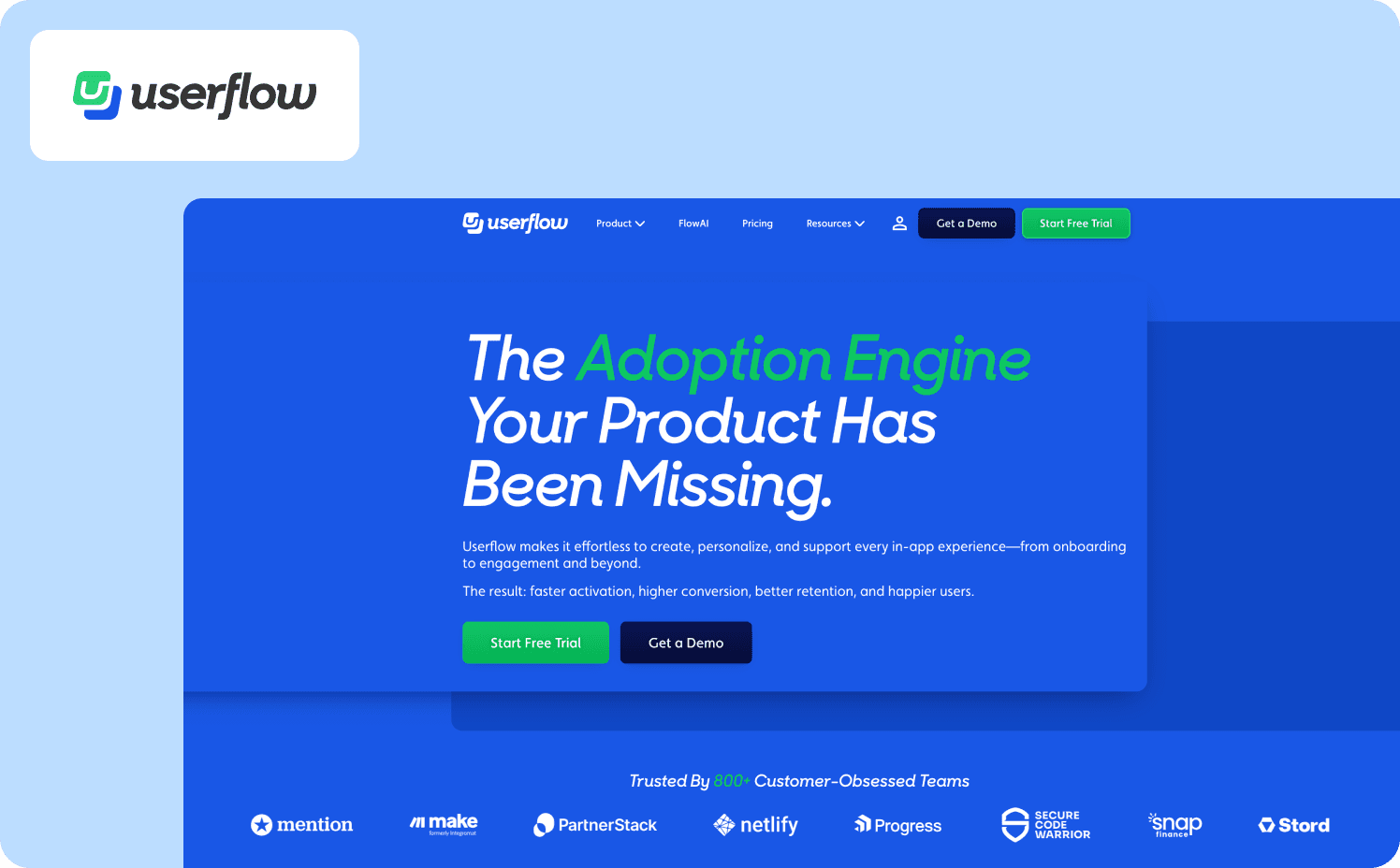
Userflow is a lightweight customer onboarding platform for building in-app tours and checklists directly in the browser. It’s known for rapid deployment and a visual node-graph Flow Builder that supports conditional branching and event-based triggers. This gives PMs more logic control than basic linear tools without requiring engineering involvement.
What it consolidates:
✅ Tour builder
⚠️ Analytics platform
✅ Survey tool
✅ Help center
✅ AI assistant
Strengths: Userflow is fast and straightforward, allowing product managers to build and deploy an onboarding journey quickly using its browser-based builder. The visual node-graph makes conditional flow logic accessible to non-technical teams, and its FlowAI tools generate editable flows from prompts, rephrase content, and translate experiences across languages. For teams that need something live without sprint dependencies, it delivers.
Limitations: Userflow includes step-level funnel analytics scoped to individual flows, but lacks broader product analytics, meaning teams still need external tools to understand behaviour outside of guided experiences. Its pricing model scales sharply past the Startup tier, often forcing teams to migrate exactly when they've grown into needing more capability.
Pricing:
Startup: From $240/mo (up to 3,000 MAUs)
Pro: From $680/mo (up to 10,000 MAUs).
Enterprise: Custom (custom MAUs)
7. UserGuiding — Best for budget-conscious teams
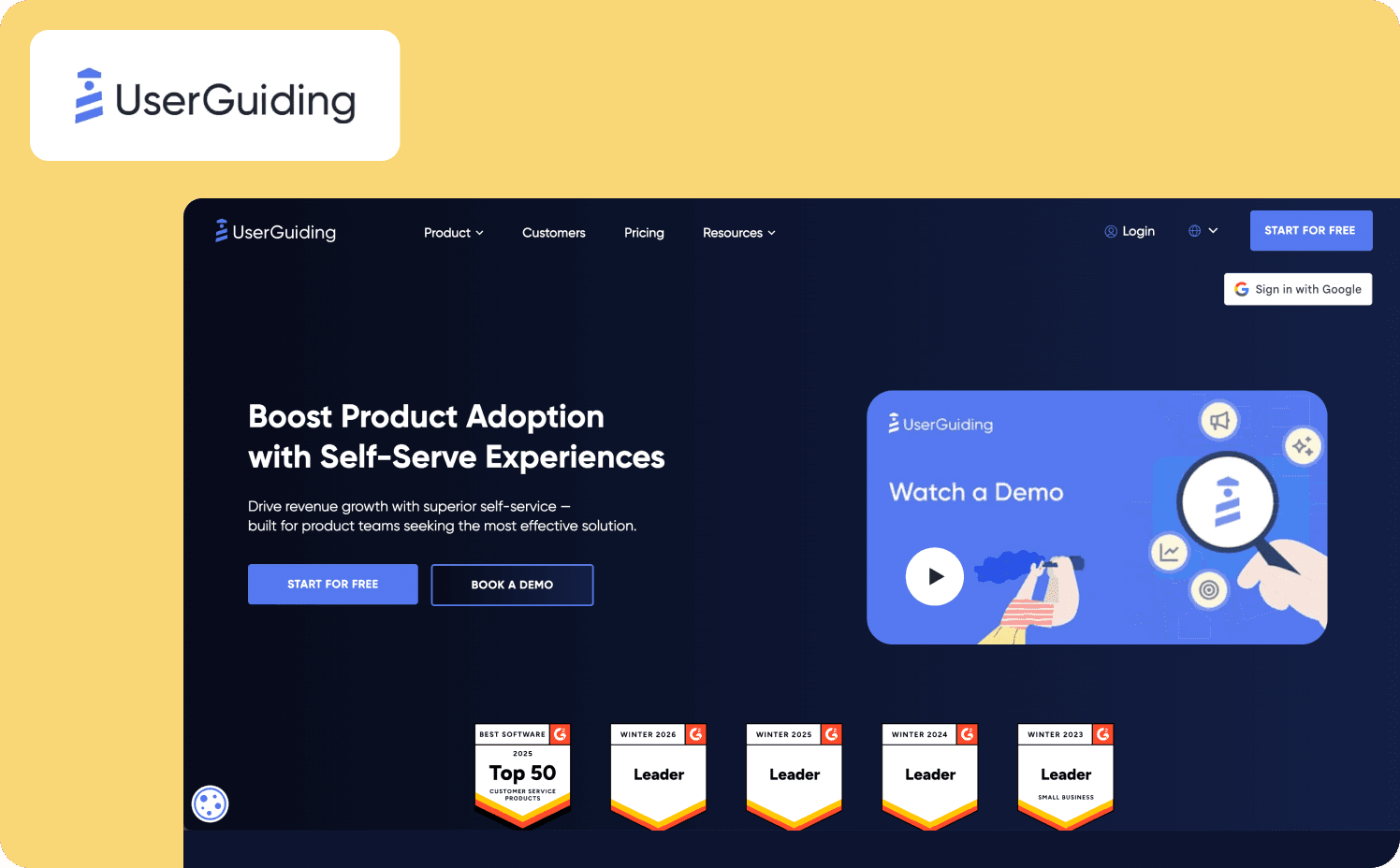
UserGuiding is an affordable customer onboarding tool for startups and small businesses that need basic product walkthroughs without the cost of a full adoption platform.
What it consolidates:
✅ Tour builder
⚠️ Analytics platform
✅ Survey tool
✅ Help center
✅ AI assistant
Strengths: UserGuiding is cost-effective, with transparent pricing and a straightforward interface that lets non-technical teams launch simple tours, checklists, and NPS surveys quickly. For teams just starting to formalize their onboarding strategy, it provides functional coverage without a long implementation process.
Limitations: UserGuiding uses linear flows only. There’s no conditional branching, no behavioral adaptation. Analytics are basic and limited to content performance within the platform, with no cohort analysis or funnel tracking.
Pricing:
Free plan
Starter: From $249/mo (2,000 MAUs+)
Growth: From $499/mo (2,000 MAUs+)
Enterprise: Custom
8. Product Fruits — Best for budget-conscious teams needing rapid deployment
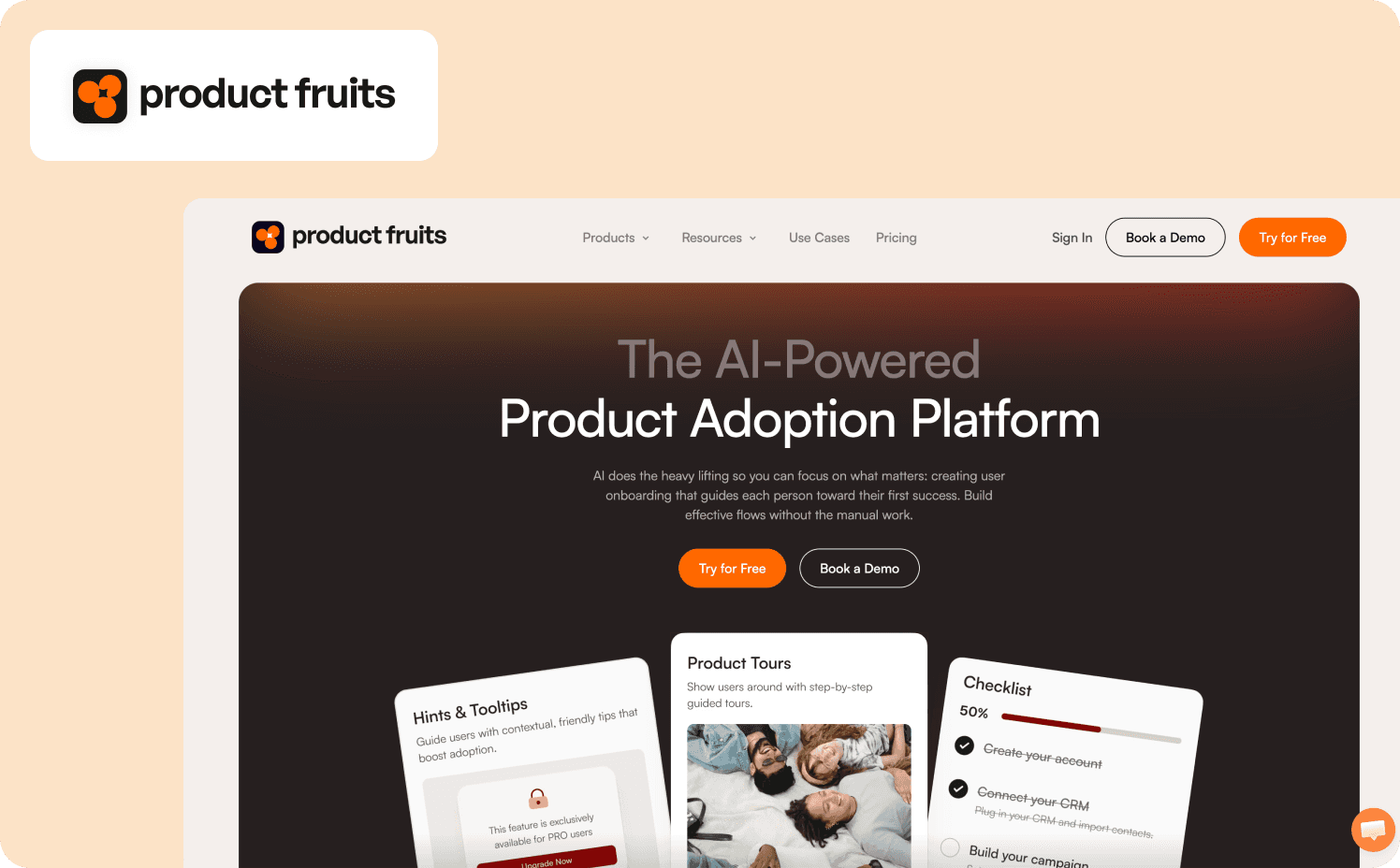
Product Fruits bundles tours, hints, checklists, and a knowledge base into a single widget. Its Elvin AI automatically generates contextual onboarding tours from a single product annotation, reducing the manual effort of content creation for early-stage teams.
What it consolidates:
✅ Tour builder
⚠️ Analytics platform
✅ Survey tool
✅ Help center
✅ AI assistant
Strengths: Product Fruits offers broad toolkit coverage for early-stage teams at an accessible price point. Tours, user feedback, and a life ring widget can all be deployed from a single platform, and Elvin AI's tour generation significantly cuts the time from annotation to live experience.
Limitations: Core tours are linear and static, which means no action-based progression and no sophisticated behavioral triggering. Analytics track Product Fruits content performance but provide minimal broader product usage insights, requiring external tools for anything beyond basic reporting.
Pricing:
Starter: From $149/mo (1,500–20,000 MAUs)
Pro: From $249/mo (1,500–20,000 MAUs)
Business: From $499/mo (1,500–20,000 MAUs)
Which user onboarding software is right for your team?
Choosing the right user onboarding tool comes down to your team's specific operational realities and growth stage. Rather than looking for a single “best” tool, evaluate based on the primary bottleneck you need to solve. Here’s an honest scenario-to-tool mapping.
Scenario | Best fit | Why |
Managing 3+ onboarding tools, no shared data, cannot prove activation impact | Jimo or Userpilot | Both consolidate tours, analytics, surveys, and help centers. Jimo excels at AI-driven activation, while Userpilot focuses on post-onboarding growth. |
Need closed-loop analytics connecting guidance to retention and revenue | Jimo or Pendo | Jimo's Success Tracker attributes onboarding changes directly to trial-to-paid conversion. Pendo provides robust retroactive event tracking for enterprise teams. |
PLG motion plateauing, self-serve not moving conversion, need the product to activate users individually | Jimo | Jimo's AI Copilot adapts guidance to individual user behavior rather than broad segments, driving measurable activation. |
Need enterprise analytics depth, 200+ employees, CS alignment | Pendo | Provides complex enterprise governance, cross-app tracking, and a Product Engagement Score (PES). |
Onboarding spans in-app + email + mobile push, need one vendor | Appcues | Offers multi-channel workflow automation across web, email, and mobile applications. |
Brand consistency is non-negotiable, design team has veto | Chameleon | Deep CSS styling capabilities ensure guidance feels completely native to your application. |
Need PM-owned iteration without sprint dependencies | Userflow or Appcues | Both offer no-code visual builders, but Userflow is exceptionally fast for browser-based deployment. |
Early-stage, budget-constrained, need functional coverage now | UserGuiding | Provides essential features at an affordable price point for startups. |
Need AI to generate tour content automatically, reduce build time | Product Fruits or Jimo | Both use AI to generate tours, reducing build time significantly. Product Fruits offers a lighter all-in-one widget, while Jimo builds full action-based structures. |
If you’re ready to stop building static tours and start driving measurable activation, book a demo with Jimo today.
FAQs
How do I justify switching user onboarding software to my leadership team?
Frame it around the metrics leadership already owns: trial-to-paid conversion, customer retention, and activation rate. If your current onboarding tool can’t show a direct line between guidance and those outcomes, that’s the gap. Show the cost of inaction, how every month of flat activation is compounding CAC against static revenue.
What typically breaks when you switch user onboarding tools?
The most common breakages are event tracking gaps, lost onboarding flow history, and temporary drops in user engagement during the migration window. Plan for a parallel-run period where both platforms are live, and audit which user segments had active flows before cutting over. Integration-dependent reporting, anything relying on your old tool’s data model, needs to be rebuilt.
How do we know if our current onboarding software is underperforming?
There’s typically three signals. Your team can’t connect onboarding effectiveness to trial-to-paid conversion without a manual export, flows are breaking after product updates and no one knows until a user reports it, or customer success managers are still fielding questions that a well-functioning in-product guidance layer should have answered. Any one of these means the platform is measuring activity, not driving outcomes.
How long before a new user onboarding platform shows measurable results?
For activation metrics, most teams see directional signals within 30 days of deploying the first well-structured onboarding process. Statistically significant changes to trial-to-paid conversion typically take 60–90 days, depending on your trial length and volume. Platforms with action-based logic tend to show faster results than linear tools because they respond to what users actually do, not just whether they clicked through.
What’s the real cost of running multiple user onboarding tools instead of one?
The subscription cost is the smallest part. The real cost is the broken feedback loop. When your tour builder doesn’t share a data model with your analytics, you can’t know whether guidance is driving customer lifetime value or just inflating completion metrics. Add the workflow automation overhead of managing onboarding tasks across existing tools, and most teams are paying for integration failures as much as capabilities.
How do I evaluate whether AI-native customer onboarding process is worth the switch from a static DAP?
Ask one question of your current platform: Does it know what this specific user has already done, and does it change its guidance accordingly? If the answer is no, if it fires the same onboarding journey at different user segments regardless of prior behavior, you’re running a PLG-era tool against ILG-era user expectations. The gap between those two shows up as flat activation despite high tour completion rates.
How to calculate ROI for user onboarding software?
Measure two baselines before switching: trial-to-paid conversion rate and 30-day customer retention. After deployment, a lift in either number multiplied against your ACV gives you the revenue case. A 5-point conversion improvement on 1,000 monthly trials at $200 ACV is $12,000 in additional MRR. For the cost side, include platform fees plus any engineering time required to track user progress and publish changes. Platforms with genuine no-code ownership keep that denominator honest.