/
6 mins read
TL;DR
For Heads of Product and product teams evaluating feature adoption tools, true product experience management requires moving beyond fragmented point solutions. Stitching together separate apps for onboarding, surveys, and analytics creates a costly blind spot where user guidance is completely disconnected from retention data. A PXM platform should natively unify action-based onboarding, behavioral nudges, contextual feedback, closed-loop analytics, and AI adaptation into one shared behavioral model. By centralizing these five core capabilities, teams can eliminate engineering dependencies, stop paying the fragmentation tax, and shift toward Intelligence-Led Growth that drives measurable activation.
Every time you add a new point solution to your product stack, you’re adding a hidden tax to your budget. Right now, most product teams are paying separately for a tour builder, a survey tool to collect feedback, a platform for advanced analytics, and maybe a fourth for in-app guides or interactive demos. The subscription costs add up, but the real drain is the integration maintenance and the blind spots between systems. You’re paying for fragmentation.
This guide defines what product experience management software means for B2B SaaS teams ready to consolidate and gain a competitive advantage. We’ll cover the five capabilities a genuine platform must deliver and explain exactly what it costs when any of them lives in a separate tool. If you’re tired of justifying the ROI of a disjointed stack, this article will help you decide if it's time to unify.
What B2B product experience management software means for SaaS teams
If you search for product experience management, you’ll likely stumble upon definitions built for e-commerce. In commerce, “product experience” usually refers to managing a catalog of physical goods. It's about how teams manage product data to ensure photos, descriptions, and pricing look consistent across multiple channels whether a customer is shopping on Amazon, a company website, or social media. That’s a valid definition for retail where teams manage marketing content to influence purchase decisions, but it has nothing to do with B2B SaaS.
For SaaS product teams, product experience management means something entirely different. It's the ability to design, deliver, measure, and iterate on every digital touchpoint a user has from their first login to power user behavior. A true experience management software platform allows you to do all of this from a single interface without engineering dependency. This way, you get a consistent experience.
Organizations used to rely on five separate point solutions to cover these capabilities. Now, a strong platform can cover all five natively, meaning the behavioral data from a user's onboarding tour directly informs the contextual nudges they see next, and every interaction is tied to your retention metrics.
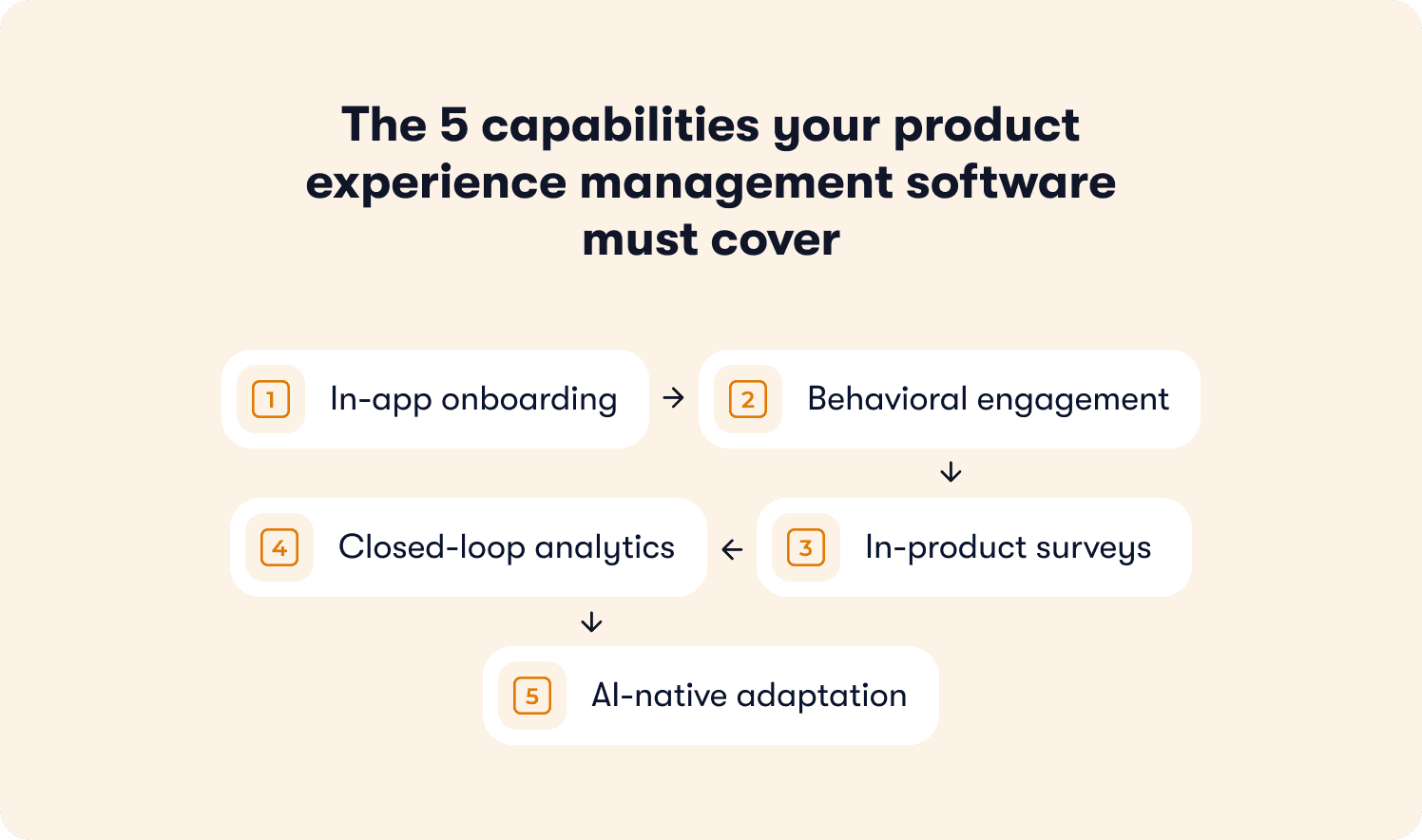
The 5 capabilities your product experience management (PXM) platform must cover
A modern platform covers all five of these capabilities natively with a shared data model. Buying an integration for the fifth capability just reproduces the fragmentation problem at a smaller scale and creates silos for internal teams.
1. Can your onboarding tool tell you what happened to the user after the tour ended? If not, you don't have a completion metric. You have a vanity metric
In-app onboarding relies on action-based flows that advance on real task completion rather than predetermined clicks to guide new users. The onboarding playbook hasn't changed in a decade, but now customer expectations have. Linear tours inflate completion metrics, but action-based guidance actually drives user adoption.
User activation isn't one problem. It’s four layers. The first layer is the foundation, which is the first session where users either find their footing or close the tab. The goal is to get to first value before they lose interest.
When this capability lives in a separate tool, you have no visibility into what happens after the tour ends or how customers interact with the product. You can measure the completion rate, but the activation outcome remains a mystery. When onboarding is unified within a broader platform, flows trigger from shared behavioral data and completions feed directly into your analytics to provide real-time insights.
For example, AB Tasty used this unified approach to launch their onboarding 6x faster, building flows in 90 minutes and reaching 2,000 users in week one.
2. Does your engagement layer fire from what this specific user is doing right now, or from a schedule set three weeks ago? The difference is whether stuck users and activated users get the same message.
Behavioral engagement means delivering guidance that fires based on what this specific user is doing right now, exactly when they encounter friction. Segments work well for analytics, but they're terrible for guidance. Real users don’t move in straight lines. They need nudges that respond to their personal buying journey and customer preferences.
This is the second layer of activation, the ability to nudge at the right moment. Once users are in, the right message at the right time matters more than another generic email. Each nudge should respond to what the user is actually doing, not a calendar.
When engagement is separated from your core data, messages fire on schedules rather than signals. A stuck user gets the exact same message as a fully activated one, which damages customer trust. When unified, triggers are defined in the exact same system that tracks behavior.
3. Is your NPS tied to what a user just did, or to a calendar date? A behavior-triggered survey captures opinion at the moment of context. A calendar survey captures memory.
In-product surveys include NPS, CSAT, and micro-surveys triggered by behavior rather than calendar intervals to gather customer insights. A behavioral trigger provides an actionable signal, while a calendar trigger only provides directional memory. You need to capture customer feedback in the moment to truly understand customer sentiment.
Most NPS surveys are sent at the wrong moment, like a generic “30 days after signup.” The timing has nothing to do with the user. A behavior-based NPS hits a user who just completed their fifth report or invited their third team member. That user has context, an opinion, and they just accomplished something, so they're in a positive, engaged mindset.
When your survey tool is disconnected, you’re analyzing customer feedback in one dashboard while looking at usage data in another. The team knows that client satisfaction dropped, but they have no idea where the experience broke. When unified, triggers and responses are analyzed alongside the exact usage data that preceded them.
4. Can your team answer, without a manual data join, whether last month's onboarding flow changed your 30-day retention rate? If not, you have guidance and analytics, but not a closed loop.
Closed-loop analytics provide native measurement connecting guidance completions to downstream outcomes, like activation rate, trial-to-paid conversion, feature adoption, and 30-day retention. You aren’t just asking if someone completed a tour. You’re asking if the experience actually changed their behavior and drove revenue growth.
When analytics live in a separate tool, you're forced into manual workflows and endless repeat demos to explain the data. You suffer a three-week lag and end up making decisions based on incomplete data. When unified, every guidance interaction is tied directly to retention signals in the same interface.
5. AI-native adaptation guidance that responds to what the user is doing
AI-native adaptation is the layer that separates a truly unified platform from a stack of well-integrated point solutions. This is the shift toward Intelligence-Led Growth (ILG). Where Product-Led Growth (PLG) meant building a product good enough to sell itself, ILG means building AI inside the product that helps every user succeed individually.
Jimo's AI layer covers the full spectrum — guiding users through real task completion, answering questions in context, and executing actions on their behalf — with the user always in the decision seat.
Keep in mind, there's a risk to automation: the IKEA Effect. Harvard research shows that people place 63% more value on things they help build compared to things handed to them fully assembled.
If an AI agent sets up your entire workspace and delivers a ready-to-use product in one click, the user has invested nothing. And users who invest nothing leave easily. The best onboarding is a progression. First, the AI proposes a setup. The user validates or adjusts. Then the AI handles the heavy lifting while the user makes the decisions. Here you have guidance, not autopilot.
For a deeper look at how this mechanism works, see our guide to AI-powered onboarding.
What it costs when any one of these five lives in a separate tool
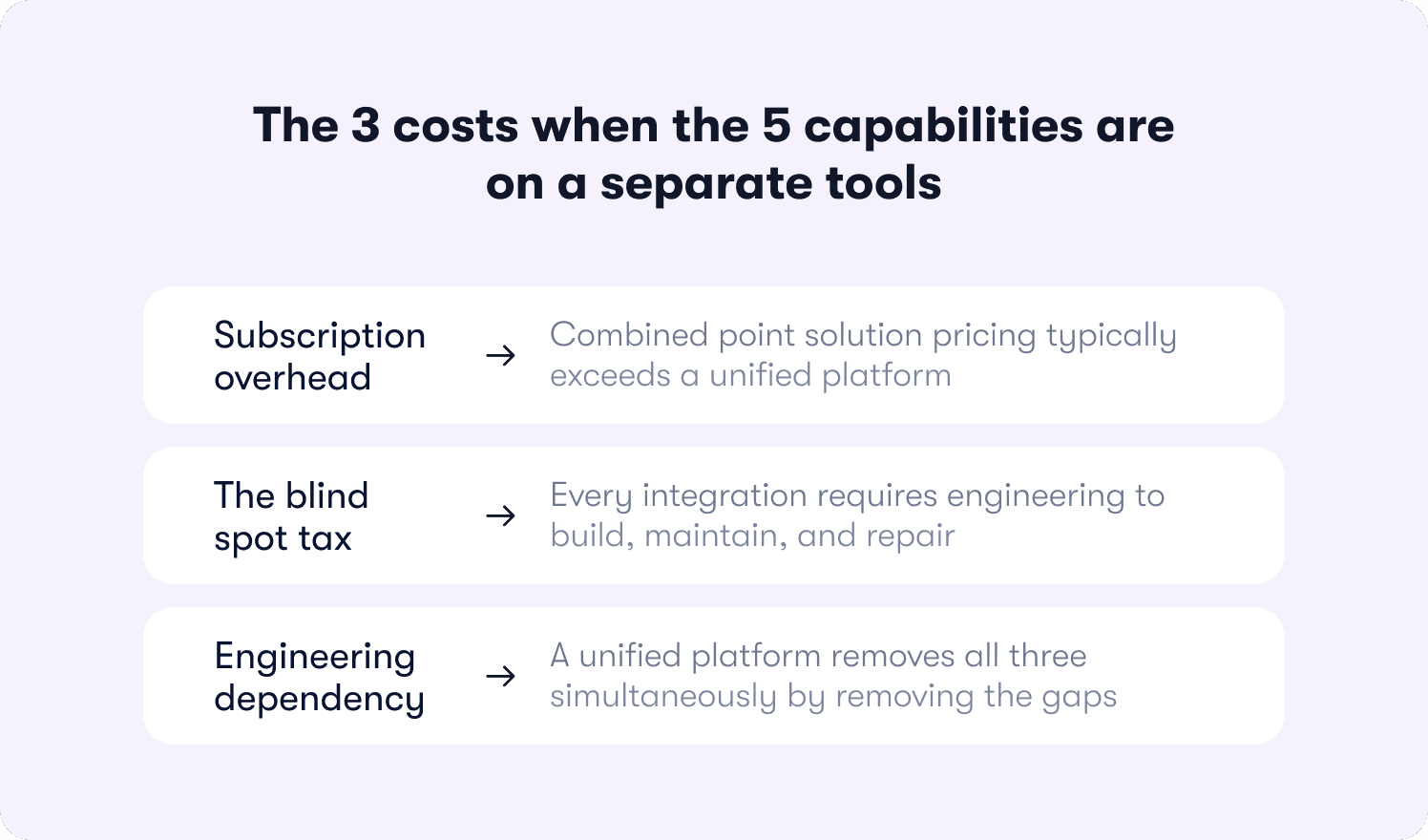
When your product experience stack is fragmented, you pay for it in three distinct ways. A unified platform removes all three of these costs simultaneously. It isn’t always about being cheaper on the invoice. It’s about removing the gaps that make the sum less than the whole.
Subscription overhead
Combined point solution pricing typically exceeds the cost of a unified platform, creating a bloated pricing structure. Shopify's enterprise research found that fragmented tech stacks carry a 36% higher total cost of ownership than consolidated alternatives. When you consolidate, the savings compound. Companies that actively reduce their SaaS stack typically see 20–35% cost reductions within the first 12 months, translating to an average ROI of 3.2x in year one.
The blind spot tax
The absence of a shared data model means teams can’t prove onboarding drives retention. They can’t identify churn signals early, and they definitely can’t justify a product experience’s ROI to leadership.
Engineering dependency
The more scattered your tech stack is, the more integrations you have to upkeep. Engineering has to build, maintain, and repair each one. When you rely on fragmented tools, your operational efficiency drops because your product team’s iteration speed is constrained by sprint capacity rather than product judgment.
Why Jimo is built for product experience excellence
If you're asking whether a single platform can cover all five of these capabilities natively for web-based B2B SaaS without enterprise overhead, the answer is yes. Jimo is built specifically for this purpose.
Jimo isn’t a tour builder with add-ons. All five layers share one behavioral data model. An event in one layer is immediately available to every other layer. There are no exports, no integrations, and no engineers required. By centralizing product data, Jimo gives you centralized control over the entire customer journey.
Many teams misunderstand PLG, thinking their product should speak for itself, so they remove all onboarding. They confuse self-serve with no-serve. The top-performing PLG companies do the opposite. They guide users to value automatically, contextually, at scale. Jimo's architecture is what allows teams to achieve this, moving from generic funnels to Intelligence-Led Growth.
Ready to stop paying the fragmentation tax? Book a demo with Jimo today.
FAQs
What is a product experience platform for B2B SaaS?
For B2B SaaS, a product experience management platform is a unified platform that allows product teams to design, deliver, measure, and iterate on every in-product experience without engineering dependency. It combines onboarding, behavioral engagement, surveys, analytics, and AI adaptation into a single interface with a shared data model.
How is product experience management platform different from a digital adoption platform?
Legacy digital adoption platforms focus primarily on building static, linear product tours. Modern product experience management platforms go much further by adapting to individual behavior in real time, connecting guidance directly to revenue outcomes, and using AI to execute tasks on the user's behalf.
What are the signs your product experience tooling is too fragmented?
The most obvious sign is that you're paying for three or more separate tools to handle tours, surveys, and analytics. If you have to manually join data in a spreadsheet to see if a product tour actually improved retention, your tooling is too fragmented and you're paying the blind spot tax.
Can one platform replace a tour builder, survey tool, and analytics platform?
Yes. A genuine product experience management platform is built on a single behavioral data model. This means the same system that tracks a user's clicks can trigger a contextual survey and immediately measure how that interaction impacted their 30-day retention.
How long does it take to implement product experience management (PXM) software?
Because modern platforms like Jimo are designed for product teams rather than engineers, implementation is incredibly fast. The platform deploys via a simple JavaScript snippet in a matter of days. Once installed, product managers can build flows, launch surveys, and track events immediately without waiting on sprint cycles.
How does unified software improve the overall customer experience?
A unified platform ensures that every touchpoint, from the first onboarding tour to a contextual survey, feels like a single, cohesive conversation. Because the system shares behavioral data, users never receive redundant messages or irrelevant guidance, resulting in a frictionless customer experience.