TL;DR
Product intelligence platforms go beyond analytics by connecting behavioral signals to team action, without a data team in the loop. This guide evaluates five intelligence tools against five criteria: event tracking without engineering, speed from signal to intervention, activation outcome measurement, PM autonomy, and full loop closure. Jimo is the only platform on this list that closes all five criteria natively. We also mention Amplitude and Mixpanel because they’re best-in-class analytics tools that define the gap precisely because they stop at insight. The right choice depends on where your team sits on the spectrum from pure analytics to full intelligence loop.
Your product team already has customer data. You know your activation rate. You know where users drop off. You can pull a funnel in under two minutes and show leadership a chart with a slope that points the wrong direction.
What you don’t know is why, and more importantly, what to do about it before the next sprint ends.
What you have is a classic fragmentation problem, not an analytics problem. User behavior lives in an analytics platform, onboarding signals live in your DAP, and engagement data lives in Intercom. Each tool gives your product teams a slice of the picture. Stitching those slices together into something actionable requires a data analyst, an engineering ticket, and two weeks of calendar time. By then, the cohort that dropped off has already churned.
A product intelligence platform is designed to close that distance by connecting the signal to the action to the measurement in one place. And it should be fast enough for a PM to run the cycle without waiting on anyone.
This guide evaluates five product intelligence platforms and two analytics tools against the major criterion that determines whether they actually solve the problem. That’s the speed and autonomy with which your team can move from signal to intervention, without the data team in the loop.
What is a product intelligence platform?
A product intelligence platform is not an analytics tool with better dashboards. The term gets used loosely, which is part of the problem.
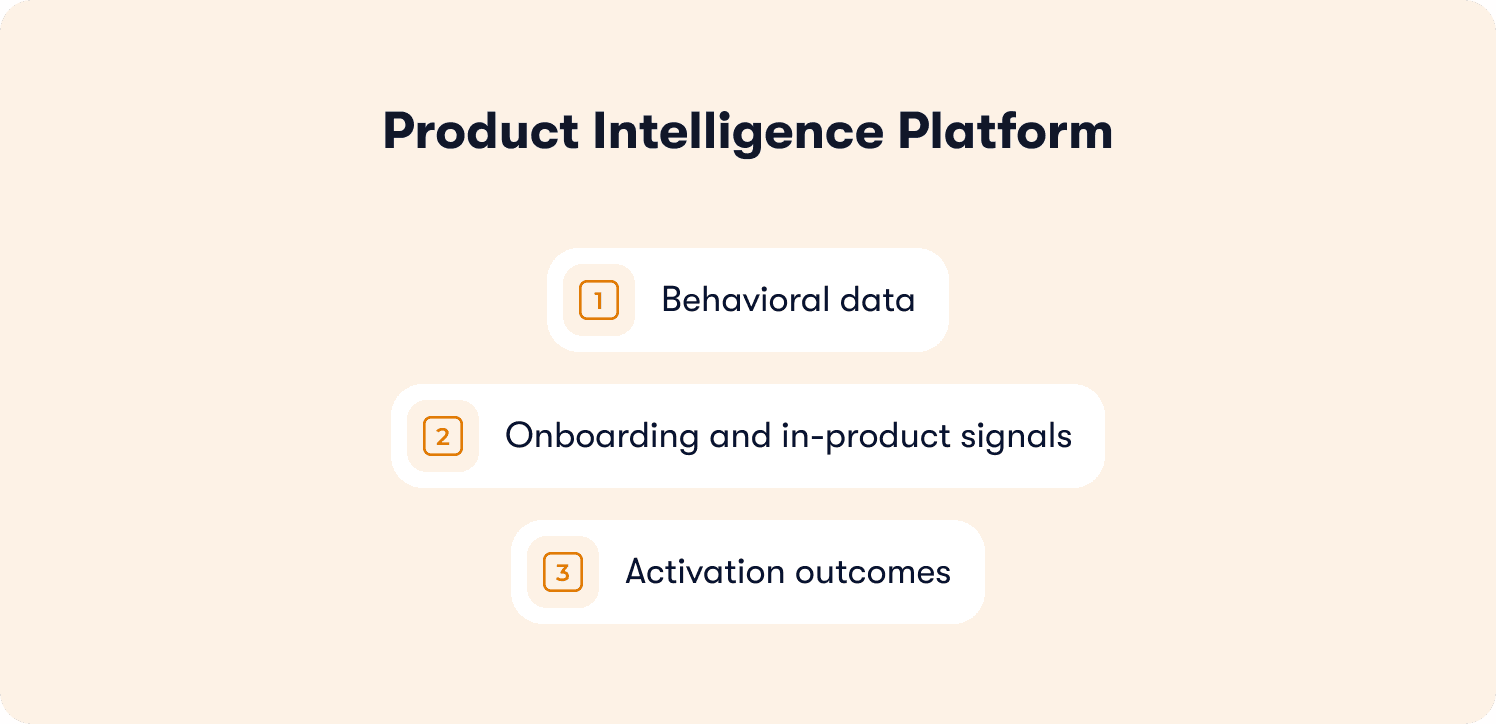
A genuine product intelligence platform connects three things:
Behavioral data: What users do
Onboarding and in-product signals: How they were guided
Activation outcomes: Whether they reached value
It surfaces that connection in a form the product team can act on, without needing a data team to translate findings into a recommendation or an engineering ticket to deploy the response. Early product intelligence tools were analytics platforms with guidance bolt-ons. The newer generation integrates signal capture, intervention, and outcome measurement into a single workflow. The decision between them is often what determines whether your activation rate actually moves.
Keep in mind this guide isn’t talking about product onboarding tools or tour builders, as those belong in a separate category and comparison. This is strictly an evaluation of product intelligence platforms through the lens of the insight-to-action loop.
Product intelligence vs product analytics
Product analytics tells you what happened. Product intelligence goes further by telling you what happened, explaining why, and giving your team the mechanism to respond.
The practical difference shows up in the activation workflow. A PLG-era team stitches analytics, onboarding signals, and engagement data across three tools. Running a signal-to-intervention cycle means exporting from the first, finding the segment in the second, building an experience, and measuring back in the first. That cycle runs on sprint cadences. An ILG-era team detects the signal, identifies the segment, deploys the intervention, and measures the outcome in one platform. That cycle runs in hours.
If your team already moves efficiently by stitching tools, the gap may not matter. If the distance between signal and action is costing you activation cycles, that is the problem a product intelligence platform solves.
How to choose a product intelligence platform
Before evaluating any tool, ensure you have a solid evaluation framework. Most product intelligence vendor demos show you dashboards that look compelling. The five questions below help you identify what you’re really looking for.
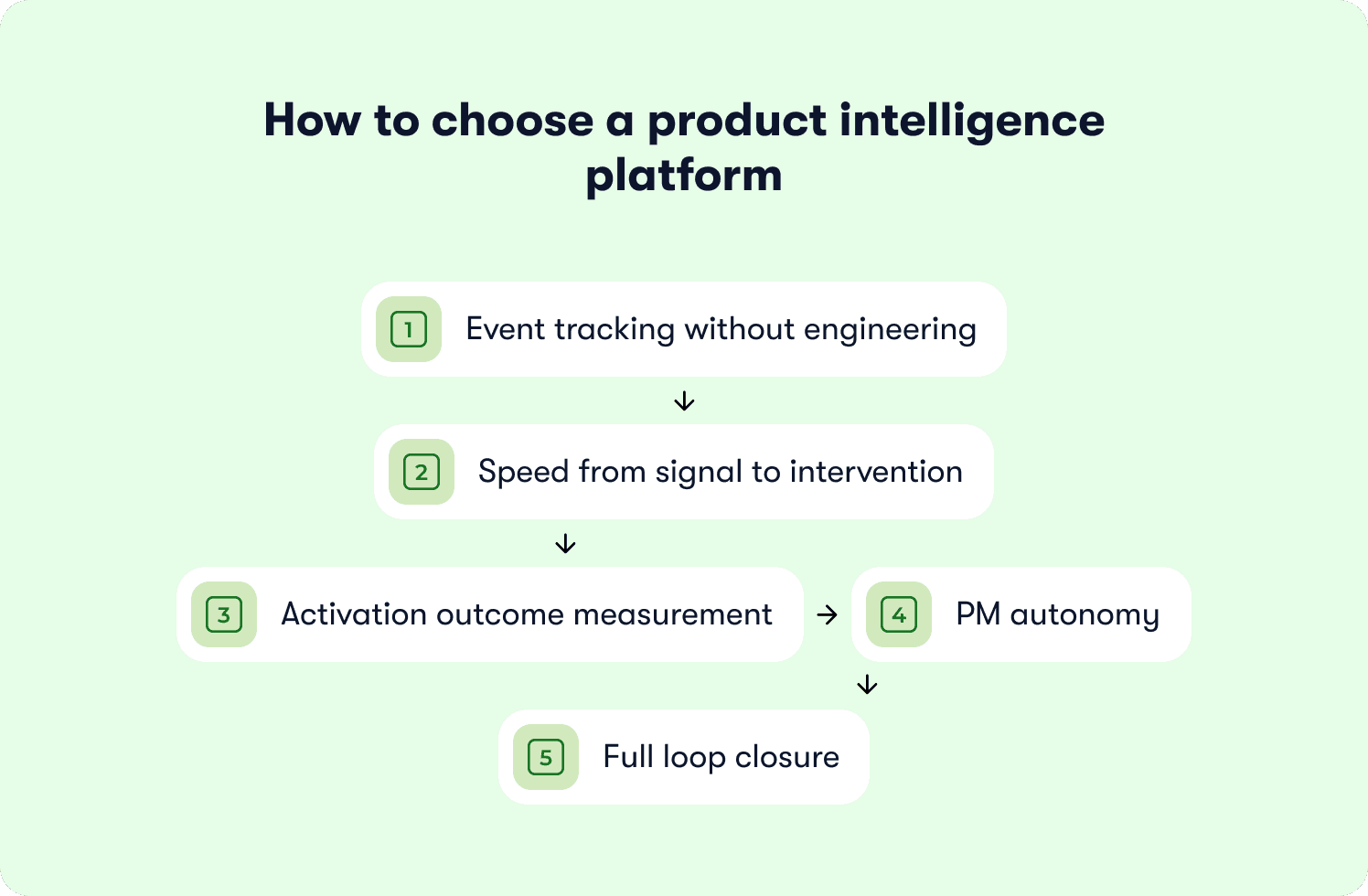
1. Event tracking without engineering
Can the tool track individual user events without engineering tickets, and does it capture what users actually do, not just page views? A platform that requires a developer to instrument every new event is a platform that runs on sprint cycles, not on signals.
2. Speed from signal to intervention
How fast can the team go from spotting a drop-off to launching an intervention: hours, days, or sprint cycles? This is the question most vendors avoid answering precisely. Push for a concrete answer.
3. Activation outcome measurement
Does the tool measure product adoption and whether interventions actually moved activation signal tracking, or does it only report vanity metrics like tour completions and page views? Completion rates tell you whether users clicked through something. Activation measurement tells you whether they actually reached the behavior that predicts retention.
4. PM autonomy
Can product managers use the tool without involving engineering or data analysts for routine tasks? The teams that move fastest from signal to action are the ones whose PMs can build, target, and adjust without filing tickets.
5. Full loop closure
Does the tool close the full loop, detect signal, surface actionable insights, trigger action, measure outcome, in one platform? Or does the team still need to stitch it with another tool? Stitching is where speed dies.
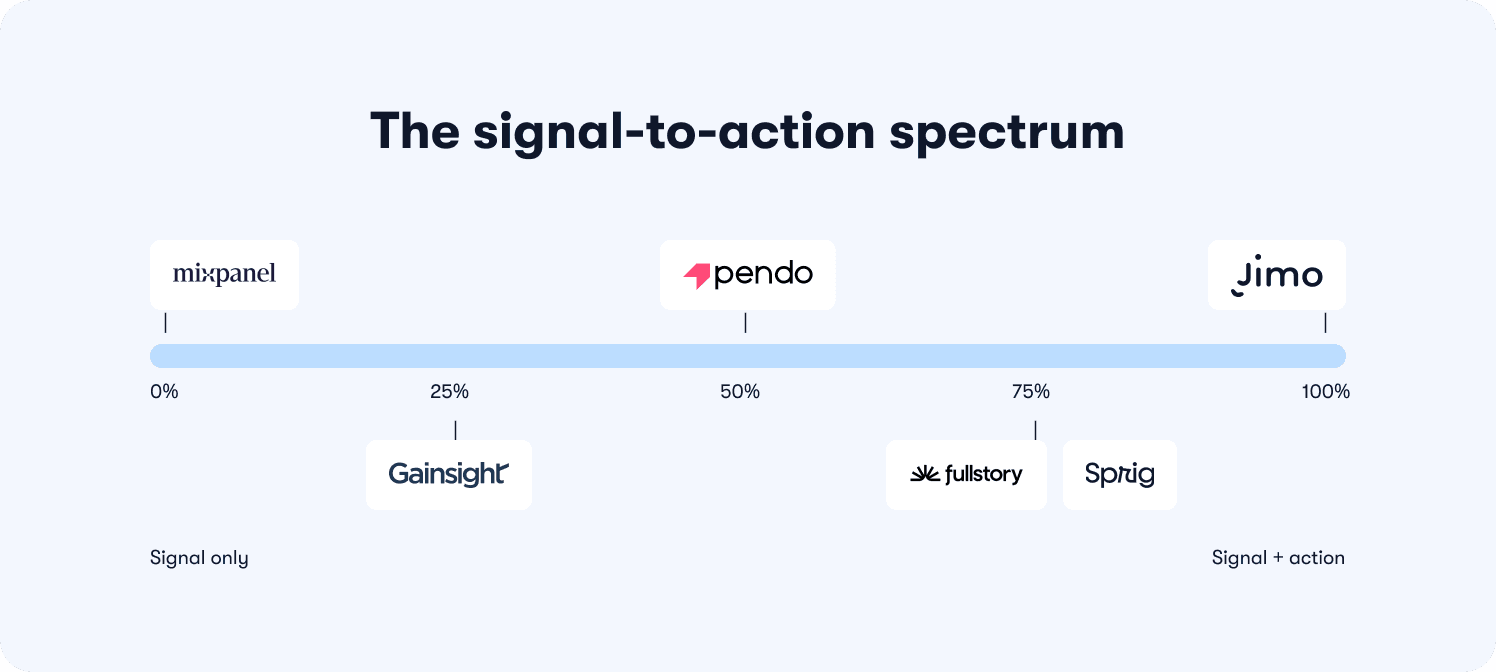
Most teams at Series A–C do not need another analytics dashboard. They need a platform that combines the intelligence layer with the action layer. To understand where each tool stands, it helps to map the spectrum.
The signal-to-action spectrum
The 5 best product intelligence software platforms for SaaS in 2026
Each platform below connects at least part of the signal-to-action loop natively, going beyond dashboards to give product teams a path from behavioral insight to deployed intervention. They’re ranked by how completely they close that loop without requiring a second tool.
1. Jimo: Best for closing the full insight-to-action loop without a data team
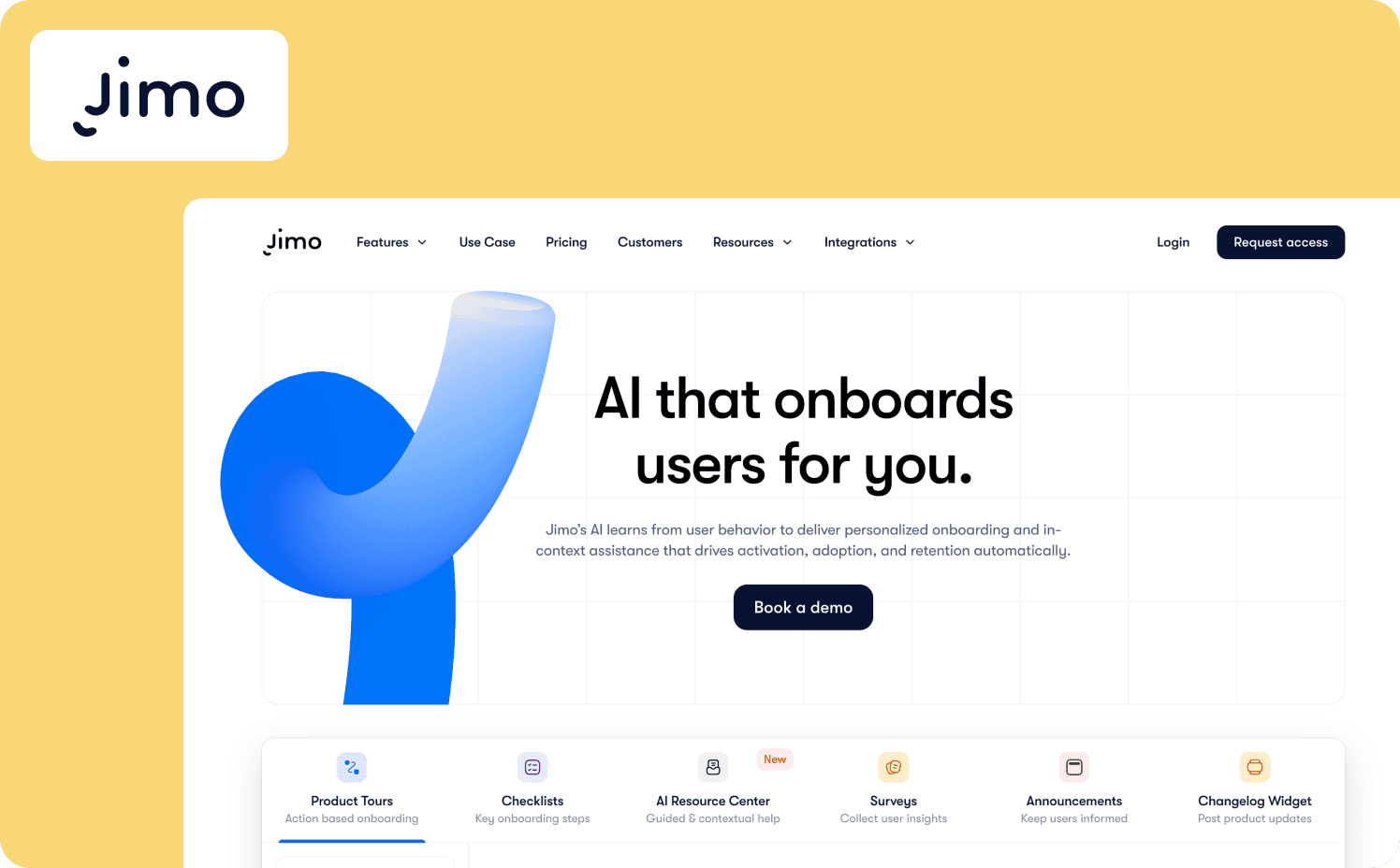
Jimo is the product intelligence platform that connects behavioral signal capture, guided in-product intervention, and activation outcome measurement in a single workflow. Plus, engineering doesn’t have to get involved at every step. It’s designed for product teams that need to reduce churn by acting on behavioral signals faster than the data team can process them.
Where most product intelligence tools give you a signal and leave the action to another platform, Jimo completes the cycle. A PM can click on a UI element to create a tracked event, see which user segments are dropping off before a key activation milestone, fire a targeted hint or guided flow at exactly that segment, and measure whether the intervention moved the activation rate, all without opening a second tool or filing a ticket.
The intervention layer runs through Jimo's AI Copilot, which guides users through context-aware walkthroughs, answers questions from the knowledge base in-product, and executes multi-step workflows from natural language input rather than fixed scripts.
Key strengths:
No-code event tracking via Success Tracker: Captures front-end events by clicking on UI elements, no SDK changes required, in approximately 10 seconds per event
Behavioral triggers fire the right experience based on what users actually did: Distinguishes “completed import” from “attempted but failed” to deliver a different response to each
Goal and conversion tracking tied directly to each experience: Measures whether a tour, hint, or checklist moved users toward the activation milestone, not just whether they clicked through it
AI Copilot layer: Guides users through adaptive walkthroughs that respond to context with full PM control over UI, guardrails, and actions after initial setup
Best fit for: B2B SaaS teams on PLG or hybrid GTM that need product intelligence and in-product action in the same platform, without a dedicated data analyst.
Honest limitations:
Jimo doesn’t support mobile apps
Advanced analytics depth, particularly around behavioral cohorting and predictive retention modeling, is thinner than Amplitude or Mixpanel
Starter: $249/mo (2,500–10,000 MAUs)
Growth: $479/mo (2,500–100,000 MAUs)
Enterprise: Custom
2. Pendo: Best for enterprise teams that want analytics and in-app guidance in one platform
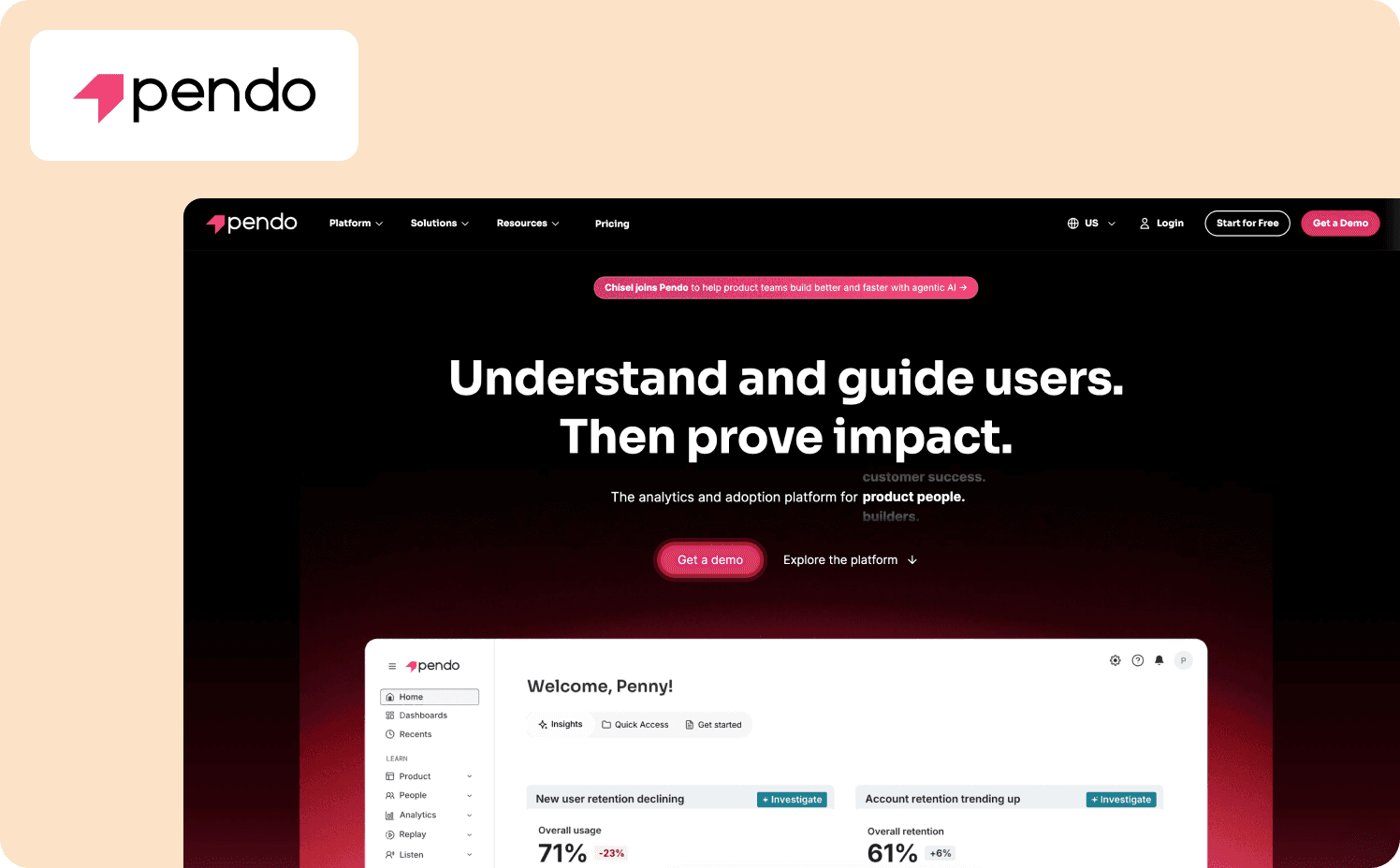
Pendo is a product intelligence platform that combines retroactive behavioral analytics with in-app guidance, connecting the analytics-to-action workflow for teams that can absorb a longer implementation cycle.
Product teams can analyze any historical click or interaction without having pre-tagged it. Its AI surfaces churn risk, behavioral patterns, and opportunity signals proactively, and the in-app guidance layer means teams can respond to those signals without switching platforms.
Key strengths:
Retroactive analytics allow you to see historical product data for any interaction without prior event tagging
Product Engagement Score combines adoption, stickiness, and growth into a single metric for tracking product performance across cohorts
Path and funnel analytics surface the exact sequence of actions that predict retention versus churn, giving product teams a behavioral map they can act on without a data analyst building the query
Best fit for: Enterprise product teams that have the implementation runway and budget to consolidate analytics and in-app guidance into one platform.
Honest limitations:
Implementation typically requires professional services and runs a few months before the platform delivers full value
Pricing scales aggressively with MAU and is entirely opaque beyond the free tier
Pricing:
Free: For 500 MAU
Base: Custom (custom MAUs)
Core: Custom (custom MAUs)
Ultimate: Custom (custom MAUs)
3. FullStory: Best for qualitative behavioral intelligence and friction detection
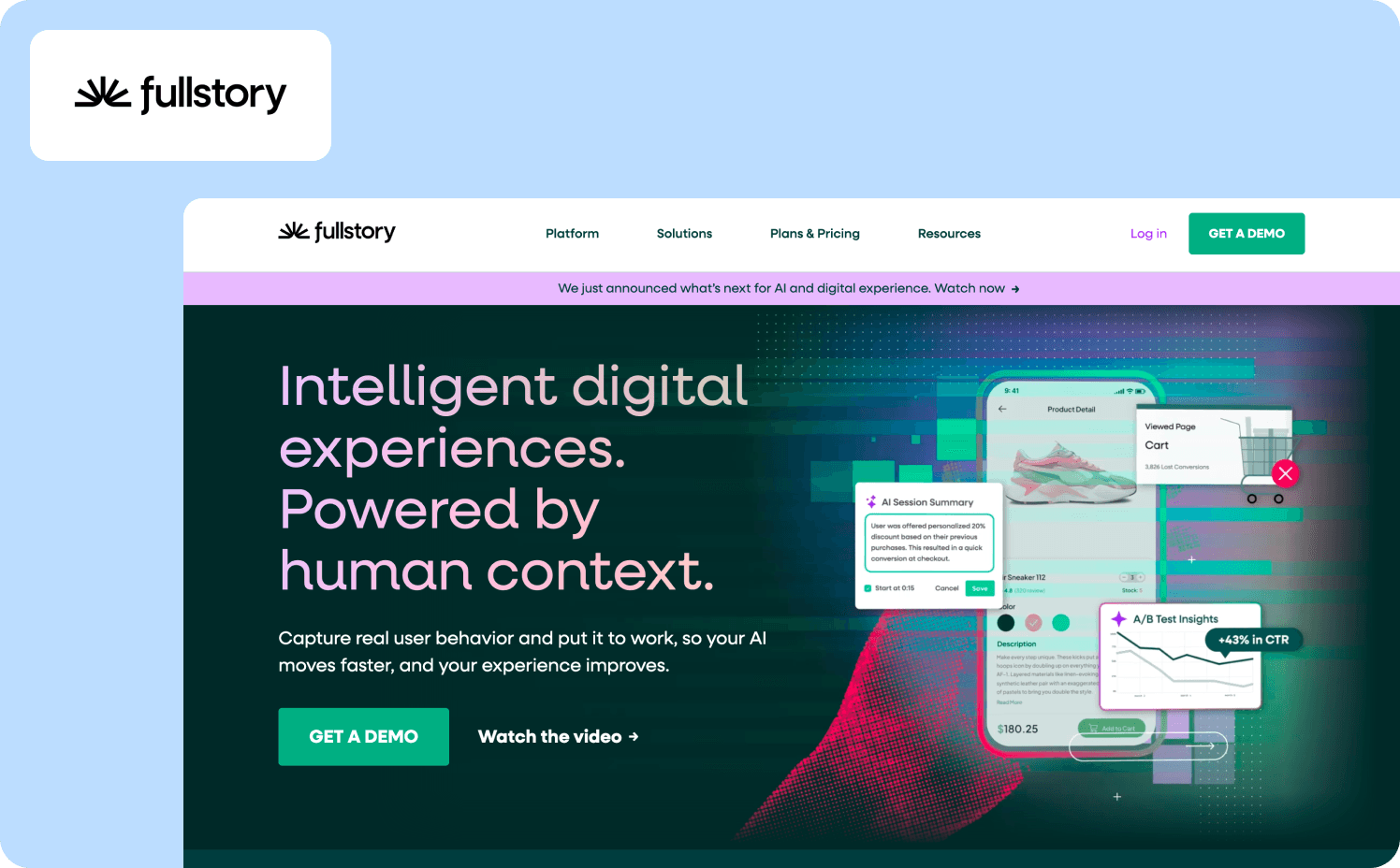
A new entrant to this list, FullStory is an intelligent digital experience platform that captures a complete, privacy-first record of every user interaction and uses AI to turn that behavioral data into friction signals and experience improvements.
FullStory's Fullcapture technology records everything: every click, scroll, and interaction, providing the richest behavioral dataset in this category as a foundation for AI-assisted analysis. Its StoryAI converts behavioral data into insights that product teams can trust.
Key strengths:
Fullcapture automatically records every user interaction with no manual event tagging required, giving product intelligence queries access to behavioral history that pre-dated the question
Surfaces user behavior signals as they happen rather than looking backward, changing how fast product teams can respond to friction
StoryAI generates answers grounded in actual behavioral data, so product managers spend less time building reports and more time making decisions
Best fit for: Product and UX teams that need the deepest qualitative picture of friction and are prepared to add the Guides layer separately for intervention capability.
Honest limitations:
The in-product action layer (Guides and Surveys) is a paid add-on, not bundled into base plans
All pricing tiers require a sales conversation
Pricing:
Business: Custom
Advanced: Custom
Enterprise: Custom
4. Sprig: Best for enterprise UX research teams running structured user studies at scale
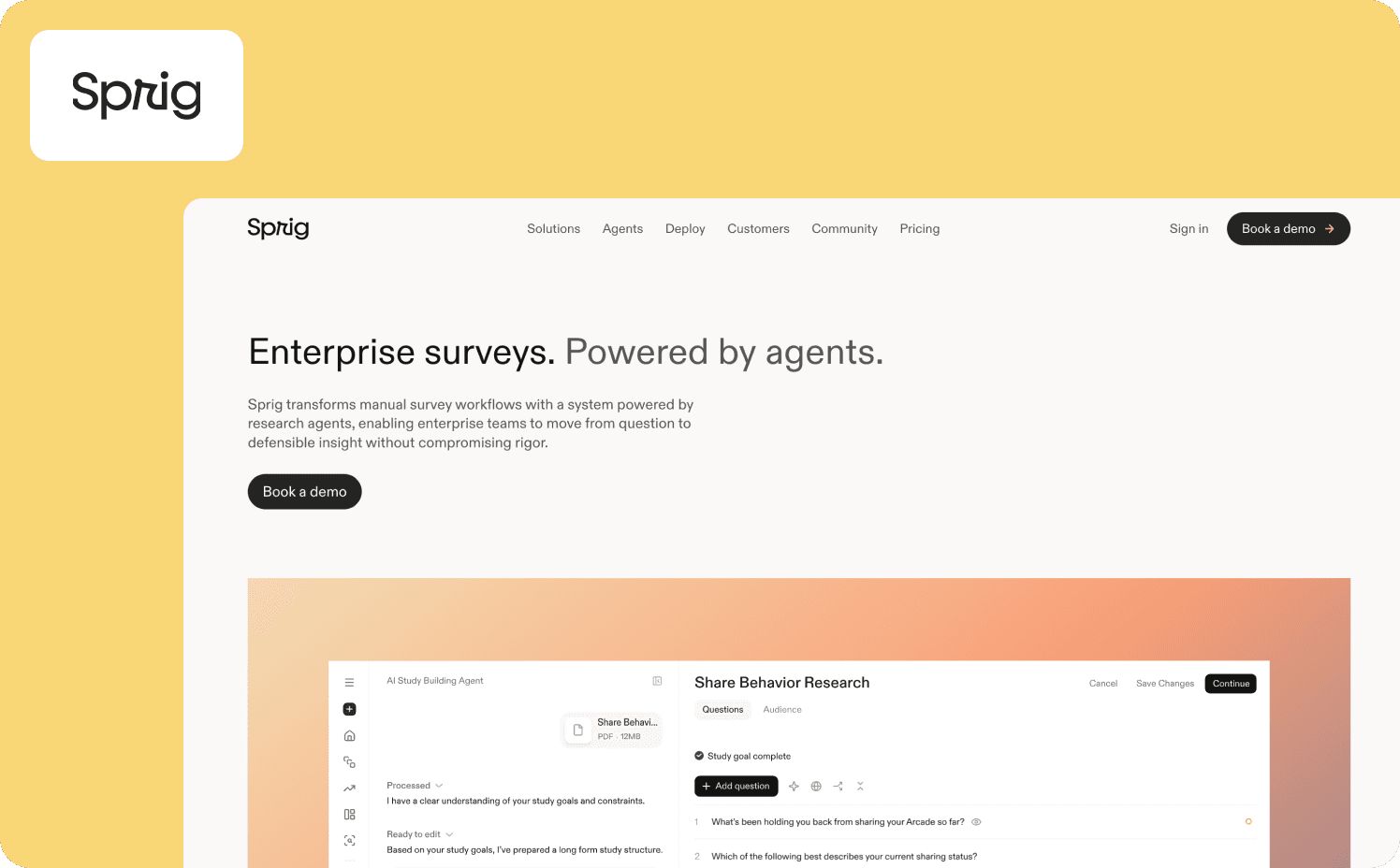
Sprig is an enterprise research platform powered by AI agents. It helps UX research and consumer insights teams design, deploy, and synthesize user studies, from NPS and CSAT to conjoint analysis and concept testing, without the manual operational overhead that traditional survey platforms require.
Sprig has moved well beyond the lightweight in-product microsurvey tool it was in earlier years. The platform is now built around three AI agents that handle the operational layer of enterprise research. It surfaces the qualitative reasons behind the behavioral patterns that usage data reveals.
Key strengths:
You can describe a research objective and the Design Agent builds the complete study logic, branching, and bias checks
Behavioral event triggers can fire in-product surveys at specific product moments, onboarding completion, feature abandonment, or first use
Synthesize Agent converts raw study results into stakeholder-ready narratives with evidence mapped to each conclusion
Best fit for: Enterprise UX research and consumer insights teams that need rigorous, structured user research at scale, not growth-stage product managers looking for a real-time activation feedback loop.
Honest limitations:
Sprig isn’t a product analytics platform, it’s more of a qualitative complement to an analytics tool, not a replacement
The platform surfaces the qualitative understanding of why users behave as they do, but a separate platform must act on that signal
Pricing:
Free: Core survey capabilities with limited responses
Starter: Custom
Enterprise: Custom
5. GainsightPX: Best for enterprise teams connecting product usage to customer success health scores
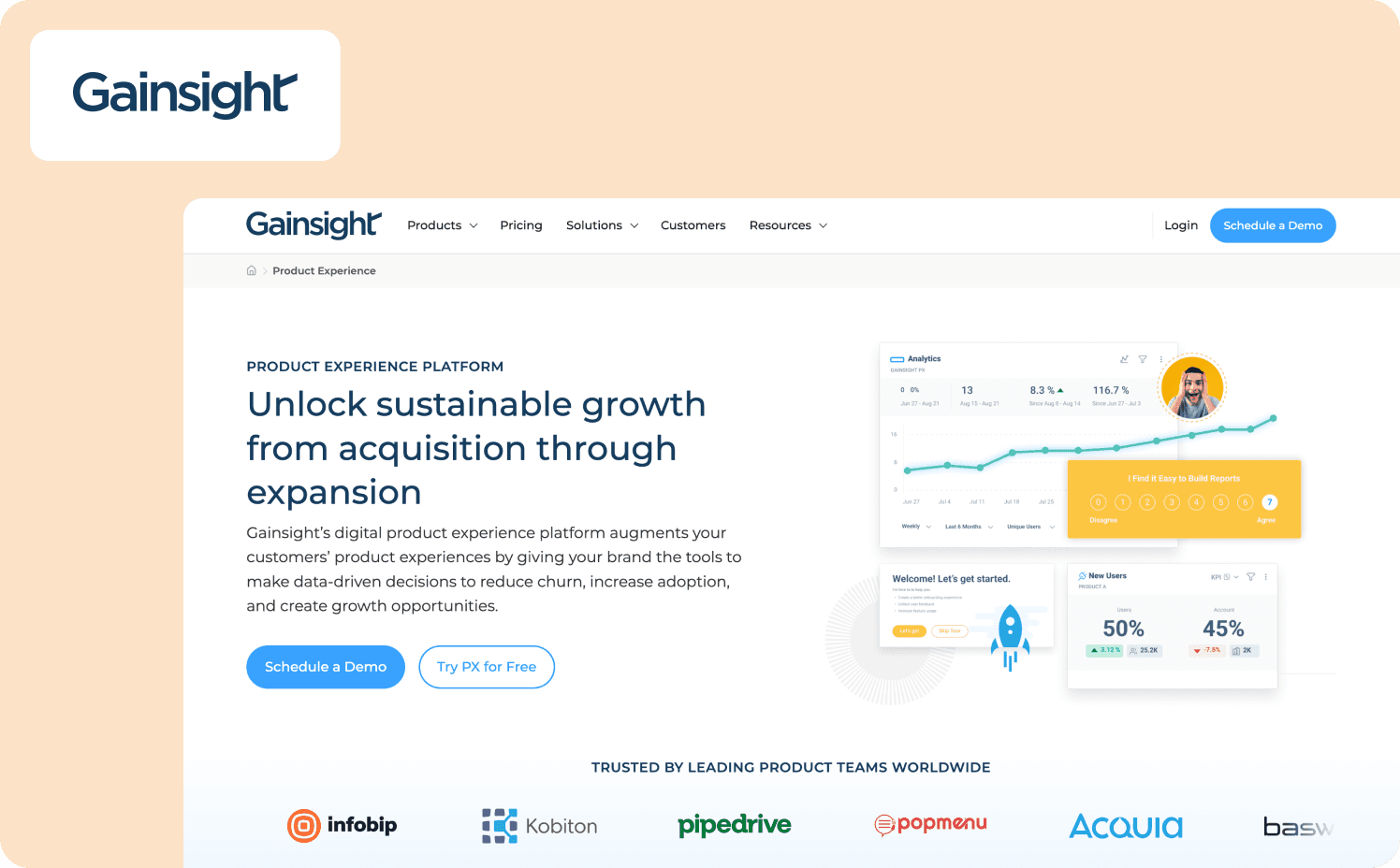
GainsightPX is a product experience platform that tracks how customers interact with a product, identifies friction and retention risk, delivers in-app guidance, and pushes those signals directly into Gainsight CS health scores for customer success alignment.
The platform’s AI-powered Product Mapper automatically instruments the entire product hierarchy. Its Golden Features analysis identifies which product features correlate with long-term customer satisfaction and retention, connecting product data to the expansion revenue signals that matter to CS and finance. Marketing teams also pull from this layer when building marketing campaigns around expansion signals or at-risk accounts
Key strengths:
AI Product Mapper requires no manual tagging or engineering involvement
Native CS integration means product usage data flows directly into Gainsight CS health scores, surfacing churn risk and expansion signals from product behavior without building a separate pipeline
Tracks product performance within 30–60 days and expansion revenue signals within 90 days
Best fit for: Enterprise B2B SaaS teams already operating on the Gainsight CS platform that want to connect product usage intelligence directly into customer success workflows and account health scoring.
Honest limitations:
Implementation complexity is significant, making this an unsuitable choice for teams that need to move at growth-stage speed
The platform is designed for enterprise budgets and doesn’t display public pricing
Pricing:
Custom pricing
2 analytics platforms worth pairing with an intelligence layer
Both of the product analytics tools below are best-in-class at surfacing behavioral signals, but neither closes the action loop natively. They’re included here because understanding where they stop is the clearest way to understand what a full product intelligence platform adds, and because Jimo is designed to be the action layer that completes what either of them starts.
1. Amplitude: Best for deep behavioral intelligence when you already have a separate activation tool
Amplitude is one of the strongest product analytics platforms in B2B SaaS, and like Mixpanel, it’s not a product intelligence platform in the full sense. It’s included here because the behavioral intelligence it delivers is best-in-class, and the gap it leaves open is precisely what a product intelligence platform closes.
If you’re a Head of Product trying to answer “which sequence of product features correlates with users who are still active at Day 90?” Amplitude is among the strongest tools in the category.
Key strengths:
Behavioral cohorting groups users by feature usage sequences to identify which activation paths lead to retention at Day 30, Day 60, and Day 90
AI proactively surfaces actionable insights, diagnoses drop-offs, and recommends next steps
Experimentation and feature flag management in the same platform so PMs can test a hypothesis and ship with confidence without disconnected tools
Best fit for: Product teams and growth teams that need deep behavioral intelligence and already have a separate engagement or guidance tool to act on the signals Amplitude surfaces.
Honest limitations:
Detecting a signal in Amplitude and responding to it require two separate platforms, which means the full intelligence loop depends entirely on the speed of the second tool
Growth and Enterprise pricing require custom quotes and scaling costs with event volume can make prices rise quickly for high-activity products
Pricing:
Starter: Free (Up to 10k MTUs)
Plus: From $61/mo (Up to 300k MTUs)
Growth: Custom (custom MTUs)
Enterprise: Custom (custom MTUs)
2. Mixpanel: Best for event-based behavioral analytics as part of a larger stack
Mixpanel is the most widely used product analytics tool in B2B SaaS, and it’s not a product intelligence platform. It’s included here because understanding what Mixpanel does exceptionally well, and where it stops, is the fastest way to understand what product intelligence actually adds.
Mixpanel tracks user behavior through event-based analytics, builds funnels, analyzes retention, and segments users any way a product team needs. Its AI surfaces the “why” behind metrics, diagnoses drop-offs, and recommends what to address next without requiring a data analyst to build the query.
Key strengths:
Real-time funnel analysis visualizes multi-step conversion paths and pinpoints friction in minutes, giving PMs immediate clarity on where users are leaving
A/B testing and feature flag management in the same platform, so product teams can test hypotheses against real product analytics metrics without disconnected tools
Sub-second query performance at scale handles billions of events per month without degrading the analysis experience
Best fit for: Product teams that have, or plan to have, a dedicated in-app engagement tool alongside Mixpanel, and want best-in-class product analytics for the signal detection half of the cycle.
Honest limitations:
Mixpanel has no in-product intervention capability of any kind, so the full intelligence loop requires a second platform like Jimo
The free tier is event-capped at 1M monthly events; growth-stage teams with active product usage can outgrow it quickly, and Growth plan pricing requires a custom quote at higher volumes
Pricing:
Free: Capped at 1M monthly events
Growth: Starts at $140/mo
Enterprise: Custom
From signal to action: Choosing the right platform for your team
The best product intelligence platform shrinks the distance between a signal and a team action to the point where the activation loop can run without a data team intermediating every step.
Map your current workflow against the five criteria honestly. If your team can already go from a behavioral signal to a deployed intervention in hours, you may need the intelligence depth that Amplitude or Mixpanel offers more than you need the action layer. But if the distance between signal and action is measured in sprint cycles, the action layer is the gap that matters most to your team. And Jimo is built to be that layer, offering integrations for teams already running Amplitude or Mixpanel
Not all product intelligence tools are solving the same problem:
Pure analytics tools (Mixpanel, Amplitude) give you the clearest picture of what is happening and why
Partial-loop platforms (Pendo, GainsightPX) add an action layer with significant implementation overhead
Qualitative intelligence platforms (FullStory, Sprig) add the "why behind the what" without native activation intervention
The full loop (Jimo) closes all five criteria in one platform for the teams whose primary constraint is the distance between signal and action
If you want to test what the full loop looks like in practice, book a demo with Jimo and run the five criteria questions live during the session.
FAQs
What is product intelligence in SaaS?
Product intelligence in SaaS connects behavioral data, customer feedback, and usage trends into a system that gives decision-makers a complete picture of how users interact with the product, without needing a data team to translate the signals. Where business intelligence delivers a high level overview of performance, product intelligence focuses on the moment-to-moment customer experience and the most important metrics that predict whether users reach value. SaaS companies use it to make data driven decisions faster and identify the gaps their analytics data alone cannot surface.
What is the difference between product analytics and product intelligence?
Product analytics tracks data points like funnels, usage trends, and customer behavior to show internal teams what happened. Product intelligence goes further and connects those signals to the onboarding process, customer lifecycle stage, and customer engagement patterns to explain why it happened, and then gives the team a mechanism to act. The practical gap is strategic action. Analytics produces valuable information, while product intelligence produces a response.
What are the best product intelligence tools for startups in 2026?
For early-stage B2B SaaS teams with an established product and active user base, the most relevant options are Jimo (full loop, $249/mo) and FullStory (qualitative friction detection with a permanent free plan). Jimo is the strongest fit for teams that need to improve product experiences and close the activation loop without internal teams relying on a data analyst for every intervention. Mixpanel and Pendo are worth evaluating once the team has the headcount and budget to support their implementation requirements.
Do I need a product intelligence platform if I already have Amplitude or Mixpanel?
It depends on whether the gap between signal and strategic action is costing your team activation cycles. Both tools deliver excellent analytics data and surface customer behavior patterns, but neither closes the action loop. A PM who spots a drop-off still needs a second platform and, in most cases, an engineering ticket to respond. If your team can already move from a signal to a deployed intervention in hours, the action layer adds limited value.
How does a product intelligence platform improve activation rates?
A product intelligence platform improves conversion rate and activation by shortening the distance between a behavioral signal, a user who hits a new feature three times without activating it, and a deployed response such as a contextual hint that walks them through the setup. When product intelligence work happens in the same platform as the intervention, the cycle runs in hours instead of sprint cadences, and companies that run it frequently see compounding gains. The teams that see the largest lifts are the ones treating activation as an ongoing loop rather than a one-time campaign.