/
7 mins read

TL;DR
Most onboarding best practices were written for single-persona SaaS products; however, fulfillment software serves warehouse operators, dispatchers, account managers, and client-side admins, all inside the same account, all with different activation events. "Reduce friction" and "find your aha moment" are necessary starting points, but they don't tell you what to do when four different user roles each have a different first meaningful action and all of them matter to your activation rate. This article reframes seven core onboarding best practices through the lens of fulfillment software's operational complexity: multi-role activation, client-level variation, support ticket deflection, and iteration without engineering dependency. The teams closing the activation gap fastest aren't running better generic onboarding; they're treating it as an operations problem: standardized, segment-specific, and product-owned. If you're a VP of Product Operations responsible for onboarding across a logistics or fulfillment SaaS product, this is the framework built for your context.
You ship a new fulfillment client. The contract is signed, the integration is live, and within 48 hours three groups of people open your product for the first time: a warehouse team lead who needs to process their first shipment before end of shift, an account manager who has never touched a WMS interface in their life, and a client-side admin who has been using a competitor's platform for six years and has strong opinions about where settings menus should live.
The standard onboarding playbook says: find your aha moment. Guide users to it. Reduce friction along the way.
That advice isn't wrong. It's just incomplete for this context. When your product serves multiple distinct roles inside a single account, each with different goals, different risk tolerances, and a different definition of "value," a single guided tour and a welcome email sequence aren't going to move your activation rate. They're going to move it for one role, partially, and leave the others to figure it out.
The best practices for onboarding new users to fulfillment software aren't dramatically different from the principles that apply to any complex B2B product. But the fulfillment context changes how each one has to be executed. High operational stakes mean there's no tolerance for irrelevant guidance. Frequent client variation means flows that worked last quarter may not fit the next account. Multi-role user bases mean your activation event isn't one thing. It turns out to be four. And because every fix currently requires an engineering ticket, the iteration loop that should take days takes sprints.
What follows is a practical framework for each of those realities, built for the VP of Product Operations who owns the onboarding outcome without always owning the engineering resources to improve it.
Why Fulfillment Software Onboarding Is Different
Most onboarding frameworks start with a reasonable assumption: your product has one primary user type, one core workflow, and one moment where value clicks. Map the path to that moment, reduce the steps, and you have a working onboarding strategy.
Fulfillment software breaks that assumption on day one.
A single account in a logistics or fulfillment SaaS product typically spans four distinct user roles, each with a genuinely different relationship to the product. Warehouse operators need to process orders accurately and fast and their tolerance for a slow start is measured in missed SLAs, not churned subscriptions.
Account managers need to pull client reports and configure billing rules before their next customer call. Dispatchers need to assign routes and track fulfillment status across multiple clients simultaneously. Client-side admins need to understand permissions, integrations, and exception workflows before they can hand the product to their own teams.
These aren't variations of the same user. They're four separate activation rate problems living inside one account.
The operational stakes compound the challenge. In most B2B SaaS products, a user who doesn't activate within the first week is a churn signal. In fulfillment software, a warehouse operator who doesn't activate is an operational liability: shipments don't go out, SLAs are missed, and the client relationship takes damage before your CS team even knows there's a problem. The cost of poor onboarding isn't measured in conversion rate. It's measured in operational failure.
Then there's client-level variation. Each new fulfillment client arrives with its own workflow expectations, integration requirements, and internal role structures. The onboarding flow that worked for your last client may not map cleanly onto this one. User segmentation at the role level is table stakes, but segmentation at the client configuration level is where most teams hit a wall, because rebuilding flows for each new account requires engineering time that product ops teams don't control.
Best Practice 1: Define Activation Per Role, Not Per Product
The standard advice is to define your aha moment and then build your onboarding toward it. It's good advice for a product with one primary persona. For fulfillment software, it creates a blind spot.
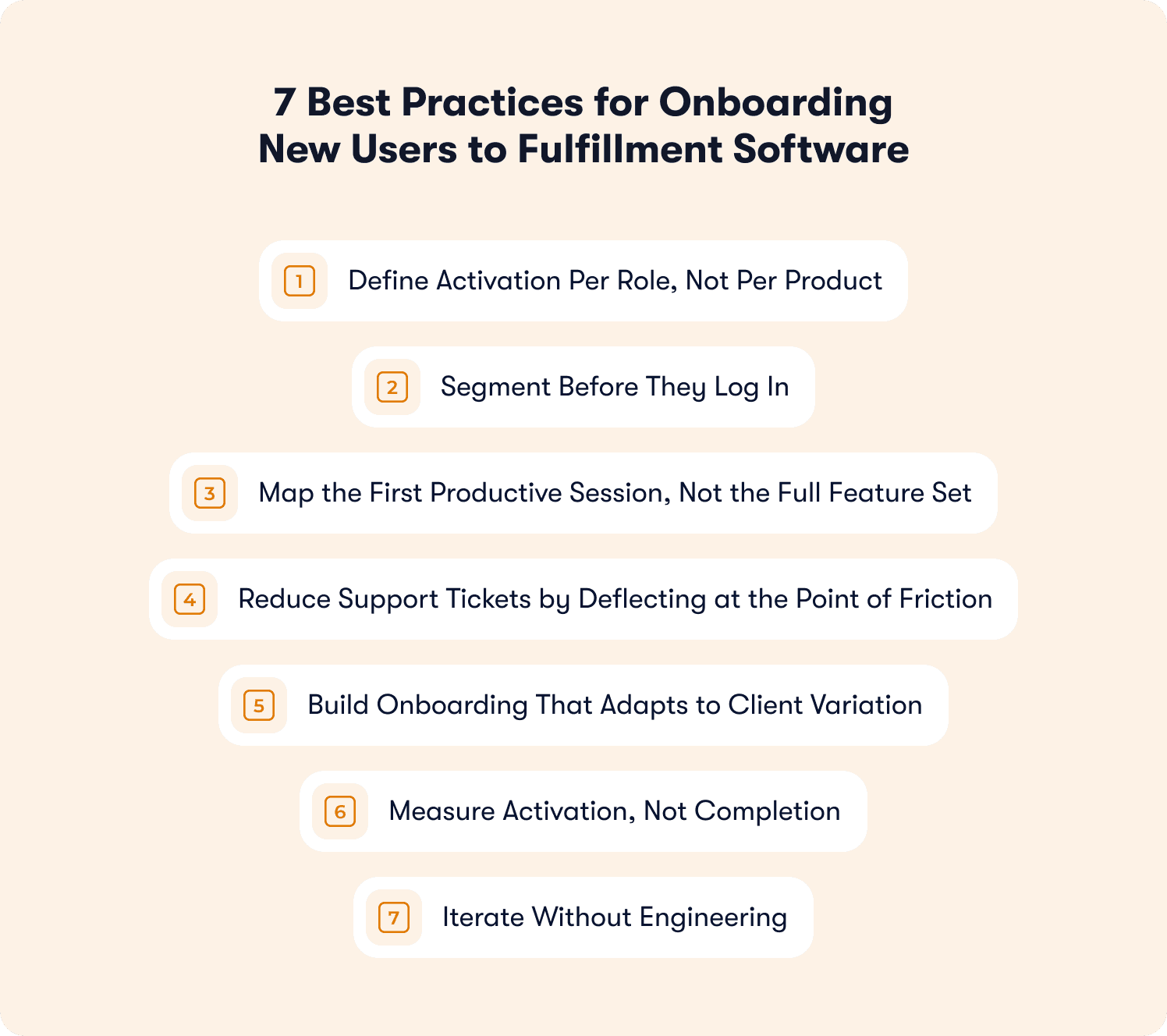
There is no single aha moment in a multi-role product. There are four. And treating them as one means your onboarding is optimized for one role's activation path while the others navigate without guidance.
The more precise framing: define one activation event per role, tied to the first action that demonstrates real workflow competence and not just product familiarity. You can set the following for each of the roles below:
For a Warehouse operator. First successfully processed shipment, zero support intervention.
For an Account manager. First client report generated and exported. Dispatcher: First route assigned with status tracking confirmed.
For a Client-side admin: Initial permissions configuration completed without a support ticket.
This is where user friction compounds quickly. When all four roles land in the same generic onboarding flow, the warehouse operator is reading about billing configuration they'll never touch. The account manager is sitting through a walkthrough of the dispatch queue. Neither reaches their activation rate target faster, they just experience more irrelevant guidance before giving up or calling support.
Before you build a single onboarding flow, map one activation event per role. Be specific. "User completes setup" is not an activation event. "Warehouse operator processes first inbound shipment with zero support intervention" is. That specificity is what makes it possible to build guidance that drives time-to-value for each segment and to measure whether it's working.
For teams using a digital adoption platform to manage this, role-based activation mapping translates directly into segment-specific onboarding flows: each user role enters a guided path built around their activation event, triggered automatically at login based on their provisioned role. No engineering ticket required to build it, and no warehouse operator forced through an account manager's tutorial. You can explore what that looks like across different product contexts in Jimo's product tour examples.
Best Practice 2: Segment Before They Log In
If your users are self-identifying their role through a signup questionnaire, you've already lost the warehouse operator.
They opened the product mid-shift. They have orders to process. An onboarding flow that asks them to answer three questions before showing them anything useful is friction at exactly the wrong moment and in a fulfillment context, that friction doesn't produce polite drop-off. It produces a support ticket, or a call to their manager, or a user who skips onboarding entirely and works from memory.
The good news: in fulfillment SaaS, you already know who every user is before they log in. Their role was provisioned by an admin at account setup. That provisioning data is your segmentation trigger. The question for VP of Product Ops is whether your onboarding infrastructure is actually using it.
What role-based provisioning enables:
Each user enters a guided path scoped to their activation event, not a generic welcome flow
No questionnaire, no welcome modal that applies to everyone and is optimized for no one
Segmentation decisions made once at the infrastructure level, not rebuilt for every new account
Where this breaks down at scale:
Client-level variation is the real challenge here. A dispatcher at one fulfillment client may carry responsibilities that another client assigns to a warehouse supervisor. Rigid role definitions that don't accommodate that variation will misroute users as reliably as no segmentation at all.
The decision is not "should we segment?" — it's "how do we build segment definitions that flex across client configurations without requiring an engineering rebuild each time?" That is an infrastructure question, and the answer determines whether your onboarding scales or stalls with every new account you bring on. Jimo's guide to interactive onboarding strategies covers how to structure that architecture in practice.
Best Practice 3: Map the First Productive Session, Not the Full Feature Set
Progressive disclosure is well understood. The execution problem in fulfillment software is that most teams draw the scope of "day one" too wide.
A warehouse operator's first session is not an orientation to your platform. It is one task: process an order correctly, without making an error that causes a shipment to go out wrong. That's the entirety of what day one looks like for that role. Every piece of guidance outside that task is noise and in a shift-based operational environment, noise doesn't get tolerated. It gets skipped, and then your support queue fills up.
The right question for VP of Product Ops is not: "What does this user need to understand about our product?"
It's: "What is the minimum set of actions this user needs to complete their first real task without calling for help?"
For each role in a fulfillment product, that answer is shorter than most product teams expect:
Role | First Productive Session |
Warehouse operator | Receive order, confirm inventory, process shipment, mark complete |
Account manager | Locate client account, pull status report, export it |
Dispatcher | View active queue, assign route, confirm assignment |
Client-side admin | Set user permissions, confirm integration status, verify notification settings |
That's the scope. Everything else in the product exists and users will find it — but it does not belong in session one.
The metric that keeps this honest:
Track time-to-value per role from first login to first completed activation event. If that number spans more than one session, the onboarding flow has scope creep. Something in the guided path is asking users to do more than their first productive task actually requires.
There is also a support cost lever here. Trimming onboarding scope to the first productive session consistently reduces inbound ticket volume from new users because the guidance they received was directly relevant to what they were trying to do. For example, a Jimo customer in the hospitality SaaS sector achieved similar results in an adjacent operational vertical. A well-structured self-service onboarding framework, built per role and measured per session, is the operational foundation that makes that kind of result repeatable.
📖 You know which session matters most per role. These 19 tactics show you exactly how to fill it — mapped to the activation stage they address and the drop-off point they fix → Get you free playbook.
Best Practice 4: Reduce Support Tickets by Deflecting at the Point of Friction
Support ticket spikes after a new client goes live are not a customer success problem. They are an onboarding design problem.
In fulfillment software, the same questions repeat at scale across every new account: how to process a return, how to update inventory counts, how to configure a shipping rule, how to resolve an exception. These are not edge cases. They are predictable friction points that your team already knows about, because they show up in every support queue, every time.
The decision here is not whether to address these friction points. It's whether to address them reactively through CS intervention, or proactively through contextual help delivered at the exact moment a user gets stuck.
The case for in-product deflection over CS intervention:
CS intervention at scale is expensive and doesn't compound. Every ticket handled is handled once, for one user.
Contextual in-app guidance delivered at the friction point handles the same question for every user who hits that step, permanently.
Deflection reduces onboarding time, not just support volume. Users who get the answer in-product don't pause and wait for a response. They keep moving.
What this looks like in practice:
Rather than building a help center that users have to navigate away from the product to access, in-app messaging surfaces the relevant guidance inside the workflow, at the step where the friction occurs. A tooltip that appears when a user opens the returns module for the first time. A checklist item that expands with context when a user stalls on inventory configuration. A short walkthrough triggered when an exception state appears for the first time.
None of these require a support ticket. None require a CS manager to intervene. They require knowing where users get stuck, which your support data already tells you, and building guidance that intercepts that friction before it becomes a ticket.
The metric to track:
Monitor ticket volume by workflow area per new account cohort, then map it against where guided flows exist and where they don't. The gaps in your funnel analysis are your in-product guidance roadmap. When you close those gaps with contextual guidance, the deflection compounds with every new account you add. That is where the operational leverage actually lives. Explore how teams are structuring this in Jimo's guide to improving the customer onboarding process.
Best Practice 5: Build Onboarding That Adapts to Client Variation
Every fulfillment client is a variation. Different warehouse configurations, different role structures, different integration requirements, different exception workflows. Most onboarding frameworks assume a stable product surface: one set of flows, deployed consistently, refined over time.
In fulfillment SaaS, that assumption breaks at the account level. The flow that worked cleanly for your last client may not map onto this one, because this client's dispatchers own a part of the workflow that the last client assigned to warehouse supervisors. Building a new flow from scratch for each account is not a scalable answer. Waiting for engineering to adapt the existing one is not either.
The real question is: how do you build onboarding that accommodates client variation without treating every new account as a custom implementation?
The three layers where variation typically occurs:
Role structure variation. Client A provisions five distinct roles. Client B provisions three, with overlapping responsibilities. Flows built around rigid role definitions will misroute users at Client B, or require manual adjustment before go-live.
Workflow configuration variation. The order processing workflow at one client includes a quality control checkpoint that another client skips entirely. A guided flow that walks users through that checkpoint is actively wrong for the client that doesn't use it.
Integration variation. Clients bring different ERP systems, carrier integrations, and inventory management setups. Onboarding guidance that references a specific integration path needs to flex based on what's actually configured for that account.
What adaptable onboarding actually requires:
The ability to modify and deploy guided flows without engineering dependency is not a feature preference at this level of client variation. It is an operational necessity. If adapting a flow for a new client requires a sprint, onboarding is not a product ops asset. It is an engineering dependency that scales at the speed of the dev team, not at the speed of the sales motion.
A flow built for Client A should be duplicatable, adjustable for Client B's role structure, and deployable before go-live without a ticket raised. That is the operational model that makes product adoption consistent across a growing client base rather than inconsistent by default. For teams evaluating how to structure feature discovery within client-specific flows, Jimo's overview of AI-powered onboarding covers how that adaptation can be automated rather than manually managed for each new account.
Best Practice 6: Measure Activation, Not Completion
A warehouse operator who clicks through every step of a guided tour and then doesn't process a single shipment has not been activated. They have completed a tour.
That distinction matters more in fulfillment software than in almost any other SaaS context, because the operational consequences of mistaking completion for activation are immediate and visible. Shipments don't go out. SLAs get missed. The client escalates. And when the product ops team reviews the onboarding data, everything looks fine: completion rates are healthy, tours are being finished, the dashboard is green.
This is the core risk of measuring the wrong thing. Completion is a lag measure and it tells you nothing about whether the user can actually do their job.
The metrics that actually indicate activation:
Metric | What it tells you |
Time from first login to first completed workflow action | Whether the onboarding path is leading to real task completion |
First session completion rate per role | Whether role-specific flows are scoped correctly |
Support ticket volume in the first 14 days per role | Where guided flows are missing or insufficient |
Drop-off point within each guided flow | Which specific steps are causing users to stall or abandon |
The measurement gap most teams are sitting in:
In-app guidance exists but its connection to downstream outcomes is unknown. Tours get built, completion rates get tracked, and the team optimizes for completion without ever confirming that completion predicts activation. This is a structural problem, not an effort problem. The data exists in two separate places — onboarding completion in the adoption tool, workflow activity in the product — and nobody has connected them.
Closing that gap means instrumenting your onboarding layer to track not just whether users finished a flow, but whether they completed the activation event that flow was designed to drive. For each role, that means defining the post-onboarding action that counts as success, then measuring how consistently guided users reach it compared to unguided users. That comparison is the only honest read of whether your onboarding is working.
Best Practice 7: Iterate Without Engineering
Your support data flags a drop-off. Users are stalling at the inventory configuration step — the same step, across three different client accounts, in the same two-week window. You know exactly where the problem is. You know what guidance is missing. And you know that fixing it will require raising a ticket, waiting for sprint planning, competing with roadmap priorities, and shipping a change in six weeks.
By which point two more client cohorts will have hit the same wall.
This is the iteration problem that sits underneath every other onboarding challenge in fulfillment software. The teams that improve activation fastest are not the ones with the best initial onboarding design. They are the ones who can identify friction and close it before it compounds across accounts.
The iteration cycle that actually works:
Identify. Use ticket volume by workflow area and drop-off data by flow step to pinpoint exactly where users are stalling. This data exists. The question is whether it's being reviewed on a weekly cadence or a quarterly one.
Build. Create or adjust the relevant guided flow — a tooltip, a checklist step, a short walkthrough at the friction point. In a no-code onboarding tool, this is a product ops task, not an engineering task.
Deploy. Push the change to the relevant user segment. Not to all users. Not after a full QA cycle. To the role and client configuration where the problem was observed.
Measure. Track whether the change moves the activation metric for that segment. If it does, extend it. If it doesn't, adjust and redeploy. The A/B testing infrastructure for this already exists inside most digital adoption platforms.
What this requires at the organizational level:
The iteration cycle above only works if onboarding is treated as a product ops asset rather than an engineering deliverable. That is a process decision as much as a tooling decision. If every change to an onboarding flow requires a ticket and a sprint, the iteration cadence will always lag behind the activation problem.
AB Tasty moved to a model where guided flows could be built and deployed in 90 minutes, cutting their feature launch cycle significantly and reaching 2,000 users in week one. The speed was not the goal — consistent activation across a fast-growing user base was. The speed was what made consistency achievable.
For teams looking to build the operational foundation for this kind of iteration cadence, Jimo's guide to how to increase product adoption covers the process model in detail. And if your current onboarding infrastructure is the bottleneck, how to run a successful SaaS onboarding process is a practical starting point for rebuilding it around a faster loop.
Where to Start: A Decision Framework for Product Ops Teams
Not every fulfillment product is broken in the same place. The seven practices above address different activation problems, and trying to implement all of them at once is its own form of scope creep. The table below maps each practice to the operational symptom that makes it the right starting point.
If your primary problem is... | Start here |
Inconsistent activation rates across user roles within the same account | Practices 1 and 2: define role-specific activation events, then build segmentation into provisioning |
Support ticket spikes in the first 30 days after a new client goes live | Practice 4: map your ticket data to workflow friction points and deploy contextual guidance there first |
Onboarding flows that break with each new client configuration | Practice 5: audit where client variation is breaking existing flows before building new ones |
Healthy completion rates but flat activation and poor retention | Practice 6: instrument against actual workflow outcomes, not tour completions |
Long time-to-fix when onboarding friction is identified | Practice 7: establish the no-code iteration cycle before optimizing any individual flow |
Users activating but taking too long to get there | Practice 3: cut everything from the first session that sits outside the minimum viable task path |
No visibility into which role is underperforming | Practice 1: role-specific activation mapping is the diagnostic foundation everything else depends on |
For most teams, Practices 1 and 2 are the right place to begin. Without role-specific activation definitions and provisioning-based segmentation, the data produced by every other practice is too aggregated to act on. You cannot diagnose a dispatcher drop-off problem if your onboarding analytics are reporting at the account level rather than the role level.
From there, the sequencing follows your data. Support ticket volume tells you where Practice 4 is most urgent. Drop-off analysis tells you where Practice 3 needs tightening. And if the time between identifying a problem and shipping a fix is measured in sprints rather than days, Practice 7 is the constraint that needs resolving before any of the others can compound.
That last point is worth sitting with. The operational challenge that connects every practice in this article is the same one: product ops teams that own the activation problem rarely own the engineering resources to fix it. The iteration loop that should take days takes sprints. The flow that needs adjusting for a new client sits in a backlog. The friction point that your support data flagged three weeks ago is still sending tickets.
The teams that close the activation gap in fulfillment SaaS are not the ones with the most sophisticated initial onboarding design. They are the ones who built the infrastructure to identify friction, act on it fast, and measure whether the fix actually moved the outcome without raising a ticket each time. That operational model is what separates onboarding that works at launch from onboarding that works across every client you add after it.
If you want to see how that model works in practice, explore how Jimo customers have built it or see how Jimo can improve your operations.