/
6 mins read

TL;DR
Cutting onboarding time by removing friction works. Cutting it by removing depth backfires. The tactics that shorten time without sacrificing adoption share one principle. They remove the time that doesn’t matter (redundant steps, manual handoffs, generic content) while protecting the time that does (the moments where users build real product understanding). If you want to reduce onboarding time, the whole point is removing wasted time, not meaningful time. Here are four tactics that hold up.
If you’re on the product team, you’ve heard this from leadership constantly: Customer onboarding takes too long, time to value (TTV) needs to shrink, and the funnel needs to move faster.
Your first instinct might be to cut steps from the onboarding process. But the wrong cuts produce users who finish onboarding without actually understanding the product. If you’re a product manager or customer success leader at a B2B SaaS company trying to reduce onboarding time, the goal isn’t speed at any cost. It’s speed that holds up after the onboarding flow ends, when users need to do real work in your product on their own.
What is onboarding time, and how should you measure it
Onboarding time is the span from signup to a user’s first meaningful value, not from signup to tour completion. Those are two different things, and confusing them is the most common mistake teams make when they try to decrease onboarding time.
Tour completion and checklist completion are vanity proxies that don’t tell you whether a user learned to use the product. Someone who finishes a five-step tour in 90 seconds might have been entertained, but not properly onboarded.
The metric that matters is time to value, which is how long it takes a new user to reach the action that predicts they’ll stick around. Every successful product has an “aha moment,” the instant users first experience real value, and the first impression that sets the tone for the entire relationship.
Jimo’s onboarding strategy framework makes this distinction explicit. Most teams try to optimize for four metrics at once: time to value, activation rate, retention, and completion rate. That produces strategy paralysis. Every decision has to balance competing pressures, and no decision feels defensible. The discipline of picking one primary metric (and treating the rest as diagnostic) is what turns a tactic stack into a strategy.
How to pick your primary onboarding metric
To reduce onboarding time efforts, the primary metric should be time to value. Completion rate becomes a diagnostic signal, not the goal. If completion rate is high and TTV is low, your onboarding is working. If completion rate is high and TTV is still long, your onboarding is producing click-throughs, not users.
The average SaaS activation rate sits around 36%, with top product-led growth (PLG) companies hitting 20–40%. That gap between signups and activated users is where time for onboarding either gets compressed or wasted. When onboarding starts well, users reach value fast. When it doesn’t, you lose them before they ever experience the product.
For SaaS users, the goal is reaching value in your product. The metrics that define success are distinct processes with fundamentally different goals.
What’s a good onboarding time? (Benchmarks)
There’s not a single number for average onboarding time because the answer depends almost entirely on product complexity. A self-serve PLG tool where one person signs up and reaches value in their first session has a completely different timeline than an enterprise platform that requires integrations, multi-user setup, and data migration.
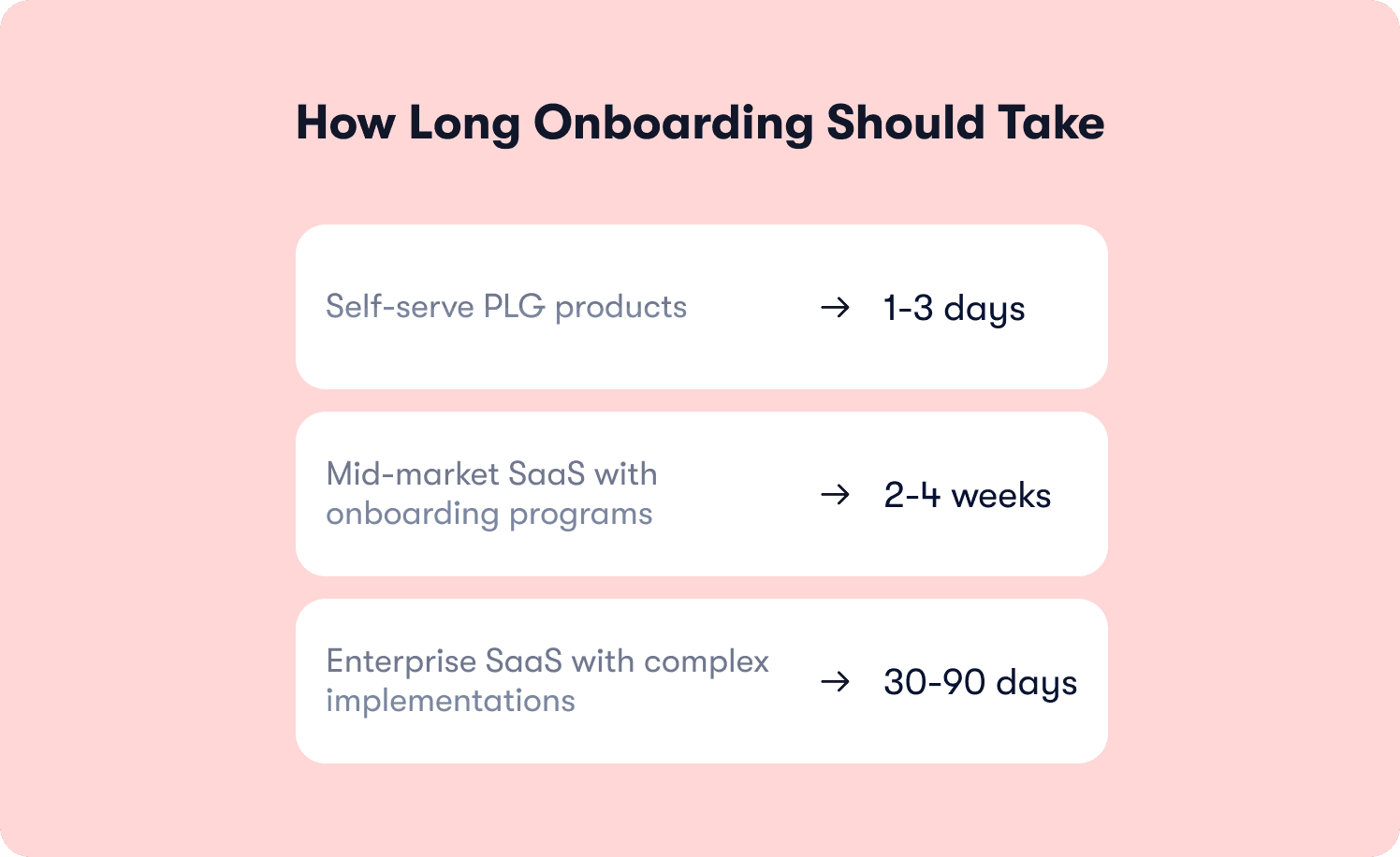
How long should onboarding take? It depends on complexity, but here are some benchmarks:
Self-serve PLG products: 1 to 3 days to first value
Mid-market SaaS with onboarding programs: 2 to 4 weeks
Enterprise SaaS with complex implementations: 30 to 90 days
TTV also scales with contract size. Products serving accounts under $5K ARR typically see median time to value around 11 minutes, because the user can reach value in a single session. Accounts in the $5K to $25K range typically take about 2.4 days, gated by multi-user setup. Enterprise accounts over $100K typically take around 23 days.
Across all product types, 60% of users abandon onboarding if they don't experience clear value in the first 7 days. The window closes fast, regardless of how complex your product is.
B2B SaaS products can typically cut TTV by 40 to 60% with automation and parallelized workflows. You can save time without cutting depth, but only if you know which time to cut. Spending valuable time on steps that don't build understanding is the real waste.
Zenchef, a Jimo customer, cut their onboarding time from 30 days to 14 with in-product guidance. The ramp time for new users dropped without sacrificing depth, and the final stage of their onboarding went from a manual CS call to a self-service checklist.
Why cutting onboarding time can backfire
Cutting time is easy. But cutting time without producing shallow, fast-but-hollow activation is hard. Poor onboarding that prioritizes speed over depth creates users who complete steps without building real understanding.
When teams cut the wrong steps, users complete onboarding faster, completion-rate dashboards look great, and nobody notices the problem until weeks later. The problem shows up as higher support ticket volume, lower feature adoption, and early churn. The onboarding experience looked like a win in the dashboard and showed up later as a loss in the retention curve.
What fast, but surface-level onboarding actually costs
The data backs this up. According to SaaS Mag, 60–70% of annual SaaS churn happens inside the first 90 days, and 40–60% of users who churn do so within the first 30 days because they never experienced the value promised.
Users who reach their “aha” moment within 7 days of signup have 3x higher 90-day retention than users who don’t. These are the leading indicators that tell you whether your onboarding is working before churn data confirms it. You need clear expectations for what onboarding should accomplish, not a dashboard full of vanity metrics.
The activation window narrows by the day. Every day a user spends in the onboarding phase without reaching value is a day they're more likely to leave. And 57% of companies that reduced their onboarding investment saw churn increase within six months. Cutting onboarding time by cutting onboarding depth costs you in churn and undermines long term success.
The benefits of active onboarding
Jimo’s onboarding strategy names this tradeoff directly. Active onboarding (where users perform real actions) has higher friction per step. Users abandon it more often than passive flows. But the users who complete active onboarding are far more likely to retain because active delivery optimizes for activation while passive optimizes for completion. If your goal is to reduce onboarding time without hurting adoption, you need active onboarding that's efficient, not passive onboarding that's fast.
It was reported that a 25% improvement in activation rate correlates with a 34% increase in revenue (FairMarkit). Speed that produces activated users drives revenue. Speed that produces completed tours drives nothing.
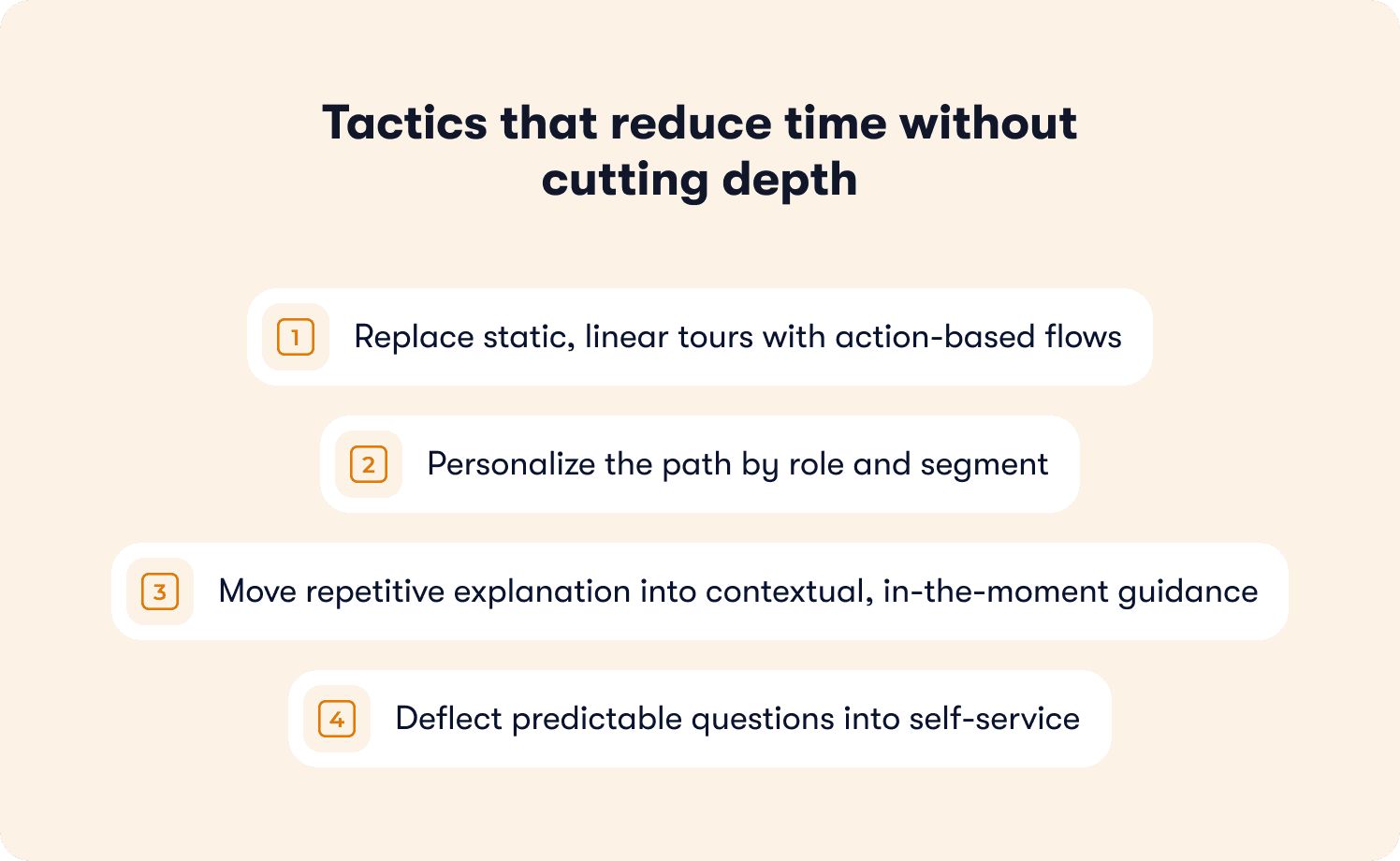
Tactics that reduce time without cutting depth
An effective onboarding process targets a specific type of wasted time in the process. The key takeaways from each are to remove what wastes time, protect what builds understanding. Effective onboarding is about efficiency, not shortcuts.
Replace static, linear tours with action-based flows
The first place to look for wasted onboarding time is the product tour itself. Static tours advance on a click, which confirms nothing was learned. Action-based tours advance when a user completes a real task, like creating their first project or connecting their first integration, which is why interactive tours convert better than passive ones: they force learning by doing instead of watching.
Personalize the path by role and segment
Generic onboarding treats all users the same. It overwhelms them with irrelevant features and wastes time on steps that don’t apply. A successful onboarding process asks a few questions at signup, then shows each user only what's relevant to their role and goals.
Personalized onboarding delivers faster time-to-productivity. A marketing manager doesn't sit through the developer setup steps. A developer doesn't sit through the campaign builder walkthrough. Each new group of users gets a personal touch through content tailored to their context. Users learn at their own pace, which is better for ongoing development of their product skills.
Set expectations early by showing users exactly what they need to do, not everything the product can do. This is one of the most important things to pay attention to when creating your onboarding design. Generic flows treat all users as one audience. Personalized, AI-powered flows treat them as team members with different job requirements and company goals.
Move repetitive explanation into contextual, in-the-moment guidance
Most onboarding front-loads explanation into a single walkthrough at the start of the user's journey. Users forget most of it by the time they need it. This is the Spacing Effect: information is better retained when learned at the moment of need, not all at once. The learning experience suffers when everything is delivered upfront.
Contextual guidance replaces the upfront dump with in-the-moment help:
A tooltip appears when a user hovers over a feature they haven’t used.
A checklist item surfaces when a user navigates to a new section.
A hint fires when a user has been on a page for two minutes without taking action
Each piece of guidance is small, relevant, and delivered when the user actually needs it.
Behavior-based triggers outperform time-based ones. Time-based messages (Giving all users X feature on day 3) assume everyone is at the same learning stage. They’re usually not. Behavior-based triggers respond to what users actually need at that moment. The other aspects of the product surface naturally as users explore, rather than being forced on them before they're ready.
This approach also feeds back into your onboarding strategy. When guidance is contextual, you can measure which moments of friction actually block users, and iterate on those specifically rather than rebuilding the entire onboarding flow.
Deflect predictable questions into self-service
Every product has a set of questions that come up over and over during onboarding. “How do I connect my CRM?”, “Where do I find my API key?”, or “Can I invite my team?” Each one becomes a support ticket, a CS touch, or a stalled user. This is time consuming for your team and frustrating for users.
The fix is to move those answers into a self-service resource center that lives inside the product, where users encounter the question. A resource center delivers help at the point of friction instead of routing users to an external knowledge base they’ll never visit. It should be pull-based, so users engage when they’re stuck, on their own terms. Make product docs and help content available in-product rather than buried in an external help center.
Onboarding checklists play a similar role. A visible, finite list of tasks that lead to activation combines three psychological forces: the Zeigarnik Effect (incomplete tasks nag at us), goal clarity (users know what to do), and progress visualization (the bar fills up). Checklists turn a vague onboarding experience into a concrete, self-directed path. Users can track progress and see exactly what’s left to do.
You should also collect feedback during onboarding to catch where users get stuck. Deploy short, contextual surveys at the exact moment and reason users drop off. Most churn analysis is post-mortem, after the user is gone. Catching friction in real time lets you fix it before it costs you a user.
Customer onboarding time reduction in practice
We’ve seen all the tactics above play out in the real world, applied by real SaaS teams using Jimo. These companies chose to invest in the right kind of speed, and the results speak for themselves.
Zenchef reduced customer onboarding time from 30 days to 14, with a goal of under 2 hours for fully self-service onboarding. They replaced manual onboarding touches with in-product guidance across five languages, so users could complete setup without a CSM on the line. They didn't cut onboarding depth, they cut the manual friction of delivering it one customer at a time. The process went from high-touch to self-service without losing substance.
AB Tasty compressed their feature launch process from 3 months to 2 weeks using Jimo's no-code onboarding tools. They built their first onboarding flow in 90 minutes, launched to 2,000 users in week one, and doubled their CSAT score. The speed came from removing the engineering dependency, not from removing steps from the user’s journey.
Customer Alliance saw a 970% increase in AI Reply feature adoption after implementing targeted in-product guidance for customers with low engagement scores. They eliminated CSM involvement for no-touch customer onboarding entirely. Their in-product surveys collected 120 responses in two weeks, compared to roughly 20 responses at 2% open rates from email surveys. That's a 6x improvement in feedback collection, which let them iterate on onboarding based on real user signal instead of guesswork.
There’s a consistent pattern across all these stories. Each team cut the time that didn't matter (manual handoffs, engineering cycles, generic content delivery) and kept the time that did (contextual guidance, real task completion, self-service depth). That’s what customer onboarding time reduction looks like in practice.
Getting faster without getting shallow
When done wrong, reducing customer onboarding time can hurt adoption. The teams that succeed don’t choose between speed and adoption. They remove the wasted time and protect the time that builds product understanding.
Users who speed through onboarding without reaching value churn at a higher rate than those who complete it properly. The wrong kind of speed ends up costing more than it saves.
But the right kind of speed compounds. Jimo's own data across 1,025 product tours shows that AI-powered interactive tours achieve 44% completion versus 27% for standard tours, nearly double the rate. Every tactic in this article targets that outcome: faster time to value that produces users who can actually use your product.
See how Jimo helps SaaS teams cut onboarding time without cutting corners. Book a demo, or explore Jimo’s pricing to see what fits your team.
FAQs
What is onboarding time?
Onboarding time is the time from signup to a user’s first meaningful value. Don’t think of it as the time to finish a tour or checklist. If you’re measuring clicks instead of outcomes, you're tracking the wrong thing.
What's the average onboarding time for a SaaS product?
There’s no universal number because it depends on product complexity and contract size. Self-serve tools can reach value in days, while enterprise products may take weeks or longer. What matters is whether your retention rates hold up after onboarding ends.
How do you decrease onboarding time without hurting activation?
Focus on removing friction, not depth. Action-based flows, personalized paths, and a personal touch in contextual guidance cut time without sacrificing understanding. The wrong shortcuts have a tremendous impact on churn, so test changes before committing.
What onboarding time reduction tactics backfire?
Cutting steps that build real understanding looks good in completion dashboards but drives churn later. Front-loading all explanations into one walkthrough fails because users forget most of it before they need it.